A planet does not move in a perfect circle, and some signal-reflecting rooms are designed around a curve whose shape depends on two special points. Those two points, called foci, can determine an entire conic section. That is one of the most elegant ideas in coordinate geometry: a curve can be described not just by an equation, but by a distance rule. For an ellipse, the sum of two distances stays constant. For a hyperbola, the difference of two distances stays constant. From that single idea, the standard equations can be derived.
In coordinate geometry, a conic section is often recognized by its equation, but each conic also has a geometric definition. For ellipses and hyperbolas, the key geometric objects are the foci. These are fixed points in the plane that control the shape of the graph.
If a point \(P(x,y)\) moves so that the sum of its distances from two fixed points remains constant, the path of \(P\) is an ellipse. If \(P\) moves so that the positive difference of its distances from two fixed points remains constant, the path is a hyperbola.
Ellipse: the set of all points in a plane for which the sum of the distances to two fixed points is constant.
Hyperbola: the set of all points in a plane for which the positive difference of the distances to two fixed points is constant.
Foci: the two fixed points used in these definitions.
These definitions are not just descriptive. They lead directly to equations. That is the heart of this topic: translating a geometric property into algebra.
When the graph is centered at the origin, the center is \((0,0)\). For a horizontal ellipse or hyperbola, the foci are usually written as \((\pm c,0)\). For a vertical one, the foci are \((0,\pm c)\).
The constant distance value in an ellipse is \(2a\), where \(a\) is the distance from the center to a vertex on the major axis. For a hyperbola, the constant positive difference is also written as \(2a\), where \(a\) is the distance from the center to a vertex on the transverse axis.
Use the distance formula whenever you measure from a point \((x,y)\) to a fixed point \((x_1,y_1)\): \[d=\sqrt{(x-x_1)^2+(y-y_1)^2}\]
Another important constant is \(b\). In the standard forms, \(a\), \(b\), and \(c\) are related, but not in the same way for ellipses and hyperbolas:
| Conic | Standard relationship | Meaning |
|---|---|---|
| Ellipse | \(c^2=a^2-b^2\) | The foci lie inside the ellipse, so \(c<a\). |
| Hyperbola | \(c^2=a^2+b^2\) | The foci lie farther from the center than the vertices, so \(c>a\). |
Table 1. Relationships among \(a\), \(b\), and \(c\) for ellipses and hyperbolas.
These relationships are not memorization tricks; they come from the derivations.
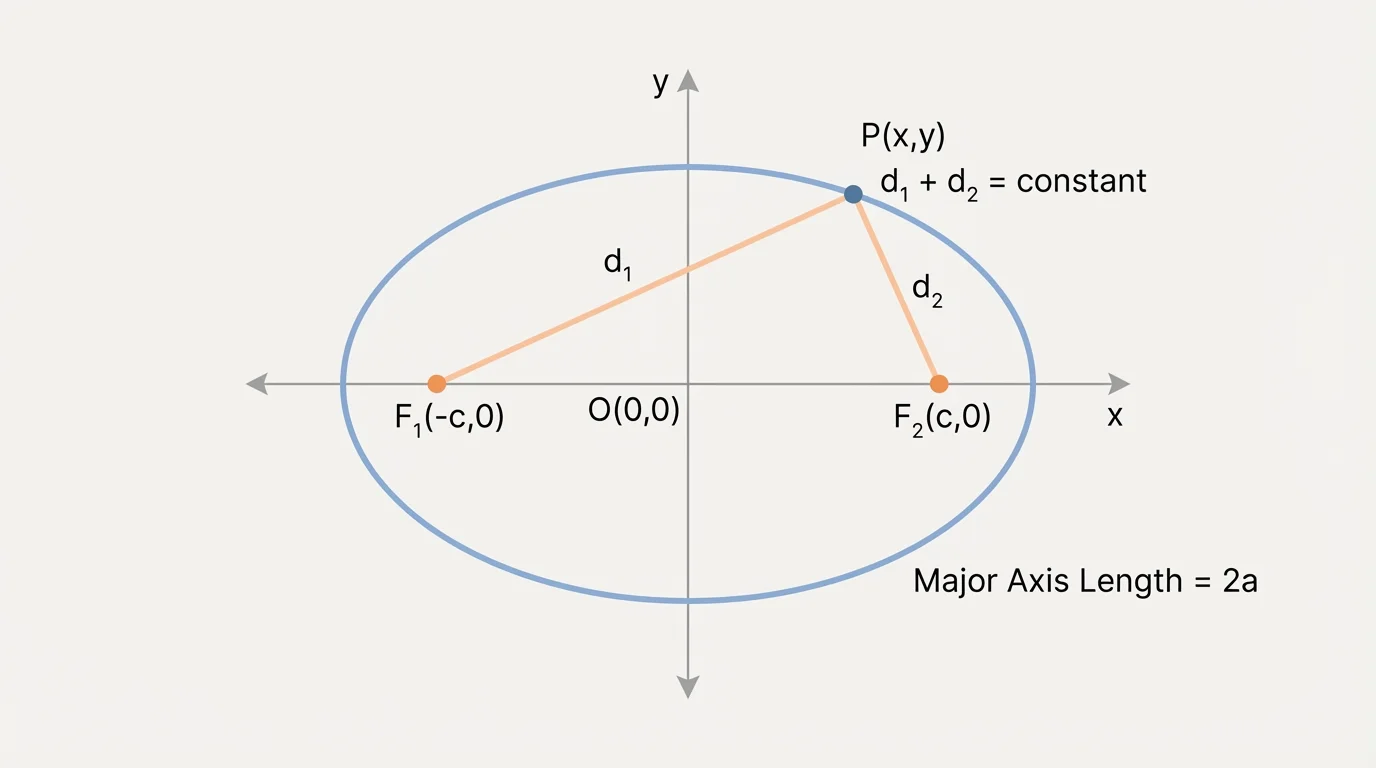
The clearest way to start is with an ellipse centered at the origin whose foci are on the \(x\)-axis. Let the foci be \(F_1(-c,0)\) and \(F_2(c,0)\), and let \(P(x,y)\) be any point on the ellipse.
[Figure 1] shows the geometric setup, including a point connected to both foci. By definition, the sum of the distances from \(P\) to the two foci is constant. Write that constant as \(2a\). Then
\[\sqrt{(x+c)^2+y^2}+\sqrt{(x-c)^2+y^2}=2a\]
This equation contains square roots because distances are involved. To turn it into a standard algebraic equation, isolate one radical and square carefully.
Start by isolating one square root:
\[\sqrt{(x+c)^2+y^2}=2a-\sqrt{(x-c)^2+y^2}\]
Now square both sides:
\[(x+c)^2+y^2=4a^2-4a\sqrt{(x-c)^2+y^2}+(x-c)^2+y^2\]
Simplify. Since \((x+c)^2-(x-c)^2=4cx\), this becomes
\[4cx=4a^2-4a\sqrt{(x-c)^2+y^2}\]
Divide by \(4\):
\[cx=a^2-a\sqrt{(x-c)^2+y^2}\]
Rearrange:
\[a\sqrt{(x-c)^2+y^2}=a^2-cx\]
Square again:
\[a^2[(x-c)^2+y^2]=(a^2-cx)^2\]
Expand both sides:
\[a^2(x^2-2cx+c^2+y^2)=a^4-2a^2cx+c^2x^2\]
The terms \(-2a^2cx\) cancel. Move everything to one side:
\[a^2x^2+a^2c^2+a^2y^2=a^4+c^2x^2\]
So
\[(a^2-c^2)x^2+a^2y^2=a^2(a^2-c^2)\]
For an ellipse, define
\(b^2=a^2-c^2\)
Then the equation becomes
\[b^2x^2+a^2y^2=a^2b^2\]
Divide by \(a^2b^2\):
\[\frac{x^2}{a^2}+\frac{y^2}{b^2}=1\]
This is the standard equation of a horizontal ellipse centered at the origin. As [Figure 1] shows, the major axis lies along the \(x\)-axis because the foci lie on the \(x\)-axis.
Why \(a\) is under \(x^2\) here
The larger denominator corresponds to the direction of the longer axis. Since the ellipse stretches farther horizontally, \(a^2\) is under \(x^2\), and the vertices are at \((\pm a,0)\).
If the foci are on the \(y\)-axis instead, the same logic gives a vertical ellipse:
\[\frac{x^2}{b^2}+\frac{y^2}{a^2}=1\]
Again, the larger denominator marks the major axis direction.
Real problems do not always place the center at the origin. If the center is \((h,k)\), then all coordinates shift by replacing \(x\) with \(x-h\) and \(y\) with \(y-k\).
For a horizontal ellipse centered at \((h,k)\), with foci \((h\pm c,k)\), the equation is
\[\frac{(x-h)^2}{a^2}+\frac{(y-k)^2}{b^2}=1\]
For a vertical ellipse centered at \((h,k)\), with foci \((h,k\pm c)\), the equation is
\[\frac{(x-h)^2}{b^2}+\frac{(y-k)^2}{a^2}=1\]
In both cases, the relationship remains \(c^2=a^2-b^2\).
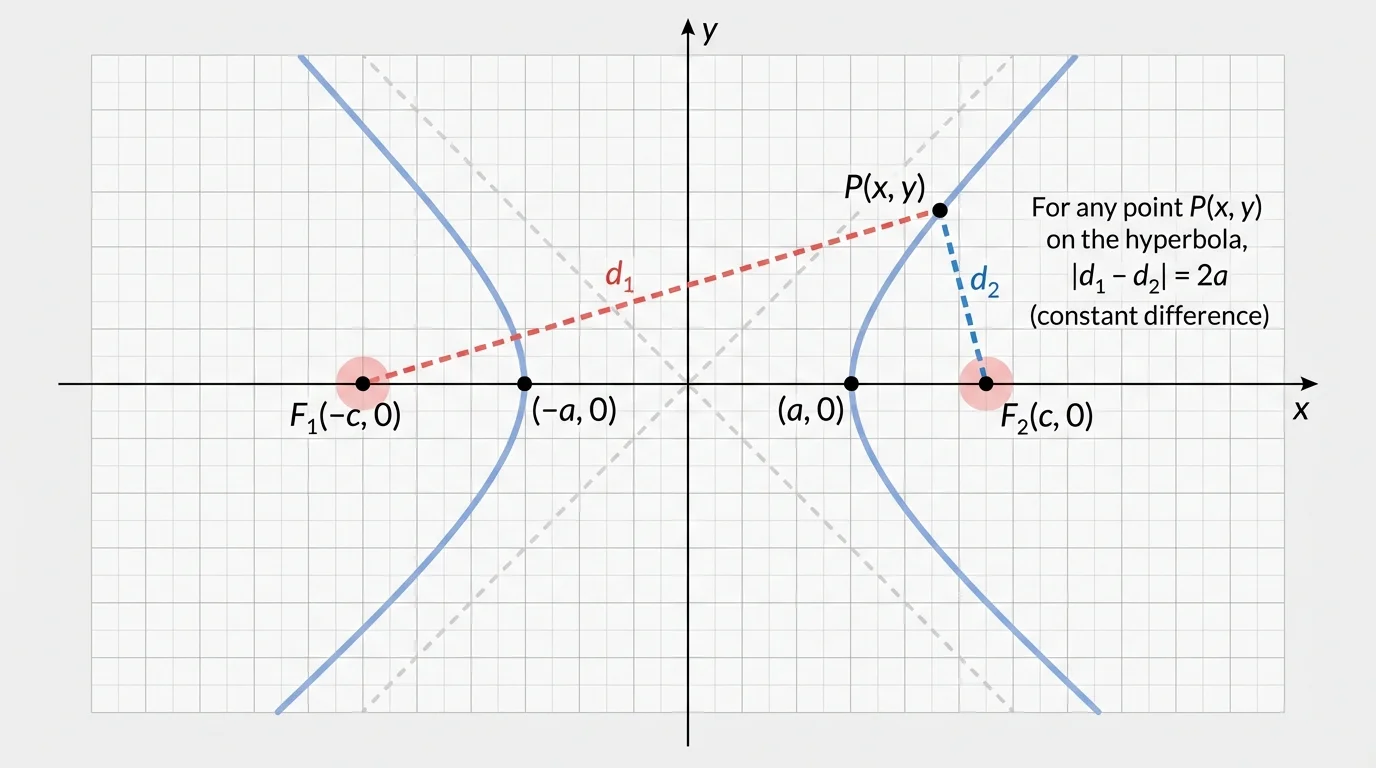
Now switch from a constant sum to a constant difference. Let the hyperbola be centered at the origin with foci \(F_1(-c,0)\) and \(F_2(c,0)\), and let \(P(x,y)\) be a point on the right branch.
[Figure 2] shows a point on a hyperbola with segments to the two foci. By definition, the positive difference of the distances from \(P\) to the foci is constant. Write that constant as \(2a\):
\[\sqrt{(x+c)^2+y^2}-\sqrt{(x-c)^2+y^2}=2a\]
As with the ellipse, derive the equation by isolating a radical and squaring twice.
Isolate one radical:
\[\sqrt{(x+c)^2+y^2}=2a+\sqrt{(x-c)^2+y^2}\]
Square both sides:
\[(x+c)^2+y^2=4a^2+4a\sqrt{(x-c)^2+y^2}+(x-c)^2+y^2\]
Simplify:
\[4cx=4a^2+4a\sqrt{(x-c)^2+y^2}\]
Divide by \(4\):
\[cx=a^2+a\sqrt{(x-c)^2+y^2}\]
Then
\[a\sqrt{(x-c)^2+y^2}=cx-a^2\]
Square again:
\[a^2[(x-c)^2+y^2]=(cx-a^2)^2\]
Expand:
\[a^2(x^2-2cx+c^2+y^2)=c^2x^2-2a^2cx+a^4\]
Cancel the matching middle terms and rearrange:
\[a^2x^2+a^2c^2+a^2y^2=c^2x^2+a^4\]
So
\[(c^2-a^2)x^2-a^2y^2=a^2(c^2-a^2)\]
For a hyperbola, define
\(b^2=c^2-a^2\)
Then
\[b^2x^2-a^2y^2=a^2b^2\]
Divide by \(a^2b^2\):
\[\frac{x^2}{a^2}-\frac{y^2}{b^2}=1\]
This is the standard equation of a horizontal hyperbola centered at the origin. Unlike the ellipse, the relation is \(c^2=a^2+b^2\), which means the foci are farther from the center than the vertices.
Radio-navigation and signal-location problems sometimes use hyperbolas because points with a constant difference in distances to two transmitters lie on a hyperbola.
If the transverse axis is vertical, then the standard form becomes
\[\frac{y^2}{a^2}-\frac{x^2}{b^2}=1\]
Again, the positive term shows the direction in which the hyperbola opens.
When the center is \((h,k)\), replace \(x\) by \(x-h\) and \(y\) by \(y-k\).
A horizontal hyperbola centered at \((h,k)\), with foci \((h\pm c,k)\), has equation
\[\frac{(x-h)^2}{a^2}-\frac{(y-k)^2}{b^2}=1\]
A vertical hyperbola centered at \((h,k)\), with foci \((h,k\pm c)\), has equation
\[\frac{(y-k)^2}{a^2}-\frac{(x-h)^2}{b^2}=1\]
In both cases, \(c^2=a^2+b^2\).
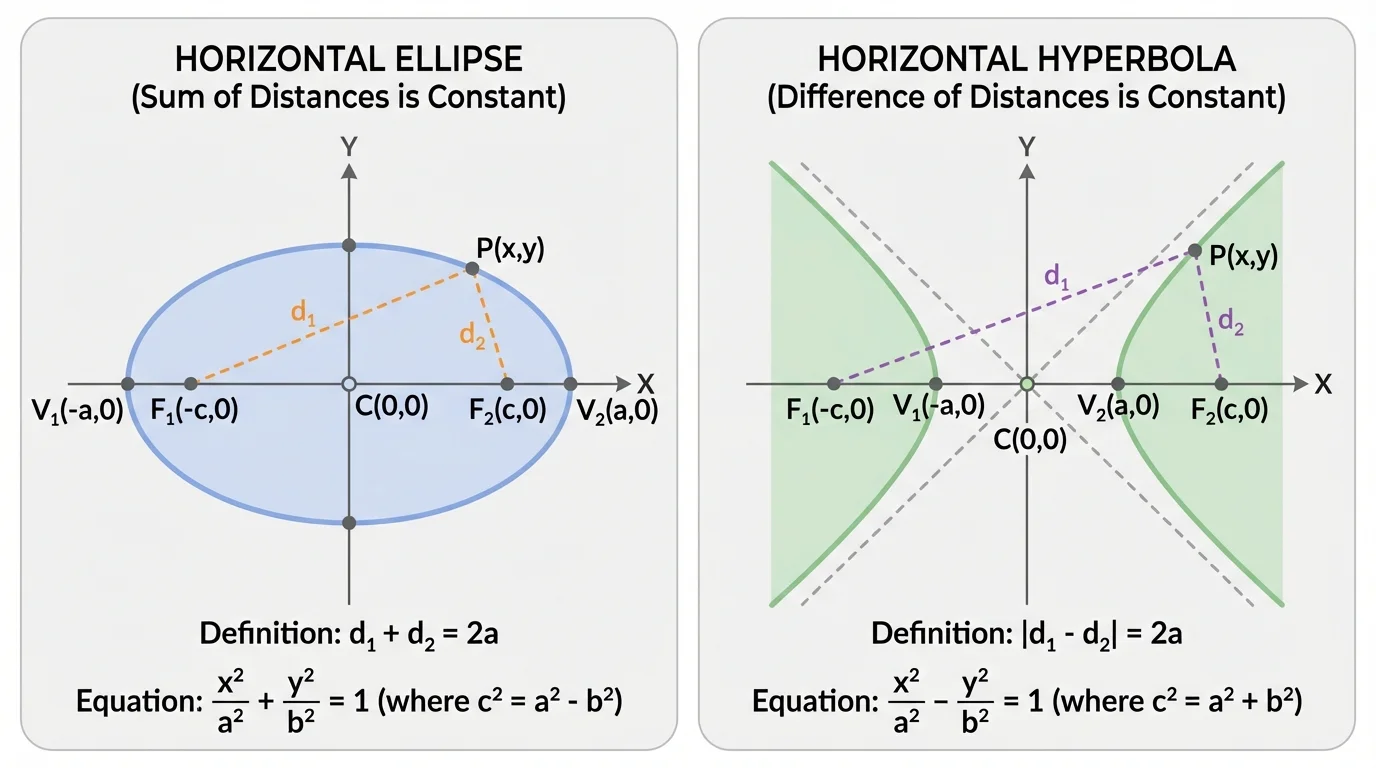
The difference between these two conics becomes much clearer when you compare their geometry side by side, as [Figure 3] does. Both involve two foci, but one uses a sum and the other a difference, and that single change produces completely different graphs.
| Feature | Ellipse | Hyperbola |
|---|---|---|
| Distance rule | Sum of distances is constant | Positive difference of distances is constant |
| Horizontal standard form | \(\dfrac{x^2}{a^2}+\dfrac{y^2}{b^2}=1\) | \(\dfrac{x^2}{a^2}-\dfrac{y^2}{b^2}=1\) |
| Vertical standard form | \(\dfrac{x^2}{b^2}+\dfrac{y^2}{a^2}=1\) | \(\dfrac{y^2}{a^2}-\dfrac{x^2}{b^2}=1\) |
| Relation among \(a,b,c\) | \(c^2=a^2-b^2\) | \(c^2=a^2+b^2\) |
| Graph shape | Closed curve | Two open branches |
Table 2. Comparison of the defining properties and equations of ellipses and hyperbolas.
A quick visual check often helps: in an ellipse, the foci sit inside the curve; in a hyperbola, the branches lie outside the center and open away from it.
Now apply the definitions to derive equations from given foci and constants.
Worked example 1
An ellipse has foci at \((-4,0)\) and \((4,0)\). The sum of the distances from any point on the ellipse to the foci is \(10\). Find the equation.
Step 1: Identify \(c\) and \(2a\)
Since the foci are \((\pm 4,0)\), \(c=4\). The constant sum is \(10\), so \(2a=10\), which gives \(a=5\).
Step 2: Find \(b^2\)
For an ellipse, \(c^2=a^2-b^2\). So \(b^2=a^2-c^2=25-16=9\).
Step 3: Write the equation
The major axis is horizontal, so the form is \(\dfrac{x^2}{a^2}+\dfrac{y^2}{b^2}=1\).
\[\frac{x^2}{25}+\frac{y^2}{9}=1\]
The equation is \(\dfrac{x^2}{25}+\dfrac{y^2}{9}=1\).
Notice how the geometric data gives the algebra almost immediately once you identify whether the conic is an ellipse or a hyperbola.
Worked example 2
A hyperbola has foci at \((0,-5)\) and \((0,5)\). The positive difference of distances from any point on the hyperbola to the foci is \(6\). Find the equation.
Step 1: Identify orientation and constants
The foci are on the \(y\)-axis, so the hyperbola is vertical. Since the foci are \((0,\pm 5)\), \(c=5\). The constant difference is \(6\), so \(2a=6\), giving \(a=3\).
Step 2: Use the hyperbola relationship
For a hyperbola, \(c^2=a^2+b^2\). Therefore \(b^2=c^2-a^2=25-9=16\).
Step 3: Write the equation
A vertical hyperbola has form \(\dfrac{y^2}{a^2}-\dfrac{x^2}{b^2}=1\).
\[\frac{y^2}{9}-\frac{x^2}{16}=1\]
The equation is \(\dfrac{y^2}{9}-\dfrac{x^2}{16}=1\).
As with [Figure 2], the positive term matches the direction in which the hyperbola opens.
Worked example 3
An ellipse is centered at \((2,-1)\) with foci at \((-1,-1)\) and \((5,-1)\). The sum of distances to the foci is \(8\). Find the equation.
Step 1: Find the center and \(c\)
The midpoint of the foci is \((2,-1)\), which matches the center. The foci are \(3\) units left and right of the center, so \(c=3\).
Step 2: Find \(a\) and \(b^2\)
The constant sum is \(8\), so \(2a=8\), hence \(a=4\). Then \(b^2=a^2-c^2=16-9=7\).
Step 3: Write the translated equation
The major axis is horizontal, so use \(\dfrac{(x-h)^2}{a^2}+\dfrac{(y-k)^2}{b^2}=1\) with \((h,k)=(2,-1)\).
\[\frac{(x-2)^2}{16}+\frac{(y+1)^2}{7}=1\]
The equation is \(\dfrac{(x-2)^2}{16}+\dfrac{(y+1)^2}{7}=1\).
Translations do not change the basic structure of the equation. They only shift the graph in the plane.
Worked example 4
A hyperbola is centered at \((-2,3)\) with foci at \((-2,10)\) and \((-2,-4)\). The positive difference of distances is \(10\). Find the equation.
Step 1: Identify orientation and \(c\)
The foci have the same \(x\)-coordinate, so the transverse axis is vertical. The center is the midpoint \((-2,3)\). The distance from the center to either focus is \(7\), so \(c=7\).
Step 2: Find \(a\) and \(b^2\)
The constant difference is \(10\), so \(2a=10\), giving \(a=5\). For a hyperbola, \(b^2=c^2-a^2=49-25=24\).
Step 3: Write the equation
Use the vertical form centered at \((h,k)\): \(\dfrac{(y-k)^2}{a^2}-\dfrac{(x-h)^2}{b^2}=1\).
\[\frac{(y-3)^2}{25}-\frac{(x+2)^2}{24}=1\]
The equation is \(\dfrac{(y-3)^2}{25}-\dfrac{(x+2)^2}{24}=1\).
Ellipses appear in orbital motion. A planet or satellite can follow an elliptical path with the central body at one focus, not at the center. That means the focus-based definition is not just a classroom idea; it helps describe real motion in astronomy.
Hyperbolas appear in systems that compare distances to two sources. If a device receives signals from two towers and the difference in travel distances is fixed, the device must lie on a hyperbola. Engineers use this kind of reasoning in location and tracking systems.
Acoustics also uses focus ideas. In elliptical rooms, waves leaving one focus tend to reflect toward the other focus. This happens because the geometry of the curve controls paths built from distances.
One common mistake is confusing the ellipse relationship \(c^2=a^2-b^2\) with the hyperbola relationship \(c^2=a^2+b^2\). A quick check helps: for an ellipse, \(c<a\); for a hyperbola, \(c>a\).
Another common mistake is putting \(a^2\) under the wrong variable. For ellipses, \(a^2\) goes under the variable in the major-axis direction. For hyperbolas, \(a^2\) goes under the positive term, since that tells the opening direction.
Also be careful with the constant distance condition. If the sum is \(2a\), then \(a\) is half that value. If the difference is \(2a\), the same rule applies. Students sometimes use the full constant as \(a\), which makes every later calculation too large.
A final check is to compare your result with the graph's geometry. As we saw in [Figure 3], an ellipse should be closed and a hyperbola should have two branches. Your equation should match that picture.
