How many steps does it take to walk across the room? How many crayons are in a box? How many days have gone by on a calendar? Counting helps us answer all of these questions. When we count, we say number names in order. We can count slowly by ones, and we can also count faster by tens.
We use numbers all day long. We count toys, books, buttons, claps, and jumps. Counting tells us how many there are. If you have \(3\) blocks and then get \(1\) more block, you can count to find the new amount: \(1, 2, 3, 4\).
Big numbers are made from smaller numbers. When we keep going and do not stop, we can count all the way to \(100\). That is a long count, but number patterns help us.
Count sequence means saying numbers in the correct order. Ones means counting one at a time. Tens means counting by groups of \(10\).
When we know the count sequence, we can start at \(1\) and keep going: \(1, 2, 3, 4, 5\), and so on. We can also start at another number and keep counting forward.
Here is the order of numbers from \(1\) to \(20\): \(1, 2, 3, 4, 5, 6, 7, 8, 9, 10, 11, 12, 13, 14, 15, 16, 17, 18, 19, 20\).
After \(20\), we keep going: \(21, 22, 23, 24, 25, 26, 27, 28, 29, 30\). Then the pattern keeps growing: \(31, 32, 33\) and later \(40, 50, 60, 70, 80, 90, 100\).
Some number names sound a little tricky, like \(11\), \(12\), \(13\), and the teen numbers. It helps to listen carefully and say them in order again and again.
The number \(100\) is called one hundred. It is made of ten groups of \(10\).
When you count in order, you are building a strong map of numbers in your mind. That map helps you know what number comes next.
Counting by ones means saying every number in order. As [Figure 1] shows, each new number is just \(1\) more than the number before it.
If you count by ones from \(1\) to \(10\), you say \(1, 2, 3, 4, 5, 6, 7, 8, 9, 10\). If you keep going, you reach \(11, 12, 13\), and later all the way to \(100\).
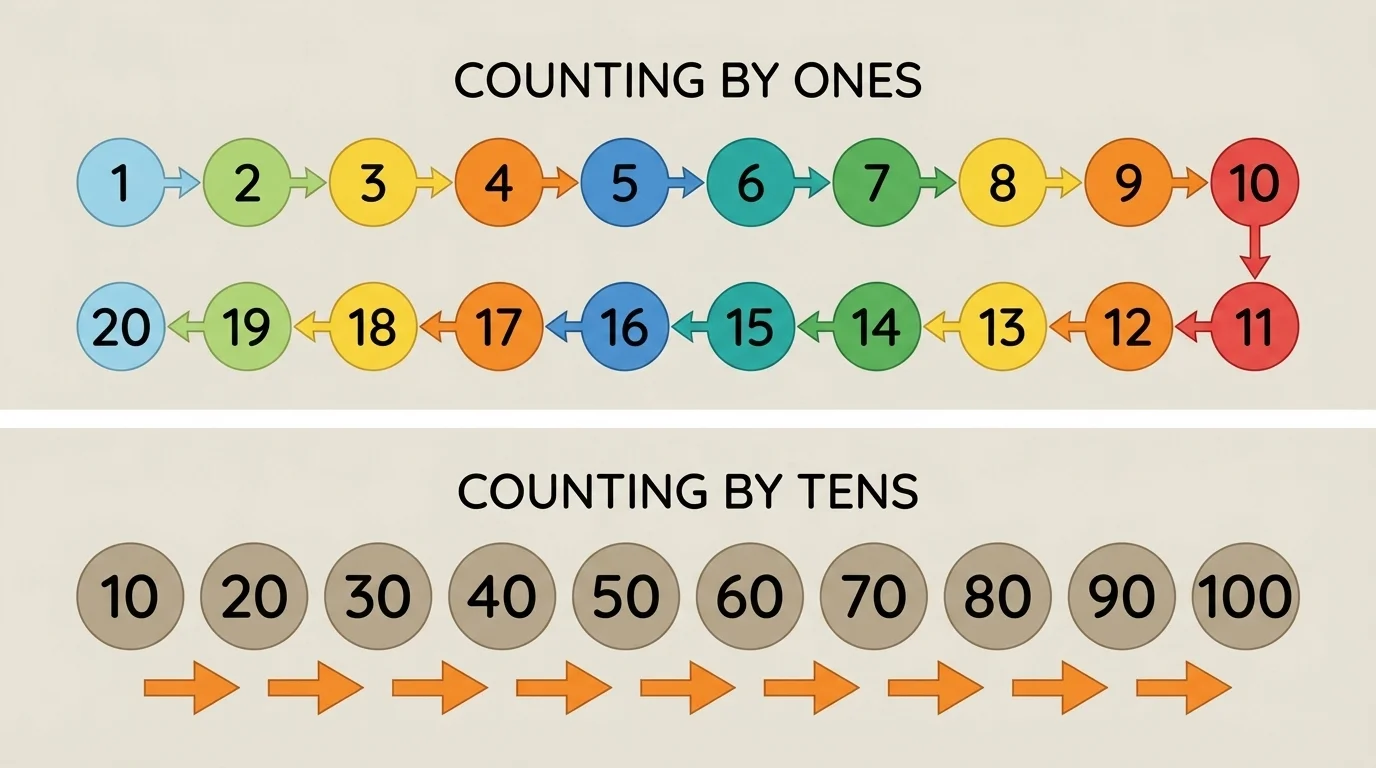
We can think about counting by ones like taking one step at a time. From \(7\), one more is \(8\). From \(8\), one more is \(9\). From \(9\), one more is \(10\).
This is an important pattern: the numbers keep growing by \(1\). Later, when you count many objects, this idea helps you not skip any and not count the same object twice.
Sometimes we want to count faster. Then we can skip count by tens. As [Figure 2] shows, counting by tens sounds like this: \(10, 20, 30, 40, 50, 60, 70, 80, 90, 100\).
Each time we say the next number, we add another group of \(10\). After \(10\) comes \(20\), after \(20\) comes \(30\), and after \(90\) comes \(100\).
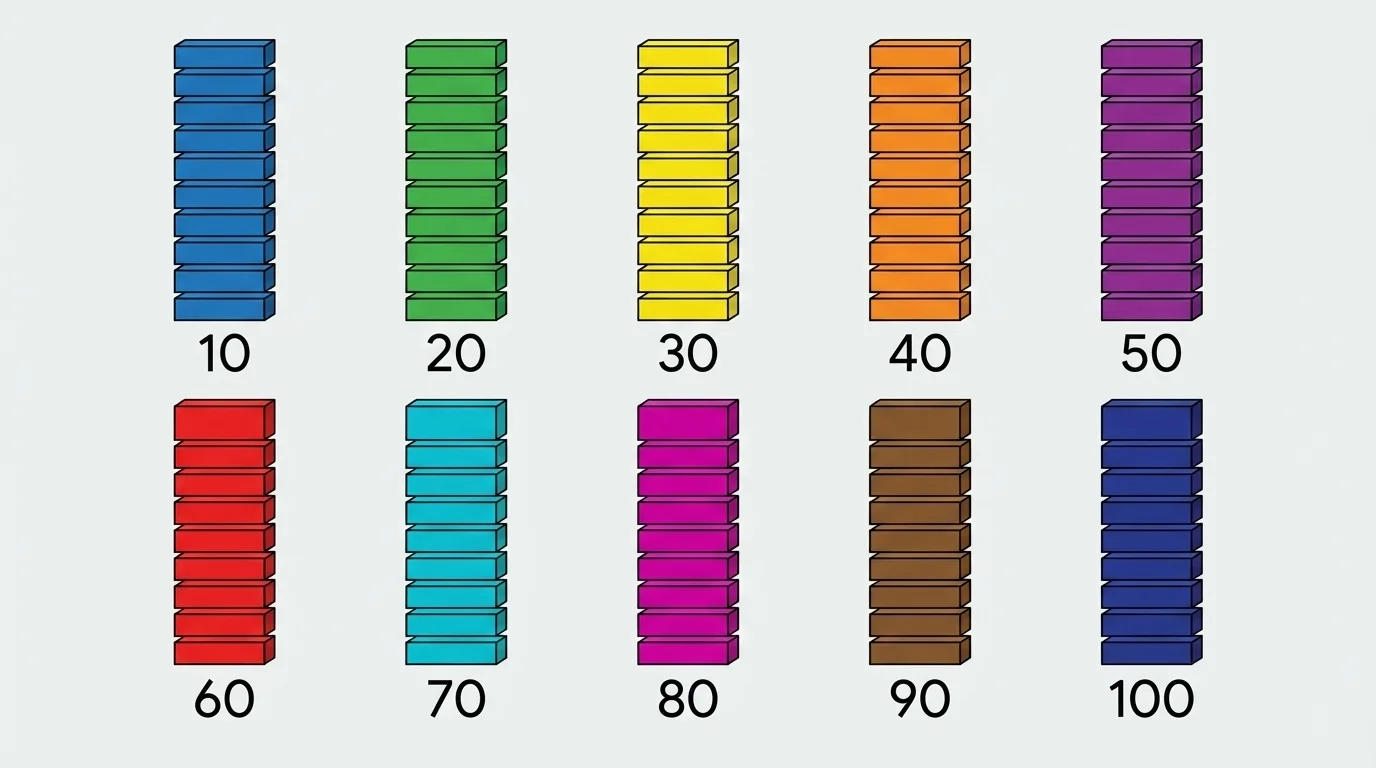
Counting by tens is helpful when things are already in groups. If there are \(10\) crayons in each box, then \(2\) boxes make \(20\) crayons, \(3\) boxes make \(30\), and so on.
Notice the pattern in the ones place when we count by tens: the numbers end in \(0\). We hear different number names, but we keep adding \(10\) each time.
Why tens are special
Our number system uses groups of \(10\). That is why counting by tens helps us reach big numbers quickly. Ten ones make \(10\), and ten tens make \(100\).
Later, when we count by ones again, we can remember the tens numbers as special stopping places: \(10, 20, 30, 40\), and so on.
Numbers work together in patterns. As [Figure 3] shows, when we count by ones, we say every number. When we count by tens, we jump from one group of \(10\) to the next.
For example, on a hundred chart, from \(30\), counting by ones goes \(31, 32, 33, 34\). Counting by tens goes \(40\), then \(50\), then \(60\). Both ways are correct, but they do different jobs.
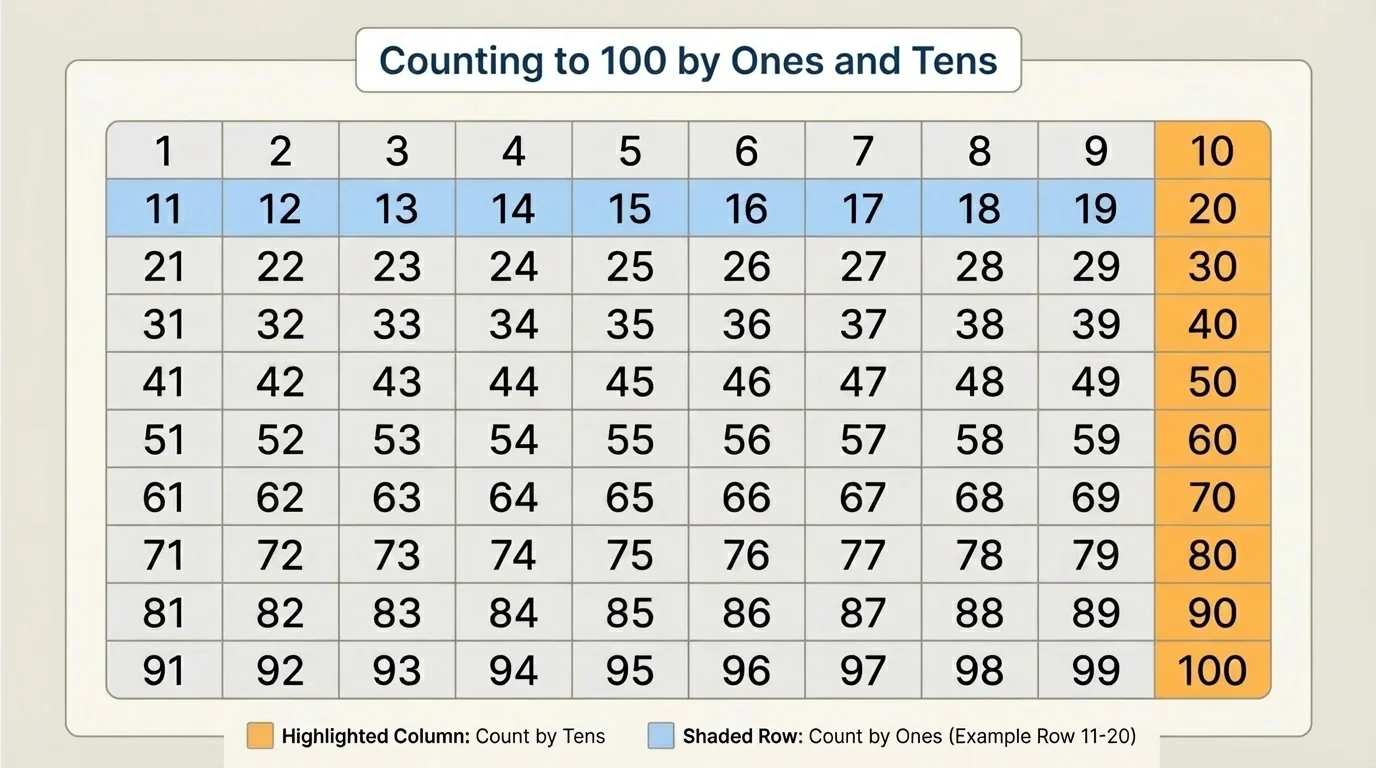
On a hundred chart, the numbers in one row often go up by \(1\). The special tens numbers help us know where a new group starts. That is why the chart is so useful for seeing number patterns.
If you know \(40\), then counting by ones after it gives \(41, 42, 43\). If you know \(40\), then counting by tens after it gives \(50\). Ones move little by little. Tens move in big jumps.
Example 1: Count on by ones
Finish this count: \(6, 7, 8, \, ? , \, ?\)
Step 1: Look at the pattern.
The numbers are going up by \(1\) each time.
Step 2: Add \(1\) after \(8\).
After \(8\) comes \(9\).
Step 3: Add \(1\) again.
After \(9\) comes \(10\).
The missing numbers are \(9\) and \(10\).
When we count by ones, we never skip the next number. The number path in [Figure 1] reminds us that each step is only \(1\) more.
Example 2: Count by tens
Finish this count: \(20, 30, 40, \, ? , \, ?\)
Step 1: Look at the pattern.
The numbers are going up by \(10\) each time.
Step 2: Find the next ten after \(40\).
After \(40\) comes \(50\).
Step 3: Find the next ten after \(50\).
After \(50\) comes \(60\).
The missing numbers are \(50\) and \(60\).
Groups help us see why this works. In [Figure 2], each new group adds another \(10\).
Example 3: What comes next?
What number comes after \(14\)? What number comes after \(90\) in the tens pattern?
Step 1: Count by ones after \(14\).
After \(14\) comes \(15\).
Step 2: Count by tens after \(90\).
After \(90\) comes \(100\).
The answers are \(15\) and \(100\).
You can also ask what comes before a number. Before \(18\) is \(17\). Before \(70\) in the tens pattern is \(60\).
Counting by ones is useful for small groups. You might count \(1, 2, 3, 4, 5\) apples in a bowl. You can also count steps, puzzle pieces, or toy cars one at a time.
Counting by tens is useful for bigger groups. If you have \(10\) fingers on two hands, then \(10\) fingers is one group of \(10\). If a class has bundles of \(10\) craft sticks, then \(4\) bundles are \(40\) sticks.
A calendar, a jar of buttons, or a shelf of books can all be counted. Some things are easiest to count by ones. Some are easier to count by tens first and then by ones after that.
You already know how to say small numbers in order. Now you are stretching that same idea to bigger numbers, all the way to \(100\).
For example, if there are \(3\) full groups of \(10\) blocks and \(2\) extra blocks, you can think \(10, 20, 30\), then \(31, 32\). That makes \(32\) blocks.
Sometimes long counts feel big, but patterns make them easier. The tens numbers are like number landmarks: \(10, 20, 30, 40, 50, 60, 70, 80, 90, 100\). Between them, counting by ones fills in all the other numbers.
If you are at \(48\), then counting by ones gives \(49, 50\). If you are counting by tens, the next big jump after \(50\) is \(60\). Looking for these patterns helps you stay in order.
When you say numbers in the right order, you are learning how numbers grow. That is a big idea in math. It helps with counting objects, adding later, and understanding bigger and bigger numbers.
