What if someone says, "Start at \(6\)!" instead of "Start at \(1\)!"? That is a big counting idea. Sometimes we already know where we are, so we do not need to go all the way back to \(1\). We can begin at a number and keep going forward in the sequence. This helps us count faster and understand how numbers go in order.
To count forward means to start at a number and say the numbers that come next. On a number line, if we start at \(4\), we can say \(5\), \(6\), \(7\), and keep going. We are moving ahead in the number order.
If a teacher says, "Start at \(3\)," you say \(3\), \(4\), \(5\), \(6\), and so on. If a teacher says, "Start at \(8\)," you say \(8\), \(9\), \(10\). You are using number names in the right order, as shown on the number line in [Figure 1].
Count forward means to begin with a given number and say the numbers that come next in order.
Next number means the number that comes right after another number.
When you count forward, each number has a number after it. After \(1\) comes \(2\). After \(2\) comes \(3\). After \(7\) comes \(8\). Knowing the next number helps you count on smoothly.
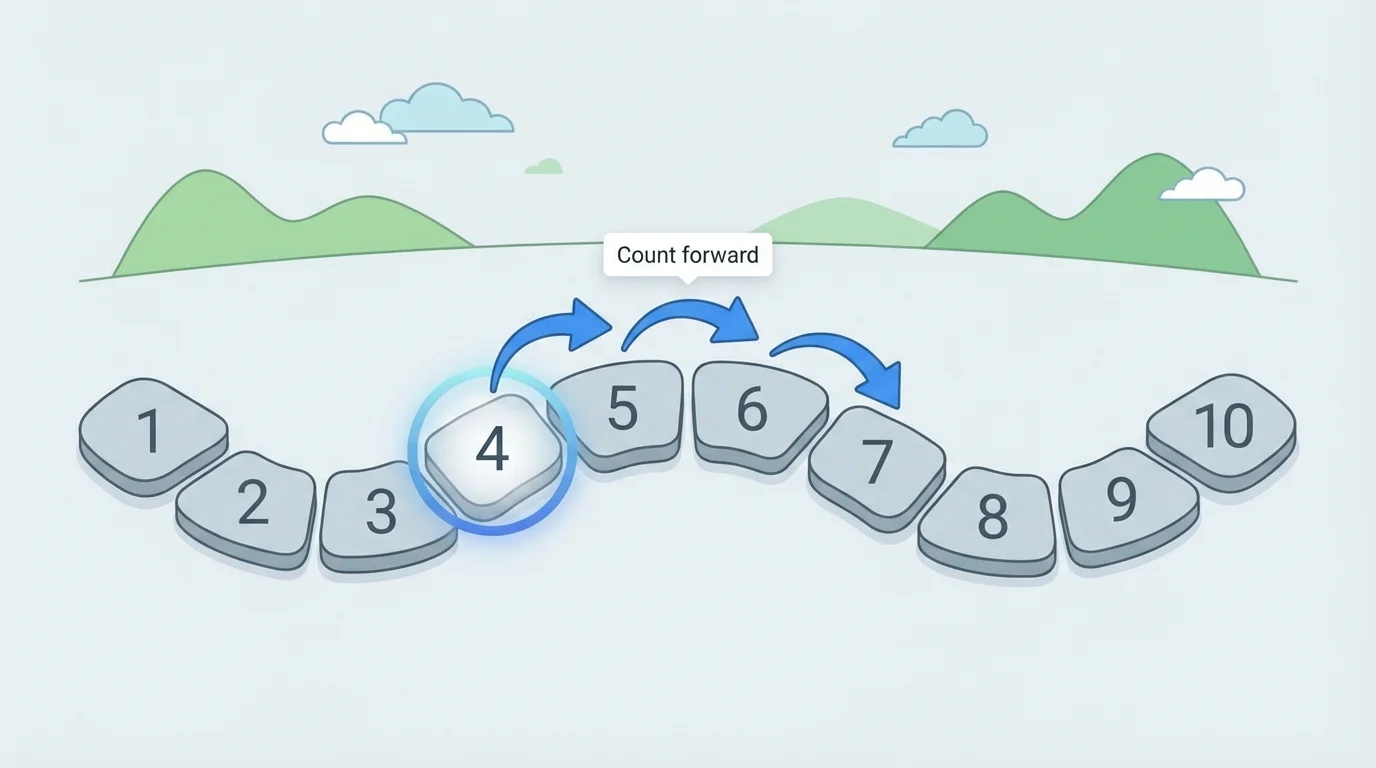
You do not always have to restart at \(1\). If you already know you are at \(5\), you can keep counting: \(5\), \(6\), \(7\), \(8\). This is an important number idea because it shows that numbers stay in the same order no matter where you begin.
Numbers follow a special order. We call this order a number order. When we count forward, we follow that order carefully.
Here are some number sequences:
Starting at \(2\): \(2, 3, 4, 5, 6\)
Starting at \(5\): \(5, 6, 7, 8\)
Starting at \(9\): \(9, 10\)
As we saw on the number line in [Figure 1], counting forward means each step goes to the next number, never backward.
You may already know how to count from \(1\) to \(10\). Counting forward uses that same number order, but now you can start at numbers like \(2\), \(4\), or \(7\) instead of always beginning with \(1\).
Sometimes you will count forward by saying the starting number first. For example, start at \(6\): \(6, 7, 8, 9\). Sometimes you may hear, "What comes after \(6\)?" Then you begin with the next number, which is \(7\).
Let's look at some examples step by step.
Example 1
Start at \(3\) and count forward to \(6\).
Step 1: Say the starting number.
Begin with \(3\).
Step 2: Say the next numbers in order.
After \(3\) comes \(4\), then \(5\), then \(6\).
The count is \(3, 4, 5, 6\).
This example shows that you do not need to say \(1, 2\) first. You can begin right at \(3\).
Example 2
Start at \(6\) and say the next three numbers.
Step 1: Start with \(6\).
The starting number is \(6\).
Step 2: Find the next numbers.
After \(6\) comes \(7\), then \(8\), then \(9\).
The count is \(6, 7, 8, 9\).
Notice that "the next three numbers" after \(6\) are \(7\), \(8\), and \(9\), but when we count forward from \(6\), we often say the starting number too.
Example 3
Start at \(9\) and count forward to \(10\).
Step 1: Say \(9\).
We begin with \(9\).
Step 2: Say the next number.
After \(9\) comes \(10\).
The count is \(9, 10\).
Even when there are only a few numbers to say, the order still matters.
People count forward all the time. If you are on page \(4\) of a book, you do not turn back to page \(1\) to find page \(5\). You just go forward.
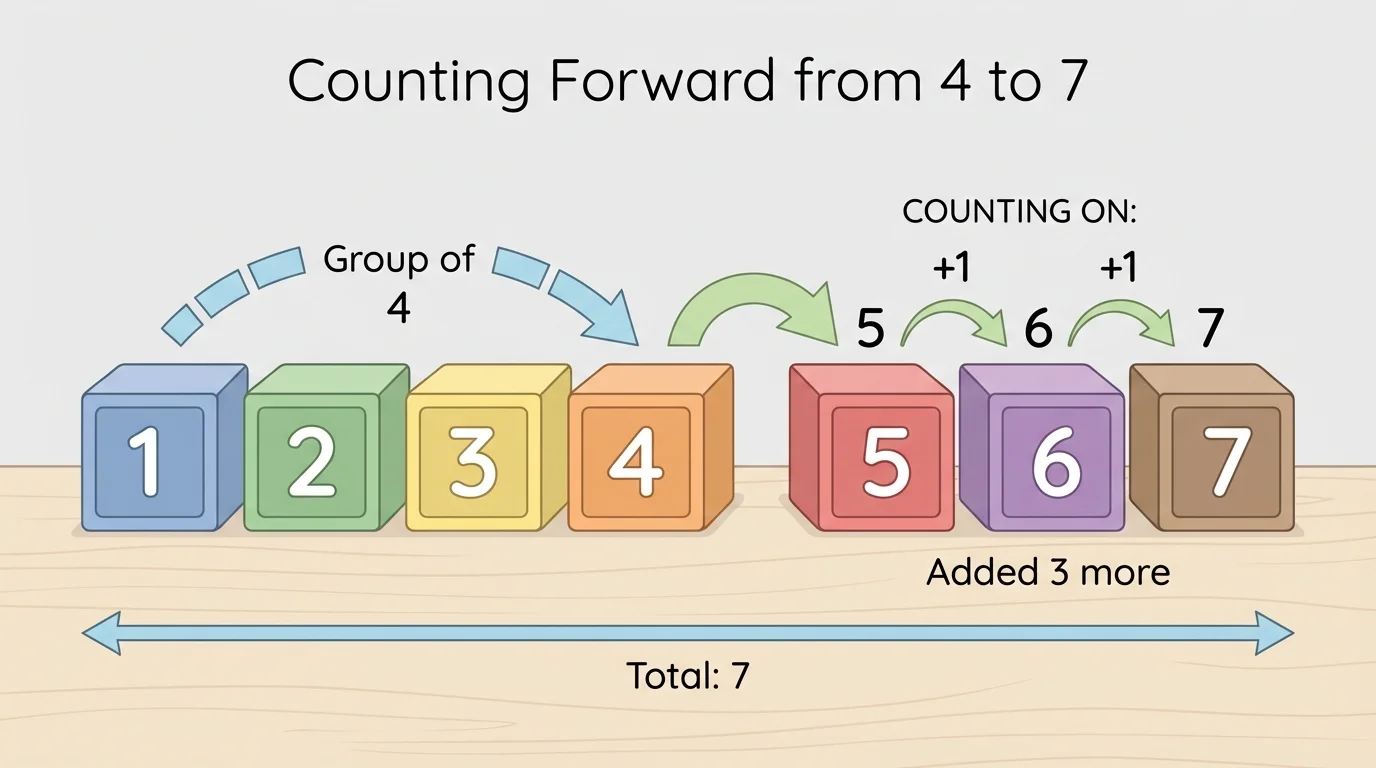
Toys, steps, and claps can help us count forward from a number we already know. A group of blocks shows how we can start with \(4\) blocks and then keep counting when more are added. We do not need to recount every block from \(1\).
Suppose you already have \(4\) apples, and someone gives you more. You can point and count forward: \(4, 5, 6\). Now there are \(6\) apples, as shown in [Figure 2].
If you climb stairs and start on step \(2\), you can count \(2, 3, 4, 5\). If you clap starting at \(1\) and keep going, that is counting too, but if someone says start at \(5\), then you begin with \(5\).
Using real objects helps your brain match number words to things you can see and touch. Later, you can do the same counting with just the numbers in your mind.
The block picture in [Figure 2] also reminds us that when we know one group already has \(4\), we can say \(5\), \(6\), \(7\) for the new blocks instead of starting over at \(1\).
One common mistake is going back to \(1\) every time. If the starting number is \(7\), do not say \(1, 2, 3\). Begin at \(7\).
Another mistake is skipping a number. For example, saying \(4, 5, 7\) misses \(6\). Go carefully in order: \(4, 5, 6, 7\).
A third mistake is stopping too soon. If you start at \(2\) and need to count to \(5\), you say \(2, 3, 4, 5\), not just \(2, 3\).
A helpful tip is to listen for the starting number and hold it in your mind. Then say the numbers that come after it, one by one. You can imagine little steps moving forward on a number path, just like the movement shown earlier in [Figure 1].
