How can one little mark like \(8\) mean eight crayons, and one little mark like \(0\) mean none at all? Numbers are powerful. They help us tell how many things we have. When we count blocks, fingers, birds, or buttons, we can write the answer with a numeral. Learning to write numbers from \(0\) to \(20\) helps us share our counting with other people.
A count tells how many objects are in a group. When we count, we say the numbers in order: \(0, 1, 2, 3, 4, 5, 6, 7, 8, 9, 10, 11, 12, 13, 14, 15, 16, 17, 18, 19, 20\).
Number names are words like zero, one, two, and three. Numerals are the written symbols \(0, 1, 2, 3\), and so on. A group of objects can be shown with a numeral.
Zero means there are no objects in the group.
If there are \(4\) toy cars, we write \(4\). If there are \(12\) shells, we write \(12\). If there are no shells left, we write \(0\). That is why \(0\) is an important number. It tells us the group is empty.
The numerals go in a special order. The order is easy to see in [Figure 1], and this helps us remember what to write after each count. Here are the number names and numerals together.
\(0\) zero, \(1\) one, \(2\) two, \(3\) three, \(4\) four, \(5\) five, \(6\) six, \(7\) seven, \(8\) eight, \(9\) nine, \(10\) ten, \(11\) eleven, \(12\) twelve, \(13\) thirteen, \(14\) fourteen, \(15\) fifteen, \(16\) sixteen, \(17\) seventeen, \(18\) eighteen, \(19\) nineteen, \(20\) twenty.
Some numbers have one digit, like \(3\) and \(8\). Some numbers have two digits, like \(10\), \(14\), and \(20\). Even though \(20\) has two digits, it is still just one number name: twenty.
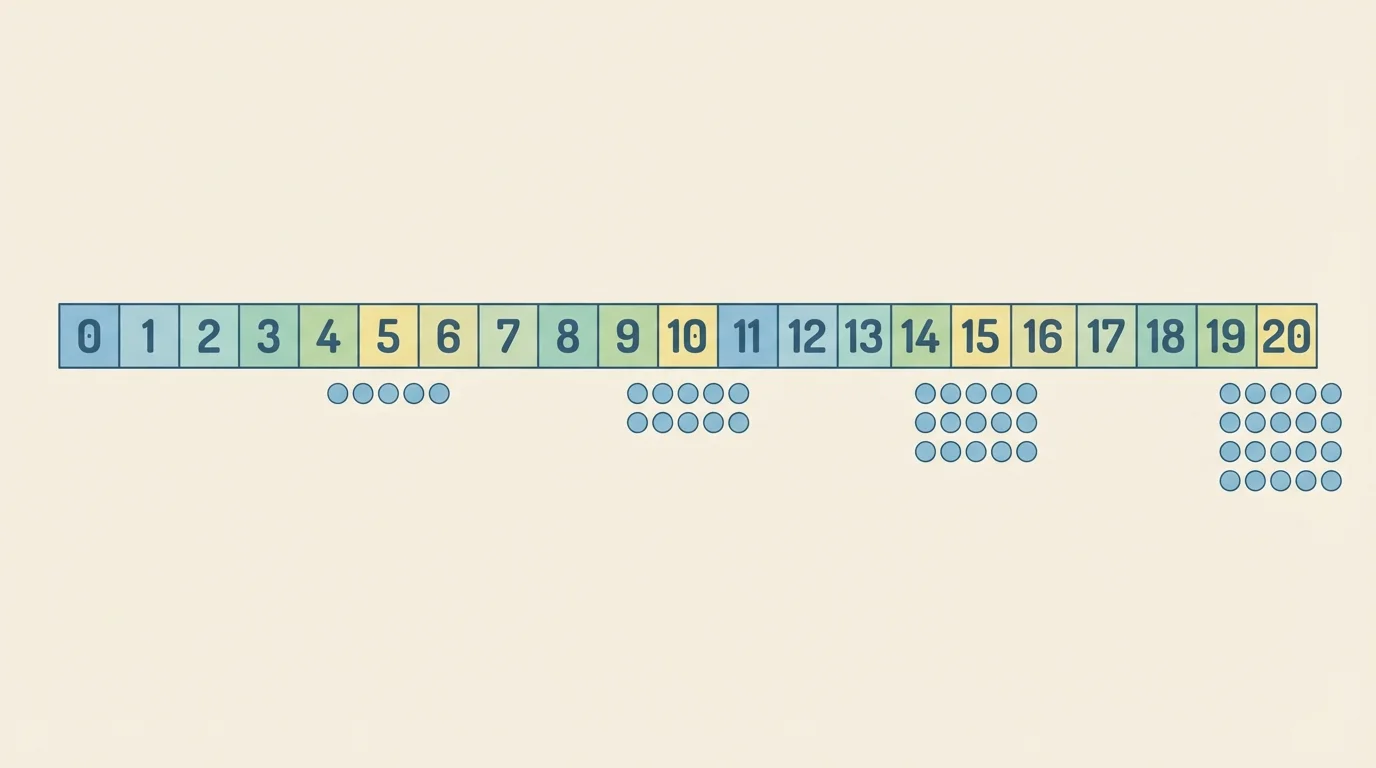
Some teen numbers, from \(13\) to \(19\), can be easy to mix up, so it is important to look carefully when writing them. For example, \(14\) is fourteen and \(15\) is fifteen. Later, when you count a larger group, the same order from [Figure 1] still helps you know which numeral comes next.
The number \(0\) was a very important idea in mathematics. It helps us show that a group has no objects, and it also helps us write bigger numbers like \(10\) and \(20\).
When you write numbers, make each numeral carefully. A neat numeral is easier to read. If you count \(6\) blocks, writing \(6\) clearly helps everyone know your answer.
When we match objects to a numeral, we use one-to-one counting. That means we say one number word for each object, as shown in [Figure 2]. We do not skip objects, and we do not count the same object twice.
Start at one object. Point to it or touch it and say \(1\). Move to the next object and say \(2\). Keep going until every object has been counted. The last number you say tells how many objects are in the whole group. Then write that numeral.
For example, if you count beads and say \(1, 2, 3, 4, 5\), then there are \(5\) beads, so you write \(5\). If there are no beads to count, the correct numeral is \(0\).
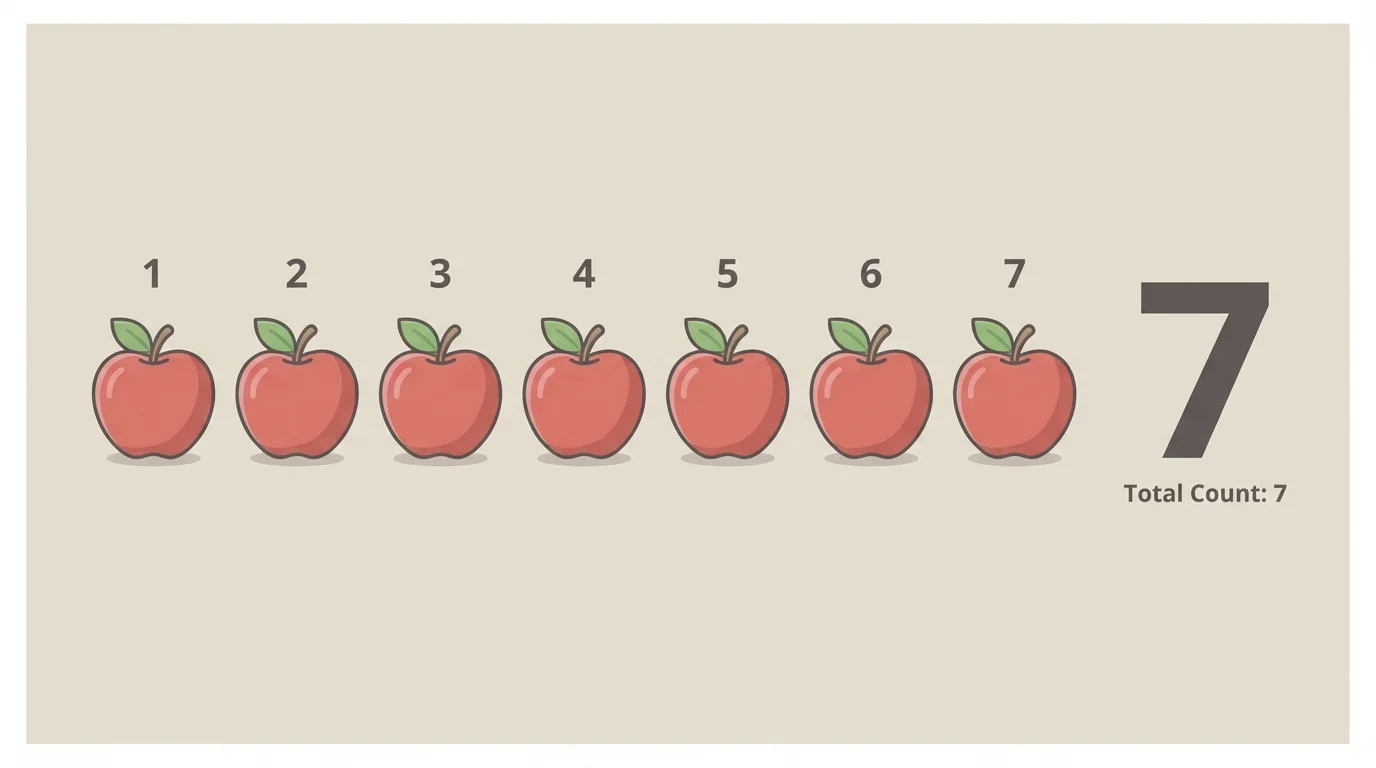
This is why careful counting matters. In the apple picture, [Figure 2] shows one count for each apple. If one apple were counted twice, the written numeral would be wrong.
The last number tells how many
When you count a group correctly, the last number word you say gives the total number of objects. If you count cubes and end at \(9\), then the group has \(9\) cubes, so the numeral you write is \(9\).
You can match numerals to many kinds of objects: \(3\) balls, \(10\) fingers, \(17\) leaves, or \(20\) crayons. The kind of object changes, but the counting idea stays the same.
[Figure 3] Let's look at some groups and write the correct numerals. One special case is when there are no objects at all, shown by an empty group.
Example 1
There are stars in a picture. Count them and write the numeral: star, star, star, star.
Step 1: Count each star once.
Say \(1, 2, 3, 4\).
Step 2: Look at the last number said.
The last number is \(4\).
Step 3: Write the numeral.
Write \(4\).
So the group of stars is represented by the numeral \(4\).
In this example, the counting and the writing match. Four objects means the numeral \(4\).
Example 2
There are toy cars on a shelf. Count them: car, car, car, car, car, car, car, car, car.
Step 1: Count in order.
Say \(1, 2, 3, 4, 5, 6, 7, 8, 9\).
Step 2: Find the total.
The last number said is \(9\).
Step 3: Write the numeral.
Write \(9\).
So there are \(9\) toy cars.
Notice that we did not need to count again after reaching \(9\). The last count already tells the whole amount.
Example 3
A plate has no cookies on it. What numeral should we write?
Step 1: Check the plate.
There are no cookies to count.
Step 2: Use the numeral for no objects.
No objects means \(0\).
Step 3: Write the numeral.
Write \(0\).
So an empty plate is represented by \(0\).
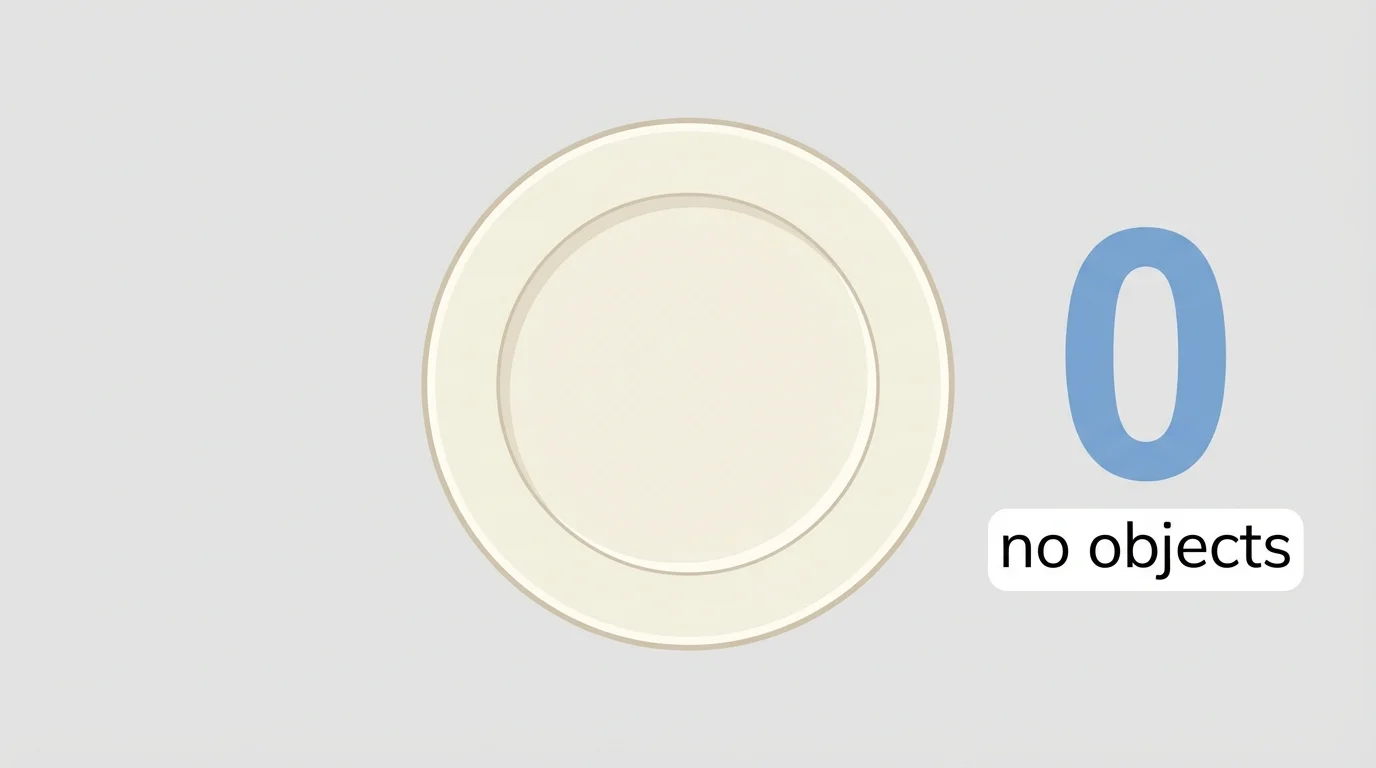
The empty group helps us see that \(0\) is not the same as \(1\). With \(1\), there is one object. With \(0\), there are none.
Example 4
Count the pencils in a box: \(10\) pencils. What numeral do we write?
Step 1: Count the pencils.
Say \(1, 2, 3, 4, 5, 6, 7, 8, 9, 10\).
Step 2: Look at the last number.
The last number is \(10\).
Step 3: Write the numeral.
Write \(10\).
So the box has \(10\) pencils.
Now we have written numerals for groups with \(4\), \(9\), \(0\), and \(10\) objects.
Numbers are everywhere. A child might have \(2\) shoes, \(5\) toy dinosaurs, \(8\) blocks in a tower, or \(12\) crackers for snack time. A classroom might have \(20\) chairs. When we write these amounts, numerals help us tell the exact number quickly.
Counting also helps in games and routines. You might count \(10\) jumps, \(7\) steps to the door, or \(15\) crayons in a box. If all the crayons are gone, you would write \(0\). That makes mathematics useful in everyday life.
Some numerals can be mixed up if we rush. For example, \(12\) and \(20\) are not the same. The numeral \(12\) means twelve objects. The numeral \(20\) means twenty objects, which is many more.
Another careful point is counting each object only once. If you count a teddy bear two times, your numeral will be too big. If you skip a teddy bear, your numeral will be too small. The careful one-to-one counting we saw earlier in [Figure 2] helps keep the answer correct.
Say the counting numbers in order, touch or point to each object once, and write the numeral that matches the last number said. If there are no objects, write \(0\).
With practice, reading and writing numerals from \(0\) to \(20\) becomes easier and faster. Each numeral stands for a quantity, and every quantity from none up to twenty can be written clearly.
