What if you had a pile of cookies and wanted to know if there were enough for everyone? Counting helps us find out. When we count, we say the number names in the right order and match each object with just one number. That is how we know exactly how many things are in a group.
Counting means looking at a group of objects and saying number names one at a time: \(1, 2, 3, 4, 5\), and so on. We count slowly and carefully. Each time we say a new number, we match it to one object.
[Figure 1] If there are blocks on the floor, you might point to the first block and say \(1\), point to the next block and say \(2\), then the next and say \(3\). This helps you keep track.
Counting is saying number names in order while matching each number to one object. How many means the total number of objects in the group.
Good counters often move objects, touch objects, or point to objects as they count. That makes it easier to remember which objects have already been counted.
The number names must be said in the standard order. We say \(1\), then \(2\), then \(3\), then \(4\), then \(5\). We do not mix them up.
For example, if you count crayons, saying \(1, 2, 4, 5\) is not correct because \(3\) is missing. Saying \(1, 2, 3, 3\) is also not correct because one number was repeated.
People all over the world count with number words, but the words can sound different in different languages. The idea is the same: each object gets one count, and the counting words follow an order.
Learning the order of number names is like learning a song. The order stays the same every time.
When we count, we use one-to-one matching. That means each object gets one number name, and each number name matches one object. No object should get two numbers, and no number should be used for two objects at the same time.
If you count \(4\) apples, you might point like this: first apple \(1\), second apple \(2\), third apple \(3\), fourth apple \(4\). That is careful counting.
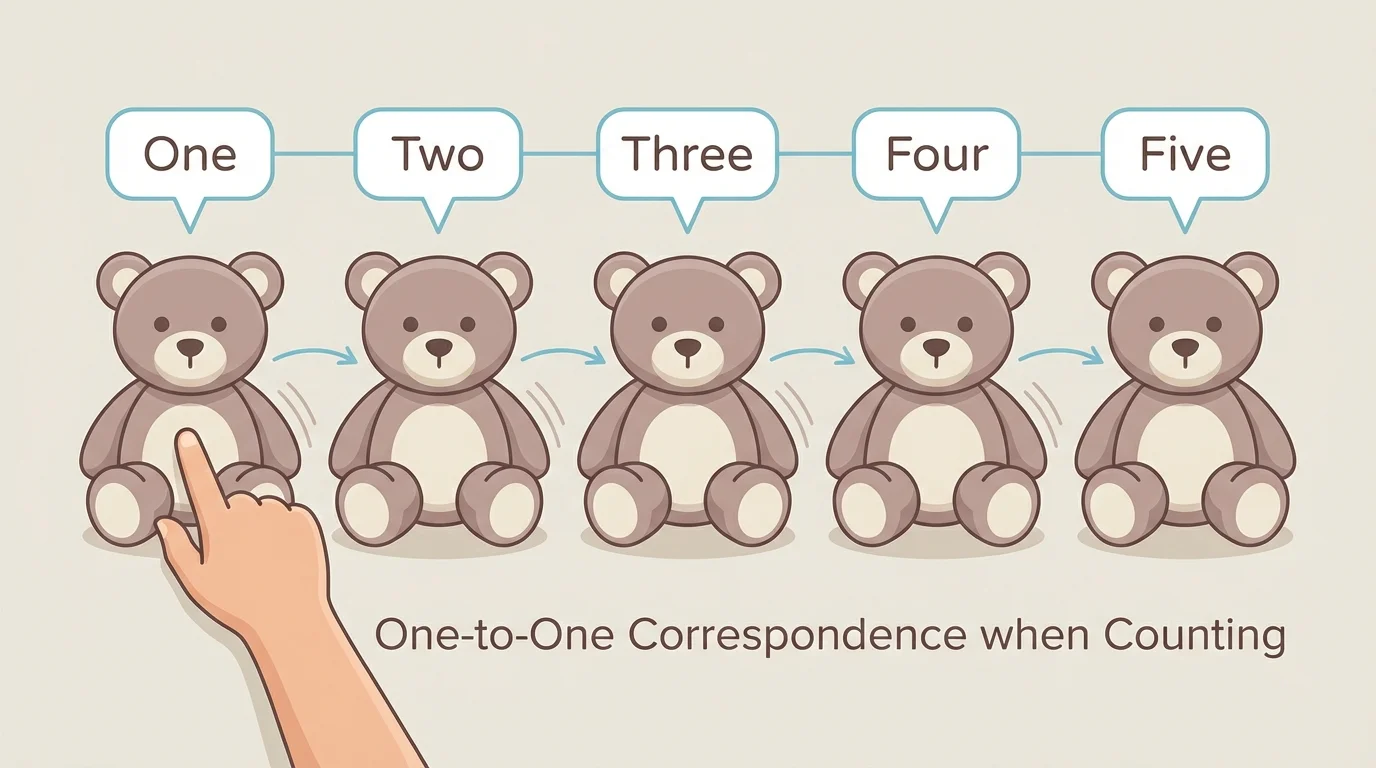
Mistakes can happen in two ways. You might skip an object, or you might count one object two times. Touching or moving each object helps stop these mistakes.
If there are toy cars in a row and you count one car two times, your answer will be too big. If you miss one car, your answer will be too small.
Why one-by-one counting works
Counting works because every object is paired with exactly one number name. This pairing helps us keep track of the whole group without losing or repeating any objects.
We saw with the bears in [Figure 1] that pointing to each object once makes the count clear and fair.
After we count all the objects, the last number we say tells the total. This important idea is called cardinality.
Suppose you count shells: \(1, 2, 3, 4, 5\). The last number is \(5\). That means there are \(5\) shells altogether.
Solved example 1
Count \(3\) balls.
Step 1: Say the number names in order.
Say \(1, 2, 3\).
Step 2: Match each number to one ball.
First ball \(1\), second ball \(2\), third ball \(3\).
Step 3: Look at the last number said.
The last number is \(3\).
So there are \(3\) balls.
The last number is special because it tells how many objects are in the whole group, not just the last object you touched.
[Figure 2] Sometimes objects are in a line. Sometimes they are in a circle. Sometimes they are scattered. You can still count them carefully, and the total stays the same.
If \(6\) buttons are in a straight line, the count is \(6\). If the same \(6\) buttons are moved into a circle, the count is still \(6\). Moving objects does not change how many there are.
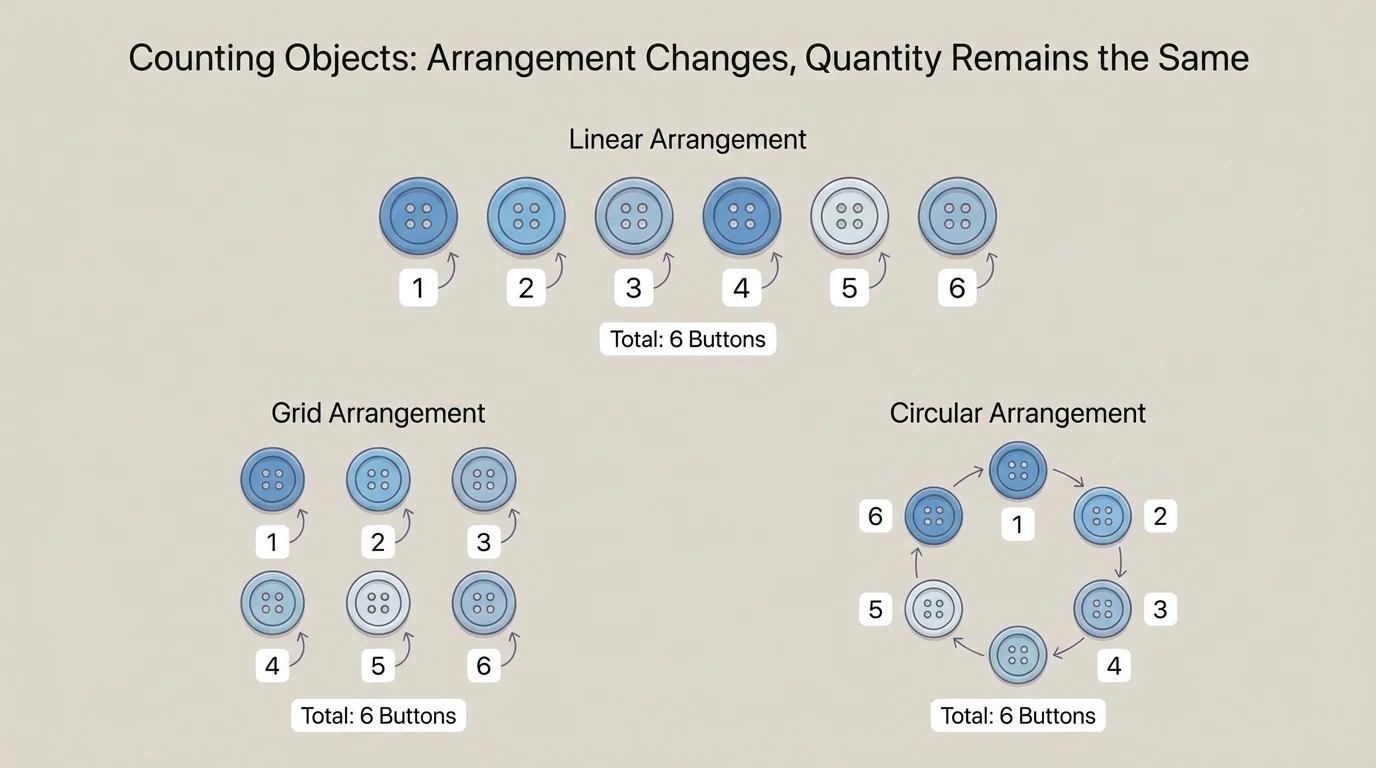
To count scattered objects, it helps to start at one side and move across, or to gently move counted objects into a new group.
This idea is important because groups can look different even when they have the same number. The buttons in [Figure 2] help us see that arrangement changes, but quantity does not.
You already know some number names. Now you are using them in a careful way so each object is counted once and only once.
You can count many kinds of things: cubes, pencils, leaves, or jumps. The counting rules stay the same.
Let's look at more groups and count them step by step.
Solved example 2
Count \(5\) stars.
Step 1: Start with the first star.
Say \(1\).
Step 2: Keep going in order.
Say \(2, 3, 4, 5\), one number for each new star.
Step 3: Use the last number.
The last number said is \(5\).
So there are \(5\) stars.
Notice that we did not jump from \(2\) to \(4\). We used all the number names in order.
Solved example 3
There are \(4\) toy ducks in a circle. Count them.
Step 1: Pick one duck to start with.
Say \(1\) for the first duck.
Step 2: Move around the circle one duck at a time.
Say \(2\), then \(3\), then \(4\).
Step 3: Stop when every duck has been counted once.
The last number said is \(4\).
So there are \(4\) ducks.
Circles can be tricky because it is easy to count the first object again. A good counter remembers where the counting started.
Solved example 4
Sam counts pencils and says \(1, 2, 3, 5\). Is that correct?
Step 1: Check the order of the number names.
The correct order is \(1, 2, 3, 4, 5\).
Step 2: Find the mistake.
The number \(4\) was missing.
Step 3: Fix the count.
Count again in order: \(1, 2, 3, 4, 5\).
No, the count was not correct because one number name was skipped.
A correct count needs both parts: the right order and one number for each object.
Counting helps in everyday life. You count snacks to make sure everyone gets one. You count steps as you climb. You count blocks to build a tower. You count classmates in line.
If you are setting out \(5\) cups for friends, you can place one cup and say \(1\), place the next and say \(2\), and keep going until \(5\). Then you know there are \(5\) cups.
Careful counting makes games fair, helps classrooms stay organized, and helps us know the exact amount of something.
"Count slowly, count in order, and count each thing once."
That simple rule helps with toys, books, snacks, art supplies, and many other things you see every day.
