What if your toys were spread out all over the floor instead of lined up neatly? Would the number change just because they moved? No. Counting helps us find how many, and the answer stays the same even when the objects look different or are counted in a different order.
When we count, we say number names in order: \(1, 2, 3, 4, 5, ...\). We also match each object to one number word. This is called one-to-one correspondence. It means one touch, one move, or one point for each object.
If there are \(4\) crayons, we count them like this: first crayon \(1\), next crayon \(2\), next crayon \(3\), last crayon \(4\). We do not count one crayon twice, and we do not skip any crayons.
Counting means saying number names in order while matching each number to one object. Total means how many objects are in the whole group.
Good counting is careful counting. Sometimes children point too fast or say extra numbers. To count correctly, each object gets just one number word.
[Figure 1] shows a group of apples. After we count all the objects, the last number we say tells the whole amount. This big idea is called cardinality. If we count \(1, 2, 3, 4, 5\), then there are \(5\) apples. The last number, \(5\), tells how many apples are in all.
We do not need to count the same group again right away just to answer "How many?" The last number already tells us. If we counted the bears and ended at \(7\), then the group has \(7\) bears.
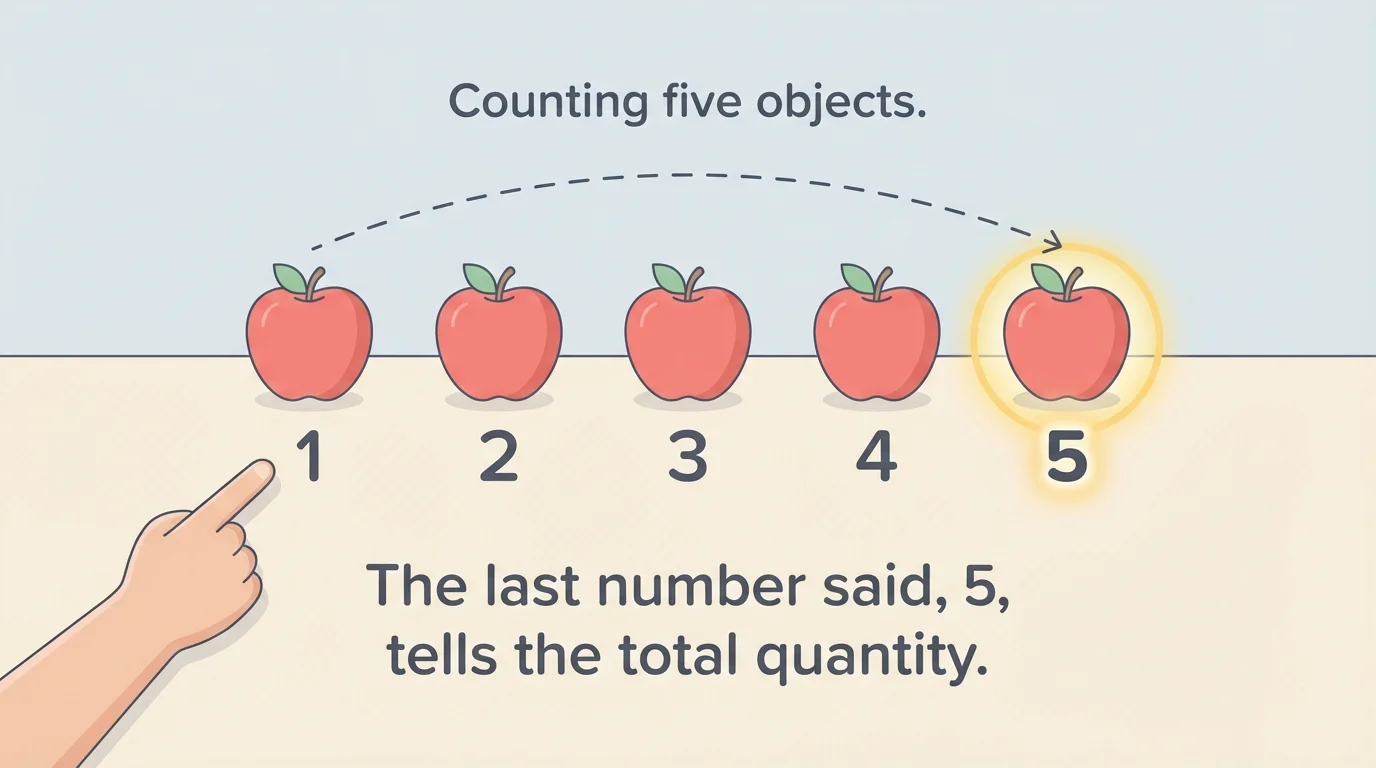
This is an important idea: counting is not only saying numbers. Counting tells the size of a group. When the last number is \(3\), the group has \(3\) objects. When the last number is \(8\), the group has \(8\) objects.
The counting word at the end tells the amount. If you count every object once and stop at \(n\), then the group has \(n\) objects. For example, ending on \(6\) means there are \(6\) objects in the set.
Later, when you see a new group, you can use the same idea again. As in [Figure 1], the count does not stop with a random number. The last number said is the answer to "How many?"
[Figure 2] shows the same buttons arranged in different ways. Sometimes objects are in a straight line. Sometimes they are in a pile, a circle, or spread apart. The arrangement may change, but the number does not. A set of \(6\) buttons is still \(6\) buttons whether the buttons are close together or far apart.
Think about \(4\) blocks. If the blocks are stacked, there are \(4\). If the same \(4\) blocks are placed side by side, there are still \(4\). Moving objects does not make more objects and does not make objects disappear.
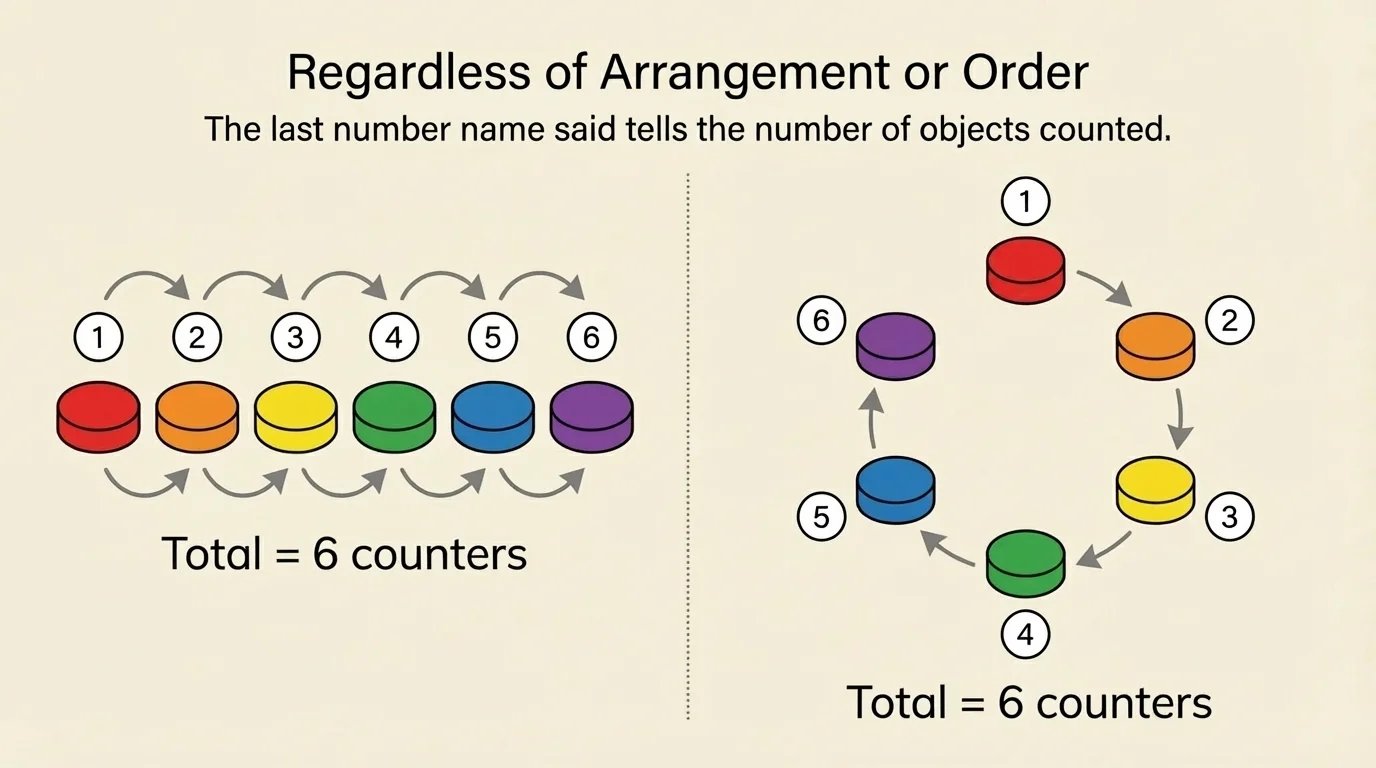
This idea helps when things look different. A long row of \(5\) cubes and a tight bunch of the same \(5\) cubes may look unlike each other, but they still have the same total. We only changed the places, not the number.
A group can look bigger when objects are spread out, even when the number stays the same. Careful counting helps our eyes and brains check the real total.
When you compare groups, remember what [Figure 2] shows: the same objects can be arranged in new ways and still keep the same number.
[Figure 3] shows two ways to count the same group. You can start with a different object and still get the same answer. If a group has \(4\) shells, you might count left to right, or right to left. If each shell is counted once, the total is still \(4\).
Order changes which object gets counted first, but it does not change how many objects are in the group. For example, with \(3\) toy cars, you could count blue, red, green or green, blue, red. Both ways end at \(3\).
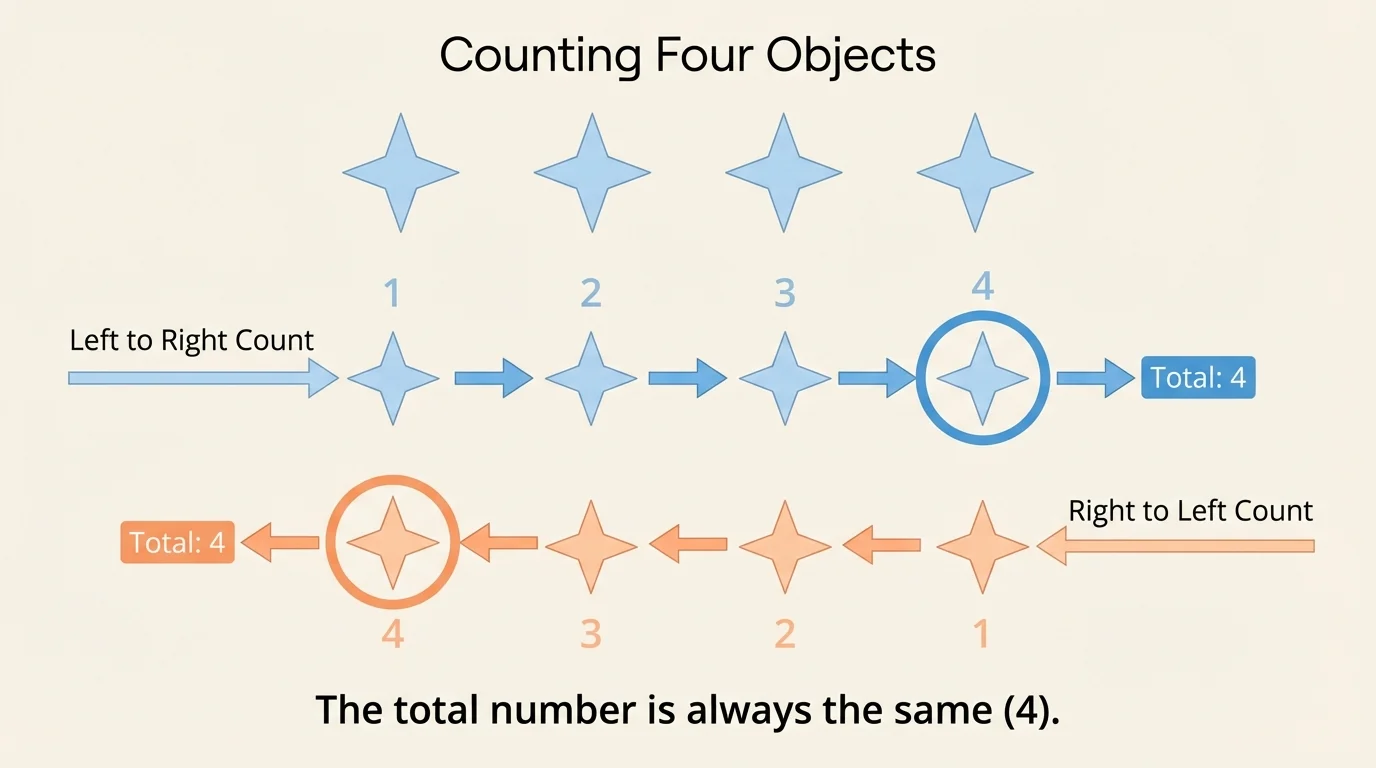
This works only when every object is counted once. If we skip an object or count one object twice, the answer will be wrong. So the order can change, but careful counting still matters.
Number words have an order: \(1, 2, 3, 4, 5\). When you count objects, keep the number words in order even if you start with a different object in the set.
When you look back at [Figure 3], you can see that different paths through the same set still lead to the same last number.
These examples show how counting tells the total and why arrangement or order does not change the number.
Example 1
There are teddy bears on a rug. We count: \(1, 2, 3, 4\).
Step 1: Match one number to each teddy bear.
The bears each get one count: \(1\), then \(2\), then \(3\), then \(4\).
Step 2: Look at the last number said.
The last number is \(4\).
Step 3: Tell how many bears there are.
There are \(4\) bears.
Answer: \(4\) is the total because it is the last number counted.
The important part is not just saying numbers. The important part is that the last number gives the whole amount.
Example 2
There are \(5\) dots in a row. Then the same \(5\) dots are moved into a circle.
Step 1: Count the dots in the row.
We count \(1, 2, 3, 4, 5\). The total is \(5\).
Step 2: Move the same dots into a circle.
No dots are added and no dots are taken away.
Step 3: Decide whether the number changes.
The number stays \(5\) because the same dots are still there.
Answer: The arrangement changed, but the total stayed \(5\).
Changing the shape of the group does not change the size of the group.
Example 3
There are \(3\) blocks. One child counts from left to right. Another child counts from right to left.
Step 1: Count left to right.
The count is \(1, 2, 3\). The total is \(3\).
Step 2: Count right to left.
The count is also \(1, 2, 3\). The total is \(3\).
Step 3: Compare the answers.
Both counts end at \(3\).
Answer: Counting in a different order still gives \(3\).
This is why counting works in many situations. You can begin with a different object, but if you count each object once, the total stays the same.
We use these ideas every day. A teacher counts \(6\) glue sticks on a table. If the glue sticks are spread out later, there are still \(6\). A child counts \(4\) crackers at snack time. If the crackers are moved to a different plate, there are still \(4\).
During cleanup, toys may be in a box, on a shelf, or on the floor. The arrangement looks different, but the number of toys stays the same unless toys are added or taken away. Counting helps us know exactly how many objects we have.
So when you count a set, remember two big ideas: the last number name tells how many, and the same group keeps the same number even if it is moved or counted in a different order.
