What happens when you have one toy, and then someone gives you one more? Your group gets bigger by just a little bit, but it changes to the next number. Counting works this way every time. When we say numbers in order — \(1, 2, 3, 4, 5\) — each new number name means there is one more than before.
When we count in order, we say a number name for each amount. The next number does not mean a lot more. It means just one more, as [Figure 1] shows with groups that grow by exactly \(1\) object each time.
If you have \(1\) bear and get one more bear, now you have \(2\) bears. If you have \(2\) bears and get one more, now you have \(3\) bears. We can think of it like this: \(1 \to 2\), \(2 \to 3\), \(3 \to 4\). Each step is one more.
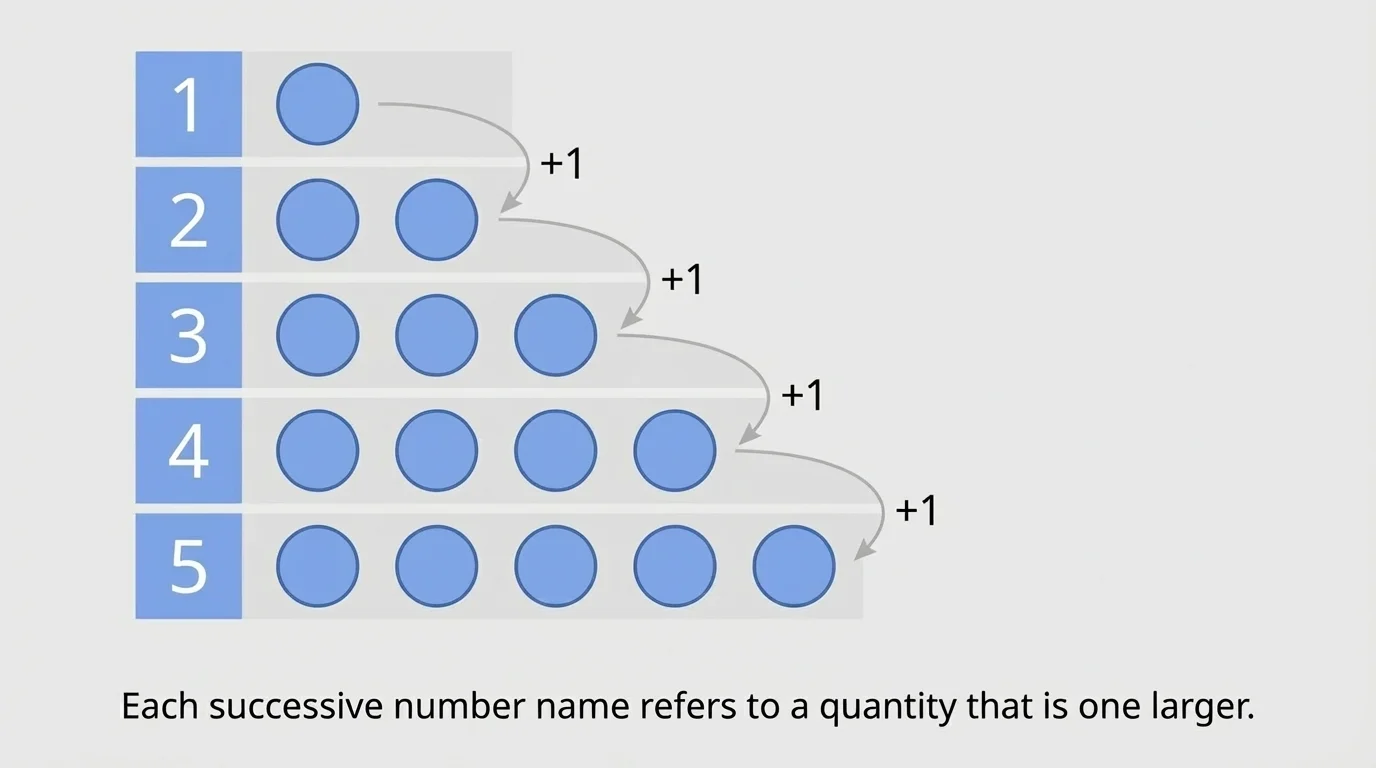
One more means adding exactly \(1\) object to a group.
Count means saying number names in order to match objects.
How many means the total number of objects in the group.
That is why number order matters. We say \(1, 2, 3, 4, 5\) in the same order each time. The number names stay in order, and each next one means the amount has grown by \(1\).
When we count objects, we use one-to-one correspondence. That means one number name goes with one object, as [Figure 2] illustrates when a child points to each block once. We do not give two number names to one object, and we do not skip an object.
Suppose there are \(4\) blocks. We touch or point to each block once and say: \(1\), \(2\), \(3\), \(4\). The last number we say is \(4\). That tells us there are \(4\) blocks in all.
If one more block is added, we do not start with a new idea. We move to the next number name. Now we count \(1, 2, 3, 4, 5\). The new group has \(5\) blocks, and \(5\) is one more than \(4\).
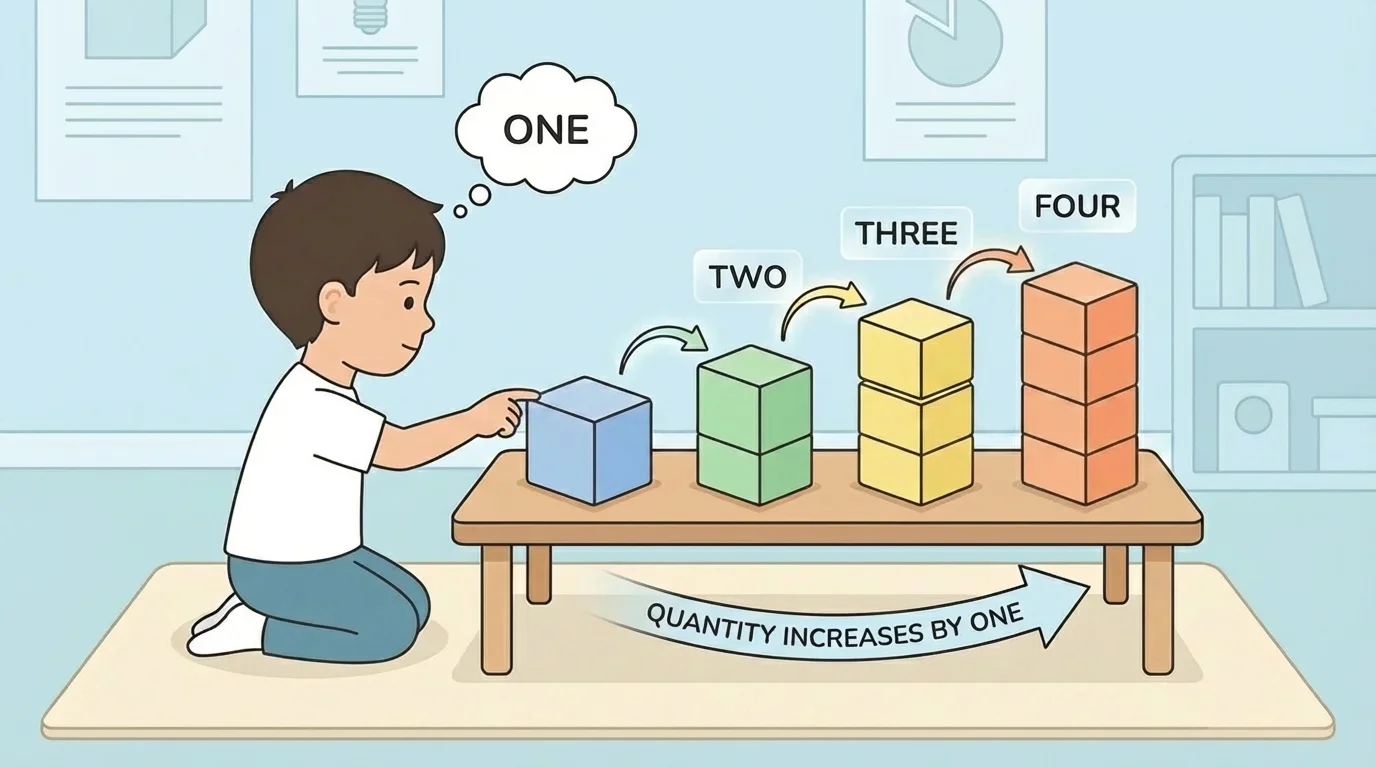
This is an important idea called cardinality. Cardinality means the last number said when counting tells how many objects are in the whole group. If the last number is \(3\), there are \(3\) objects. If the last number is \(6\), there are \(6\) objects.
We can watch quantities grow one at a time. As we saw in [Figure 1], each next group is bigger by exactly \(1\), not by \(2\) or \(3\).
Solved example 1
There are \(2\) stars. One more star is added. How many stars are there now?
Step 1: Start with the first amount.
The group has \(2\) stars.
Step 2: Add one more.
Move to the next number after \(2\). The next number is \(3\).
Step 3: Tell how many.
\(2 + 1 = 3\)
There are \(3\) stars.
When we say the next number, we are showing the group got larger by one object. This happens every time we add one more object to a counted set.
Solved example 2
A row has \(4\) ducks. One more duck joins. How many ducks are there now?
Step 1: Say the starting number.
The row starts with \(4\) ducks.
Step 2: Find the next number name.
After \(4\), we say \(5\).
Step 3: Write the new amount.
\(4 + 1 = 5\)
There are \(5\) ducks.
Counting forward by one helps us know the new total without guessing. We can trust the count because each object gets one number name.
Solved example 3
There are \(5\) cubes. One cube is taken from another pile and put with them. How many cubes are there now?
Step 1: Start at \(5\).
The group already has \(5\) cubes.
Step 2: Add one more cube.
The next number after \(5\) is \(6\).
Step 3: Tell the total.
\(5 + 1 = 6\)
There are \(6\) cubes.
In real life, this happens all the time. If you have \(3\) crackers and someone gives you one more, the amount becomes \(4\). If you climb \(2\) steps and then climb one more step, you are on step \(3\). This growing-by-one idea appears in daily life, as [Figure 3] shows with apples in baskets.
We can compare two groups and ask, "Which one has one more?" A basket with \(4\) apples has one more apple than a basket with \(3\) apples. A group with \(6\) cars has one more car than a group with \(5\) cars.
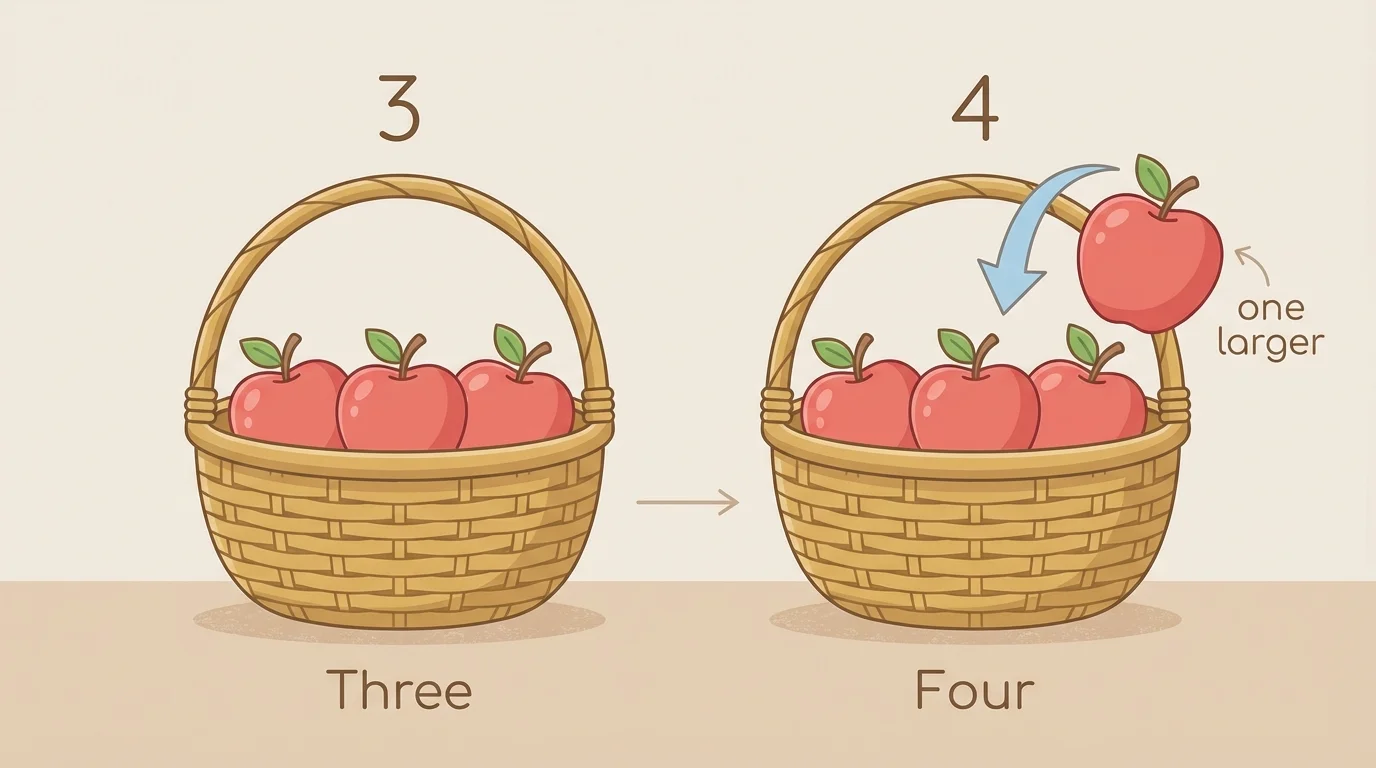
Counting by ones is one of the first big ideas in math. It helps with adding later, because many addition facts begin by understanding what happens when we add \(1\).
When children line up, each next child in line makes the line longer by one. When one more book is put on a shelf, the number of books moves to the next number name. The same counting idea works with toys, cups, buttons, jumps, and claps.
Sometimes a count is wrong because we skip a number, skip an object, or count the same object twice. Careful counting means moving through the group in a clear way, like left to right or top to bottom. That is why the pointing in [Figure 2] is so helpful.
For example, if there are \(5\) shells and we say \(1, 2, 3, 5, 6\), the number names are out of order. We must keep the count sequence steady: \(1, 2, 3, 4, 5\).
If there are \(4\) objects and we touch one object two times, the count may sound like \(1, 2, 3, 4, 5\), but that does not mean there are really \(5\) objects. The count is only correct when each object matches one number name.
The counting sequence stays in the same order: \(1, 2, 3, 4, 5, 6, 7, 8, 9, 10\). Each number after another number means one more than before. So \(7\) is one more than \(6\), and \(10\) is one more than \(9\).
This pattern keeps going. No matter which counting number we use, the next number name tells about a quantity that is larger by exactly \(1\). As we noticed earlier in [Figure 1], numbers grow step by step, not all at once.
You already know how to say counting numbers in order. Now you are connecting those number names to real groups of objects and seeing that each next number means one more object in the group.
So when you count a set and then add one object, you move to the next number name. That next number tells the new total. Counting is not just saying words in order. It is a way to show how many things there are.
