How many crayons are on the table? How many blocks are in the box? Every day, we count to find out how many. Counting is not just saying number words. Counting helps us match one number to one object, and then the last number we say tells the total.
When we count, we say the numbers in order: \(1, 2, 3, 4, 5\) and on up to \(20\). We touch, point to, or look at one object for each number word. This is called one-to-one correspondence. It means each number word matches one object.
Count means to say number words in order while matching each number to one object.
How many asks for the total number of objects in a group.
Cardinality means the last number you say when counting tells the total in the group.
[Figure 1] If a child counts apples and says \(1, 2, 3, 4, 5, 6\), then there are \(6\) apples. The answer is not all the numbers said. The answer is the last number said: \(6\).
Sometimes objects are in a neat row. Objects in a line are easy to count when you start at one end and move to the other end. Touch each object once and say one number for each object.
If there are shells in a row, you might count: \(1, 2, 3, 4, 5, 6, 7\). That means there are \(7\) shells. Be careful not to skip one shell or count one shell two times.
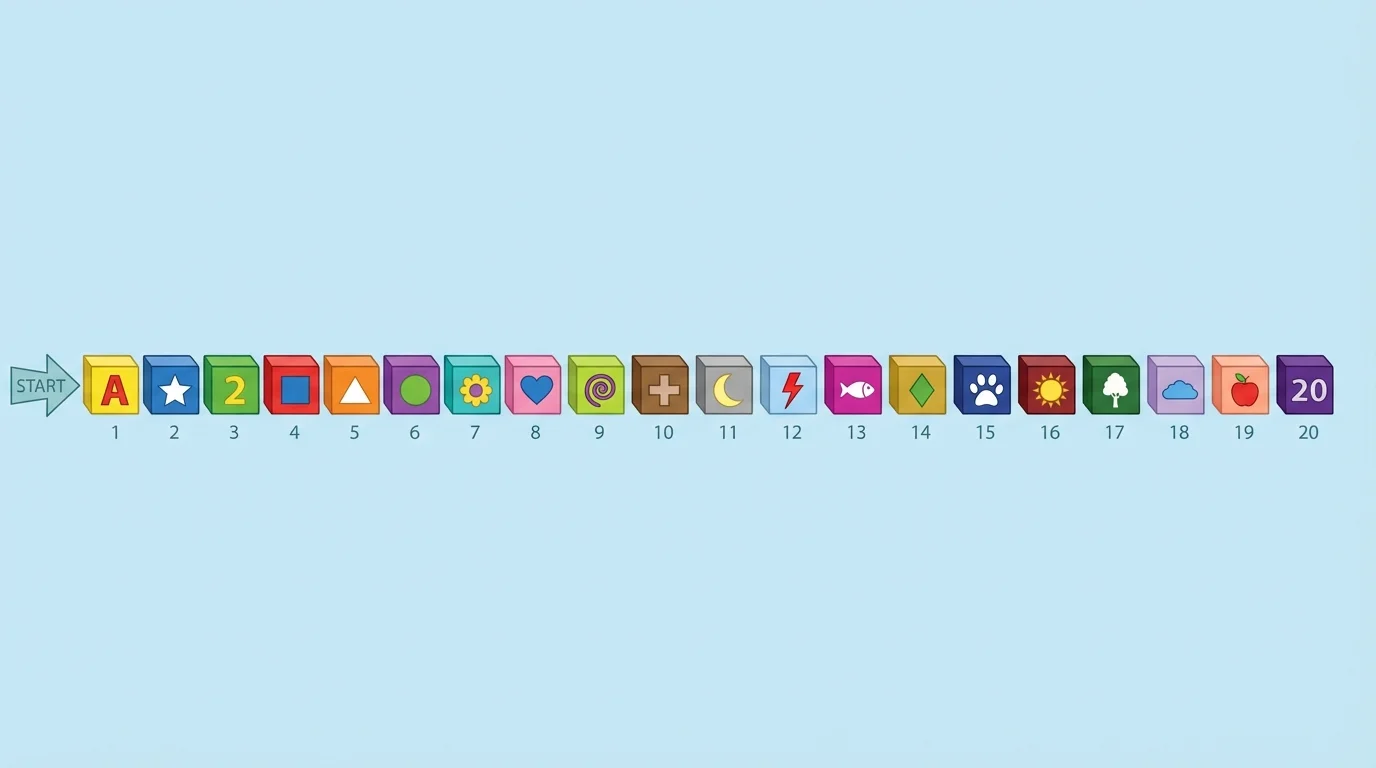
A good way to count a line is to begin at the left end or the right end. Either way works. What matters is counting each object once. Starting from either end gives the same total.
Solved example 1
There are stars in a row. How many stars are there?
Step 1: Start at one end of the row.
Step 2: Count each star once: \(1, 2, 3, 4, 5, 6, 7, 8\).
Step 3: Use the last number said.
There are \(8\) stars.
[Figure 2] When the objects are lined up, our eyes can follow the row easily. That is why rows are often the simplest groups to count.
Sometimes objects are arranged in straight rows and columns. This is called a array. In an array, count across one row, then the next row. This helps us stay organized.
For example, if dots are arranged in \(3\) rows with \(4\) dots in each row, we can count all the dots one by one: \(1, 2, 3, 4\), then \(5, 6, 7, 8\), then \(9, 10, 11, 12\). There are \(12\) dots.
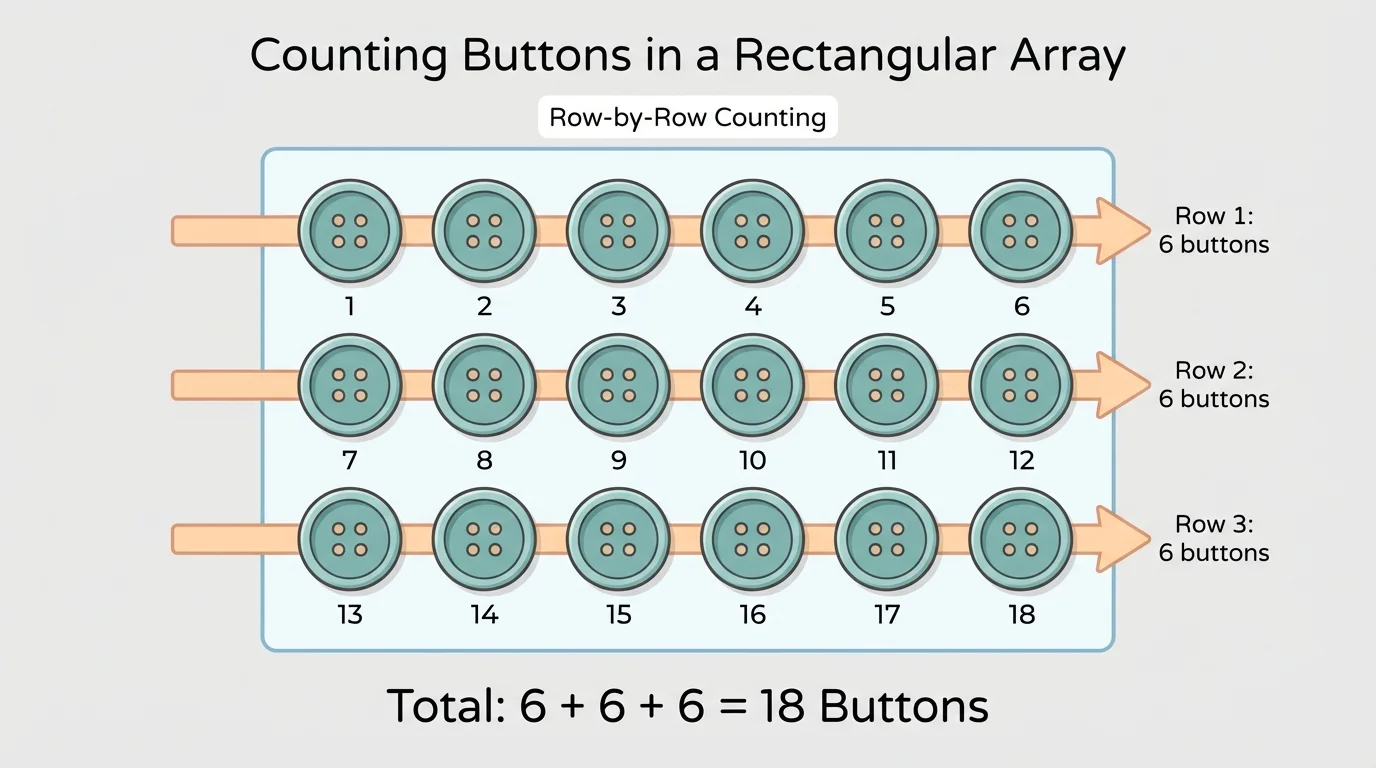
Arrays are neat and tidy. They help us see where we have counted and where we still need to count. Later, arrays also help with bigger math ideas, but right now they help us count carefully.
Organized counting means using a path that helps you keep track. In a rectangle, counting row by row is an organized way. Organized counting helps stop mistakes like skipping or double-counting.
[Figure 3] Just like the cubes in [Figure 1] stay in a row, the objects in an array stay in rows too. The arrangement looks different, but the rule is the same: one number for one object.
Sometimes objects go around in a ring. A circular arrangement can be tricky because there is no end. Pick one object to start with, and then count around until you come back to the starting object.
You can mark the first object with your finger or just remember it in your mind. Suppose there are plates around a table. Count: \(1, 2, 3, 4, 5, 6\). When you are back at the first plate, stop. There are \(6\) plates.
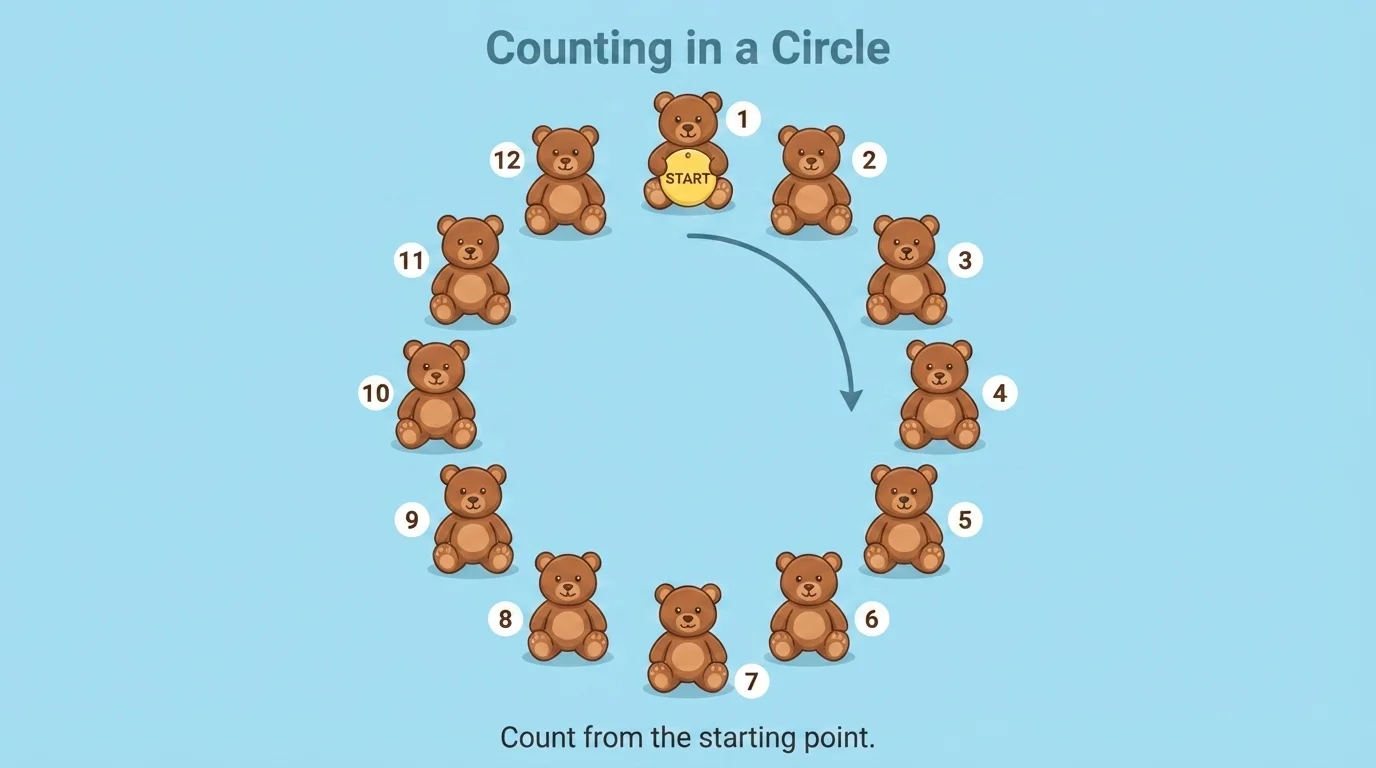
In a circle, stopping at the right time is important. If you keep going past the first object, you will count some objects again. Choosing a starting place helps you know exactly when to stop.
Solved example 2
There are flowers in a circle. How many flowers are there?
Step 1: Choose one flower as the start.
Step 2: Count around the circle once: \(1, 2, 3, 4, 5, 6, 7, 8, 9\).
Step 3: Stop when you are back at the starting flower.
There are \(9\) flowers.
The same careful thinking works in circles and rows. We count each object once, and the last number gives the total.
Sometimes objects are spread out and mixed up. This is called a scattered arrangement. For scattered groups up to \(10\), it helps to point to each object, move counted objects aside, or keep track carefully in your mind.
If \(8\) buttons are scattered on a desk, you might touch one and say \(1\), touch another and say \(2\), and keep going until \(8\). Moving each counted button into a new little pile can help.
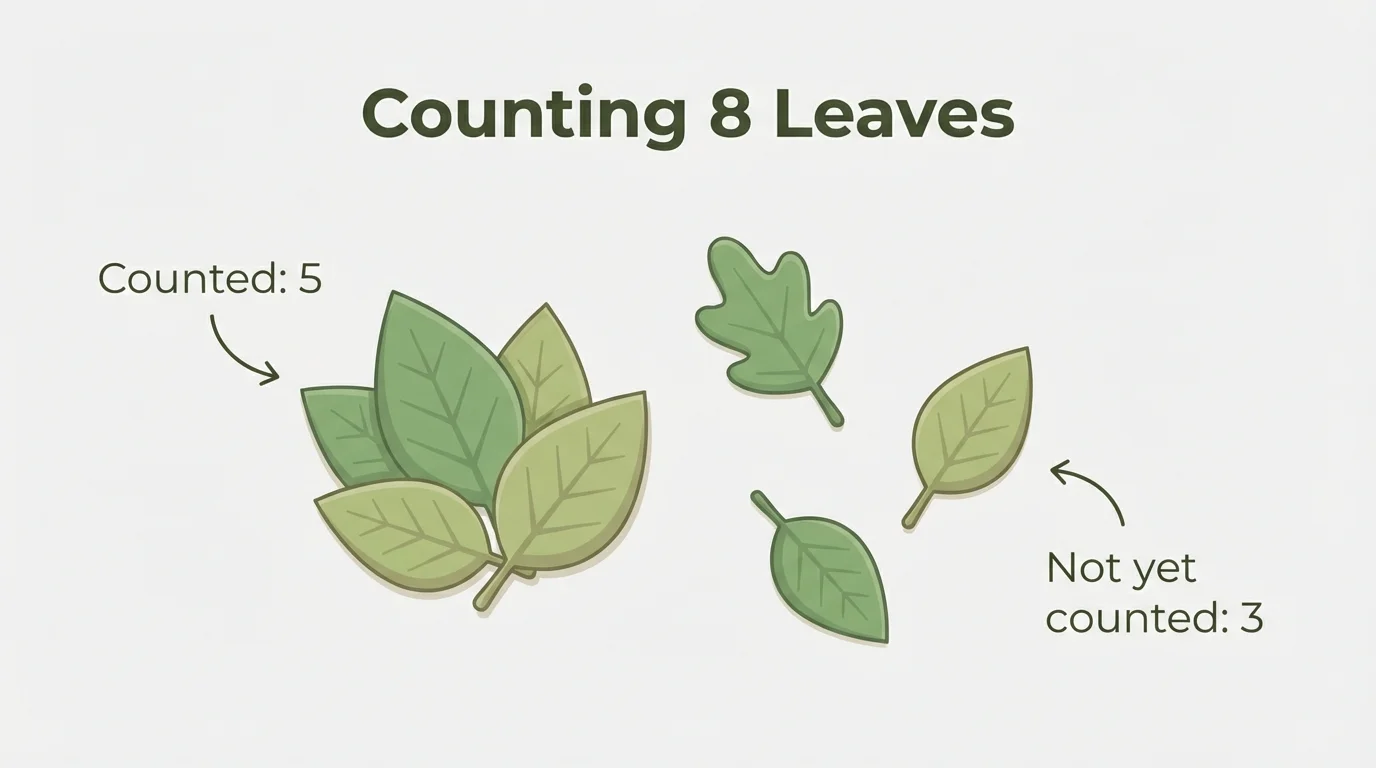
Scattered groups can be harder because the objects are not in a neat path. That is why moving objects or pointing slowly is so helpful. For this kind of counting, we usually work with as many as \(10\) objects so the group is still easy to keep track of.
[Figure 4] People count in many ways all over the world, but one big counting idea stays the same: each object gets one number word, and the last number tells how many.
When the objects are not lined up, organized moves matter even more. The strategy in [Figure 4] helps us see which objects have already been counted.
Sometimes you already know the number, and your job is to make a group with exactly that many objects. This is called count out. If someone says, "Give me \(7\) cubes," you count cubes one by one until you reach \(7\).
Count out carefully: \(1, 2, 3, 4, 5, 6, 7\). Then stop. If you keep going, you will have too many. If you stop early, you will have too few.
Solved example 3
You are asked to count out \(5\) blocks.
Step 1: Take one block and say \(1\).
Step 2: Keep taking one block for each next number: \(2, 3, 4, 5\).
Step 3: Stop when you say \(5\).
You counted out \(5\) blocks.
You can count out any number from \(1\) to \(20\). For example, to count out \(12\) crayons, say the numbers in order until the last one is \(12\). Then the group has exactly \(12\) crayons.
Solved example 4
You are asked to count out \(10\) counters.
Step 1: Put out counters one at a time.
Step 2: Say the numbers: \(1, 2, 3, 4, 5, 6, 7, 8, 9, 10\).
Step 3: Stop at \(10\).
You counted out \(10\) counters.
Counting out is like building a group to match a number. The number tells how many objects belong in the group.
We use counting everywhere: counting \(4\) spoons for lunch, \(9\) students in a small group, \(6\) books on a shelf, or \(15\) steps to the playground gate. When chairs are around a table, the circle idea from [Figure 3] helps. When stickers are in rows, the array idea from [Figure 2] helps.
At cleanup time, you might count toys in a line, count paint jars in rows, or count out \(8\) pencils for your table. Counting helps us answer questions, share fairly, and make sure we have the right amount.
No matter how the objects are arranged, the important ideas stay the same: say numbers in order, count each object one time, and use the last number as the answer to how many.
