Have you ever noticed that sometimes one snack bowl has more crackers, or one toy bin has fewer blocks? Mathematicians compare groups to find out which group has more, which has less, or whether both groups have the same number. When we compare, we are looking carefully at two groups of objects.
To compare groups means to look at two groups and decide how they are alike or different in number. We do not look at color, shape, or size first. We look at how many objects are in each group.
[Figure 1] If one group has more objects, that group is greater. If one group has fewer objects, that group is less. If both groups have the same number of objects, they are equal.
Greater than means one group has more objects.
Less than means one group has fewer objects.
Equal means both groups have the same number of objects.
For example, if one group has \(3\) cubes and another group has \(5\) cubes, then \(3\) is less than \(5\), and \(5\) is greater than \(3\).
Sometimes we say more and fewer. In math, we can also say greater than and less than. These words mean almost the same thing when we talk about groups of objects.
You might say: "This group has more." You can also say: "This number is greater." If both groups match perfectly, you can say: "They are equal."
When we compare \(2\) groups, there are \(3\) possible answers: one group is greater, one group is less, or the groups are equal.
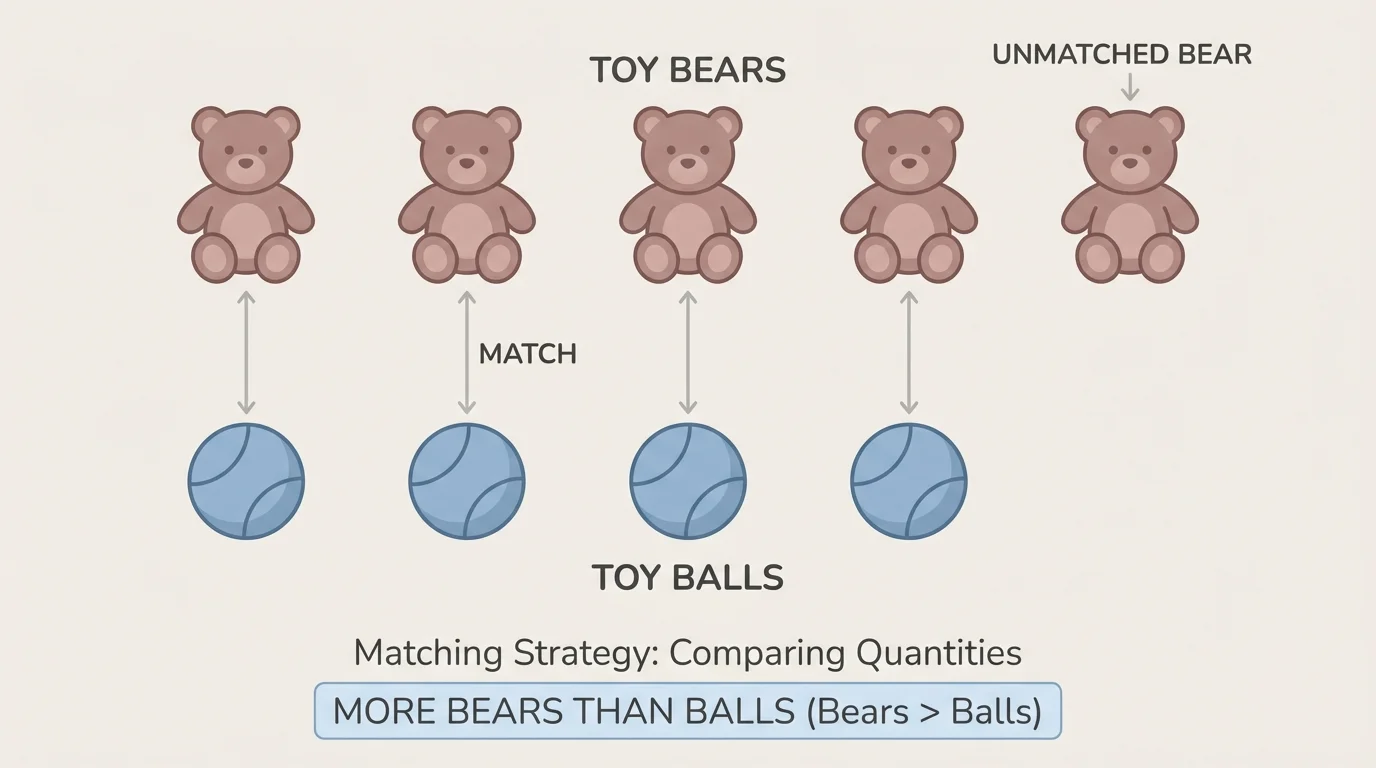
One helpful way to compare is by matching one object from the first group with one object from the second group. This is called one-to-one matching. If every object gets a partner, the groups are equal.
If one group has an extra object left over, that group has more. The other group has fewer. Matching is a great strategy when you can move objects or point to them carefully.
Suppose there are \(4\) toy cars and \(4\) toy garages. If each car can go into one garage, and no cars or garages are left over, then the groups are equal because \(4 = 4\).
Now suppose there are \(5\) ducks and \(3\) ponds. Match one duck to one pond. After matching, \(2\) ducks are left over. That tells us \(5\) is greater than \(3\). We also know \(3\) is less than \(5\).
How matching helps
Matching works because each object in one group gets exactly one partner in the other group. If there is no leftover object, the groups are equal. If there are leftovers in one group, that group is greater. This helps us compare even before we know the number words for every object.
Later, when you count, the same idea is still true. The extra objects you saw while matching mean that one number is bigger than the other number. The leftover objects in [Figure 1] make it easy to see which group is greater.
[Figure 2] Another way to compare is by counting each group. First count one group. Then count the other group. Last, compare the numbers.
If the numbers are the same, the groups are equal. If one number is bigger, that group has more objects. If one number is smaller, that group has fewer objects.
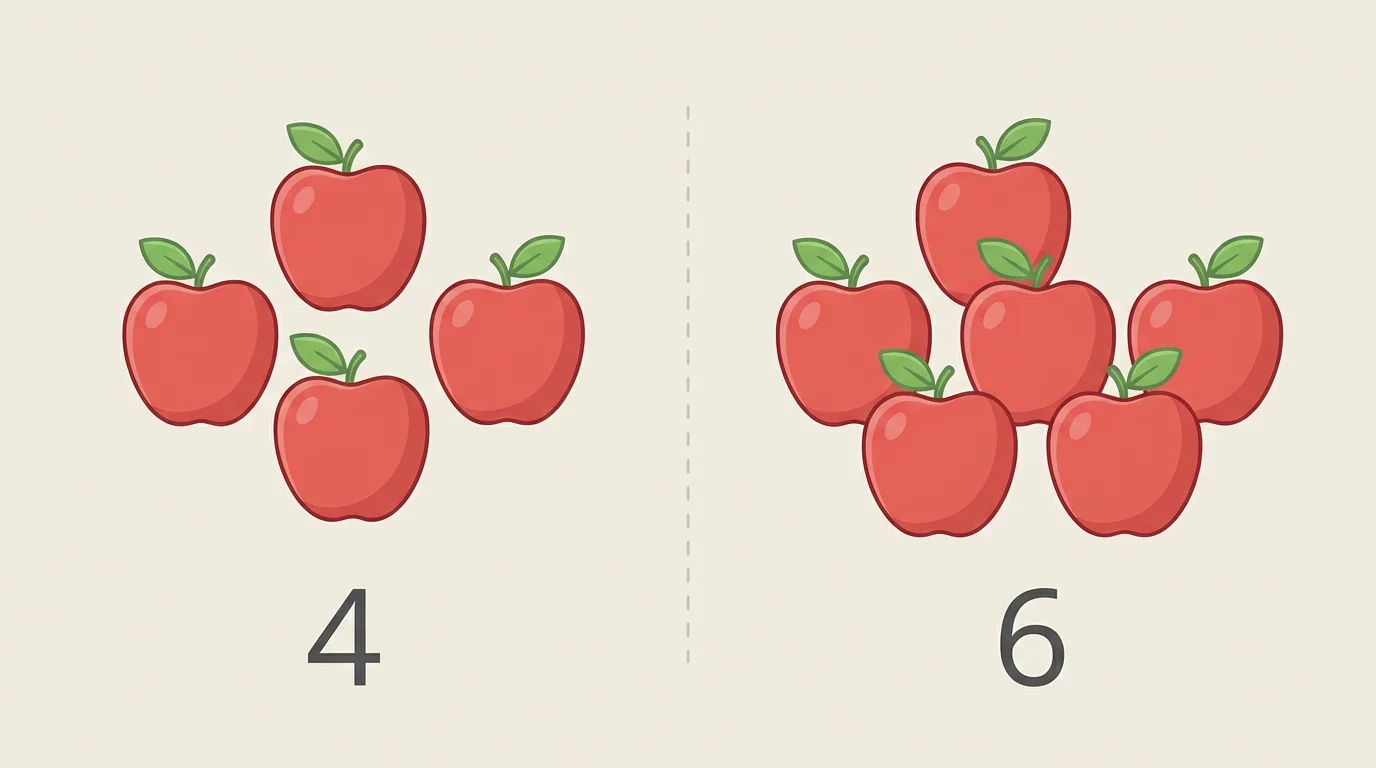
For example, count \(2\) flowers in one vase and \(6\) flowers in another vase. Since \(2 < 6\), the second vase has more flowers, and the first vase has fewer flowers.
Sometimes you can compare by looking, especially with small groups. But counting helps when the groups are close, like \(7\) and \(8\). Counting carefully makes the answer clear.
When you count, touch or point to each object one time. Say one number for each object. The last number you say tells how many are in the group.
You can compare any two groups this way. If one plate has \(1\) cookie and another has \(1\) cookie, then \(1 = 1\), so the groups are equal. If one basket has \(0\) balls and another has \(3\) balls, then \(0 < 3\), so the empty basket has fewer.
Let's look at some examples step by step.
Example 1: Compare by matching
There are \(3\) red blocks and \(5\) blue blocks. Which group is greater?
Step 1: Match one red block to one blue block.
Make pairs: \(1\) red with \(1\) blue, again, and again.
Step 2: Look for leftovers.
After matching \(3\) pairs, \(2\) blue blocks are left.
Step 3: Decide which group has more.
The blue block group is greater. The red block group is less.
So, \(5 > 3\).
Matching is very useful when objects can be lined up in pairs.
Example 2: Compare by counting
One group has \(4\) shells. Another group has \(4\) shells. Are they greater, less, or equal?
Step 1: Count the first group.
The first group has \(4\) shells.
Step 2: Count the second group.
The second group also has \(4\) shells.
Step 3: Compare the numbers.
Since \(4 = 4\), the groups are equal.
The answer is equal.
When the numbers are the same, no group has more or fewer.
Example 3: Compare two snack groups
There are \(2\) bananas on one table and \(7\) bananas on another table. Which group has fewer bananas?
Step 1: Count both groups.
First table: \(2\). Second table: \(7\).
Step 2: Compare the numbers.
Since \(2 < 7\), the first table has fewer bananas.
Step 3: Say the comparison in words.
\(2\) is less than \(7\), and \(7\) is greater than \(2\).
The group with \(2\) bananas has fewer bananas.
[Figure 3] You can always check your work by matching after counting, or count after matching.
People compare groups all the time in sharing situations. You might compare chairs at a table and children in the room, crayons in \(2\) boxes, or cups and straws at snack time.
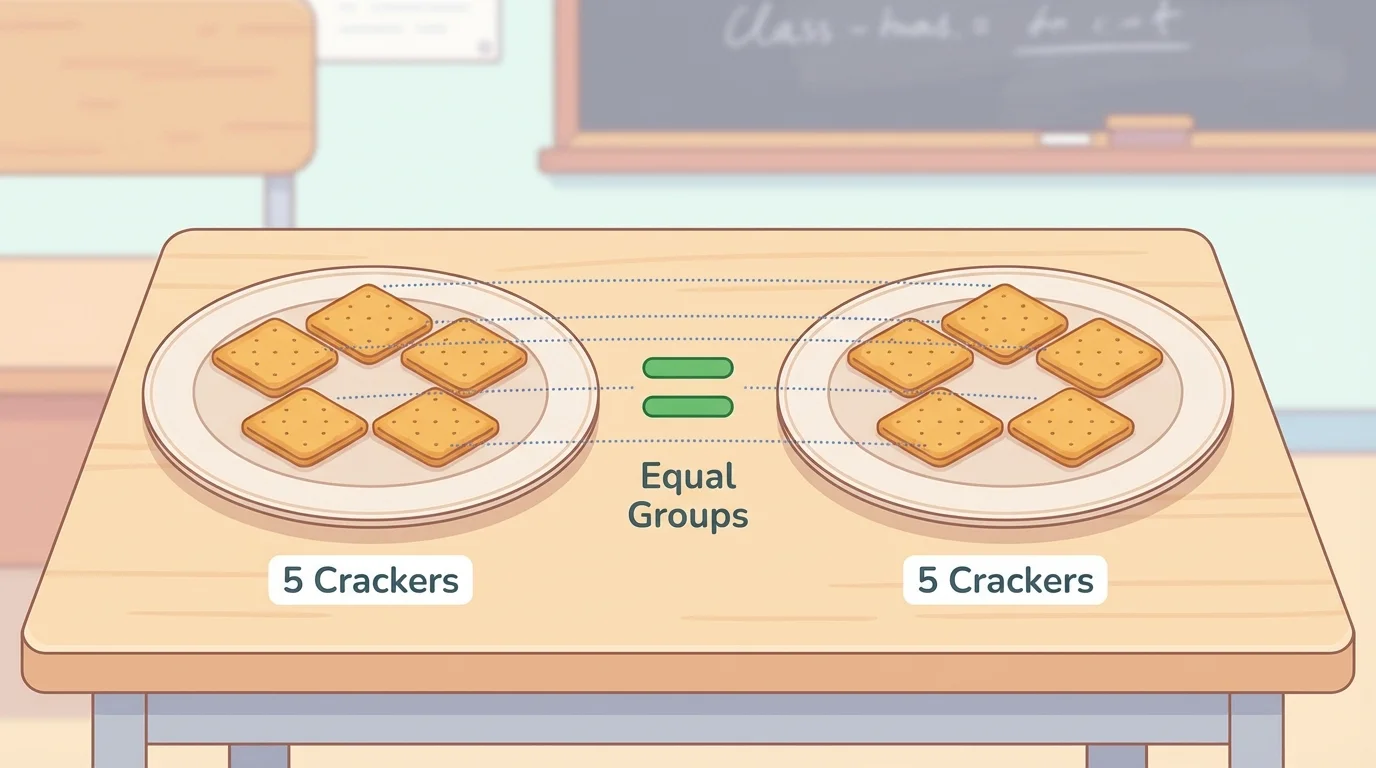
If there are \(6\) children and \(6\) juice boxes, everyone can get one because the groups are equal. If there are \(6\) children and only \(4\) juice boxes, there are fewer juice boxes than children.
When teachers set out art supplies, they may compare \(8\) paintbrushes and \(8\) sheets of paper. When families set the table, they compare plates and forks. Equal groups help sharing feel fair.
Even animals compare in simple ways. A bird looking for berries may go to the bush with more berries because that bush gives it a better chance to eat.
Equal groups in [Figure 3] help us see what fair sharing looks like. Comparing groups helps us solve everyday problems.
When you compare groups, look only at how many objects there are. A group of big objects is not always greater than a group of small objects. For example, \(2\) big balls are still less than \(4\) small balls because \(2 < 4\).
Be careful to count each object once. If you skip an object or count one object two times, the comparison may be wrong. Slow, careful counting helps.
You can compare groups by matching or by counting. Both strategies work. Good mathematicians use the strategy that helps them see the answer clearly.
