Which is greater: \(2\) cookies or \(9\) cookies? You can tell right away that \(9\) cookies is more than \(2\) cookies. Comparing numbers helps us do that same kind of thinking with written numerals. When we compare numbers from \(1\) to \(10\), we decide which number means more, which means less, or whether both numbers are the same.
When we compare two numbers, we look at how many each number tells us. The numbers are called numerals when we write them as symbols like \(3\), \(6\), or \(10\).
Greater than means a number is bigger and shows more.
Less than means a number is smaller and shows fewer.
Equal to means two numbers are the same amount.
If we compare \(5\) and \(8\), then \(8\) is greater than \(5\). We can also say \(5\) is less than \(8\). If we compare \(4\) and \(4\), the numbers are equal.
It helps to remember that every number from \(1\) to \(10\) has a place in counting order. That order helps us compare quickly and correctly.
[Figure 1] shows the counting order: \(1, 2, 3, 4, 5, 6, 7, 8, 9, 10\). A number that comes later when we count is greater.
If one number comes before another number in counting order, it is less. For example, \(3\) comes before \(6\), so \(3 < 6\). Also, \(9\) comes after \(2\), so \(9 > 2\).
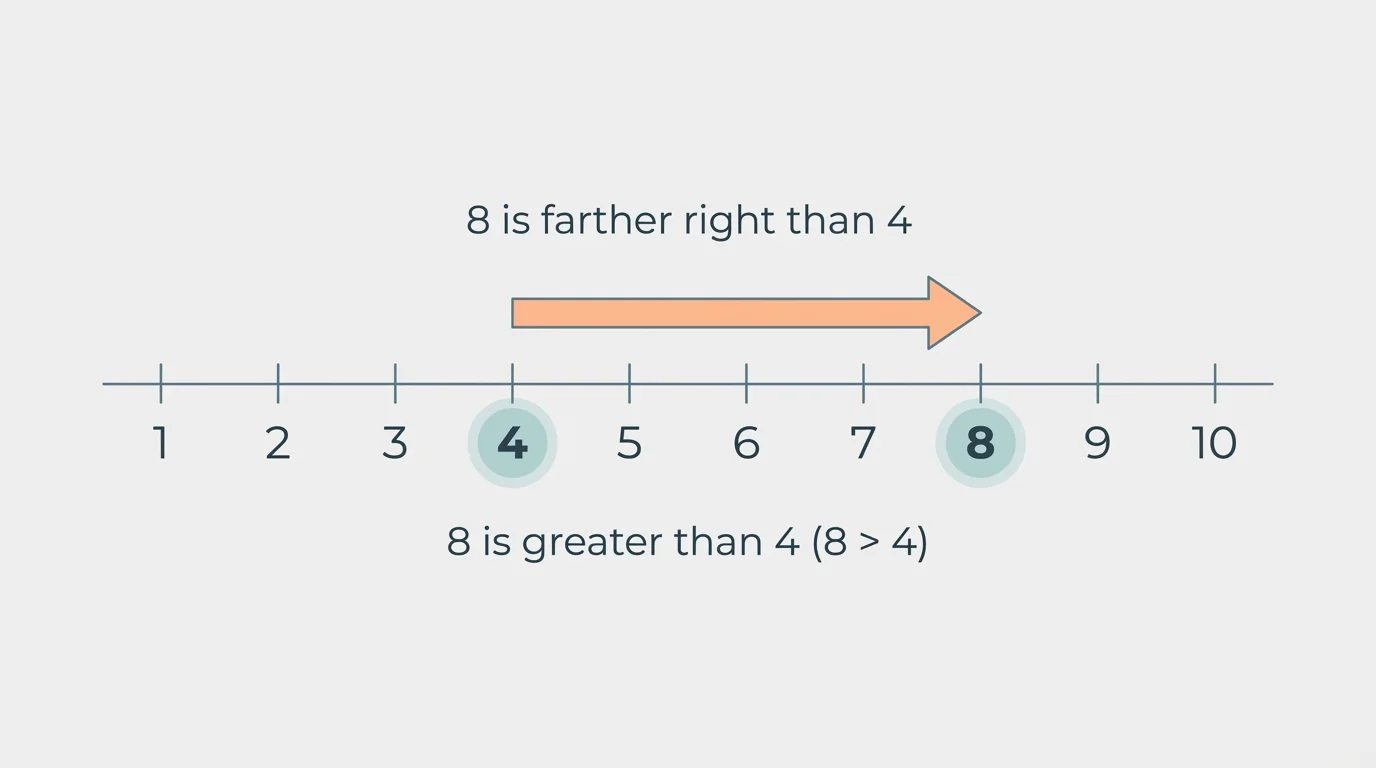
You can think, "Which number do I say first when I count?" If you say \(4\) before \(7\), then \(4\) is less than \(7\). If you say \(10\) after \(8\), then \(10\) is greater than \(8\).
Remember how to count from \(1\) to \(10\). Counting in order helps you compare, because numbers later in the list mean more.
This same idea works for every pair of numbers between \(1\) and \(10\). Numbers farther to the right are greater, and numbers farther to the left are less.
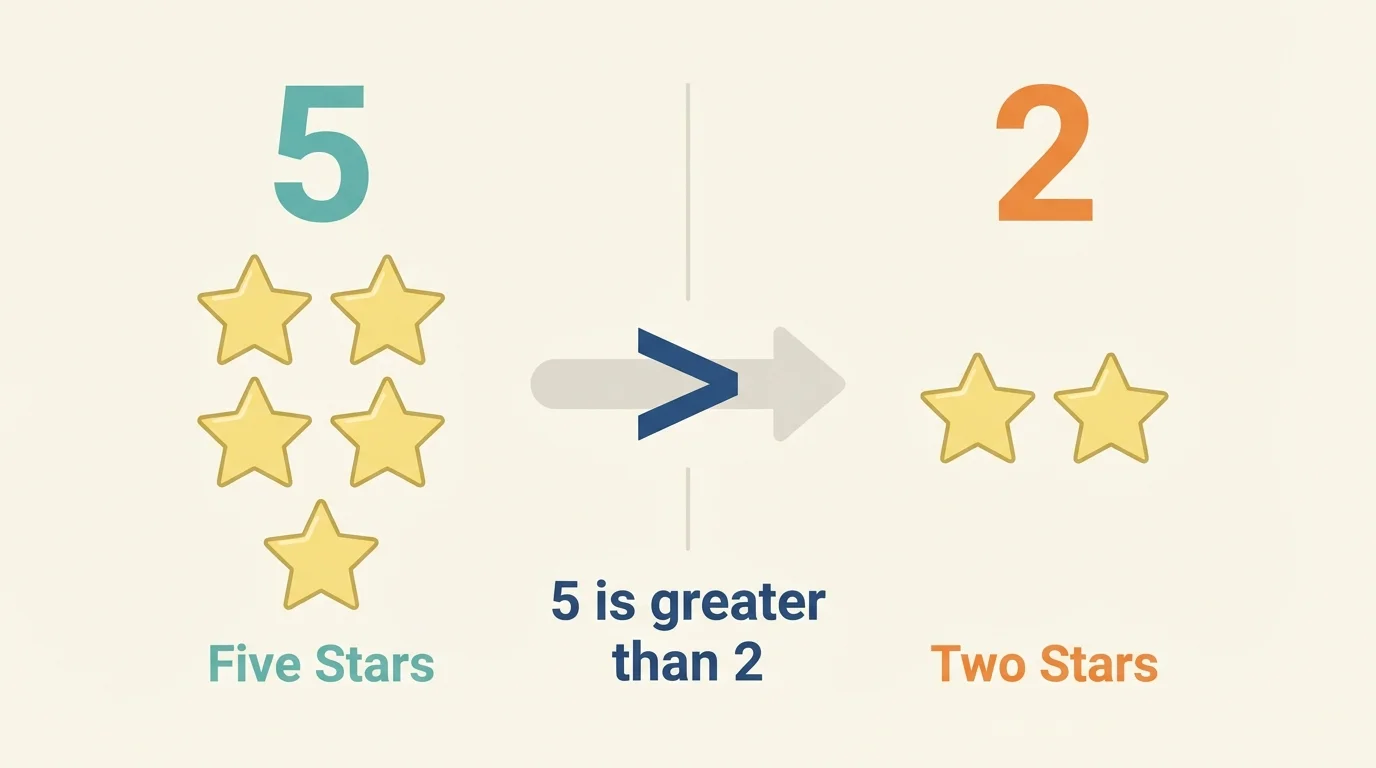
Sometimes it is easier to compare if we think about real groups. To compare means to look at two amounts and decide which has more, fewer, or the same number. Groups make that easy to see, as [Figure 2] illustrates.
If one group has \(2\) blocks and another group has \(5\) blocks, the group with \(5\) blocks has more. So \(5\) is greater than \(2\).
You can also match objects one by one. If every object in one group gets a partner and one group still has extras, that group is greater.
For example, compare \(7\) apples and \(7\) apples. Every apple in one group matches one apple in the other group. No extras are left, so \(7 = 7\).
Thinking about groups helps when a written numeral feels tricky. If you forget whether \(6\) or \(4\) is greater, picture \(6\) toys and \(4\) toys. The larger group tells you the larger number, just like the groups in [Figure 2].
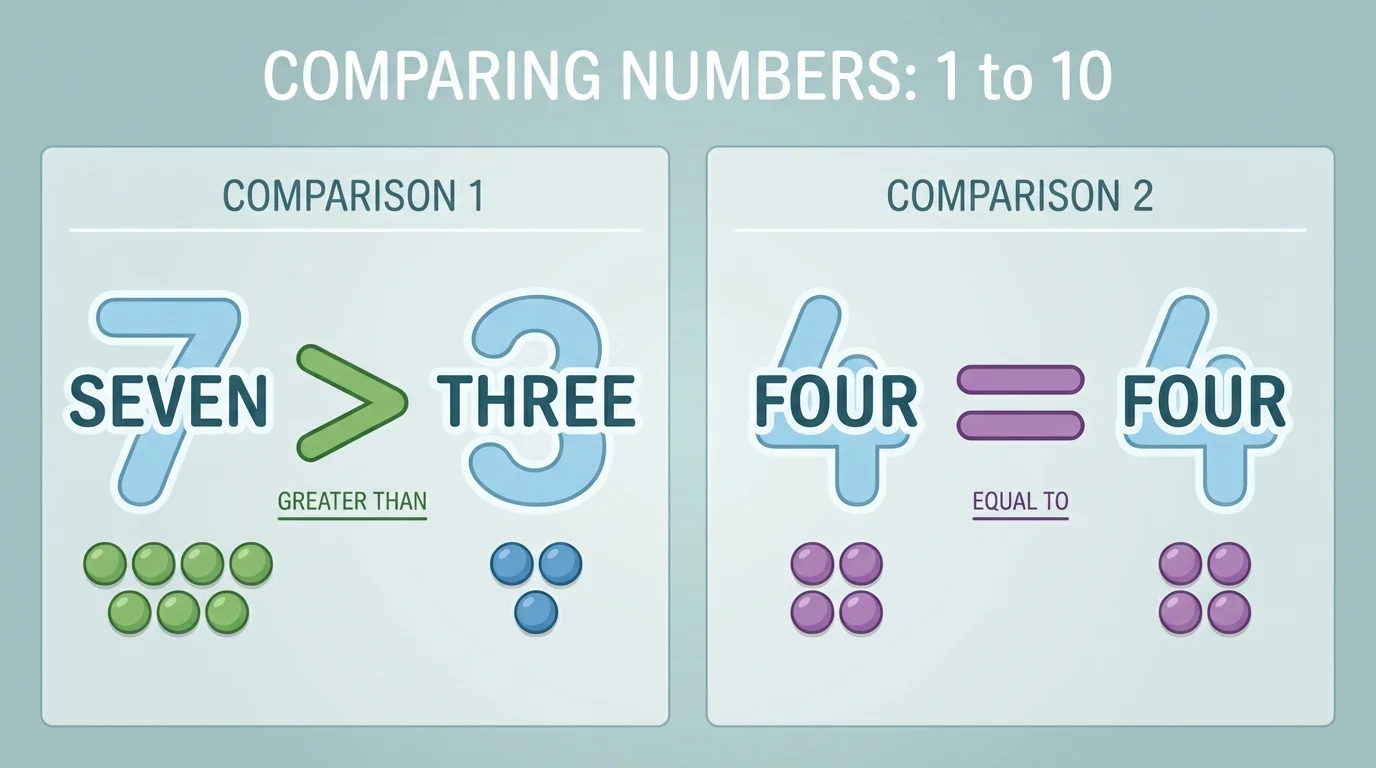
[Figure 3] helps show how we compare with words and with symbols. The symbol \(>\) means greater than, the symbol \(<\) means less than, and the symbol \(=\) means equal to.
Here are three examples:
\(8 > 3\) means \(8\) is greater than \(3\).
\(2 < 9\) means \(2\) is less than \(9\).
\(6 = 6\) means \(6\) is equal to \(6\).
A good way to check is to say the comparison aloud. If you read \(5 < 8\), say, "\(5\) is less than \(8\)." If that sounds true, your comparison is correct.
Later, when you compare more numbers, this idea stays the same. These symbols help you read and write number comparisons clearly.
Let's solve some number comparisons step by step.
Example 1
Compare \(3\) and \(7\).
Step 1: Look at counting order.
We count \(1, 2, 3, 4, 5, 6, 7\). The number \(3\) comes before \(7\).
Step 2: Decide which number is less.
Because \(3\) comes before \(7\), \(3\) is less than \(7\).
Step 3: Write the comparison.
\(3 < 7\)
The correct comparison is \(3 < 7\).
This example shows that the earlier number in counting order is the smaller number.
Example 2
Compare \(9\) and \(4\).
Step 1: Look at counting order.
The number \(9\) comes after \(4\).
Step 2: Decide which number is greater.
Because \(9\) comes after \(4\), \(9\) is greater than \(4\).
Step 3: Write the comparison.
\(9 > 4\)
The correct comparison is \(9 > 4\).
When one number comes later in counting, it is the greater number.
Example 3
Compare \(6\) and \(6\).
Step 1: Check both numbers.
The first number is \(6\). The second number is also \(6\).
Step 2: Decide if they are the same.
Because both numbers are \(6\), they are equal.
Step 3: Write the comparison.
\(6 = 6\)
The correct comparison is \(6 = 6\).
Equal numbers are not greater and not less. They are the same amount.
Example 4
Compare \(10\) and \(1\).
Step 1: Think about counting.
We say \(1\) first and \(10\) later.
Step 2: Find the greater number.
Since \(10\) comes after \(1\), \(10\) is greater.
Step 3: Write the comparison.
\(10 > 1\)
The correct comparison is \(10 > 1\).
Comparing numbers is something children do all the time. If one child has \(8\) crayons and another child has \(5\) crayons, then \(8 > 5\). If one shelf has \(2\) books and another has \(2\) books, then \(2 = 2\).
Games often use comparing numbers. If one player scores \(7\) points and another scores \(9\) points, the player with \(9\) points is ahead because \(9\) is greater than \(7\).
We also compare steps, toys, stickers, cups, and snacks. If you have \(4\) crackers and your friend has \(6\), then your friend has more because \(6 > 4\). If both of you have \(5\), then the amounts are equal.
Comparing numbers helps us answer simple questions: Who has more? Who has fewer? Are the amounts the same? These are number questions, and written numerals help us show the answer clearly.
