What happens if \(3\) toy cars are on the rug and \(2\) more zoom over to join them? You can find out with math. Little stories about toys, snacks, pets, and games often hide addition and subtraction. When we listen carefully, we can tell whether things are coming together or being taken away.
Addition means putting together or adding to. If you have \(2\) blocks and get \(3\) more blocks, you put them together. That makes \(5\) blocks. We can write that as \(2 + 3 = 5\).
Subtraction means taking apart or taking from. If you have \(5\) crackers and eat \(2\), some are gone. That leaves \(3\). We can write that as \(5 - 2 = 3\).
Addition means joining groups or getting more. Subtraction means taking away or finding how many are left. A word problem is a little story with math in it.
Sometimes the answer gets bigger, and sometimes the answer gets smaller. If things are joining, we often add. If things are leaving, we often subtract.
You do not have to solve a story problem only in your head. You can use toys, counters, fingers, or a drawing to help. A picture makes the story easier to see, as [Figure 1] shows with groups joining and objects being crossed out.
For addition, you can draw one group, then draw the new group, and count all of them. For subtraction, you can draw the whole group first, then cross out the ones that go away, and count what is left.
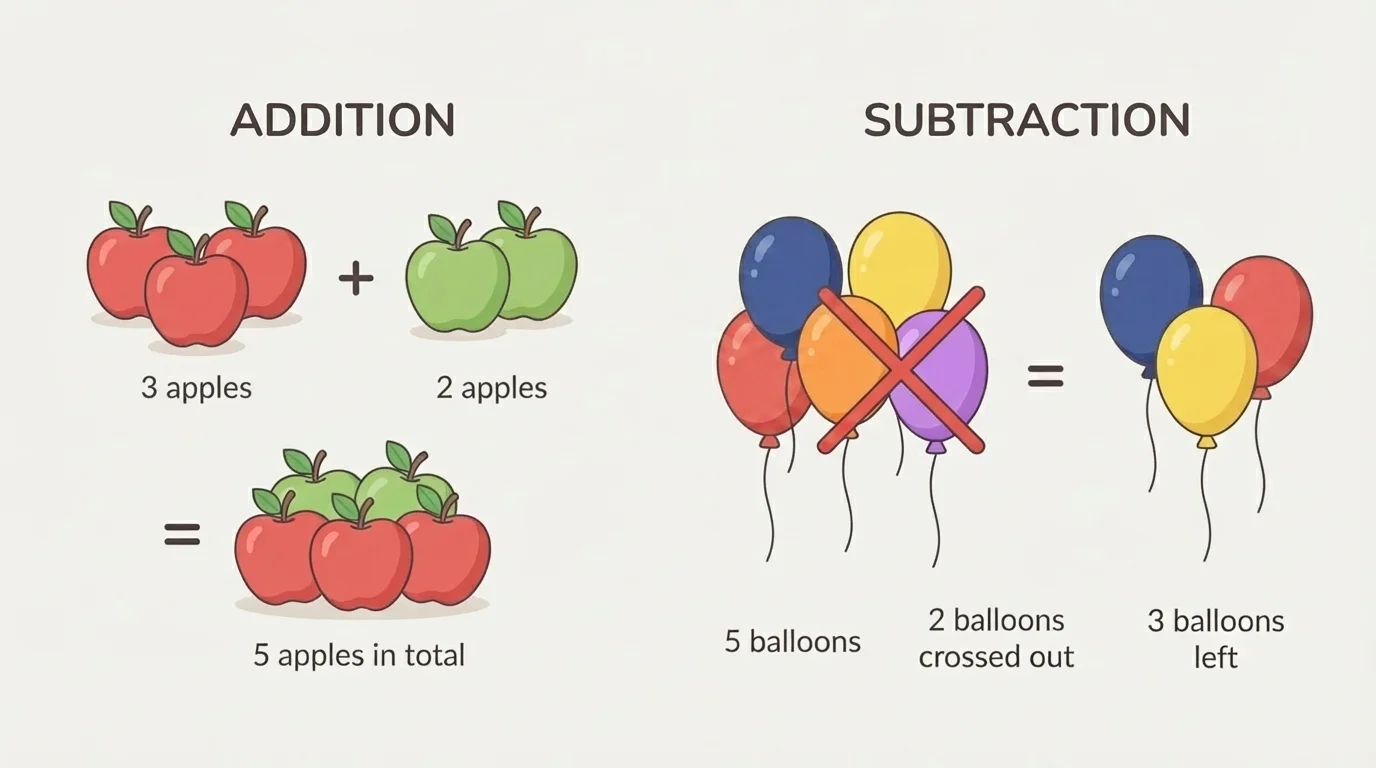
A object can be anything you count, such as cubes, buttons, or bears. A picture can be circles, stars, or quick little marks. The picture does not have to be fancy. It only has to help you count.
You already know how to count from \(0\) to \(10\). That counting helps you solve stories like \(1 + 2\), \(6 - 1\), or \(4 + 4\).
When you solve, it helps to ask: Are things joining together, or are things going away? That question helps you choose addition or subtraction.
Sometimes two groups are both already there. Then we put them together to find how many there are in all.
Example 1
There are \(3\) red flowers and \(2\) yellow flowers. How many flowers are there in all?
Step 1: Find the two groups.
The groups are \(3\) red flowers and \(2\) yellow flowers.
Step 2: Put the groups together.
We add: \(3 + 2\).
Step 3: Count all.
\(3 + 2 = 5\).
The answer is \(5\) flowers.
You could draw \(3\) circles, then \(2\) more circles, and count all \(5\). This is addition because the two groups are being joined.
Sometimes a story starts with one group, and then more come later. That is another kind of addition, as [Figure 2] shows in a pond story where more ducks arrive.
Listen for words like more, came, or joined. These words often tell you to add.
Example 2
There are \(4\) ducks in a pond. Then \(3\) more ducks come. How many ducks are in the pond now?
Step 1: Start with the first group.
First there are \(4\) ducks.
Step 2: Add the new ducks.
\(3\) more ducks come, so we add \(4 + 3\).
Step 3: Find the total.
\(4 + 3 = 7\).
The answer is \(7\) ducks.
You can draw \(4\) ducks, then draw \(3\) more. Count all the ducks to check your answer.
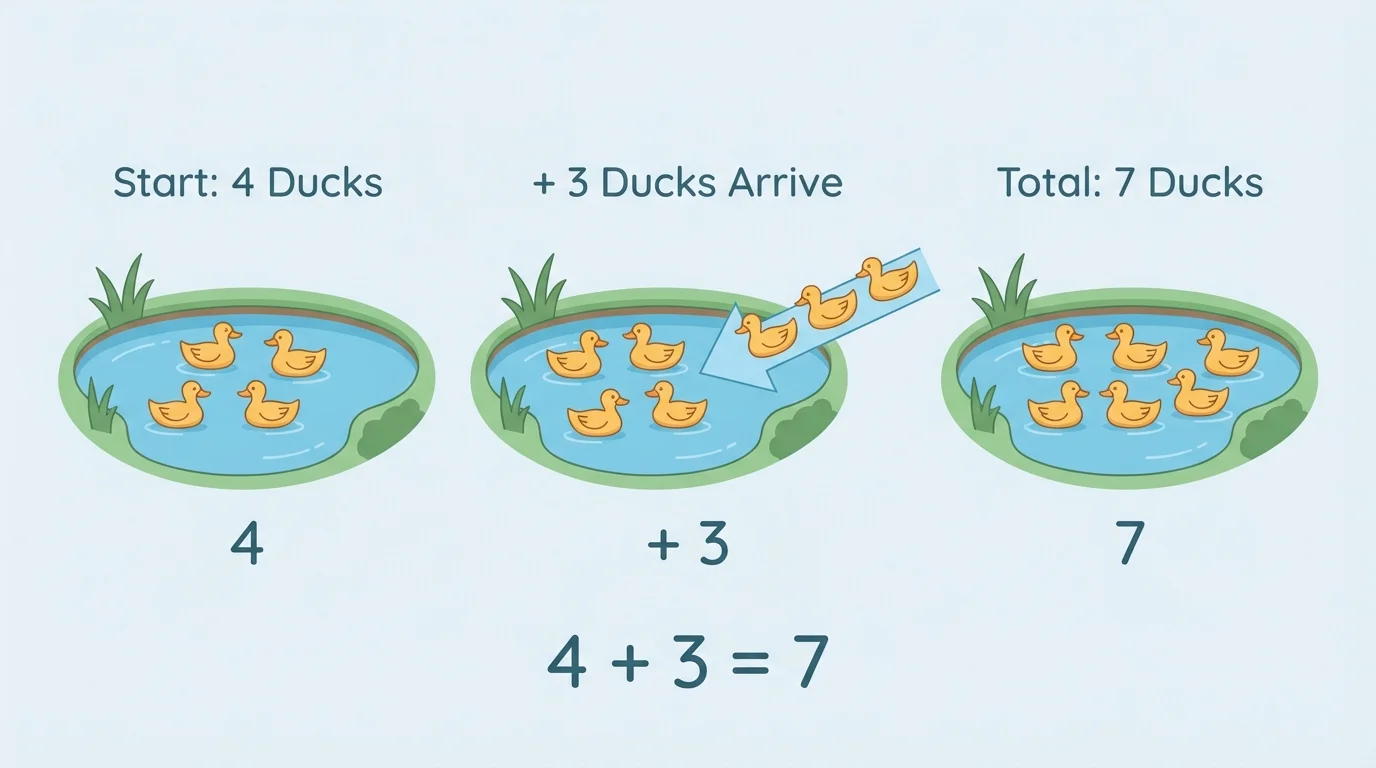
Many real stories happen in steps: first some are there, and then more are added. The total grows bigger.
Subtraction happens when something is taken away, as [Figure 3] illustrates with cookies being removed from a plate. The starting group gets smaller.
Words like left, gave away, took, or ate can mean subtraction.
Example 3
There are \(8\) cookies on a plate. \(3\) cookies are eaten. How many cookies are left?
Step 1: Find the starting number.
Start with \(8\) cookies.
Step 2: Take away the number that is gone.
\(3\) cookies are eaten, so we subtract: \(8 - 3\).
Step 3: Find what is left.
\(8 - 3 = 5\).
The answer is \(5\) cookies.
You can draw \(8\) cookies and cross out \(3\). Then count the cookies that are not crossed out. There are \(5\) left.
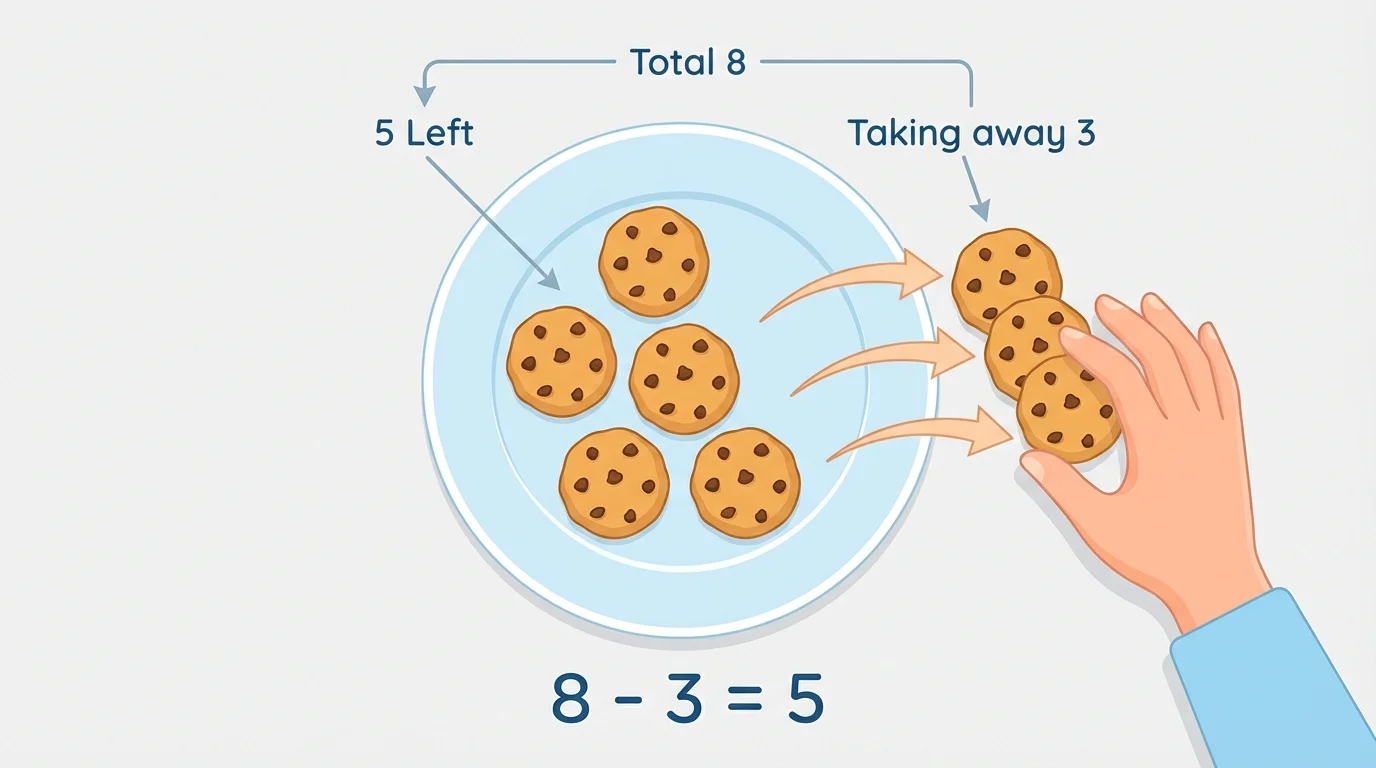
The cookie picture helps us see subtraction clearly: begin with the whole group, take some away, and count what remains.
Subtraction can also mean taking a group apart. You may have one whole group and need to find how many are left after part of it is gone.
Example 4
A child has \(6\) balloons. \(2\) balloons fly away. How many balloons are left?
Step 1: Start with the whole group.
The whole group is \(6\) balloons.
Step 2: Take away the part that flew away.
\(2\) balloons are gone, so we subtract: \(6 - 2\).
Step 3: Count the balloons left.
\(6 - 2 = 4\).
The answer is \(4\) balloons.
If you draw \(6\) balloons and cross out \(2\), you can count \(4\) left. The picture matches the story.
Some words in a story can help you choose the operation. These words are clues, but you should still think about what is happening in the story.
| Story clue | What it often means | Example |
|---|---|---|
| in all | addition | \(2\) cats and \(3\) cats are \(5\) cats in all |
| more | addition | \(4\) birds and \(1\) more bird make \(5\) |
| joined | addition | \(3\) kids joined \(2\) kids to make \(5\) |
| left | subtraction | \(7\) apples take away \(2\) apples, leaving \(5\) |
| took away | subtraction | \(6\) blocks take away \(1\) block, leaving \(5\) |
| gave away | subtraction | \(9\) stickers give away \(4\) stickers, leaving \(5\) |
Table 1. Common word-problem clues for choosing addition or subtraction.
Sometimes a story does not use these exact words. That is why it is important to think about the action. Are things joining together? Are some things going away? The action tells the math.
Matching the story to the number sentence
A number sentence is a math sentence such as \(5 + 2 = 7\) or \(9 - 4 = 5\). The numbers must match the story. If \(2\) fish join \(5\) fish, the story matches \(5 + 2 = 7\). If \(4\) toys are taken from \(9\) toys, the story matches \(9 - 4 = 5\).
When the story and the number sentence match, the math makes sense. Drawings and objects help you check that match.
You use addition and subtraction every day. At snack time, if you have \(2\) crackers and get \(2\) more, you have \(4\). On the playground, if \(7\) children are playing tag and \(1\) goes to swing, then \(6\) are still playing tag.
In the classroom, you might count pencils, cubes, or books. At home, you might count socks, cars, or pieces of fruit. These little stories are real word problems because they tell about things happening in the world.
People all over the world learn addition and subtraction first with real things they can touch and see. Counting toys, snacks, and steps helps math feel true and useful.
When you use pictures, fingers, or objects, you are showing your thinking. That is powerful math work. Even small numbers like \(1\), \(2\), and \(3\) can tell big stories.
