If you have \(5\) crackers, do they always have to stay in one pile? No. You can put them into two small groups in different ways. That is what mathematicians do when they break a number into parts. A number like \(5\) can be made from \(2\) and \(3\), or from \(4\) and \(1\), and both ways are true.
To decompose a number means to take one whole number and split it into parts. One whole can have different pairs of parts. When we put the parts together again, they make the whole number.
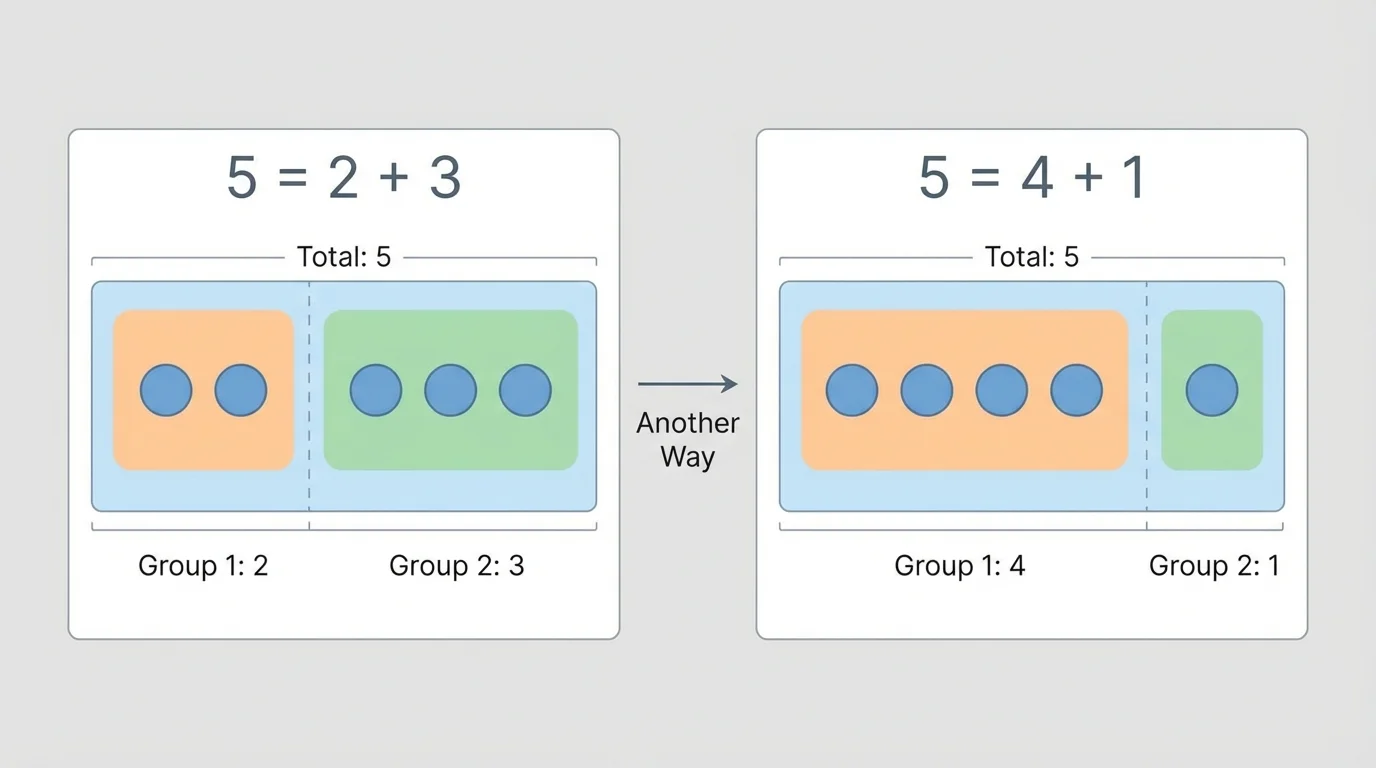
[Figure 1] shows that if the whole number is \(5\), one pair can be \(2\) and \(3\). Another pair can be \(1\) and \(4\). We can even use \(0\) as a part, because \(0\) means no objects. So \(5\) can also be \(0\) and \(5\).
Whole means the total number. Parts are the smaller groups that make the whole. A pair is two numbers that go together to make the whole.
When we take apart numbers, we are learning how addition works. The two parts are added together to make the whole. If we know the whole and one part, we can think about the other part too.
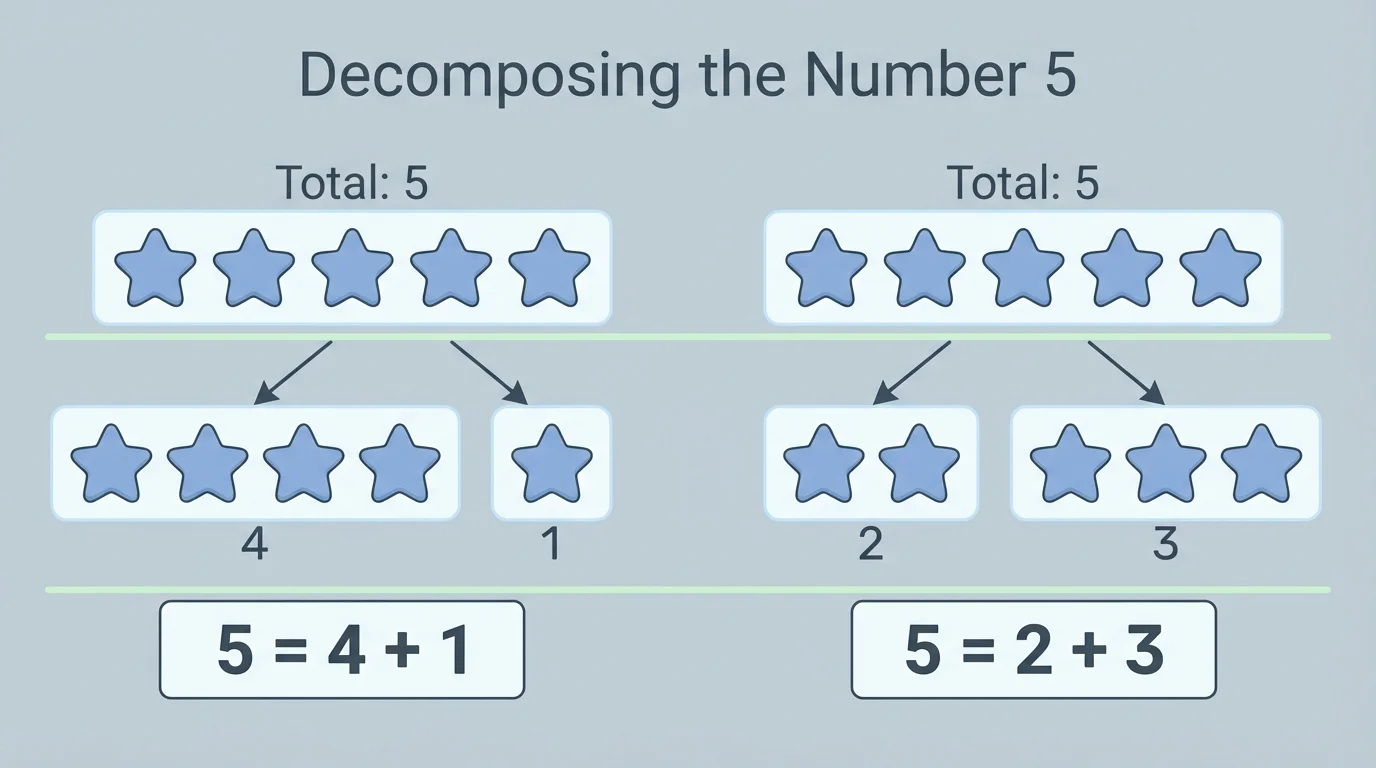
[Figure 2] We can show a number pair with counters, fingers, dots, or little drawings. We can also write what we see with an equation. The picture and the equation show the same mathematical idea.
This illustrates that if we draw \(5\) stars, we can circle \(4\) stars in one group and \(1\) star in another group. Then we write the equation \(5 = 4 + 1\). If we circle them a different way, maybe \(2\) stars and \(3\) stars, we write \(5 = 2 + 3\).
An equation uses numbers and a symbol to show that two amounts are the same. In this lesson, the equal sign tells us that the whole number is the same as the two parts added together.
The order of the parts can change too. For example, \(5 = 2 + 3\) and \(5 = 3 + 2\) both make \(5\). The total stays the same even when the parts switch places.
The number \(0\) can be part of a number pair. For example, \(6 = 0 + 6\). That still makes the whole number \(6\).
This is like sharing toys into two baskets. One basket might have more, and one might have less, but together they still make the same total number of toys.
Let's look at some numbers and break them into pairs in more than one way. We can use drawings in our minds and then write equations to match.
Worked example 1
Show different pairs for \(4\).
Step 1: Start with all \(4\) in one group and none in the other group.
\(4 = 0 + 4\)
Step 2: Move \(1\) object to the other group.
\(4 = 1 + 3\)
Step 3: Move one more object.
\(4 = 2 + 2\)
More true pairs are \(4 = 3 + 1\) and \(4 = 4 + 0\).
Notice that \(4 = 2 + 2\) is an equal pair because both parts are the same.
Worked example 2
Show two different ways to make \(5\).
Step 1: Pick one split of the whole number.
Suppose we make one group of \(2\) and one group of \(3\).
\(5 = 2 + 3\)
Step 2: Pick another split.
Now make one group of \(4\) and one group of \(1\).
\(5 = 4 + 1\)
Both equations are correct because both pairs make the whole number \(5\).
These pairs are like taking apart a set of \(5\) blocks and putting them into two cups.
Worked example 3
Find several pairs for \(7\).
Step 1: Start with no objects in the first group.
\(7 = 0 + 7\)
Step 2: Move one object at a time.
\(7 = 1 + 6\)
\(7 = 2 + 5\)
\(7 = 3 + 4\)
Step 3: Keep going if you switch the order.
\(7 = 4 + 3\)
\(7 = 5 + 2\)
\(7 = 6 + 1\)
\(7 = 7 + 0\)
All of these are number pairs for \(7\).
[Figure 3] Sometimes we want to find every pair for a number in a neat order. A helpful way is to start with \(0\) and the whole number, then change one part by \(1\) each time.
This shows the pairs for the number \(6\) in order: \(6 = 0 + 6\), \(6 = 1 + 5\), \(6 = 2 + 4\), \(6 = 3 + 3\), \(6 = 4 + 2\), \(6 = 5 + 1\), and \(6 = 6 + 0\).
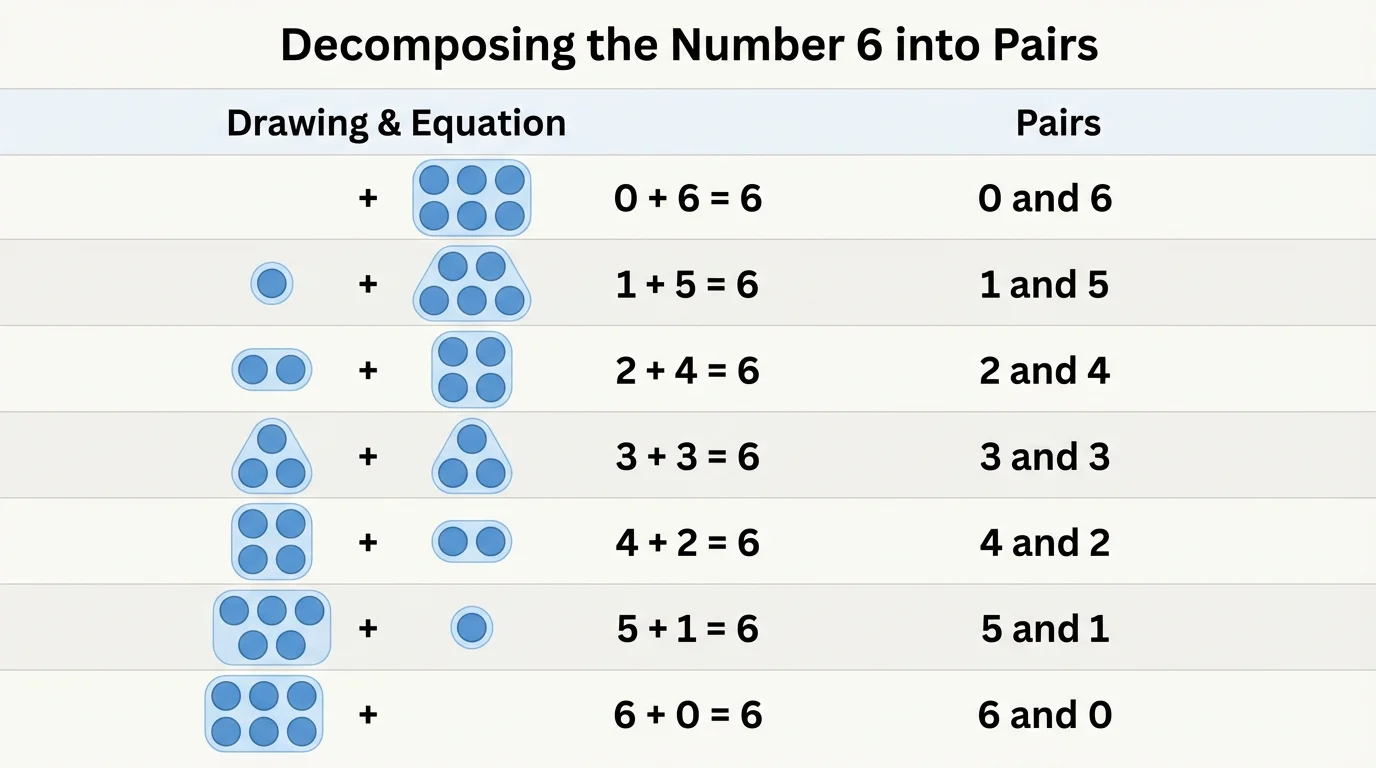
This ordered way helps us not miss any pairs. It also helps us see patterns. The first part gets bigger by \(1\), and the second part gets smaller by \(1\).
We can do this for any whole number up to \(10\). For \(3\), the pairs are \(3 = 0 + 3\), \(3 = 1 + 2\), \(3 = 2 + 1\), and \(3 = 3 + 0\). For \(10\), there are many pairs, from \(10 = 0 + 10\) all the way to \(10 = 10 + 0\).
| Whole Number | Some Number Pairs |
|---|---|
| \(3\) | \(0 + 3\), \(1 + 2\) |
| \(5\) | \(0 + 5\), \(1 + 4\), \(2 + 3\) |
| \(8\) | \(0 + 8\), \(1 + 7\), \(2 + 6\), \(3 + 5\), \(4 + 4\) |
Table 1. Examples of whole numbers and some pairs that make each whole.
Number pairs are everywhere. If there are \(6\) children on the playground, maybe \(2\) are on the slide and \(4\) are on the swings. That makes \(6 = 2 + 4\). If there are \(9\) crayons, maybe \(5\) are red and \(4\) are blue, so \(9 = 5 + 4\).
At snack time, \(8\) apple slices can be split between two plates. One plate might have \(3\), and the other plate might have \(5\). That means \(8 = 3 + 5\). If the slices are shared another way, the equation changes, but the whole number stays \(8\).
When we remember the organized list from [Figure 3], it becomes easier to find all the ways to split a number. When we remember the pictures from [Figure 1] and [Figure 2], we can connect the drawings to the equations we write.
You already know how to count objects and how to add small numbers together. Decomposing a number uses those same ideas: count the whole, split it into two groups, and write the matching addition equation.
Each time you take apart a number and write it in a new way, you are learning more about how numbers work. Small numbers up to \(10\) are full of patterns, and those patterns help with addition and subtraction later.
