What happens when \(2\) little ducks join \(3\) more ducks in a pond? You can find out with math. Numbers up to \(5\) are small, but they are very important. They help us count toys, snacks, buttons, and friends in line. When you can add and subtract within \(5\) quickly, your brain starts to notice number patterns everywhere.
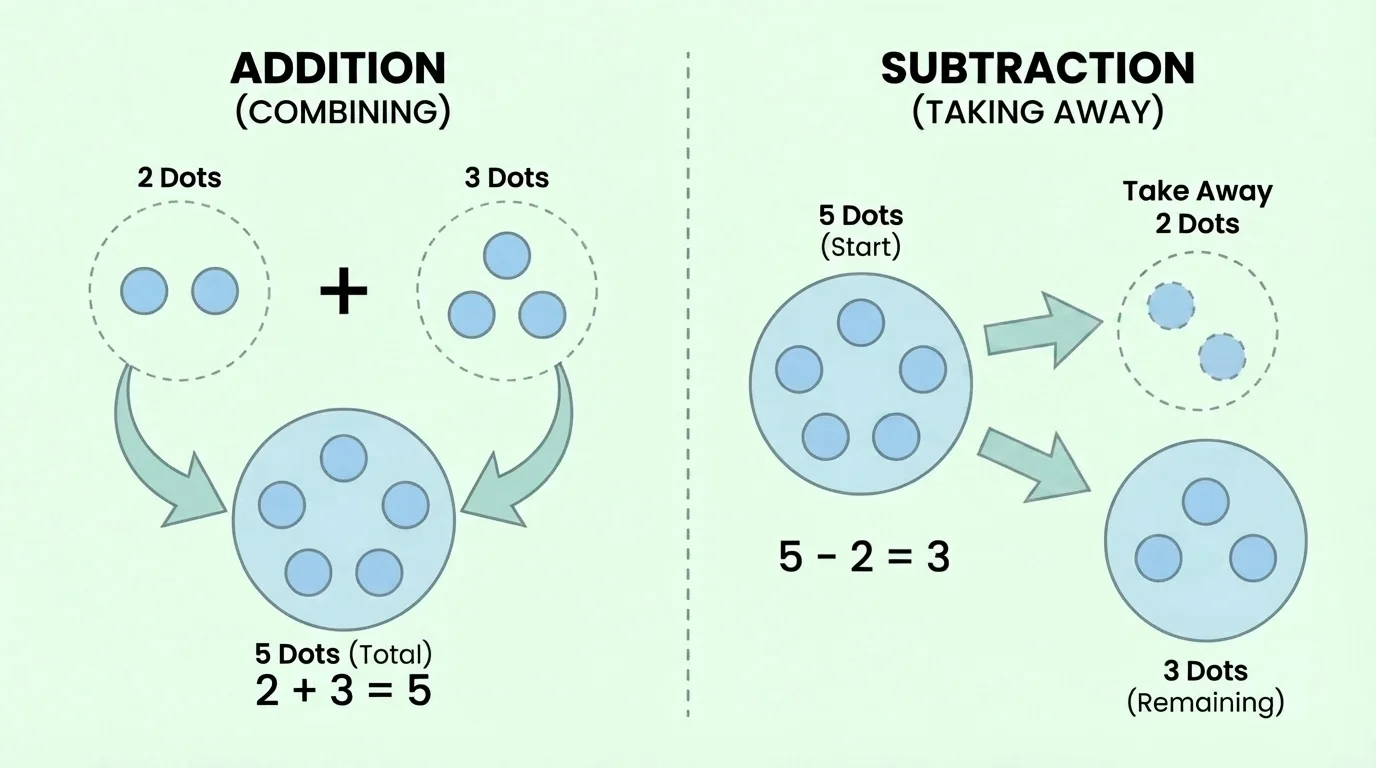
[Figure 1] Addition means putting groups together or adding more. Subtraction means taking some away or breaking a group apart. If you have \(2\) apples and get \(1\) more apple, you now have \(3\) apples. We write that as \(2 + 1 = 3\).
If you have \(4\) blocks and give \(1\) away, you have \(3\) blocks left. We write that as \(4 - 1 = 3\). Addition helps us find how many in all. Subtraction helps us find how many are left.
Addition is putting together or adding to.
Subtraction is taking apart or taking from.
An equation is a math sentence that shows two amounts are equal, such as \(2 + 1 = 3\).
We can use real things, pictures, or fingers to show these ideas. For example, draw \(3\) circles and then draw \(2\) more circles. Count all the circles: \(3 + 2 = 5\). Or start with \(5\) circles and cross out \(2\). Count what is left: \(5 - 2 = 3\).
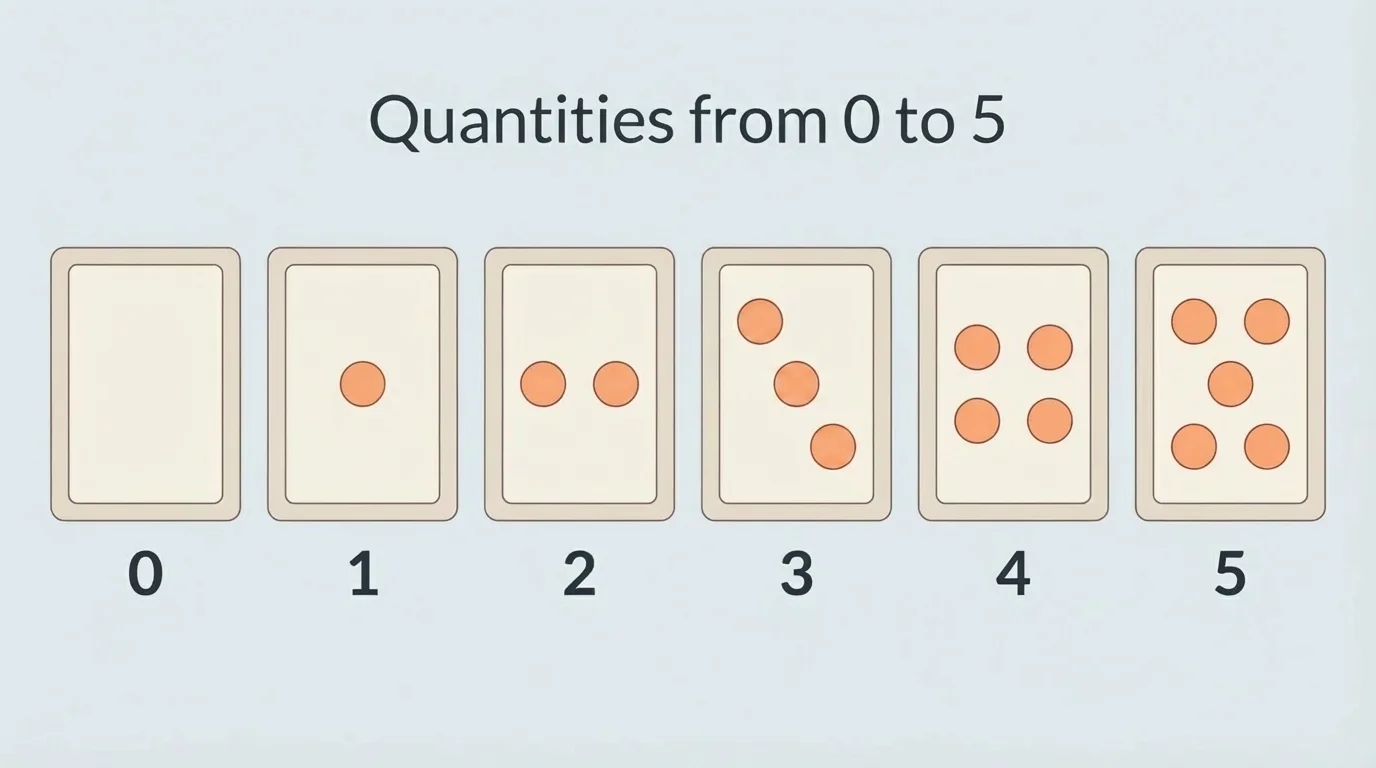
To work quickly, it helps to know what amounts from \(0\) to \(5\) look like. A five-frame helps you see small amounts fast, as shown in [Figure 2]. When you see \(5\), you know the frame is full. When you see \(4\), there is just one empty space.
The number \(0\) means none. The number \(5\) means five objects. Every number in between has its own amount: \(1\), \(2\), \(3\), and \(4\). If you know these amounts well, you can add and subtract more easily.
You can also use fingers. Hold up \(2\) fingers, then raise \(2\) more. Now you see \(4\). Put down \(1\) finger from \(4\), and you see \(3\). Fingers are helpful because they show numbers right away.
Count carefully from \(0\) to \(5\): \(0, 1, 2, 3, 4, 5\). The last number you say tells how many objects there are.
Small numbers have patterns. For example, \(5\) can be made with \(4\) and \(1\), or \(3\) and \(2\). These number pairs help addition and subtraction feel faster and easier.
When we add within \(5\), the total is never more than \(5\). We can start with one small number and join another small number. Then we count all.
Here are some addition facts:
| Addition sentence | Total |
|---|---|
| \(1 + 1 = 2\) | \(2\) |
| \(2 + 1 = 3\) | \(3\) |
| \(2 + 2 = 4\) | \(4\) |
| \(3 + 1 = 4\) | \(4\) |
| \(3 + 2 = 5\) | \(5\) |
| \(4 + 1 = 5\) | \(5\) |
Table 1. Examples of addition facts with totals within \(5\).
Solved example 1
Find \(1 + 3\).
Step 1: Start with \(1\).
Step 2: Add \(3\) more: \(2, 3, 4\).
Step 3: Count the total.
\(1 + 3 = 4\)
The answer is \(4\).
Sometimes you can see the answer without counting each object one by one. If you know that \(2\) and \(2\) make \(4\), you can answer quickly. That is what it means to become fluent: the math feels smooth and fast.
Solved example 2
Find \(2 + 2\).
Step 1: Think of two groups with \(2\) in each group.
Step 2: Put them together.
Step 3: Count all the objects.
\(2 + 2 = 4\)
The total is \(4\).
Another important fact is adding zero. If nothing is added, the number stays the same. For example, \(5 + 0 = 5\) and \(0 + 4 = 4\).
Solved example 3
Find \(4 + 1\).
Step 1: Start with \(4\).
Step 2: Add \(1\) more.
Step 3: Say the next number.
\(4 + 1 = 5\)
The answer is \(5\).
Subtraction within \(5\) means we begin with \(5\) or less and take some away. Then we find what is left. This is like taking crackers off a plate or moving toys out of a box.
Here are some subtraction facts:
| Subtraction sentence | Amount left |
|---|---|
| \(2 - 1 = 1\) | \(1\) |
| \(3 - 1 = 2\) | \(2\) |
| \(4 - 2 = 2\) | \(2\) |
| \(5 - 1 = 4\) | \(4\) |
| \(5 - 2 = 3\) | \(3\) |
| \(5 - 5 = 0\) | \(0\) |
Table 2. Examples of subtraction facts within \(5\).
Solved example 4
Find \(5 - 2\).
Step 1: Start with \(5\) objects.
Step 2: Take away \(2\) objects.
Step 3: Count what is left.
\(5 - 2 = 3\)
The answer is \(3\).
When you subtract, you can cover up objects, cross out pictures, or put down fingers. Those actions help your eyes and hands understand what the numbers mean.
Solved example 5
Find \(3 - 1\).
Step 1: Begin with \(3\).
Step 2: Take away \(1\).
Step 3: Count the amount left.
\(3 - 1 = 2\)
The answer is \(2\).
Subtracting zero is also important. If you take away nothing, the number stays the same. For example, \(4 - 0 = 4\).
Solved example 6
Find \(2 - 2\).
Step 1: Start with \(2\).
Step 2: Take away all \(2\).
Step 3: See that nothing is left.
\(2 - 2 = 0\)
The answer is \(0\).
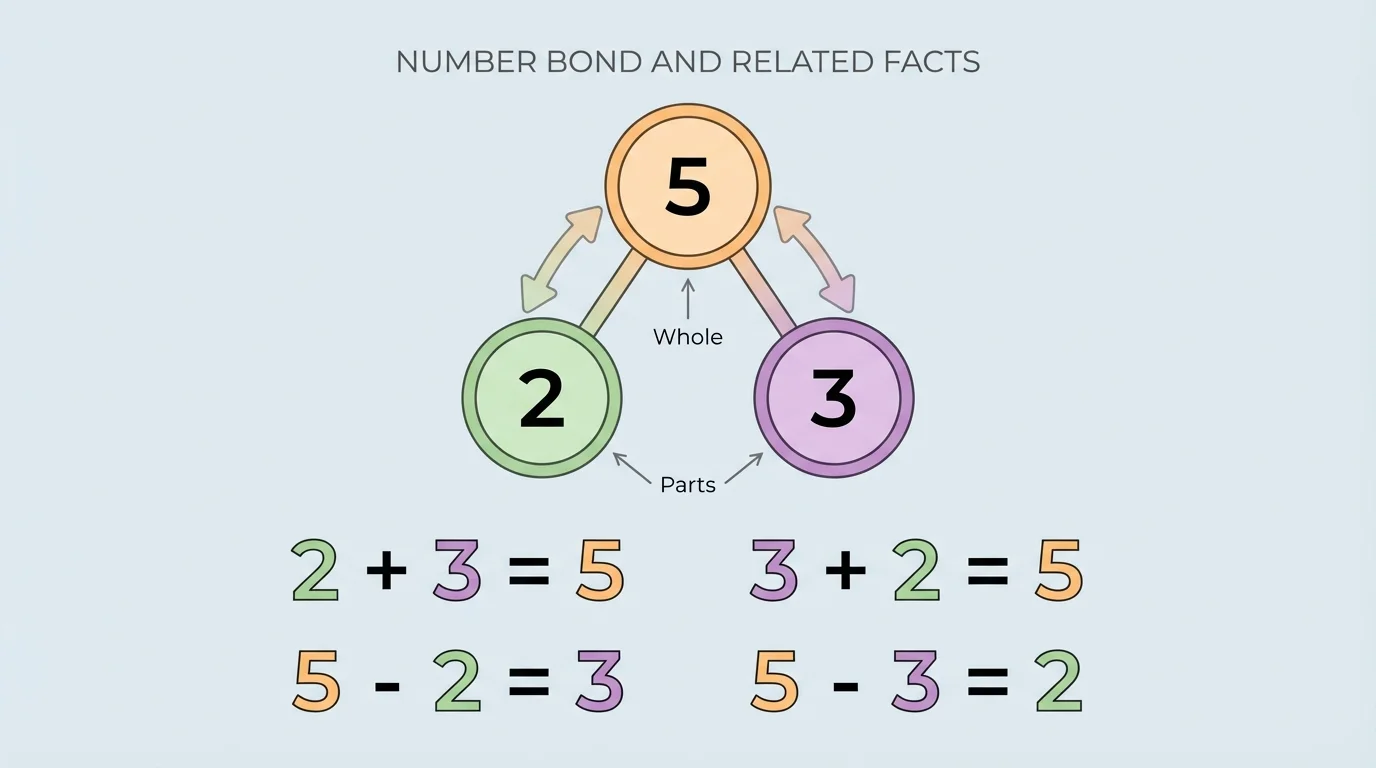
Some fact families use the same three numbers in different ways, as shown in [Figure 3]. If you know one fact, you can often use it to figure out another fact. For example, \(2 + 3 = 5\) and \(3 + 2 = 5\). The addends changed places, but the total stayed the same.
The numbers \(2\), \(3\), and \(5\) make a fact family:
\(2 + 3 = 5\)
\(3 + 2 = 5\)
\(5 - 2 = 3\)
\(5 - 3 = 2\)
This shows that addition and subtraction are connected. If parts make a whole, then the whole can be split back into parts. We saw earlier in [Figure 1] that adding puts together and subtracting takes apart. Fact families use both ideas with the same numbers.
How related facts help
If you know that \(4 + 1 = 5\), then you also know that \(1 + 4 = 5\), \(5 - 4 = 1\), and \(5 - 1 = 4\). Related facts help your brain work faster because one fact reminds you of another.
Turnaround facts are only for addition. For subtraction, order matters. \(5 - 2 = 3\), but \(2 - 5\) is not a subtraction fact within this lesson.
Addition and subtraction within \(5\) happen all day. If \(2\) children are on the rug and \(2\) more come, then \(2 + 2 = 4\). If you have \(5\) grapes and eat \(1\), then \(5 - 1 = 4\).
At cleanup time, a shelf might have \(3\) toy cars. If \(2\) more cars are put away, then there are \(5\) cars on the shelf. At snack time, if there are \(4\) crackers and \(4 - 3 = 1\), then only \(1\) cracker is left.
Your brain gets stronger at small math facts each time you notice number patterns. Quick facts within \(5\) help with bigger math later, because larger numbers are often built from small ones.
When you use drawings, fingers, counters, and number facts together, you understand math in more than one way. That makes your thinking strong, careful, and flexible.
