If you count crayons, toy cars, or snack crackers, something exciting happens after \(10\). The numbers \(11\) to \(19\) are not just bigger numbers. They all share the same key idea: each one has one group of \(10\) and then some more ones.
When we count to \(10\), we have ten ones. When we count one more, we get \(11\). That means \(11\) is ten ones and one more one. Then \(12\) is ten ones and two more ones. This keeps going all the way to \(19\).
Teen numbers can sound a little tricky when we say them, but we can understand them by looking at how they are built. We can compose a number by putting parts together, and we can decompose a number by breaking it into parts.
Compose means to put parts together to make a number. Decompose means to break a number into parts. Ones are single objects. A ten is a group of \(10\) ones.
For the teen numbers, the most important part is that they all have exactly one ten. After that, they have extra ones.
Every teen number has the same start. As [Figure 1] shows, we can look at a teen number as one full group of \(10\) and some extra ones. For example, \(14\) means one ten and four ones.
We can write that idea like this:
\(11 = 10 + 1\)
\(12 = 10 + 2\)
\(13 = 10 + 3\)
\(14 = 10 + 4\)
We can keep going:
\(15 = 10 + 5\)
\(16 = 10 + 6\)
\(17 = 10 + 7\)
\(18 = 10 + 8\)
\(19 = 10 + 9\)
Each equation tells the same story: one ten, then some ones.
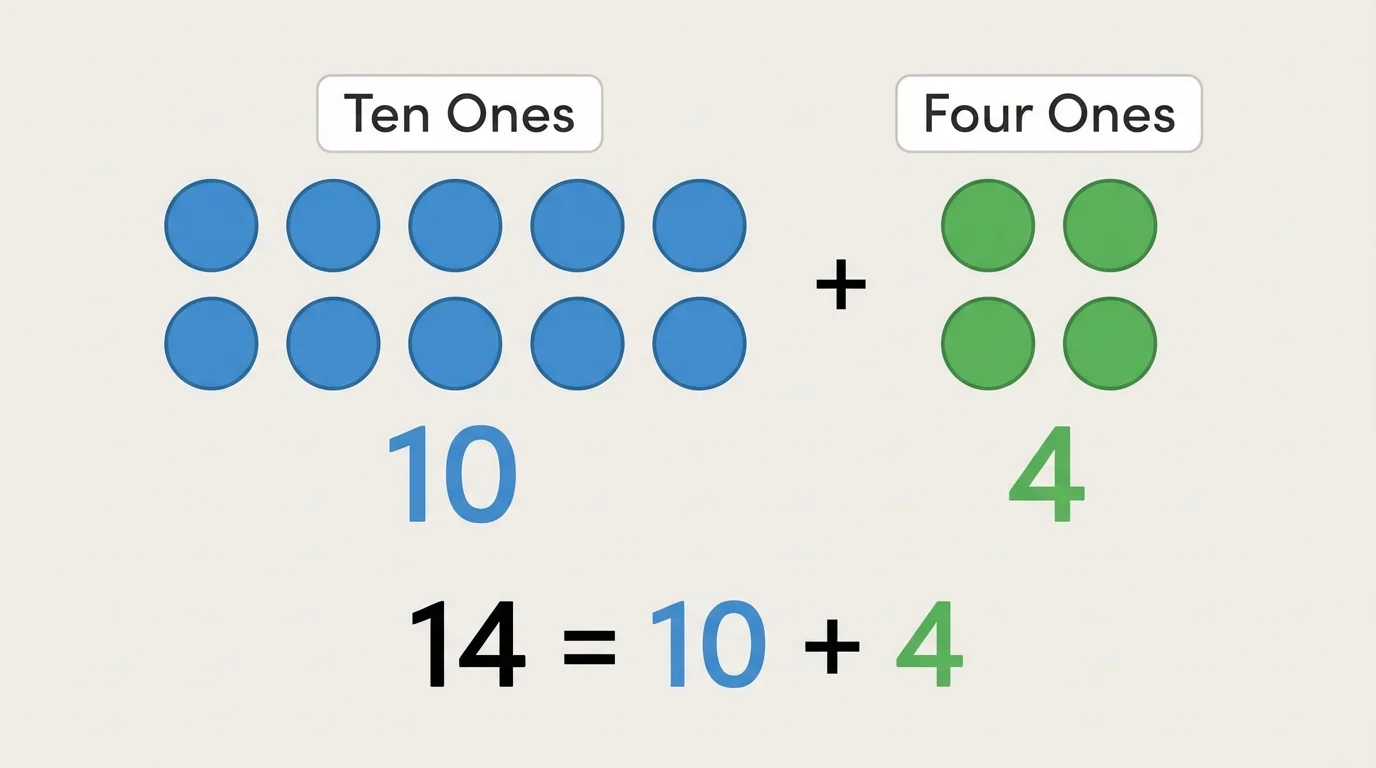
Look closely at the extra part. In \(14\), the extra part is \(4\). In \(18\), the extra part is \(8\). The ten stays the same, but the ones change.
Drawings help us see numbers clearly. As [Figure 2] illustrates, we can draw one group for \(10\) and then draw single ones next to it. This makes teen numbers easier to understand.
You might draw \(10\) dots in a line and then add \(6\) more dots to show \(16\). Or you might draw one bundle of \(10\) sticks and \(3\) single sticks to show \(13\).
Here are some picture ideas written as number stories:
One bundle of \(10\) and \(2\) cubes means \(12\).
One group of \(10\) stars and \(7\) more stars means \(17\).
One row of \(10\) counters and \(9\) more counters means \(19\).
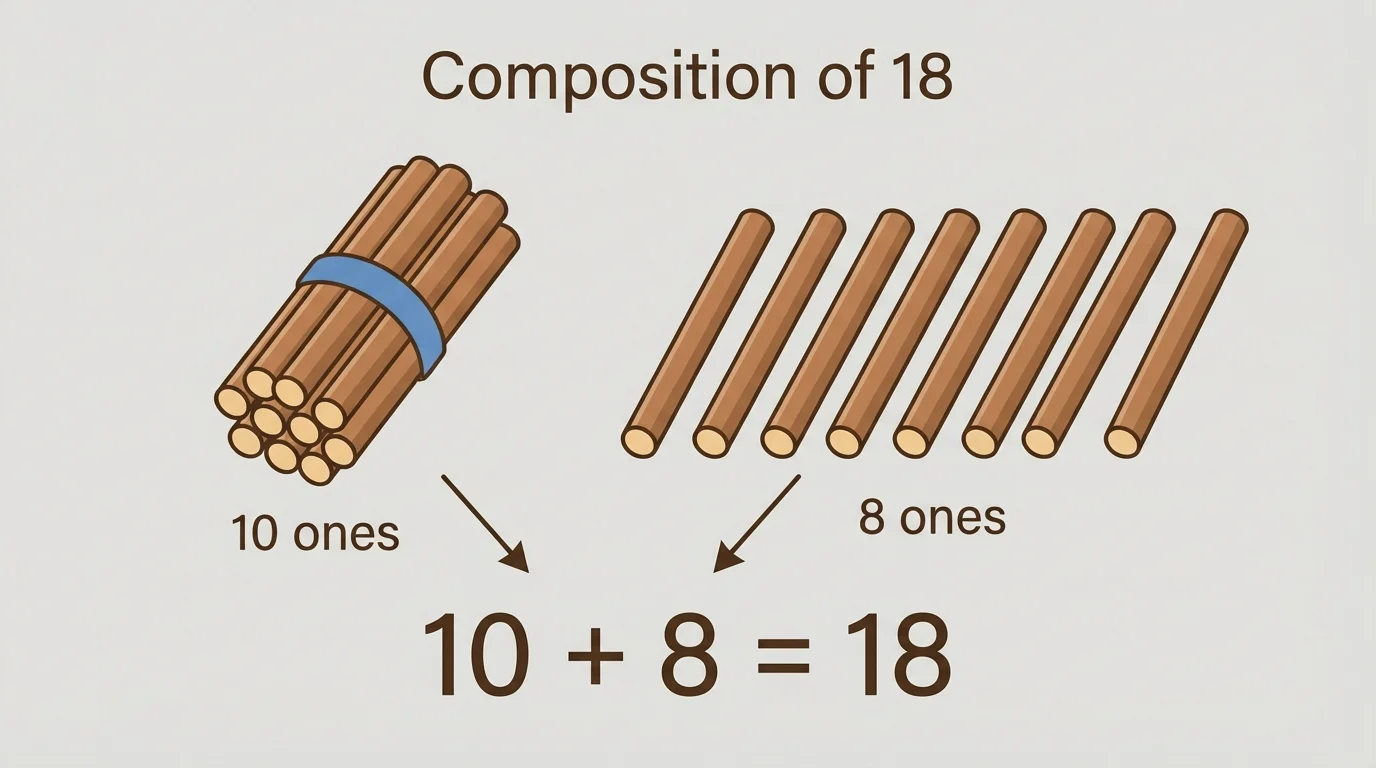
When we draw a teen number, we do not need fancy pictures. We only need to show the big group of \(10\) and the extra ones. That is enough to tell what the number is.
You already know how to count objects and how to make a group of \(10\). Teen numbers use that same idea again: first a full group of \(10\), then more ones.
This is why a number like \(18\) is not just a number we say while counting. It is one ten and eight ones, the same way we saw with drawings in [Figure 2].
A drawing and an equation can match. If you see one ten and five ones, you can write:
\(15 = 10 + 5\)
If you see one ten and nine ones, you can write:
\(19 = 10 + 9\)
We can also read equations the other way. When we see \(10 + 4\), we know the number is \(14\).
These equations help us say the number, show the number, and understand the number.
The teen-number idea is that the first part is always \(10\), and the second part tells how many extra ones there are. So in \(17 = 10 + 7\), the \(10\) means one full ten, and the \(7\) means seven more ones.
This is an important foundation for place value. Place value means a digit tells how many tens or ones there are. In teen numbers, we are learning to see the ten and the ones.
To compose a teen number, we put one ten together with some ones. To decompose a teen number, we break it into \(10\) and some ones.
For example, to compose \(16\), we put together \(10\) and \(6\):
\(10 + 6 = 16\)
To decompose \(16\), we break it apart:
\(16 = 10 + 6\)
Both equations tell the same idea. One shows putting together. One shows breaking apart.
Here are more examples:
\(10 + 1 = 11\)
\(13 = 10 + 3\)
\(10 + 8 = 18\)
\(19 = 10 + 9\)
Let's look at some teen numbers step by step.
Worked example 1
Show \(12\) as one ten and some ones.
Step 1: Find the ten.
The number \(12\) has one group of \(10\).
Step 2: Find the extra ones.
After the \(10\), there are \(2\) more ones.
Step 3: Write the equation.
\(12 = 10 + 2\)
So \(12\) is one ten and two ones.
Now try to notice the same structure in every teen number: one ten, then more ones.
Worked example 2
A child draws one bundle of \(10\) straws and \(7\) single straws. What number is shown?
Step 1: Count the bundle.
One bundle means \(10\).
Step 2: Count the single straws.
There are \(7\) ones.
Step 3: Put the parts together.
\(10 + 7 = 17\)
The drawing shows \(17\).
When we see objects, we can represent them with a number sentence.
Worked example 3
Break apart \(18\).
Step 1: Find the ten.
The teen number has one ten, which is \(10\).
Step 2: Find how many ones are left.
In \(18\), there are \(8\) ones after the ten.
Step 3: Write the decomposition.
\(18 = 10 + 8\)
So \(18\) is one ten and eight ones.
We can use the same thinking for \(11\), \(15\), or \(19\). The ten stays the same, and the ones part changes.
The numbers \(11\) to \(19\) are special because they help us get ready for bigger numbers later, like \(25\), \(36\), and \(84\), where we also look for tens and ones.
Understanding teen numbers now makes larger numbers much easier later.
You use teen numbers every day. If you have \(14\) crayons, you can think of them as one group of \(10\) crayons and \(4\) more crayons. If there are \(19\) blocks on the floor, you can see them as \(10\) blocks and \(9\) more blocks.
At snack time, \(13\) crackers can be seen as \(10\) crackers and \(3\) crackers. When you count fingers and toes, you can even think about groups of \(10\) and extra ones.
This way of thinking helps us count neatly and understand what a number means, not just how to say it.
As [Figure 3] shows, the teen numbers follow a pattern. Every number from \(11\) to \(19\) has one ten. The only part that changes is the number of ones, which goes from \(1\) to \(9\).
Here is the pattern in a table:
| Number | One Ten | Extra Ones | Equation |
|---|---|---|---|
| \(11\) | \(10\) | \(1\) | \(11 = 10 + 1\) |
| \(12\) | \(10\) | \(2\) | \(12 = 10 + 2\) |
| \(13\) | \(10\) | \(3\) | \(13 = 10 + 3\) |
| \(14\) | \(10\) | \(4\) | \(14 = 10 + 4\) |
| \(15\) | \(10\) | \(5\) | \(15 = 10 + 5\) |
| \(16\) | \(10\) | \(6\) | \(16 = 10 + 6\) |
| \(17\) | \(10\) | \(7\) | \(17 = 10 + 7\) |
| \(18\) | \(10\) | \(8\) | \(18 = 10 + 8\) |
| \(19\) | \(10\) | \(9\) | \(19 = 10 + 9\) |
Table 1. Teen numbers shown as one ten and extra ones.
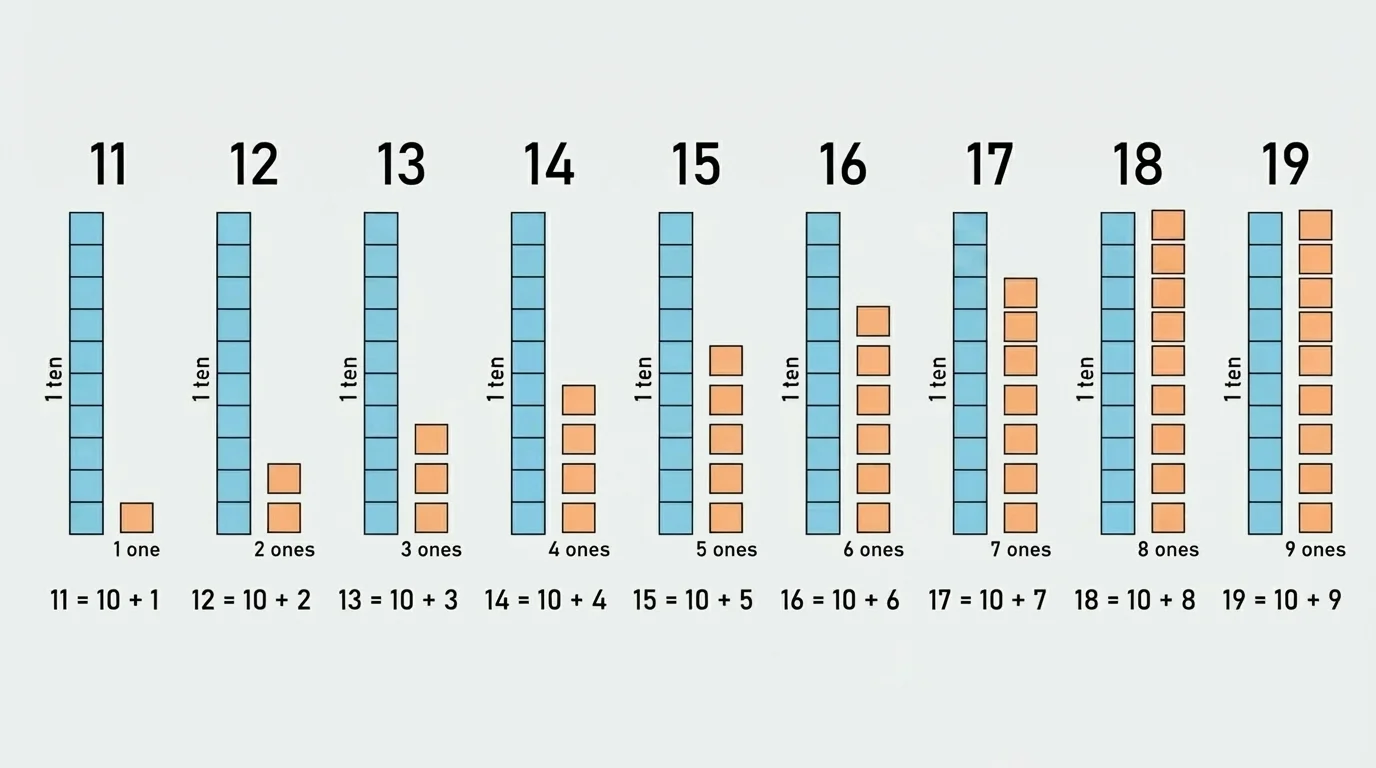
When you look back at [Figure 1] and [Figure 3], you can see the same big idea again and again: teen numbers are made from one ten and some ones.
