[Figure 1] Have you ever opened a toy box and seen cars, blocks, and balls all mixed together? It can look messy, but math helps us make sense of it. We can put things into groups, count each group, and see which group has the most or the least.
When we classify objects, we sort them into groups that belong together. We might group by color, shape, size, or kind. A category is the name of each group. For example, red buttons can be one category, blue buttons can be another category, and yellow buttons can be another category. Sorting by kind is easy to see with toys placed into matching groups.
If we have toy cars, toy blocks, and toy balls, we can make three categories: cars, blocks, and balls. Each object goes into the group where it belongs. One car goes with the cars. One block goes with the blocks. One ball goes with the balls.
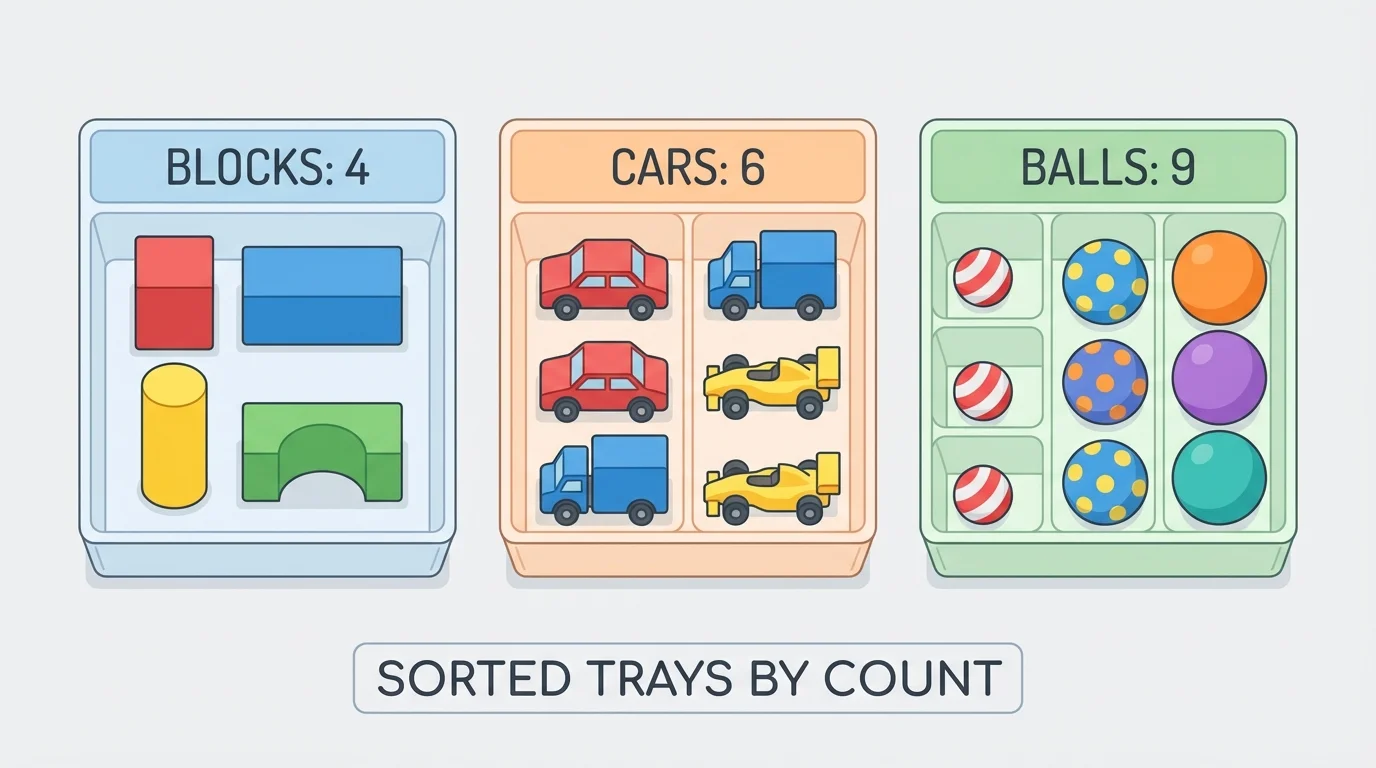
Classify means to put objects into groups that are alike. A category is one of those groups. Count means to say how many objects are in a group.
Sometimes we can classify the same objects in different ways. A set of buttons could be grouped by color, or the same buttons could be grouped by size. Both ways can be correct if we follow one rule at a time.
After we sort objects, we count how many are in each group. We count carefully, touching or pointing to each object one time. If a group has apples, we might count: \(1, 2, 3, 4\). Then we know there are \(4\) apples.
Each category gets its own number. If there are \(2\) balls, \(5\) blocks, and \(3\) cars, then each number tells how many are in that group. The number is called the count for that category.
One rule at a time
Good sorting uses one clear rule. If we sort by color, all the red objects stay together. If we sort by shape, all the circles stay together. Mixing rules can make counting confusing.
[Figure 2] We can also check our counting by counting again. If we count a group and get \(4\), then count again and get \(4\), we can feel more sure the count is correct.
When we know the count for each category, we can compare them. We can ask, "Which group has more?" or "Which group has fewer?" We can even put the categories in order. The fruit groups are arranged by how many are in each basket.
If one group has \(5\) objects and another group has \(2\) objects, then \(5 > 2\). The group with \(5\) has more. The group with \(2\) has fewer. If two groups both have \(3\) objects, then they have the same number because \(3 = 3\).
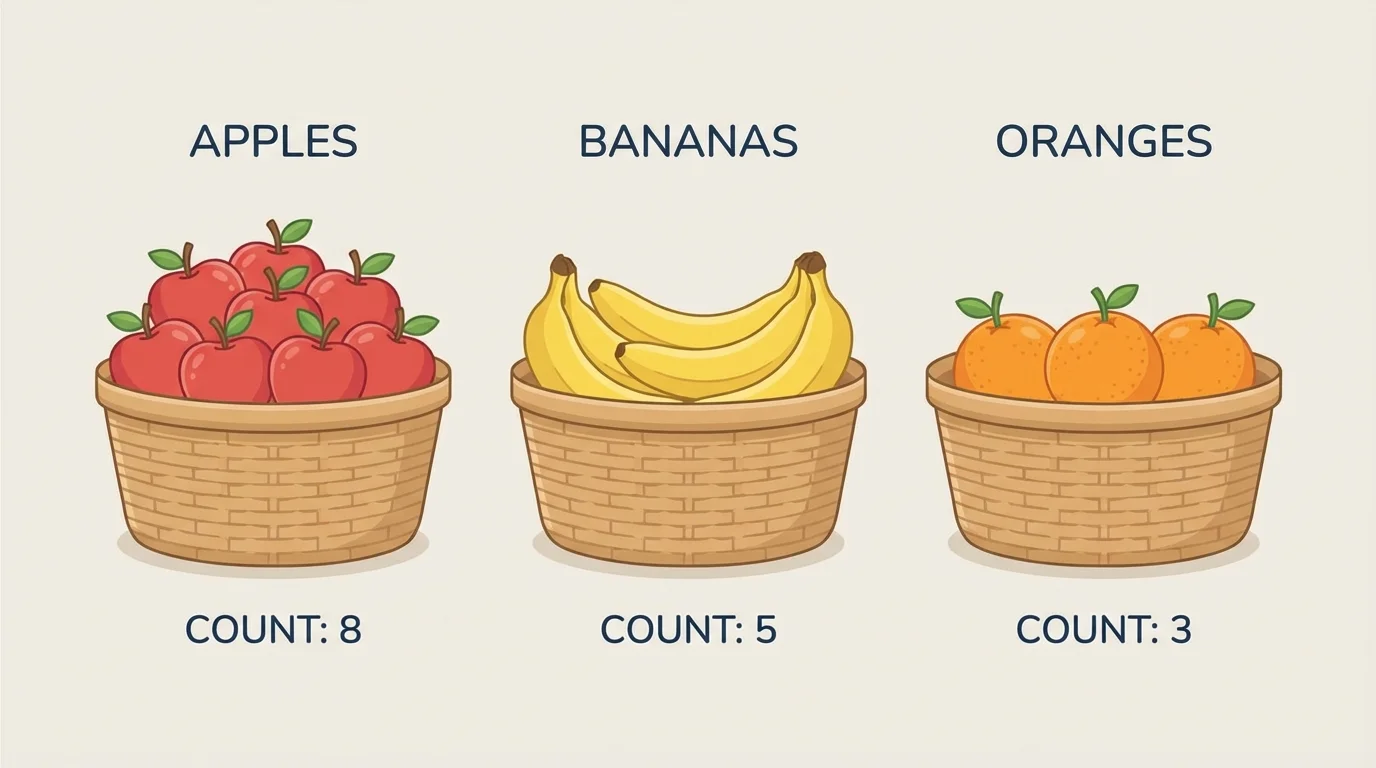
We can sort categories by count. From most to fewest means starting with the biggest number and going down. From fewest to most means starting with the smallest number and going up. If there are \(6\) toy bears, \(4\) toy ducks, and \(1\) toy trains, then from most to fewest the order is bears, ducks, trains.
Stores sort and count objects all the time. Workers may group fruit by kind and count how many are in each crate so they know what they have.
Sometimes two categories can tie. If there are \(2\) cats and \(2\) dogs, the groups have the same count. A tie means the categories have the same count.
Let's look at some clear examples and solve them step by step.
Example 1: Sorting crayons
There are red, blue, and green crayons. After sorting, there are \(3\) red crayons, \(1\) blue crayon, and \(2\) green crayons.
Step 1: Name the categories.
The categories are red, blue, and green.
Step 2: Count each category.
Red: \(3\), Blue: \(1\), Green: \(2\).
Step 3: Put the categories in order from most to fewest.
We compare the numbers: \(3, 2, 1\).
The order is red, green, blue.
We can write the comparison as \(3 > 2 > 1\).
Notice that we did not sort the crayons by size or by where they were on the table. We used only one rule: color.
Example 2: Sorting snack fruit
A snack tray has bananas, apples, and pears. There are \(2\) bananas, \(2\) apples, and \(4\) pears.
Step 1: Count each fruit group.
Bananas: \(2\), Apples: \(2\), Pears: \(4\).
Step 2: Find the greatest count.
The greatest number is \(4\), so pears have the most.
Step 3: Find equal groups.
Bananas and apples both have \(2\), so \(2 = 2\).
Pears have the most. Bananas and apples have the same number.
This is like the fruit baskets example, where categories can be compared by their counts.
Example 3: Classroom shapes
A teacher has shape cards. There are \(5\) circles, \(3\) squares, and \(4\) triangles.
Step 1: Write the counts.
Circles: \(5\), Squares: \(3\), Triangles: \(4\).
Step 2: Compare the counts.
We know \(5 > 4 > 3\).
Step 3: Sort categories from fewest to most.
The numbers go \(3, 4, 5\).
From fewest to most, the order is squares, triangles, circles.
We can sort objects in many places: in the classroom, at home, outside, or at the store.
Sorting and counting help us every day. During cleanup, children can put all the blocks in one bin and all the animals in another bin. Then they can count each group to see how many toys are in each place. This is the same idea as the toy groups in [Figure 1].
At snack time, we can group crackers, apple slices, and carrot sticks. We can count each group and see which snack has more pieces. In nature, we might collect leaves and group them by shape or color, then count how many are in each category.
When you count, touch each object once and say one number for each object. That helps you count correctly.
People also use sorting and counting in bigger ways. A librarian sorts books into groups. A pet store may count fish, birds, and food cans. A garden helper may group flowers by color and count each group.
Good classifying means every object belongs in a group, and no object is counted two times. If an object does not fit the rule, we stop and think. Are we sorting by color? By shape? By kind? One clear rule helps us keep categories neat.
After sorting and counting, we can talk about the groups with math words: more, fewer, same, most, and least. If one basket has \(6\) shells and another has \(1\) shell, then the first basket has the most and the second basket has the least.
