Look around a room and you can spot shapes everywhere. A clock may look like a circle. A door may look like a rectangle. A ball may look like a sphere. We can use shape names to tell what things look like, and we can use location words to tell where things are. That helps us describe the world clearly.
Objects around us have shapes, as [Figure 1] shows in a classroom scene. Some shapes are flat shapes. These are shapes we often draw on paper. A circle is round. A square has 4 equal sides. A triangle has 3 sides. A rectangle has 4 sides. In many everyday examples, it has two longer sides and two shorter sides. A hexagon has 6 sides.
Some shapes are solid shapes. These are shapes we can hold. A cube looks like a box. A cone has a point at the top and a round bottom. A cylinder has two flat round ends. A sphere is round all over like a ball.
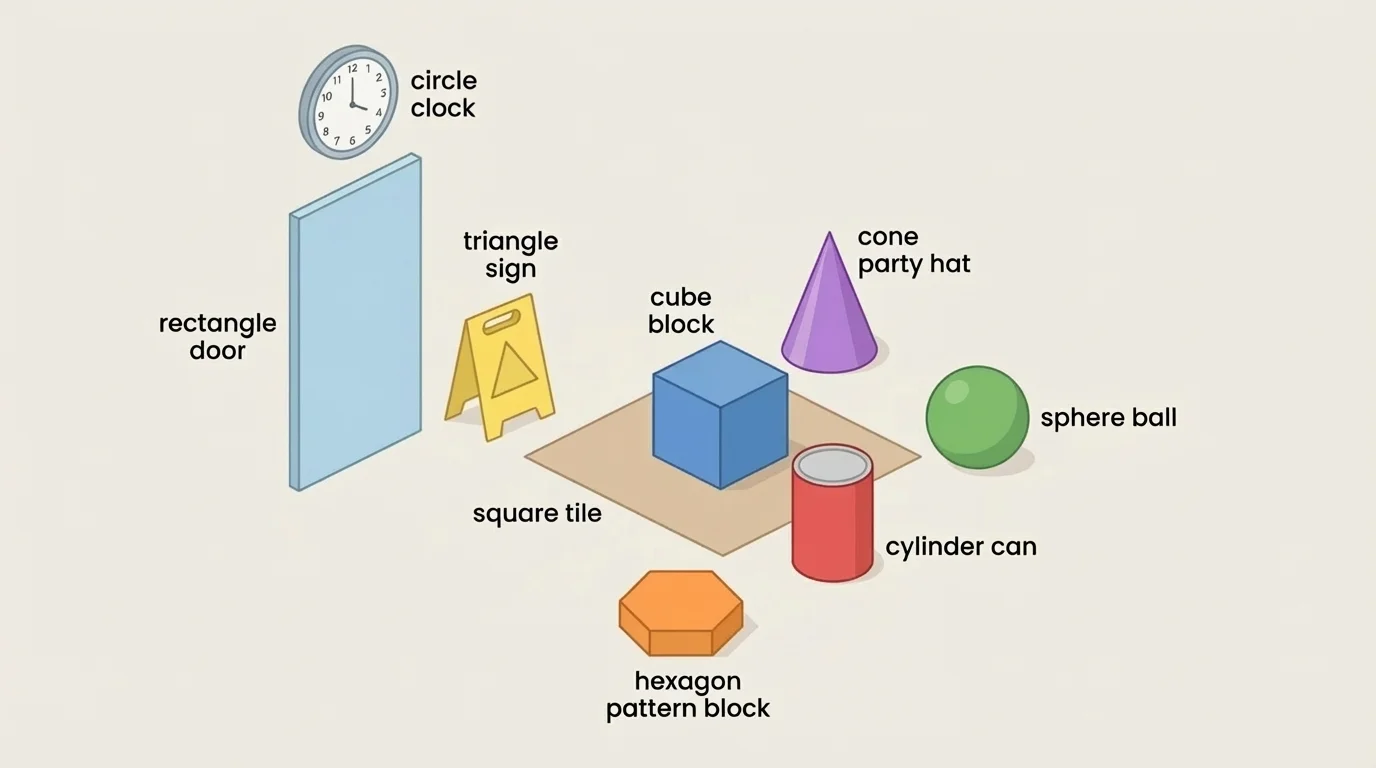
When we see an object, we can ask, "What shape is it like?" A cookie may be like a circle. A window may be like a square or a rectangle. A block may be like a cube. A soup can may be like a cylinder.
Shape tells what something looks like. Position tells where something is.
We do not always need a shape to be perfect. A real object can be like a shape. A slice of pizza is like a triangle. A stop sign is like a hexagon. A birthday hat is like a cone.
We can describe one object by saying its shape name. We can say, "The clock is a circle." We can say, "The book is a rectangle." We can say, "The block is a cube." Shape words help us speak clearly.
We can also compare shapes. A square and a rectangle both have 4 sides. A triangle has 3 sides. A hexagon has 6 sides. A sphere is round all over, but a circle is a flat round shape.
Flat shapes and solid shapes are not the same. A flat shape can be drawn on paper. A solid shape can be picked up and turned. For example, a circle is flat, but a sphere is solid. A square is flat, but a cube is solid.
Using the right shape word makes our description stronger. Instead of saying "a box shape," we can say "a cube." Instead of saying "a round shape," we can say "a circle" for a flat object or "a sphere" for a ball-like object.
Now we can talk about where objects are. Position words, as [Figure 2] illustrates, help us tell the place of one object compared with another object. These words are very useful when we give directions or describe a picture.
Above means higher than something. A lamp may be above a table. Below means lower than something. Shoes may be below a chair. Beside means at the side of something. A backpack may be beside a desk. Next to means very close at the side. A crayon may be next to a book.
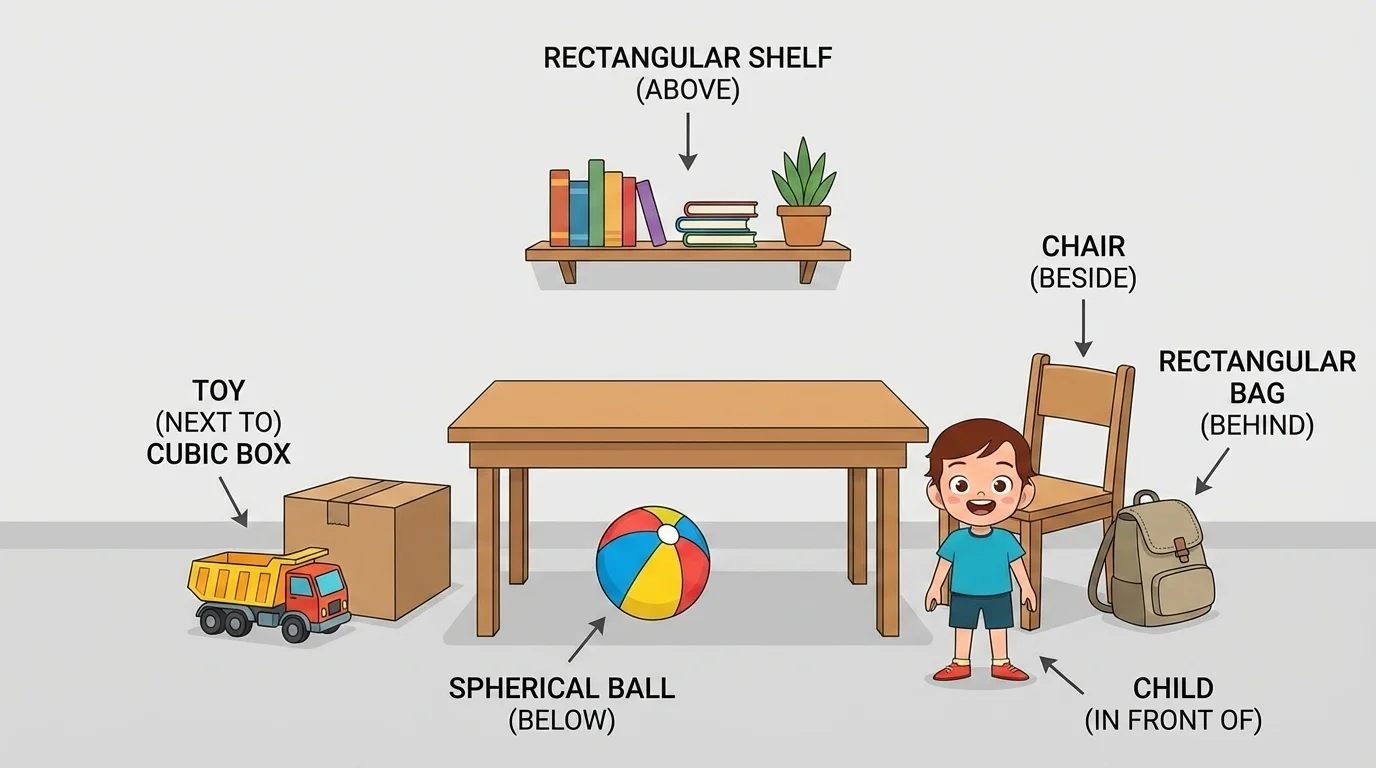
In front of means ahead of something. If you stand and look at a chair, a toy on the floor may be in front of the chair. Behind means at the back of something. A box may be behind the chair.
We always compare one object with another. If we say, "The ball is below the table," we are using the table to tell the ball's place. If we say, "The book is beside the lamp," we are using the lamp to tell the book's place.
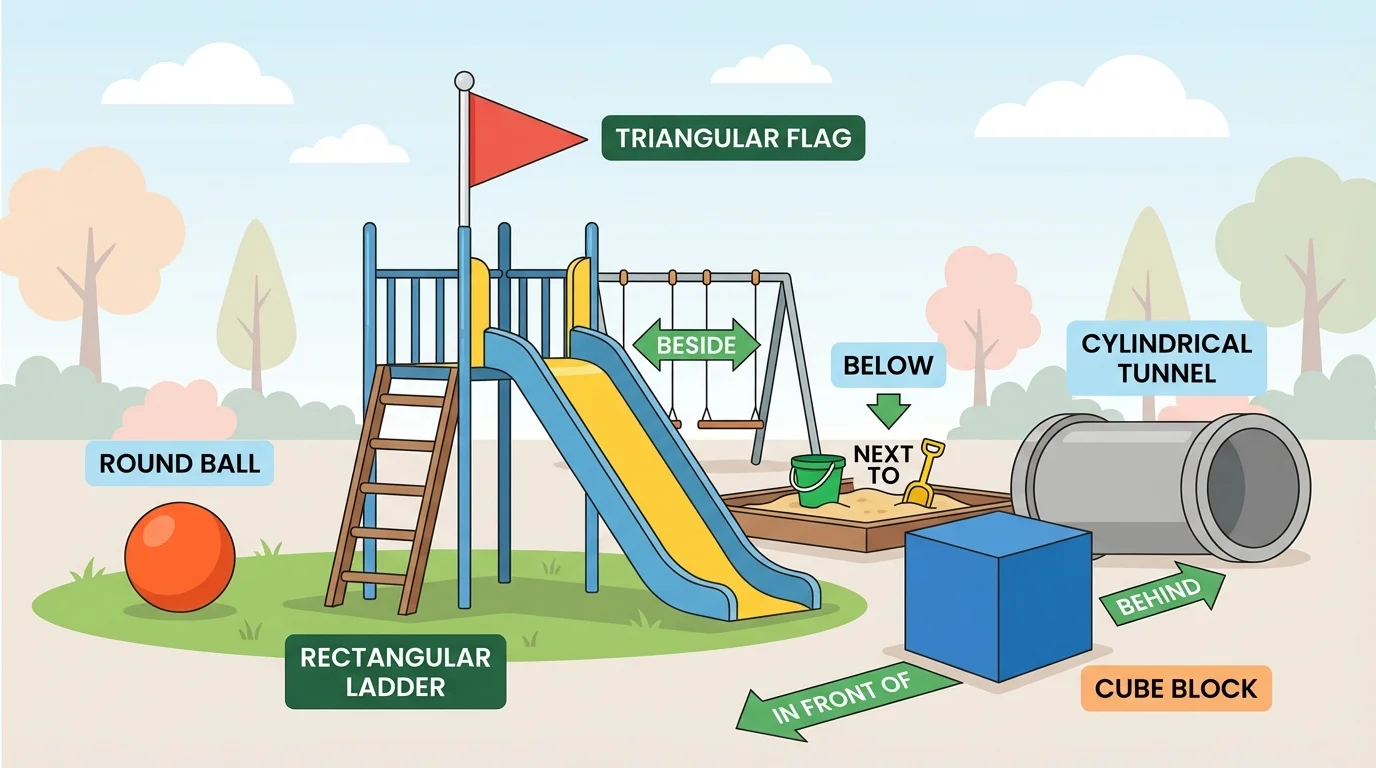
We can put shape words and position words together, as [Figure 3] shows in a playground scene. This helps us give a full description. We can say, "The ball is below the bench," or "The triangle flag is above the slide."
In a room, we might say, "The rectangle door is beside the square window." We might also say, "The circle clock is above the board." In a playground, we might say, "The cylinder tunnel is behind the cube block."
Notice how shape and place work together. If there are two balls, we can be clearer by saying, "The ball next to the slide," or "The ball behind the bench." This kind of description helps people know exactly which object we mean.
Many road signs use shape names. A yield sign is like a triangle, and a stop sign is like a hexagon. Shapes help people understand signs quickly.
We also use these words in stories, games, and clean-up time. A teacher might say, "Put the cube block beside the basket," or "Set the cone behind the toy car." Those words help us know what to do.
Let us look at some simple examples. We will name the shape and then tell the position.
Example 1
A ball is on the floor under a table. What shape is the ball like, and where is it?
Step 1: Name the shape.
A ball is like a sphere.
Step 2: Name the position.
Under the table means below the table.
The ball is like a sphere, and it is below the table.
This example shows that one object can be described in two ways: by shape and by place.
Example 2
A book is next to a lamp. The book has 4 sides. In this example, it has two longer sides and two shorter sides. What shape is the book like, and where is it?
Step 1: Use the side clue.
An object with 4 sides, two long and two short, is like a rectangle.
Step 2: Name the position.
By the lamp means beside or next to the lamp.
The book is like a rectangle, and it is beside the lamp.
As we saw earlier in [Figure 1], many classroom objects can be matched to shape names, and the same idea works for books, windows, and doors.
Example 3
A party hat is at the back of a chair. What shape is the hat like, and where is it?
Step 1: Name the shape.
A party hat is like a cone.
Step 2: Name the position.
At the back of the chair means behind the chair.
The party hat is like a cone, and it is behind the chair.
We can do the same with other objects. A can is like a cylinder. A die is like a cube. A sign may be like a triangle or hexagon. Then we add where it is: above, below, beside, next to, in front of, or behind.
Example 4
A flag is over a slide. The flag has 3 sides. What shape is it like, and where is it?
Step 1: Count the sides.
A shape with 3 sides is a triangle.
Step 2: Name the position.
Over the slide means above the slide.
The flag is like a triangle, and it is above the slide.
The playground picture in [Figure 3] uses this same kind of description. We can pick one object, say its shape, and then tell where it is compared with another object.
These words help in real life. If you are looking for a toy, someone might say, "The ball is behind the box." If you are drawing, you might add a triangle roof above a rectangle house. If you are building, you might put a cube block next to a cylinder block.
These words also help us listen carefully. When we hear, "Put the book beside the bag," we know where the book goes. When we hear, "Find the circle sign above the door," we know what to look for and where to look.
The room scene in [Figure 2] reminds us that position words only make sense when we compare objects. A ball is below the table, but the same ball may be beside a chair. One object can have different position descriptions depending on what we compare it to.
