Have you ever seen a window that looked like it was leaning, or a cracker turned sideways on your plate? It may look a little different, but its shape name stays the same. A square is still a square when it turns. A triangle is still a triangle when it is small or large. Learning to name shapes means looking carefully at what the shape is, not just how it is sitting.
A shape does not get a new name just because it turns, flips, or changes size, as [Figure 1] shows. If a square is standing straight, leaning like a diamond, or made bigger, it is still a square. If a triangle points up, down, or sideways, it is still a triangle.
We can say that the shape has the same orientation or a different orientation when it turns. We can also notice its size. But the name of the shape comes from its parts, not from whether it is big or small.
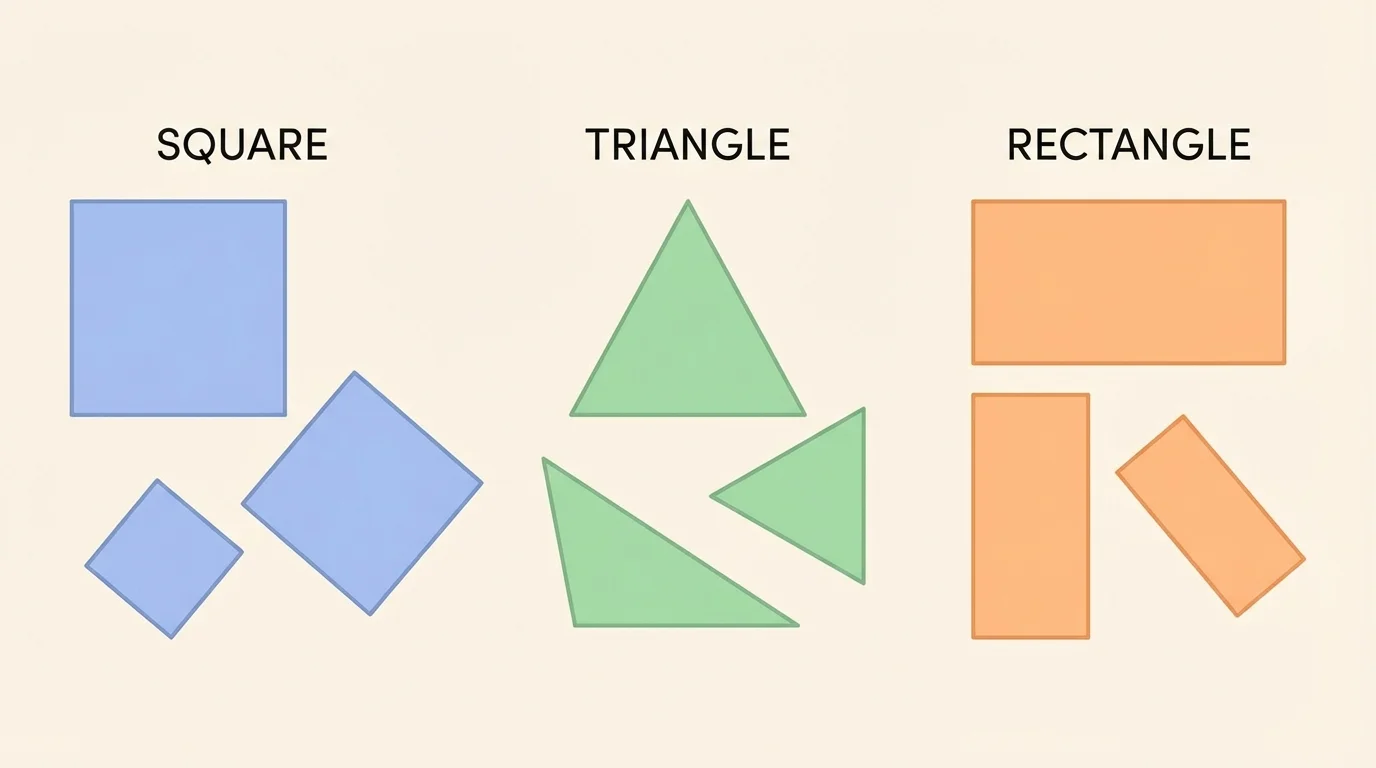
So when you look at a shape, ask: How many sides does it have? Does it have corners? Is it round? Those clues help you name it correctly.
Shape means the form of something. Some shapes are flat, like a drawing on paper. Some shapes are solid, which means they are objects you can hold.
When we name shapes, we do not need the shape to be in one special position. We can name it correctly wherever it is turned.
Flat shapes are shapes you can draw on paper. To name them, look closely at their parts, as [Figure 2] illustrates. We pay attention to sides, corners, and whether the shape is round.
A circle is round all the way around. It has no straight sides and no corners. A cookie or a clock face can look like a circle.
A triangle has exactly \(3\) straight sides and \(3\) corners. A triangle can point up, down, or sideways. It is still a triangle because it still has \(3\) sides.
A square has \(4\) straight sides and \(4\) corners. All \(4\) sides are the same length. When a square turns so one corner points up, it is still a square.
A rectangle has \(4\) straight sides and \(4\) corners too. Its opposite sides match. Some rectangles are long and skinny. Some are shorter. If it turns, it is still a rectangle.
A hexagon has \(6\) straight sides and \(6\) corners. A honeycomb shape is often a hexagon.
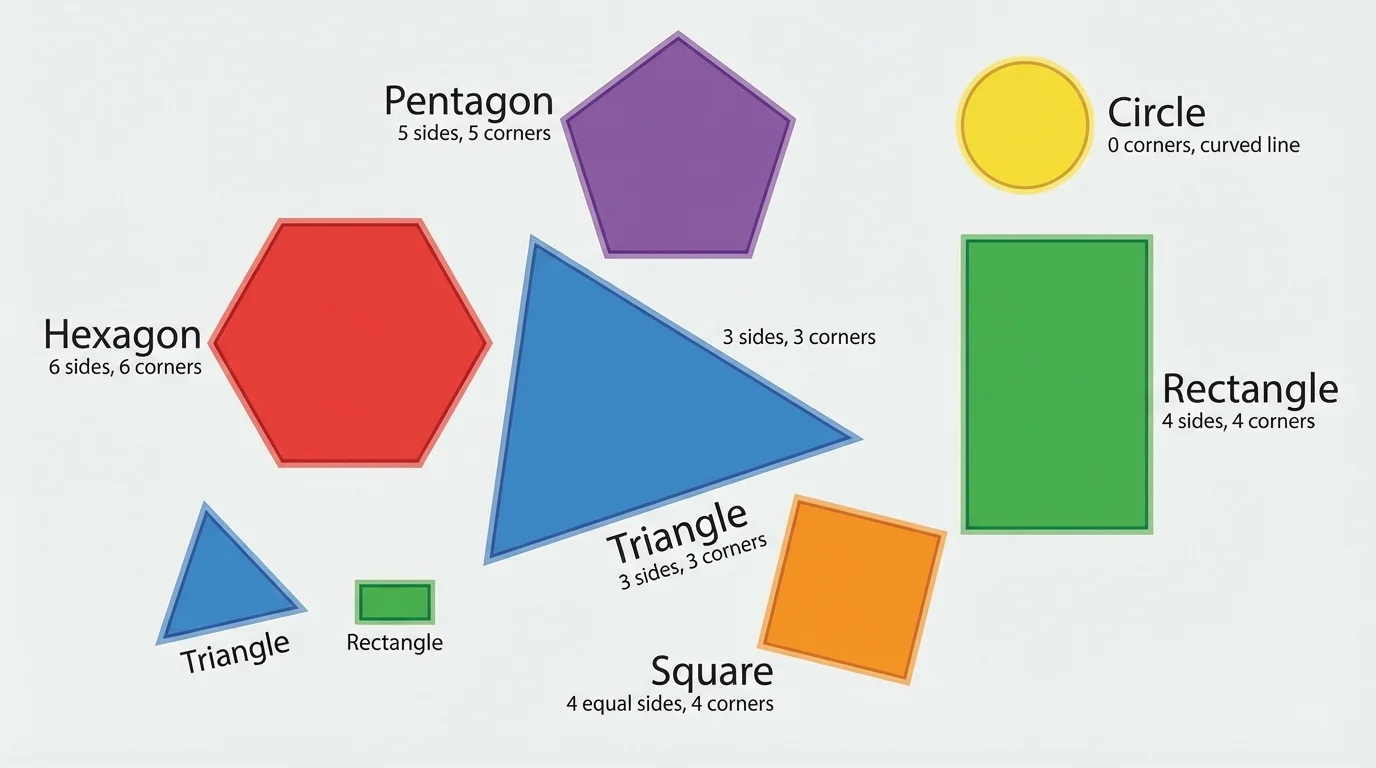
When two shapes look different because one is tilted, do not let that trick you. Count or notice the parts. In [Figure 2], each flat shape keeps its own special parts, and that is why its name stays the same.
Some shapes are solid shapes. These are shapes you can hold in your hands, as [Figure 3] shows. Solid shapes are not just flat drawings. They are objects with height, width, and depth.
A cube looks like a box with equal square faces. A toy block can be a cube. A cube can sit on any face and still be a cube.
A cone has one point and a round bottom. A party hat or an ice cream cone can have this shape. If it tips over, it is still a cone.
A cylinder has two circular flat faces and one curved surface. A can is a cylinder. A cylinder lying down is still a cylinder.
A sphere is round like a ball. It has no corners and no flat faces. A sphere looks the same when it rolls because it is round all over.
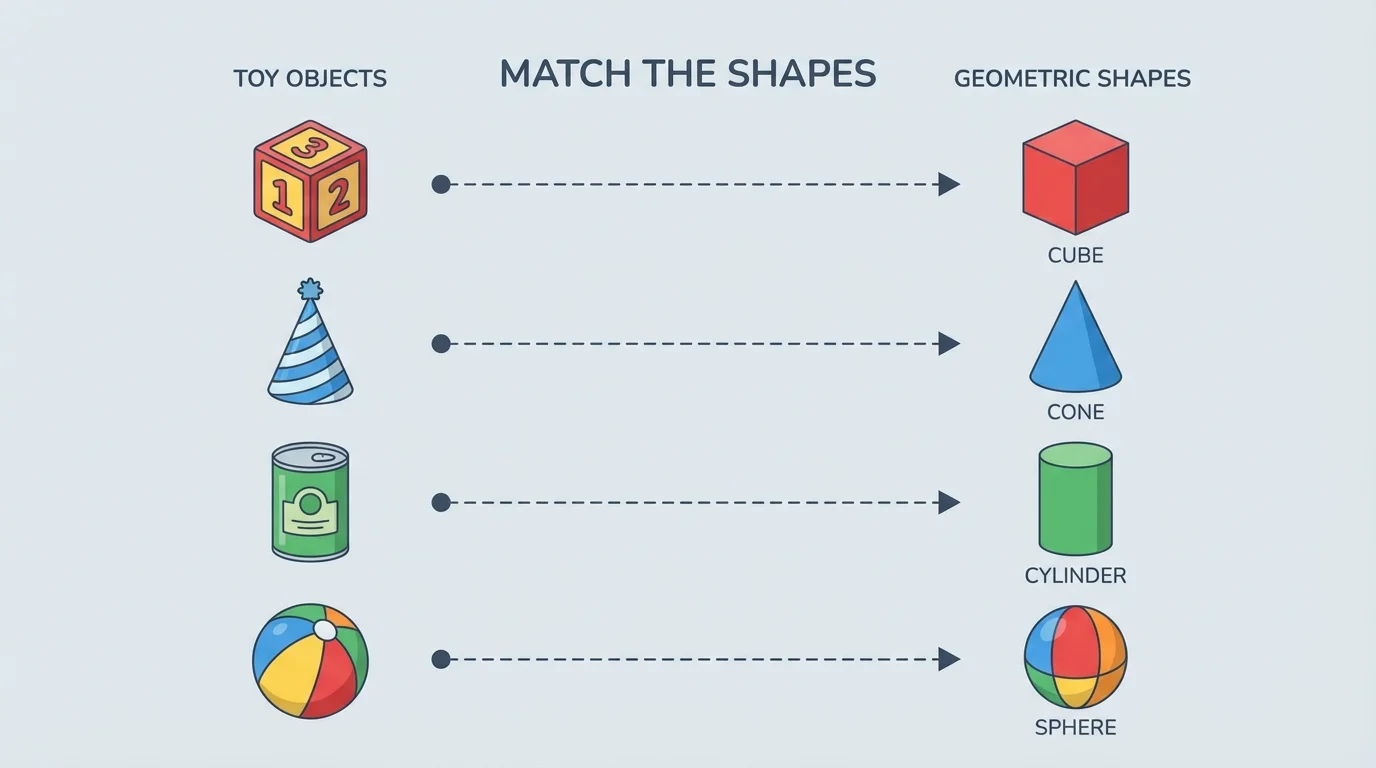
Solid shapes can also be big or small. A tiny ball and a giant ball are both spheres. A small block and a large block can both be cubes.
To name a shape, look for simple clues. Sides are straight edges on flat shapes. Corners are the pointy places where sides meet. Some shapes are round and do not have corners.
For solid shapes, we can notice flat faces, curved surfaces, and points. A cube has flat faces. A cone has one point. A sphere is round all over. These parts help us tell one solid shape from another.
How to identify a shape
First, look at the whole shape. Next, notice whether it is flat or solid. Then count straight sides and corners, or notice if it is round. Last, ignore whether it is turned, flipped, big, or small. Those changes do not change the shape's name.
This is why a turned square should not be called a different shape. The square still has \(4\) equal sides and \(4\) corners. A long rectangle still has \(4\) sides and \(4\) corners, even if it is standing tall or lying across.
Here are some examples of how we can name shapes correctly.
Example 1
A shape is rotated so one corner points up. It has \(4\) equal sides and \(4\) corners. What is it?
Step 1: Look at the parts.
The shape has \(4\) sides and \(4\) corners.
Step 2: Notice the side lengths.
All \(4\) sides are equal.
Step 3: Ignore the turn.
Even though it looks tilted, its parts stay the same.
The shape is a square.
A turned square is one of the most common tricky pictures. Remember that the turn does not change the name.
Example 2
A small shape has \(3\) straight sides and \(3\) corners. It points sideways. What is it?
Step 1: Count the sides.
There are \(3\) straight sides.
Step 2: Count the corners.
There are \(3\) corners.
Step 3: Ignore the size and direction.
Being small and sideways does not change the shape name.
The shape is a triangle.
The same idea works for very large shapes too. A giant triangle on a sign is still a triangle because it still has \(3\) sides.
Example 3
An object looks like a can. It is lying on its side. What solid shape is it?
Step 1: Think about the object's parts.
A can has two circular flat faces and one curved surface.
Step 2: Match the shape.
That is the shape of a cylinder.
Step 3: Ignore how it is placed.
Lying down does not change the shape.
The object is a cylinder.
We can use the same careful looking for cubes, cones, and spheres. In [Figure 3], the objects keep their shape names no matter how they are held or placed.
[Figure 4] Shapes are everywhere in the world around us, and they appear in many positions and sizes. A window can be a rectangle. A slice of pizza can be a triangle. A clock can be a circle. A ball can be a sphere. A box can be a cube. A soup can can be a cylinder.
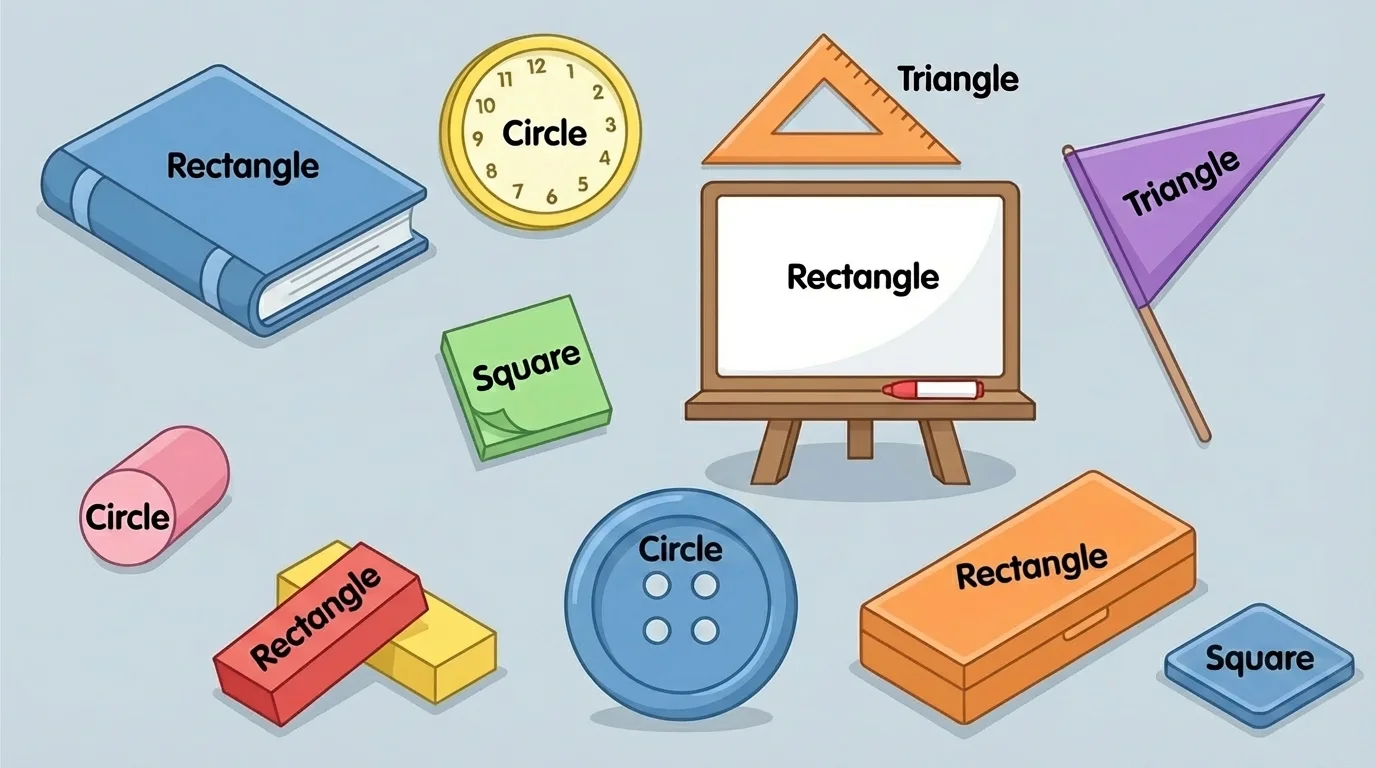
Sometimes a shape in real life is turned or partly hidden. You can still look for clues. If the sign has \(6\) sides, it is a hexagon. If the block has square faces all around, it is a cube. If the object is round like a ball, it is a sphere.
Honeybees build wax cells that are often hexagonal. That means a shape from geometry can be found in nature.
When you notice shapes around you, try naming them by their parts. In [Figure 1] and [Figure 4], the important idea stays the same: turning a shape or changing its size does not change its name.
