Look around the room. A window, a ball, a book, and a slice of pizza all have shapes. Some shapes are flat like a drawing on paper. Some shapes are solid like a toy you can hold. Learning to tell these apart helps us understand the world.
A shape can be part of something you see every day. A clock may look like a circle. A box may look like a cube. A party hat may look like a cone. When we talk about shapes, we can put them into two big groups.
One group is two-dimensional. That means the shape is flat and lies in a plane. [Figure 1] shows examples of these flat shapes. Another group is three-dimensional. That means the shape is solid and has thickness.
Two-dimensional means flat. A two-dimensional shape has length and width.
Three-dimensional means solid. A three-dimensional shape has length, width, and height.
When something is flat, it is like a picture you can draw. When something is solid, it is like an object you can pick up. [Figure 2] shows examples of solid shapes.
A two-dimensional shape is flat. You can draw these shapes on paper. They do not pop out. They stay flat.
Some flat shapes have straight sides. Some have curves. A square has 4 equal sides. A triangle has 3 sides. A rectangle has 4 sides. A hexagon has 6 sides. A circle is round.
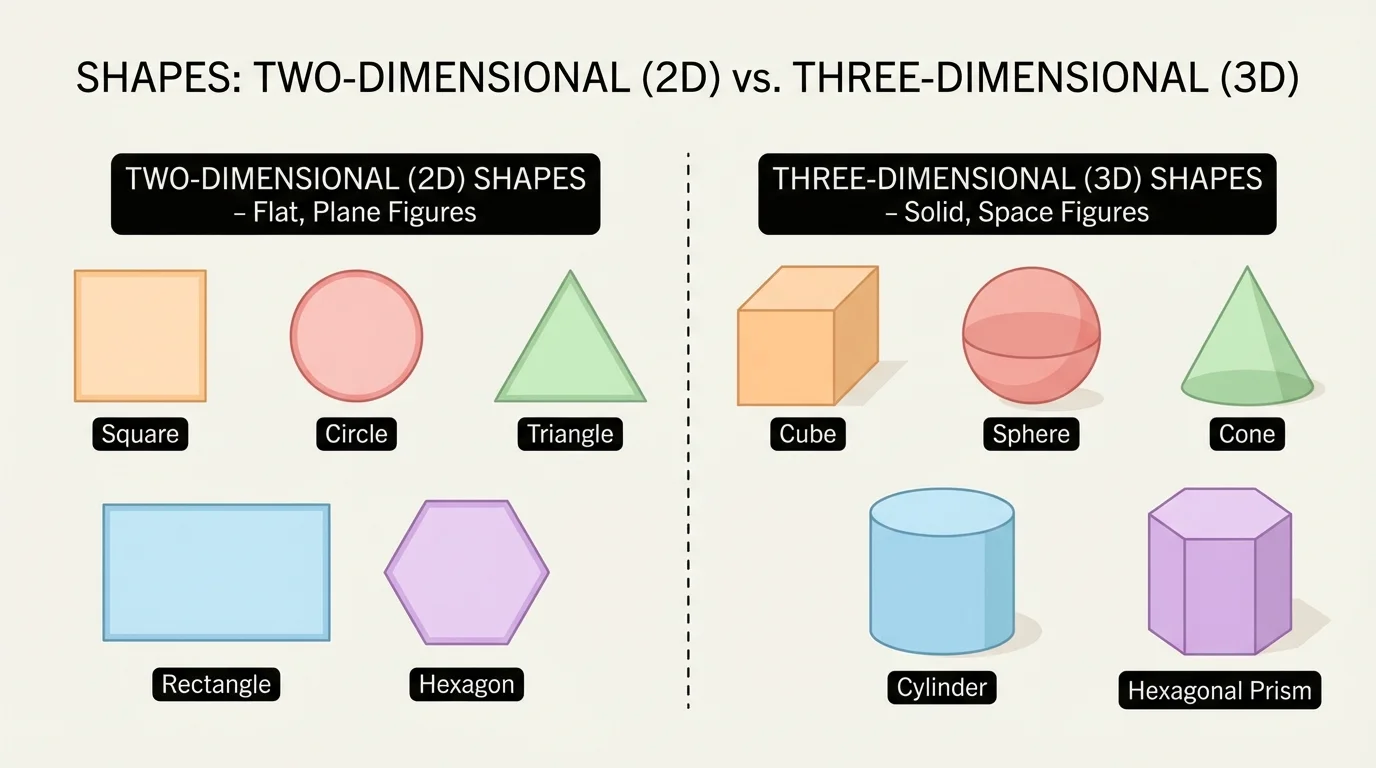
Flat shapes do not have thickness. If you draw a circle on paper, it is still flat. If you draw a square with crayons, it is still flat.
You may see flat shapes on signs, in books, and in pictures. A slice of toast cut into a triangle can remind you of a triangle. A window can remind you of a rectangle. Later, when you sort objects, [Figure 1] helps you remember what flat shapes look like.
A stop sign is shaped like a hexagon's cousin, an octagon, which has 8 sides. Even when we learn extra shapes, we still ask the same question: is it flat or solid?
For this lesson, the most important idea is that flat shapes lie in a plane. They do not have thickness you can hold in your hands.
A three-dimensional shape is solid. These shapes look like real objects you can hold. They are not just drawings. They take up space.
A cube looks like a box. A cone looks like an ice-cream cone. A cylinder looks like a can. A sphere looks like a ball. These are all solid shapes.
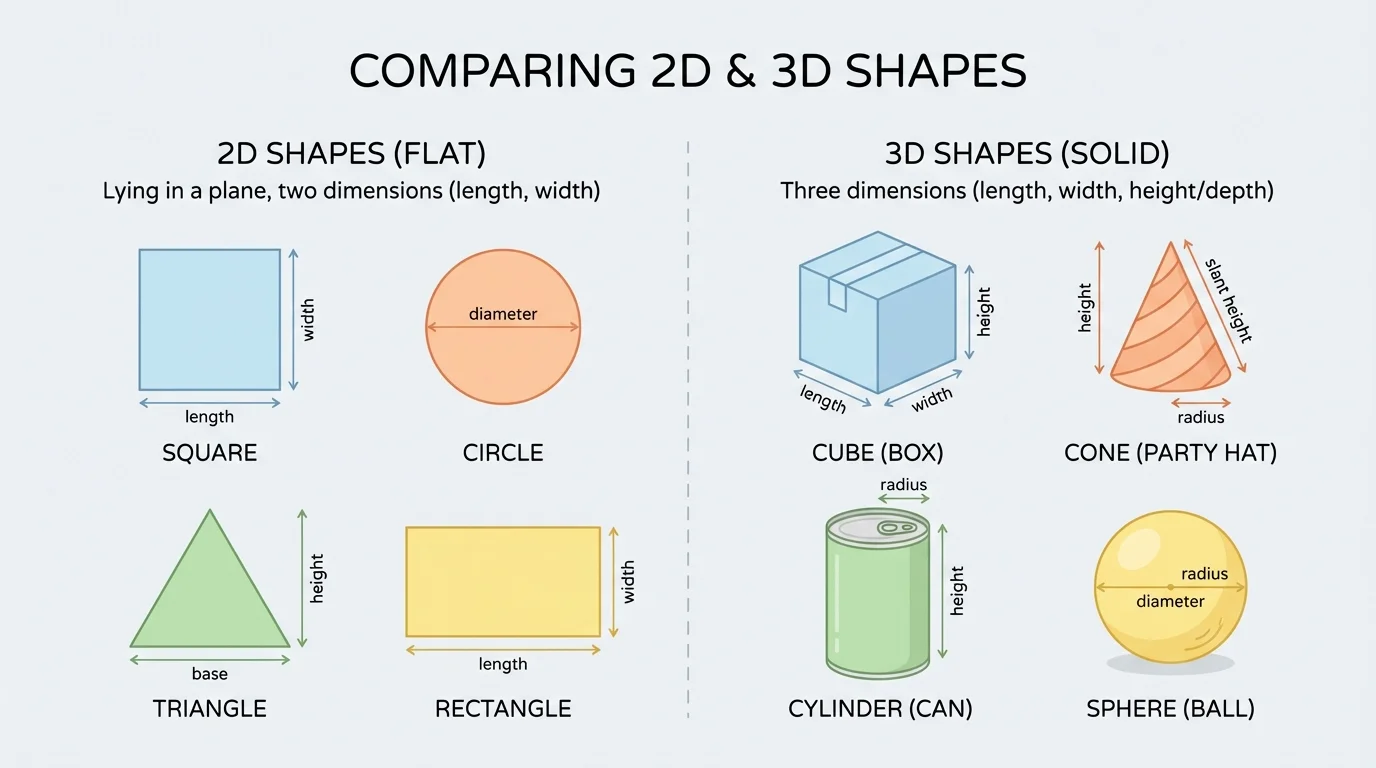
Solid shapes have thickness. You can hold a cube block. You can roll a sphere. You can stack some solid shapes. A cylinder can stand up. A cone has a point. A sphere is round all over.
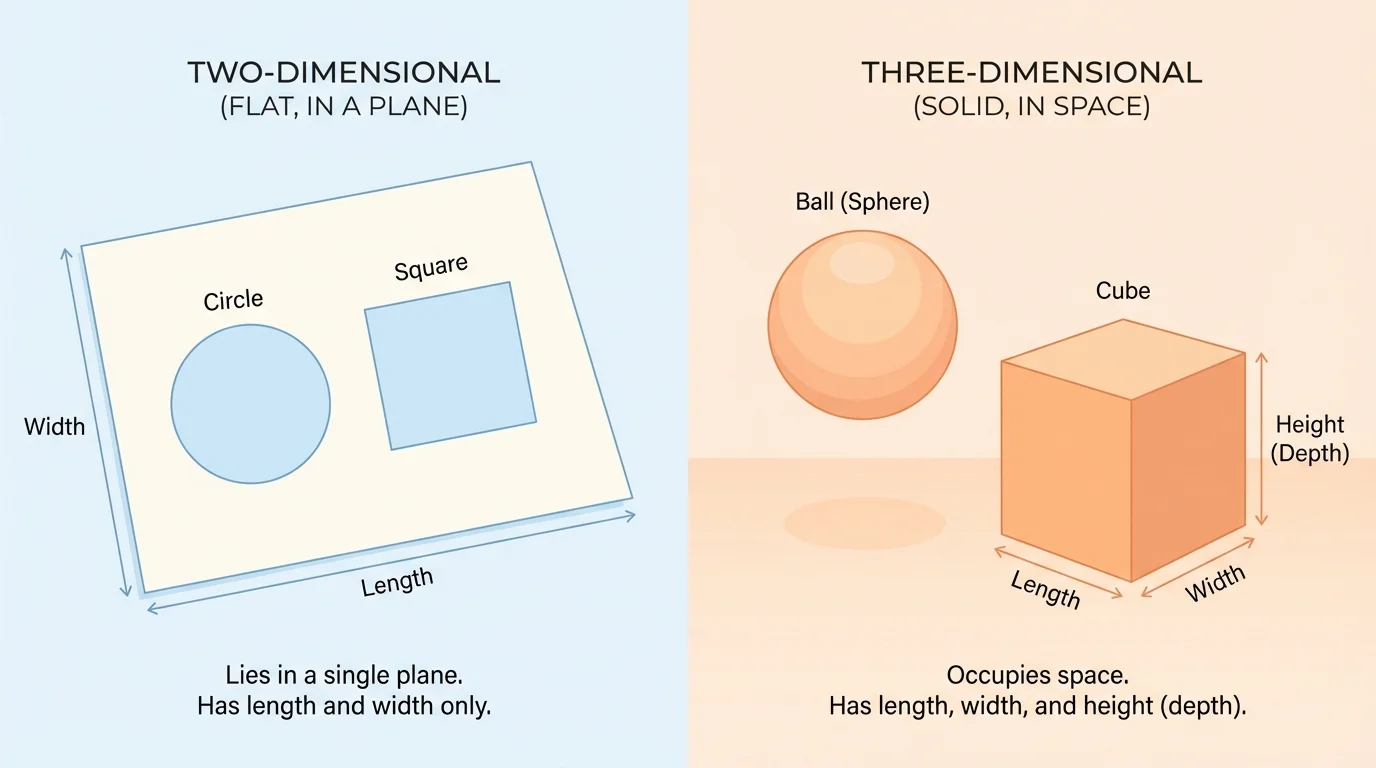
Sometimes a flat picture shows a solid shape, but the picture itself is still flat. [Figure 3] compares flat drawings and solid objects. The object in the picture may be a cube or a sphere, but the paper is flat. That is an important difference.
Flat picture, solid object
A drawing of a ball is flat because the paper is flat. The real ball is a sphere because you can hold it and it takes up space. We always ask about the shape itself, not just whether we see it in a picture.
When you think about solids, remember real objects in the classroom and at home. A block may be a cube. A soup can may be a cylinder. A globe may be a sphere. A party hat may be a cone. These are all easier to notice when you remember [Figure 2].
To tell if a shape is flat or solid, look for thickness and ask whether you can hold it. If it is only like a shape on paper, it is flat. If it is like an object that takes up space, it is solid.
You can ask simple questions. Can I draw it on paper as a flat shape? Can I pick it up like an object? Does it have thickness? Does it roll like a ball or stand like a can? These questions help you sort shapes.
| Shape group | What it is like | Examples |
|---|---|---|
| Flat | Lies in a plane, like a drawing | square, circle, triangle, rectangle, hexagon |
| Solid | Takes up space, like an object | cube, cone, cylinder, sphere |
Table 1. A comparison of flat shapes and solid shapes.
A circle and a sphere are not the same. A circle is flat. A sphere is solid. A square and a cube are not the same either. A square is flat. A cube is solid. The comparison in [Figure 3] helps show that one is a drawing shape and one is an object shape.
You may already know some shape names like square, circle, and triangle. Now you are learning a new way to describe them: flat or solid.
Sometimes real things are not perfect shapes, but they can still remind us of a shape. A ball is like a sphere. A cracker may be like a circle. A gift box may be like a cube.
Let's sort some shapes and objects step by step.
Example 1: Is a circle flat or solid?
Step 1: Think about what a circle looks like.
A circle is like a round drawing on paper.
Step 2: Ask if it has thickness.
A circle does not have thickness.
Step 3: Decide the group.
A circle is flat, so it is two-dimensional.
Answer: A circle is a flat shape.
A flat circle is different from a real ball. That idea connects back to [Figure 3], where the flat and solid versions are compared.
Example 2: Is a cube flat or solid?
Step 1: Think about a cube.
A cube is like a box or a block.
Step 2: Ask if you can hold it.
Yes, a cube is an object you can hold.
Step 3: Decide the group.
A cube is solid, so it is three-dimensional.
Answer: A cube is a solid shape.
Many toys and building blocks are cubes, so this is a shape you can often find in real life.
Example 3: A can of soup looks like which kind of shape?
Step 1: Look at the object.
A can is round and tall.
Step 2: Match it to a shape name.
A can looks like a cylinder.
Step 3: Decide if it is flat or solid.
A cylinder is something you can hold, so it is solid.
Answer: A can looks like a cylinder, and it is a solid shape.
Now compare that with a rectangle drawn on a label. The label can be flat, but the can itself is solid.
Example 4: Is a triangle on a sign flat or solid?
Step 1: Think about the triangle shape.
A triangle has 3 sides and can be drawn on a sign.
Step 2: Ask if the triangle shape is just a drawing.
Yes, the triangle shape on the sign is flat.
Step 3: Decide the group.
A triangle is two-dimensional.
Answer: The triangle shape is flat.
Even if the sign itself is made of metal, the triangle shape we see on its face is still a flat shape.
Shapes are everywhere. A wheel can look like a circle. A ball can look like a sphere. A block can look like a cube. A party hat can look like a cone. A paper towel roll can look like a cylinder.
When artists draw, they often start with flat shapes. When builders make objects, they work with solid shapes. Both kinds of shapes help us describe what we see.
If you look at books, toys, food, and signs, you can name the shape and then tell whether it is flat or solid. That is the big skill. You are learning to identify shapes by how they take up space.
