[Figure 1] Look around your room. A window, a ball, a book, and a block do not all have the same shape. Shapes are everywhere, and learning to talk about them helps us describe the world. Some shapes are flat like paper. Some shapes are solid like toys you can hold.
A flat shape is one you can draw on paper. It has length and width. A two-dimensional shape is flat, including shapes like a circle, triangle, and rectangle. These shapes do not have thickness.
A three-dimensional shape is a solid shape you can hold in your hands. A sphere is like a ball. A cube is like a box-shaped block. A cylinder is like a can. Solid shapes have height, width, and depth.
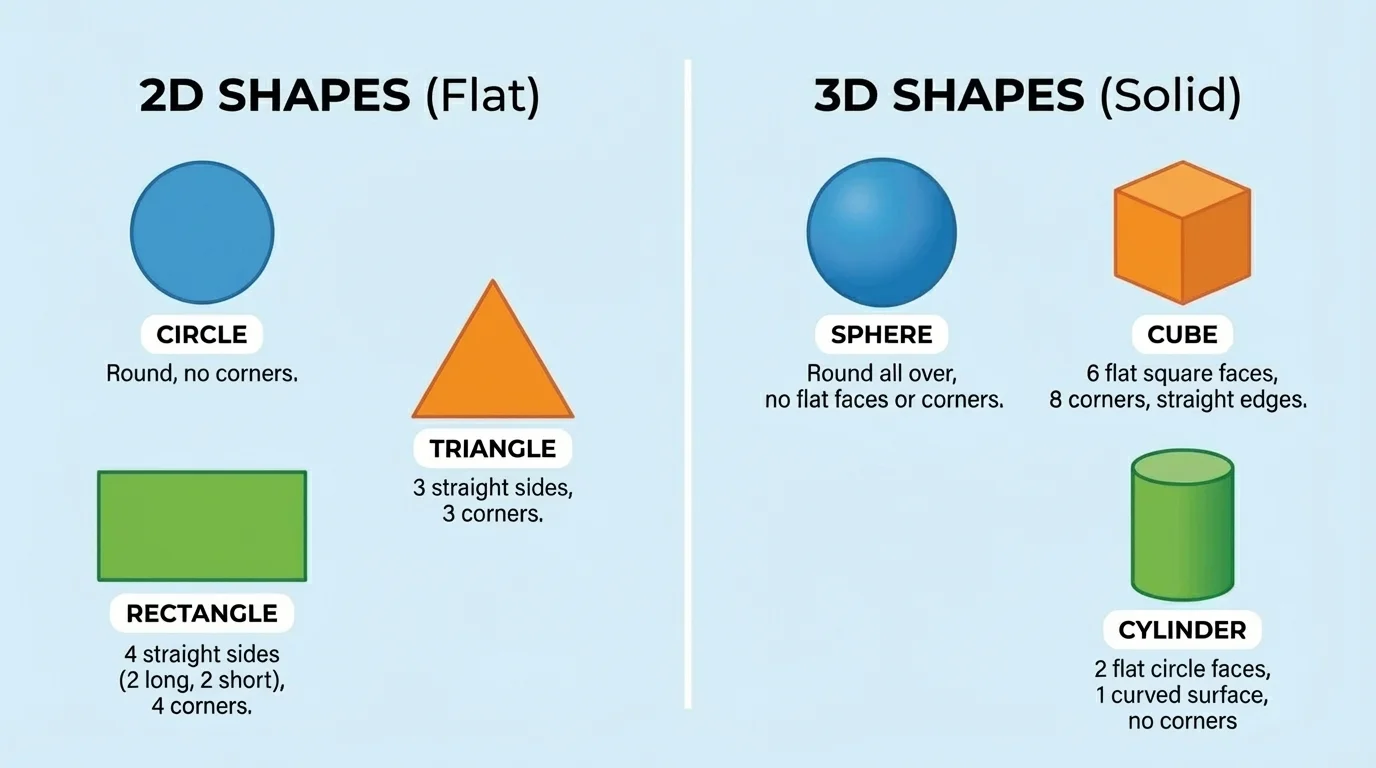
Some common flat shapes are a circle, triangle, square, and rectangle. Some common solid shapes are a sphere, cube, cone, and cylinder. Flat shapes and solid shapes can be compared by how they look and what parts they have.
A side is a straight edge on a flat shape. A vertex is a corner where two sides meet. A face is a flat surface on a solid shape. Some shapes also have curved parts instead of straight parts.
[Figure 2] A circle is flat, but it has no straight sides and no corners. A triangle is flat and has straight sides. A cube is solid and has flat faces. A sphere is solid and has no flat faces.
A side is a straight edge on a flat shape. A vertex, or corner, is where two sides meet. The corners are marked so they are easy to count.
How many sides does a triangle have? A triangle has exactly \(3\) sides and \(3\) corners. A square has \(4\) sides and \(4\) corners. A rectangle also has \(4\) sides and \(4\) corners. A circle has \(0\) sides and \(0\) corners.
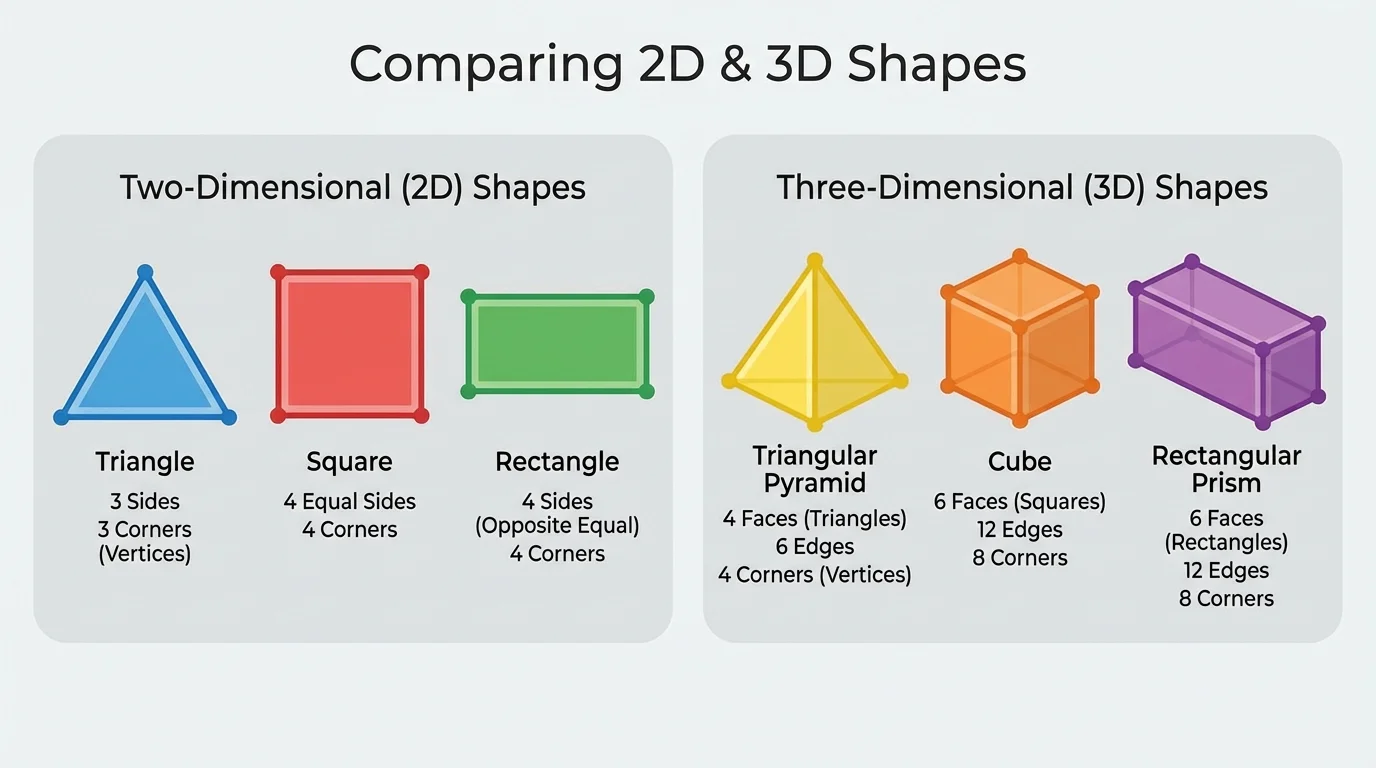
Some shapes have sides that are the same length. A square has \(4\) sides of equal length. A rectangle has \(4\) sides, but not all of them must be the same length. It has two long sides and two short sides when it is not a square.
Solid shapes have different parts. A cube has flat faces, straight edges, and vertices. A sphere has one curved surface and no corners. A cylinder has \(2\) flat faces and one curved part around the middle.
A shape is still the same even when it is big, small, or turned. Triangles and rectangles in different sizes and directions are still the same kinds of shapes.
A small triangle and a large triangle are both triangles if each one has \(3\) sides and \(3\) corners. A rectangle standing up and a rectangle lying sideways are both rectangles. Turning a shape does not change what it is.
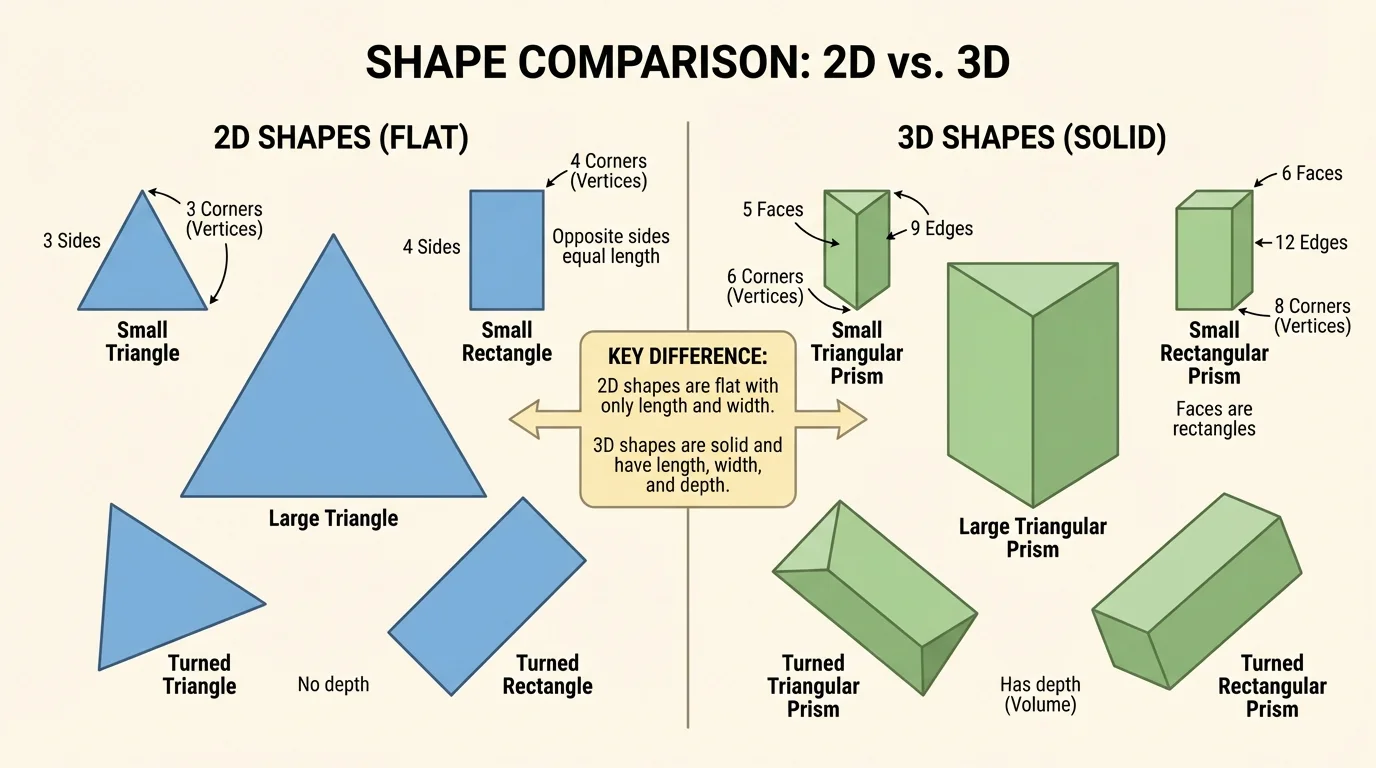
This is important when we compare shapes. We do not decide only by where a shape points. We look at its parts. If it has the same kind of sides and corners, it is the same kind of shape.
A square is also a rectangle because it has \(4\) sides and \(4\) corners. Its special feature is that all \(4\) sides are equal.
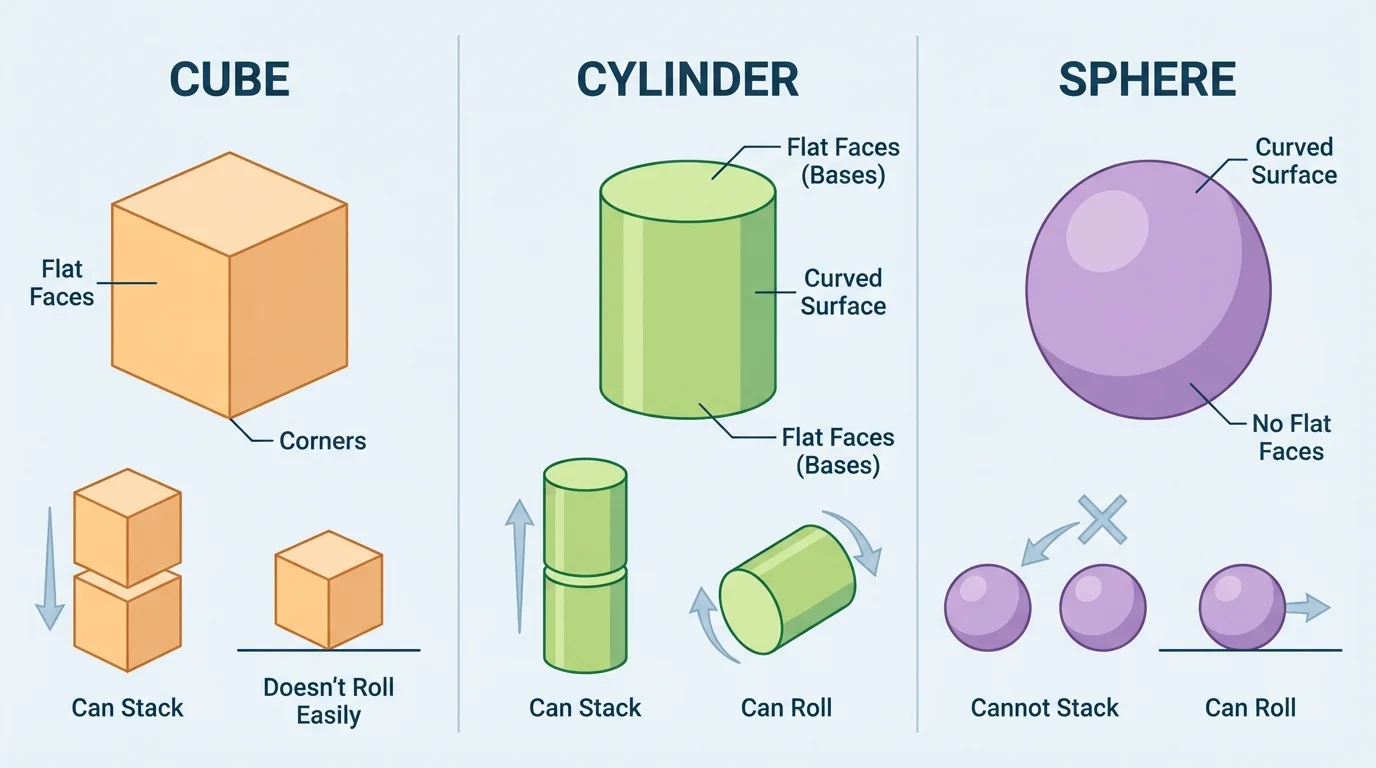
[Figure 4] When we look carefully, we can say more than just a shape name. We can say, "This shape has \(4\) sides," or "This shape has no corners," or "These two shapes are both solid."
A cube and a sphere are both solid shapes, but they do not move the same way.
A cube has flat faces, so it can stack nicely. A sphere is round all over, so it rolls. A cylinder can roll, but it can also stand on its flat faces. That makes it different from a sphere and similar to some other solids.
A triangle and a square are alike because both are flat shapes with straight sides and corners. They are different because a triangle has \(3\) sides and a square has \(4\) sides. A square and a rectangle are alike because both have \(4\) sides and \(4\) corners. They are different because a square has all sides equal.
Later, when we look again at solids like these, we can use words such as flat, curved, roll, and stack to describe them. These are helpful shape clues.
Here are some simple ways to talk about shapes by looking at their parts and attributes.
Example 1
Which shape is a triangle: a shape with \(3\) sides or a shape with \(4\) sides?
Step 1: Remember what makes a triangle.
A triangle has \(3\) sides and \(3\) corners.
Step 2: Compare the shapes.
The shape with \(3\) sides matches a triangle. The shape with \(4\) sides does not.
The triangle is the shape with \(3\) sides.
Counting sides helps us name flat shapes correctly.
Example 2
Are these the same kind of shape: one small square and one big square?
Step 1: Look at the parts of each shape.
Each shape has \(4\) sides and \(4\) corners.
Step 2: Check the special feature.
Each shape has sides of equal length.
Step 3: Decide.
Even though one is bigger, both are squares.
Size does not change the kind of shape.
This is the same idea we saw earlier, where turning or resizing a shape does not change its name.
Example 3
How are a cube and a sphere different?
Step 1: Look for flat faces and corners.
A cube has flat faces and vertices. A sphere has no flat faces and no vertices.
Step 2: Think about movement.
A sphere rolls easily. A cube does not roll easily.
Step 3: Say the comparison.
Both are solid shapes, but a cube has flat parts and a sphere is round all over.
The shapes are both solid, but they have different attributes.
When we compare shapes, we can use words like same, different, more sides, fewer corners, flat, and round.
Shapes are not just in math lessons. A clock may be a circle. A slice of pizza can look like a triangle. A book cover may be a rectangle. A ball is like a sphere. A tissue box can be like a rectangular solid, and a soup can is like a cylinder.
When people build with blocks, they compare shapes without even noticing. They learn that cubes stack well, and cylinders can roll. They see that some toys have corners and some are smooth and round.
If you see a sign turned sideways, it is still the same shape. If one window is bigger than another, both can still be rectangles. Looking at parts instead of just position helps us understand shapes correctly.
You already know how to count. Counting helps with shapes too. We count sides, corners, and sometimes faces to tell what a shape is.
Good shape thinkers describe what they notice. They can say, "These are both flat," "This one has \(4\) corners," or "This one rolls because it is round." That is how we analyze and compare shapes.
