Look around the room. A window, a book, a slice of pizza, and a wheel all have different shapes. Shapes are everywhere, and we can do something exciting with them: we can build them and draw them. When we make shapes with our hands, we learn what each shape is like.
A shape is the form of something. Some shapes are flat, like a picture on paper. A circle on a page is flat. A triangle you draw is flat too. We can see flat shapes on signs, tiles, crackers, and toys.
Some shapes have straight sides. Some shapes are round and curved. A triangle has straight sides. A square has straight sides. A circle is round all the way around.
Side means a straight edge of a shape. Corner means the place where two sides meet. A circle has no straight sides and no corners. A triangle has corners and sides.
When we study shapes, we look carefully at what makes each one special. We can ask: How many sides does it have? How many corners does it have? Is it round, or does it have straight parts?
A triangle has \(3\) sides and \(3\) corners. A square has \(4\) sides and \(4\) corners. A rectangle also has \(4\) sides and \(4\) corners. A circle has \(0\) corners.
These numbers help us tell shapes apart. If you build a shape with \(3\) sticks and \(3\) clay balls, you can make a triangle. If you build a shape with \(4\) sticks and \(4\) clay balls, you might make a square or a rectangle.
A square is a special kind of rectangle because both have \(4\) sides and \(4\) right angles. The square is special because all its sides are the same length.
We can also notice whether sides are the same or different. In a square, all \(4\) sides are the same length. In a rectangle, opposite sides are the same length.
When we use sticks and clay balls, each stick can be a side and each clay ball can be a corner. This helps us see how a shape is put together. The sticks make the edges, and the clay balls hold the edges together where they meet.
[Figure 1] shows examples of this idea. To build a triangle, use \(3\) sticks and \(3\) clay balls. To build a square, use \(4\) sticks and \(4\) clay balls. To build a rectangle, use \(4\) sticks and \(4\) clay balls too, but some sticks may be longer than others.
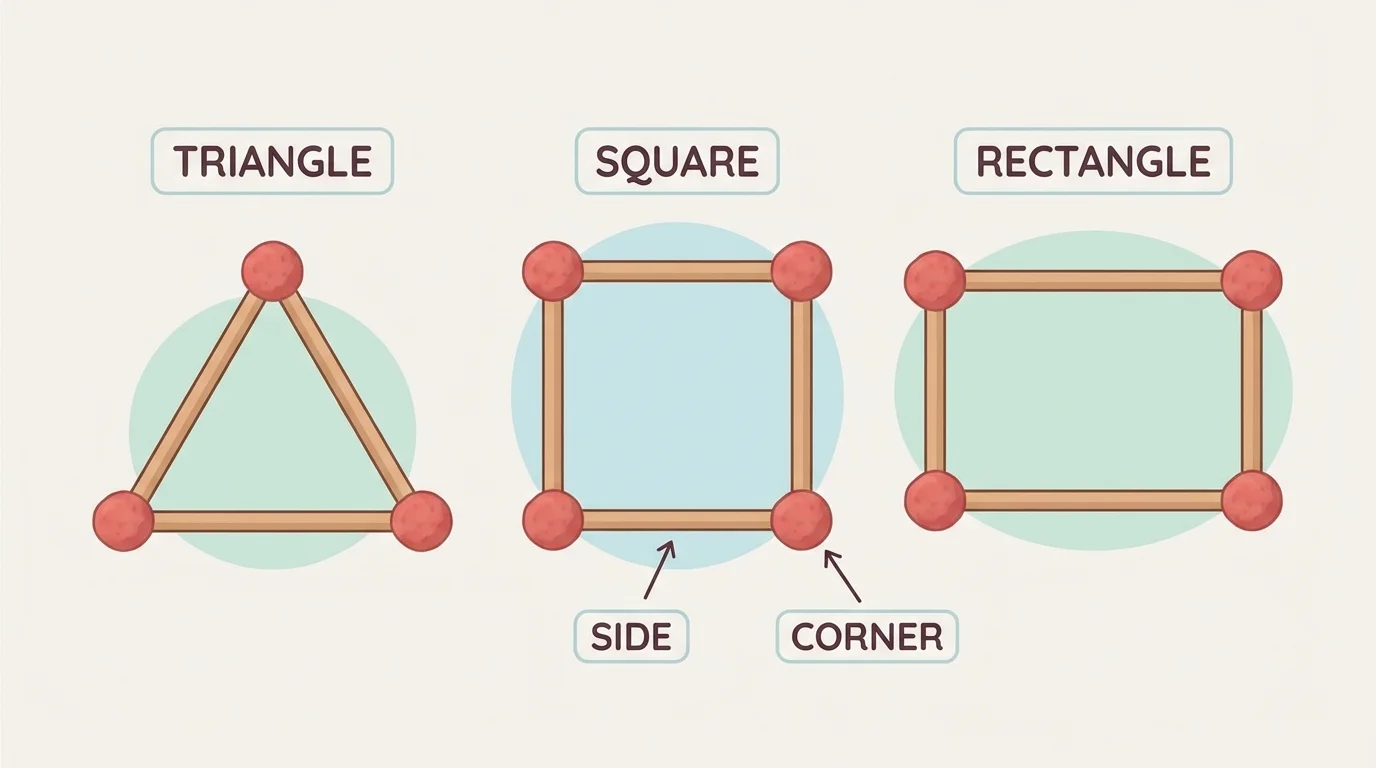
If the sticks do not join all the way around, the shape is not closed. A shape like a triangle or square is closed because the sides meet and make one whole path. Closed shapes are important because they make a complete figure.
Solved example 1
How can we build a triangle?
Step 1: Think about the number of sides.
A triangle has \(3\) sides.
Step 2: Match sides to sticks.
We need \(3\) sticks.
Step 3: Think about the corners.
A triangle has \(3\) corners, so we need \(3\) clay balls.
The built shape uses \(3\) sticks and \(3\) clay balls.
When you build carefully, you can feel the shape with your fingers and see where the sides meet. That makes the idea of a shape easier to understand.
A built shape and a drawing can represent the same shape. The model and the picture match: both have the same number of sides and corners. A drawing is another way to show what you built.
[Figure 2] shows examples of this match. If you build a square with \(4\) sticks, you can draw a square with \(4\) lines. If you build a triangle with \(3\) sticks, you can draw a triangle with \(3\) lines. The drawing does not need clay balls, but the corners are still there where the lines meet.
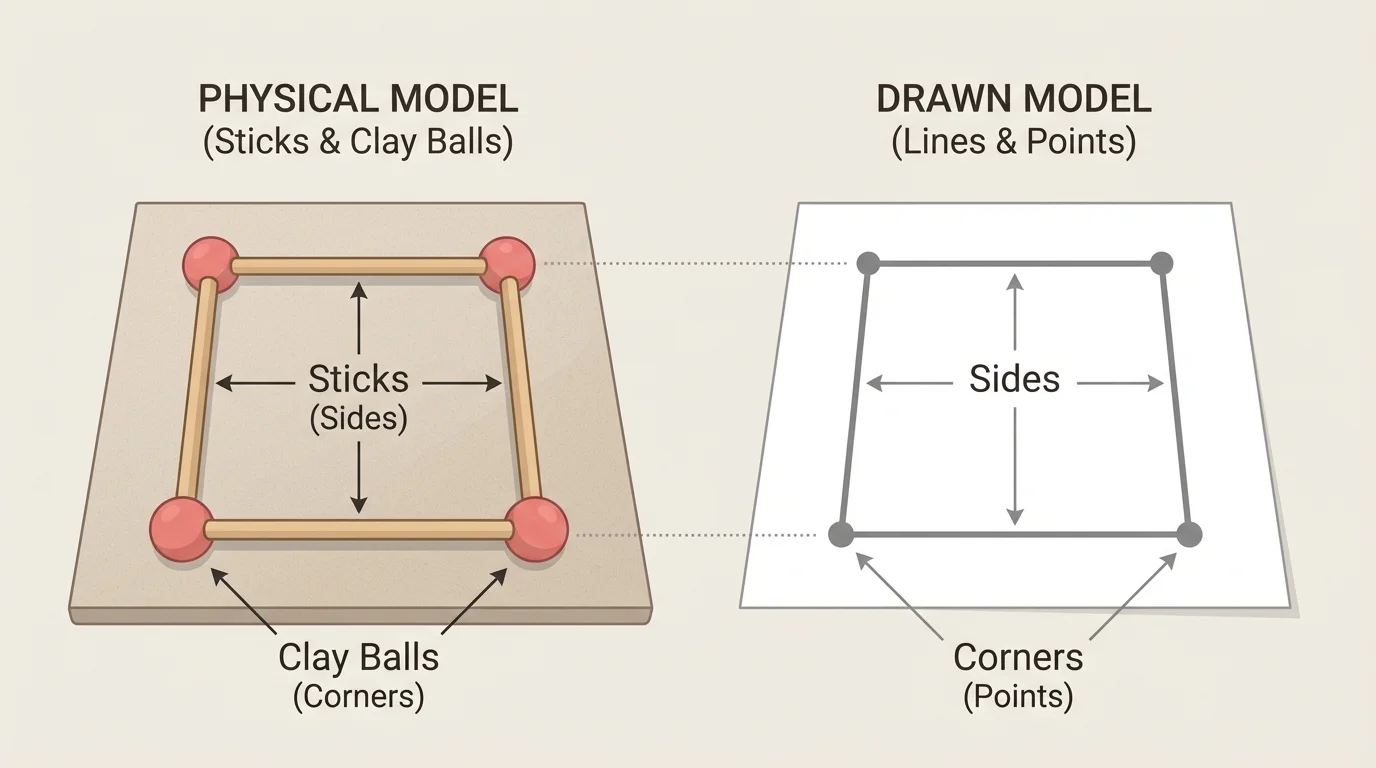
Drawings help us remember shapes. They also help us share ideas. You might build a rectangle first and then draw it on paper. Even though one is made with materials and one is made with lines, both represent the same figure.
Solved example 2
A child builds a square. How can the child draw it?
Step 1: Count the sides on the built shape.
A square has \(4\) sides.
Step 2: Draw the sides.
Draw \(4\) straight lines that meet.
Step 3: Check the corners.
The lines meet to make \(4\) corners.
The drawing is a square with \(4\) sides and \(4\) corners.
When you compare the model to the picture, the important idea stays the same: shape names come from how the parts fit together.
Shapes can join to make bigger shapes. A small shape does not disappear when it joins another shape. We can still notice the smaller parts inside the larger one.
[Figure 3] shows examples of this idea. For example, \(2\) triangles can join to make a larger shape with \(4\) sides. Sometimes \(2\) small squares can join to make a rectangle. This is called putting shapes together, or composing shapes.
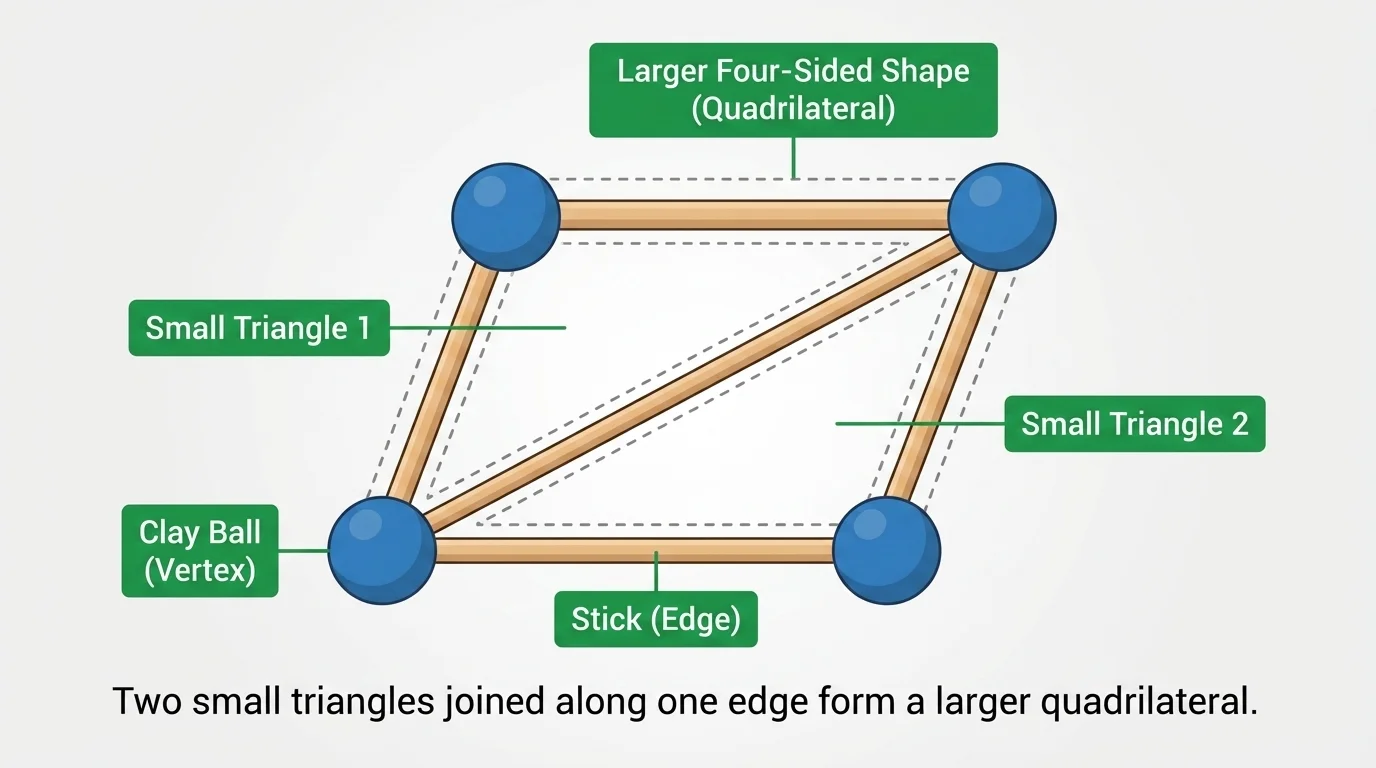
This is an important geometry idea. We do not look at only one shape at a time. We also notice how smaller shapes can build something new. A roof shape may look like a triangle on top of a rectangle. A picture can have many shapes inside it.
Solved example 3
What larger shape can we make with \(2\) small squares placed side by side?
Step 1: Put the \(2\) squares together.
The squares touch along one side.
Step 2: Look at the outside edge.
The outside makes a longer shape with \(4\) sides.
Step 3: Name the new shape.
The new shape is a rectangle.
So, \(2\) small squares can make \(1\) rectangle.
Later, when you look at buildings or toys, you can look for small shapes hiding inside bigger ones.
Geometry is not only on paper. It is in the world around us. A window may be a rectangle. A clock may be a circle. A sandwich cut in half may make triangles. A kite may look like a special four-sided shape.
Builders, artists, and designers all use shapes. Toy blocks stack neatly because many of them have square or rectangular faces. Road signs often use clear shapes so people can notice them quickly. When we model shapes with sticks and clay balls, we practice seeing those same shapes in real life.
Building, drawing, and noticing are connected. When children build a shape, they learn how its parts fit together. When they draw it, they represent the same idea in a new way. When they spot it in the world, they understand that geometry belongs to everyday life.
The triangle, square, and rectangle models from [Figure 1] connect directly to real objects such as roofs, floor tiles, and books. The matching picture in [Figure 2] shows how a real model can become a simple drawing.
Some shapes may look alike at first, so we compare them. A square and a rectangle both have \(4\) sides and \(4\) corners. A triangle has only \(3\) sides and \(3\) corners. A circle is different because it is round and has no corners.
We can organize what we know in a simple table.
| Shape | Sides | Corners | What to notice |
|---|---|---|---|
| Triangle | \(3\) | \(3\) | All sides are straight |
| Square | \(4\) | \(4\) | Sides match in length |
| Rectangle | \(4\) | \(4\) | Often has \(2\) long and \(2\) short sides |
| Circle | \(0\) straight sides | \(0\) | Round all the way around |
Table 1. Common shapes with their numbers of sides and corners.
Comparing shapes helps us name them correctly. It also helps us build them correctly. If a shape has \(3\) corners, it cannot be a square. If it is round with no corners, it is not a triangle or rectangle.
You already know how to look for things that are the same and different. Geometry uses that same idea. We look at shapes and ask what matches and what does not match.
Careful looking is part of being a mathematician. We count sides, count corners, and notice whether shapes are straight or curved, small or large, alone or joined with other shapes.
