Have you ever looked at a puzzle piece picture and noticed that one big picture is made from many small parts? Shapes can work like that too. A small shape can join with another small shape, and together they can make one bigger shape. This is called putting shapes together, or composing shapes.
Composing shapes means putting two or more small shapes together to make a new, larger shape. For example, one triangle is a small shape. Another triangle is a small shape. Put them together the right way, and they can make a rectangle, a square, or a bigger triangle.
When we build with shapes, we look carefully at the sides and corners. We want to see how the shapes fit. Sometimes they fit neatly. Sometimes they do not. If the shapes leave a gap, then they do not make one full larger shape yet.
Small shape means one shape by itself, like one triangle or one square. Larger shape means the new shape made when small shapes join together. A rectangle has four sides, and a triangle has three sides.
We can think of shapes like blocks on the floor. One block by itself is nice, but two or three blocks together can make something new. Shapes do the same thing in geometry.
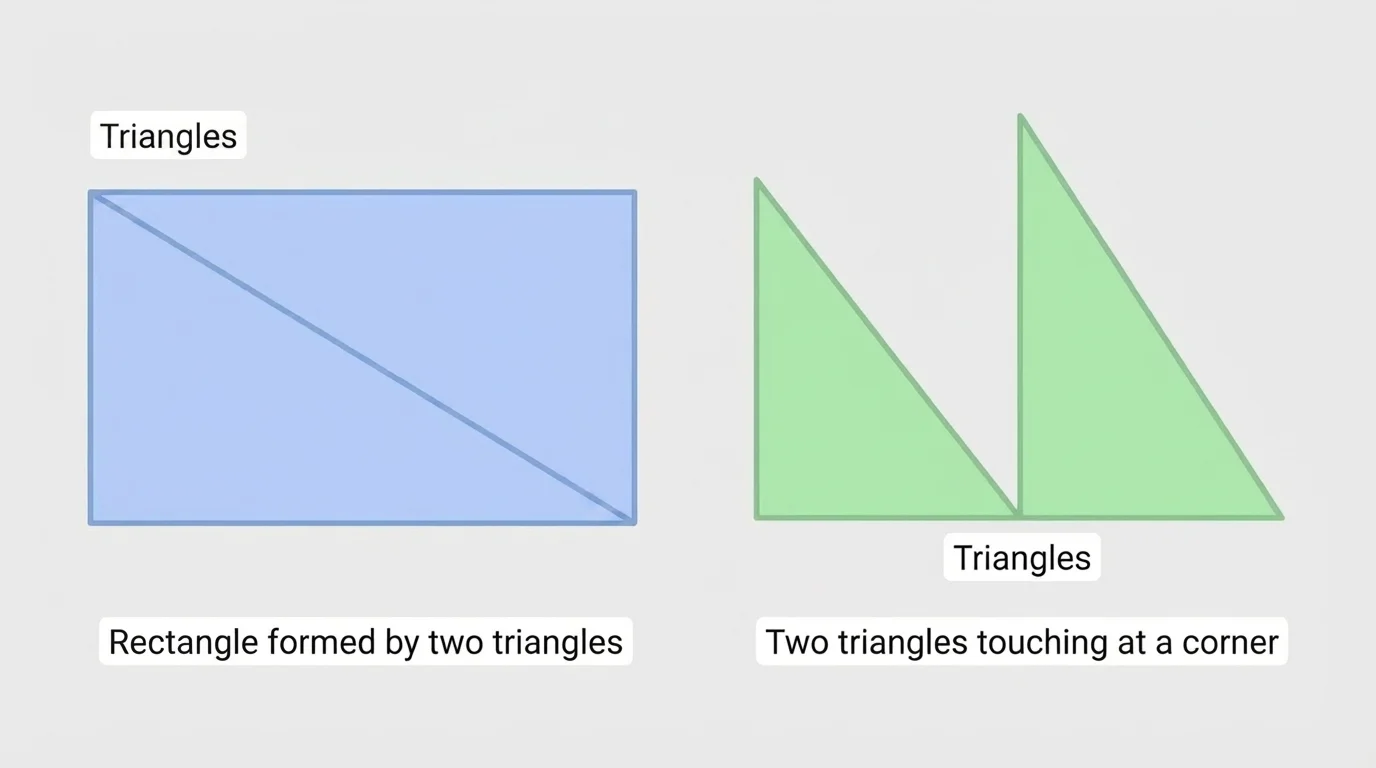
Shapes usually join best when one whole side touches another whole side, as [Figure 1] shows. If shapes only touch at one tiny corner, they are touching, but they are not making one full larger shape in the same strong way.
If two triangles have full sides touching, they can fit snugly together. "Full sides touching" means the side of one shape matches the side of the other shape all the way from one end to the other end. That helps us make a closed shape with no hole in the middle.
A corner is where two sides meet. Corners matter, but for making larger shapes, we often look first at the sides. Matching side to side helps shapes fit together neatly.
Why full sides matter
When full sides touch, the shapes line up. The new outside edge is easier to see, and that helps us name the larger shape. If sides do not line up, we may get gaps, overlaps, or a shape that is harder to name.
Later, when you look again at [Figure 1], you can see that one pair of triangles makes a clear bigger shape, while the pair touching only at a point does not make the same kind of neat larger shape.
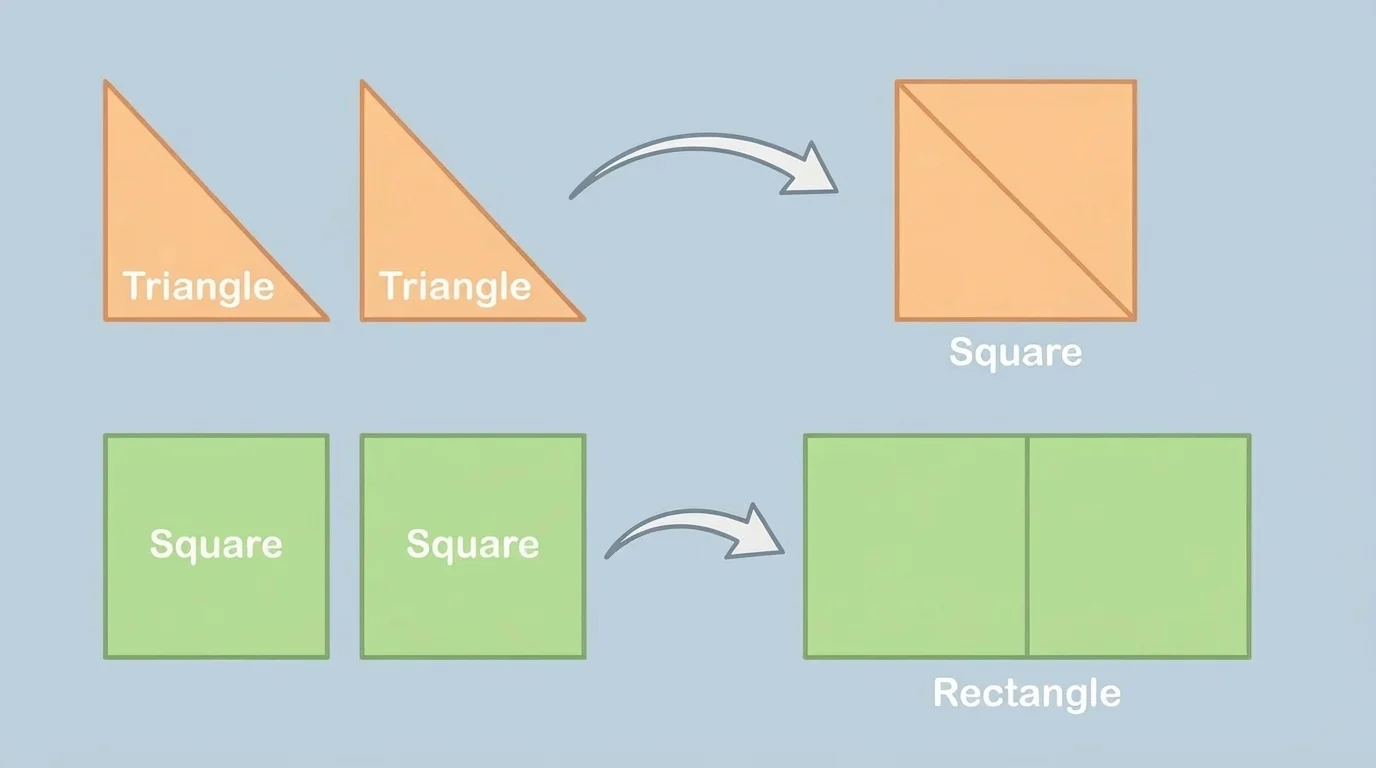
The same small shapes can make different larger shapes, as [Figure 2] illustrates. That is one of the fun things about geometry. We can turn, flip, and slide shapes to see new ways they fit.
Two equal triangles can join to make a square. Two equal triangles can also join to make a rectangle, depending on the kind of triangles and how they are placed. When the sides match, the outside edge becomes the new big shape.
Two squares can join side to side and make a rectangle. One square has four equal sides. When two same-size squares touch along one full side, the new shape is longer. That larger shape is often a rectangle.
We do not only look at the small parts. We also ask, "What is the whole shape now?" That is an important geometry idea. We can see parts and whole at the same time.
Many floor patterns, quilts, and picture mosaics are made by putting simple shapes together. Designers use tiny shapes to make beautiful larger patterns.
When you return to [Figure 2], notice that the little shapes are still there, but your eyes can also see the big shape they make together.
Many little shapes can fit together to make one big shape. We are not limited to only two shapes. Three, four, or even more shapes can join to build something larger.
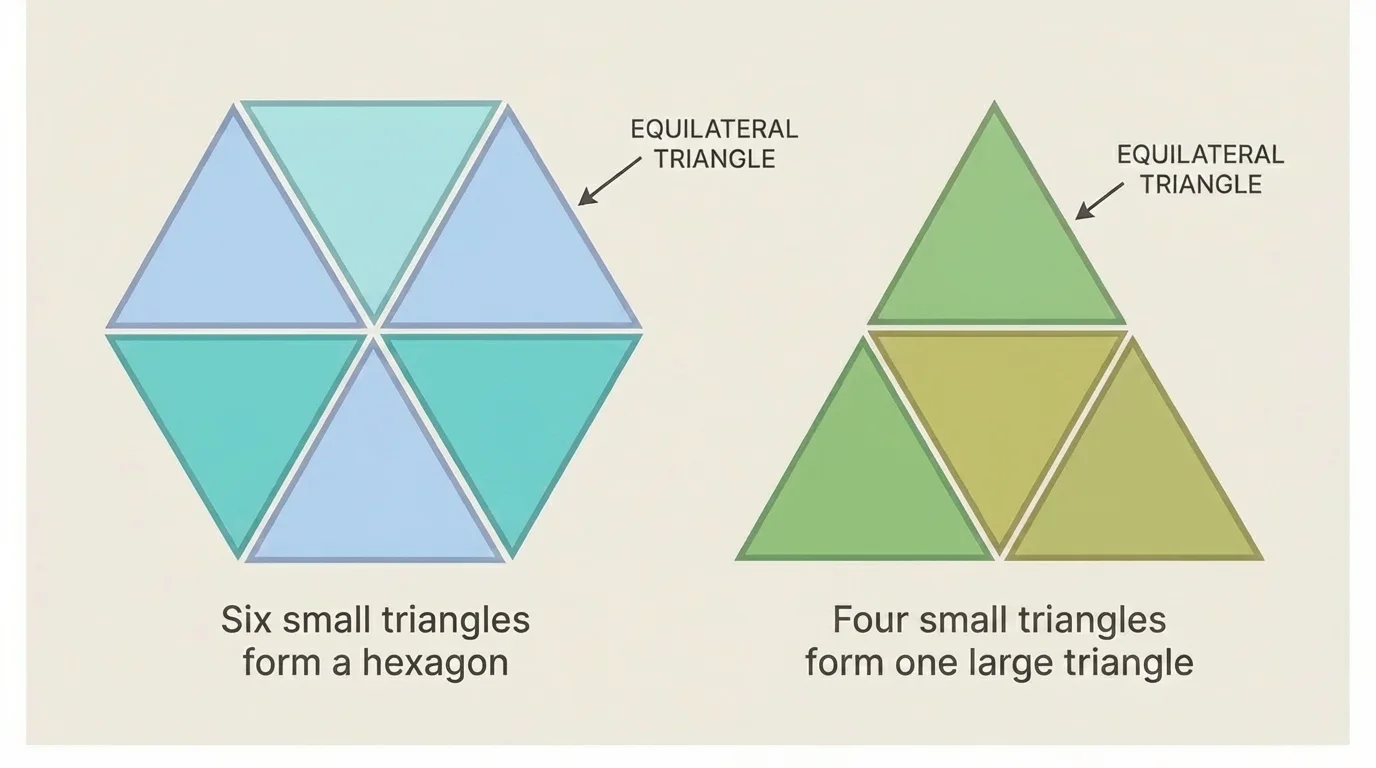
[Figure 3] For example, three triangles can make a bigger triangle. Six small triangles can make a hexagon. A hexagon is a shape with six sides. When the triangles are arranged carefully, the outside edge becomes the new larger shape.
Sometimes a larger rectangle can be made from many small squares. If four same-size squares are placed in a \(2 \times 2\) arrangement, they make one bigger square. If two same-size squares are placed in a \(1 \times 2\) arrangement, they make a rectangle.
You may already know shape names like triangle, square, rectangle, and hexagon. When we compose shapes, we still use those same names. We are just looking for the new bigger shape made by the pieces.
The pattern in [Figure 3] helps us see that one large shape can be built from many small shapes that are alike.
After shapes join, we look at the outside. The outside edge tells us the name of the new shape. If the outside has three straight sides, it is a triangle. If it has four sides and opposite sides match, it may be a rectangle. If it has six sides, it may be a hexagon.
We also check whether the shape is closed. A closed shape has no gaps. If there is a space left open, then the shapes have not made one full larger shape yet.
Turning a shape does not change what shape it is. A triangle is still a triangle when it turns. A square is still a square when it turns. That is helpful when we try different ways to fit shapes together.
People use composed shapes in many places. Builders use tiles to cover floors. Toy blocks make towers and walls. Puzzle makers use little pieces to form one picture. Artists use small shapes to make pictures of houses, animals, and trees.
A roof in a picture may look like a triangle on top of a rectangle. A window may be a square. A wall may be a large rectangle made from smaller rectangles. Geometry helps us notice how big things are made from simple parts.
Let's look at some simple examples of making larger shapes.
Example 1
Two triangles are joined with one full side touching. What larger shape can they make?
Step 1: Look at how the shapes touch.
The two triangles touch along one whole side.
Step 2: Look at the outside edge.
The outside has four sides and forms a rectangle.
Step 3: Name the new shape.
The two triangles can make a rectangle.
Answer: The larger shape is a rectangle.
This is a common way to see that small pieces can make one larger shape with a new name.
Example 2
Two same-size squares are put together side to side. What larger shape do they make?
Step 1: Count the small shapes.
There are \(2\) squares.
Step 2: See how they join.
They touch on one full side.
Step 3: Look at the outside.
The new outside is longer than one square and has \(4\) sides.
Step 4: Name the shape.
The larger shape is a rectangle.
Answer: \(2\) squares can make \(1\) rectangle.
Here we can see a parts-and-whole idea: two small equal shapes become one larger shape.
Example 3
Three small triangles are put together with sides matching. What larger shape might they make?
Step 1: Check that the sides fit with no gaps.
The triangles join neatly.
Step 2: Look only at the outside edge.
The outside edge has \(3\) sides.
Step 3: Name the larger shape.
A shape with \(3\) sides is a triangle.
Answer: The \(3\) small triangles can make \(1\) bigger triangle.
Sometimes the larger shape has the same name as the smaller shapes, but it is bigger. Small triangles can make a larger triangle.
