Look around a room and you can spot numbers everywhere: on books, clocks, doors, and toys. Those little marks help us tell how many. Today we will learn to look at a written number like \(4\) or \(9\), say its name, and know what amount it means.
A numeral is a written symbol for a number. The numeral \(3\) is written one way, and its number name is three. When we see \(3\), we can say "three" and think of a group with three things.
Each numeral has a name: \(0\) is zero, \(1\) is one, \(2\) is two, \(3\) is three, \(4\) is four, \(5\) is five, \(6\) is six, \(7\) is seven, \(8\) is eight, \(9\) is nine, and \(10\) is ten.
Numeral means a written number symbol, like \(2\) or \(8\). A numeral tells us a number name and can match an amount.
When we count objects, we can stop at the last object and say how many there are. That amount is the quantity. A written numeral helps us show that quantity without holding the objects.
We can match each numeral to an amount, as [Figure 1] shows. If we see \(1\), we think of one ball. If we see \(5\), we think of five fingers. If we see \(10\), we think of ten toes.
Here is the set of numerals in order: \(0, 1, 2, 3, 4, 5, 6, 7, 8, 9, 10\). Each one has its own shape. Some are curvy, like \(3\) and \(8\). Some are straight, like \(1\). The numeral \(10\) is special because it uses two digits: \(1\) and \(0\).
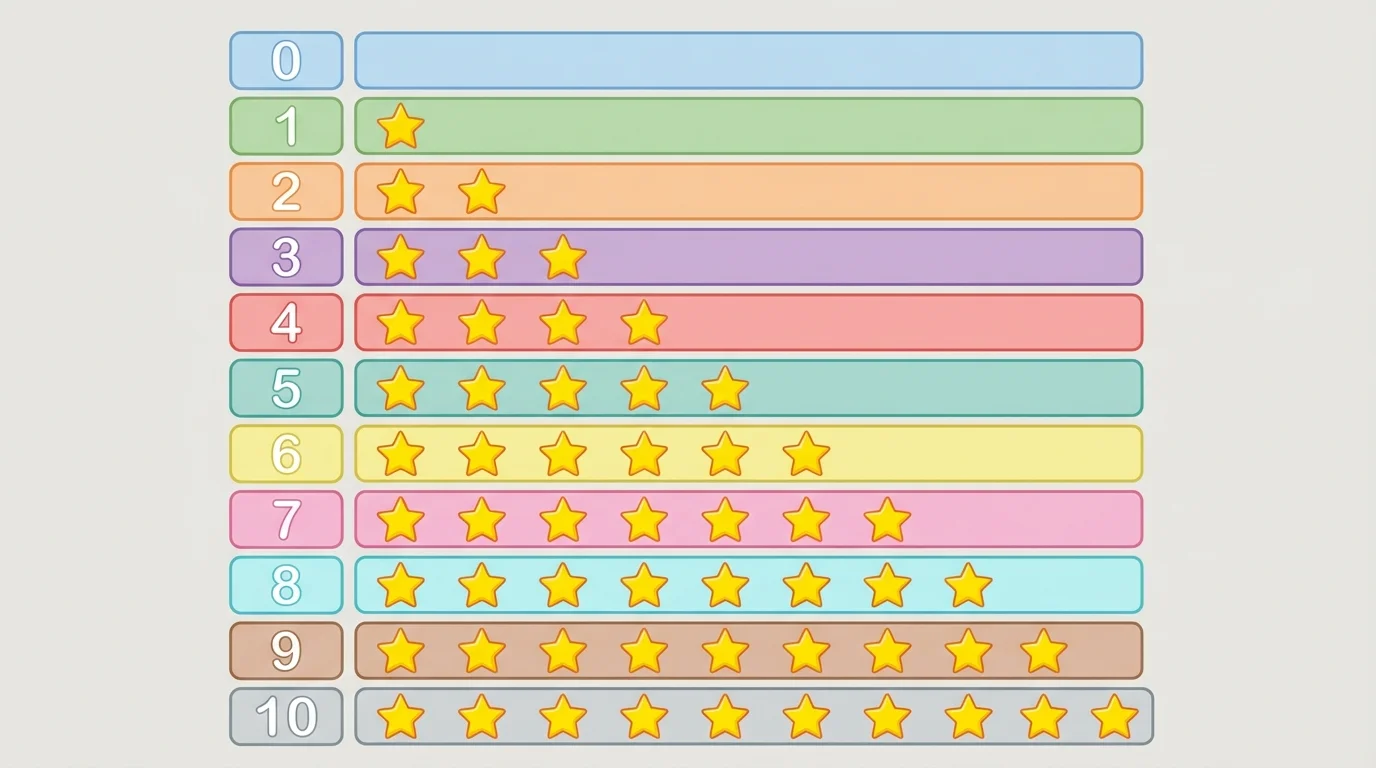
Let's name them carefully: \(0\) zero, \(1\) one, \(2\) two, \(3\) three, \(4\) four, \(5\) five, \(6\) six, \(7\) seven, \(8\) eight, \(9\) nine, \(10\) ten.
Solved example 1
What is the name of the numeral \(4\)?
Step 1: Look at the written numeral.
The numeral is \(4\).
Step 2: Say its number name.
\(4\) is four.
The numeral \(4\) is named four.
We also use numerals to talk about groups we can see. A picture with \(2\) ducks matches the numeral \(2\). A picture with \(7\) blocks matches the numeral \(7\). The chart in [Figure 1] helps us see that the written symbol and the amount belong together.
The numeral \(0\) is very important. Zero means there are no objects. If a basket has \(0\) apples, the basket is empty.
Sometimes children think zero is "nothing," so it does not count as a number. But zero is a number, and it has its own numeral: \(0\). We say "zero" when there are none.
Why zero matters
Zero helps us describe empty groups. If there are \(3\) cookies and then all \(3\) are gone, there are \(0\) cookies left. The numeral \(0\) tells us clearly that the quantity is none.
A plate with crackers might start with \(5\) crackers. After everyone eats them, the plate has \(0\) crackers. So \(0\) matches an empty set.
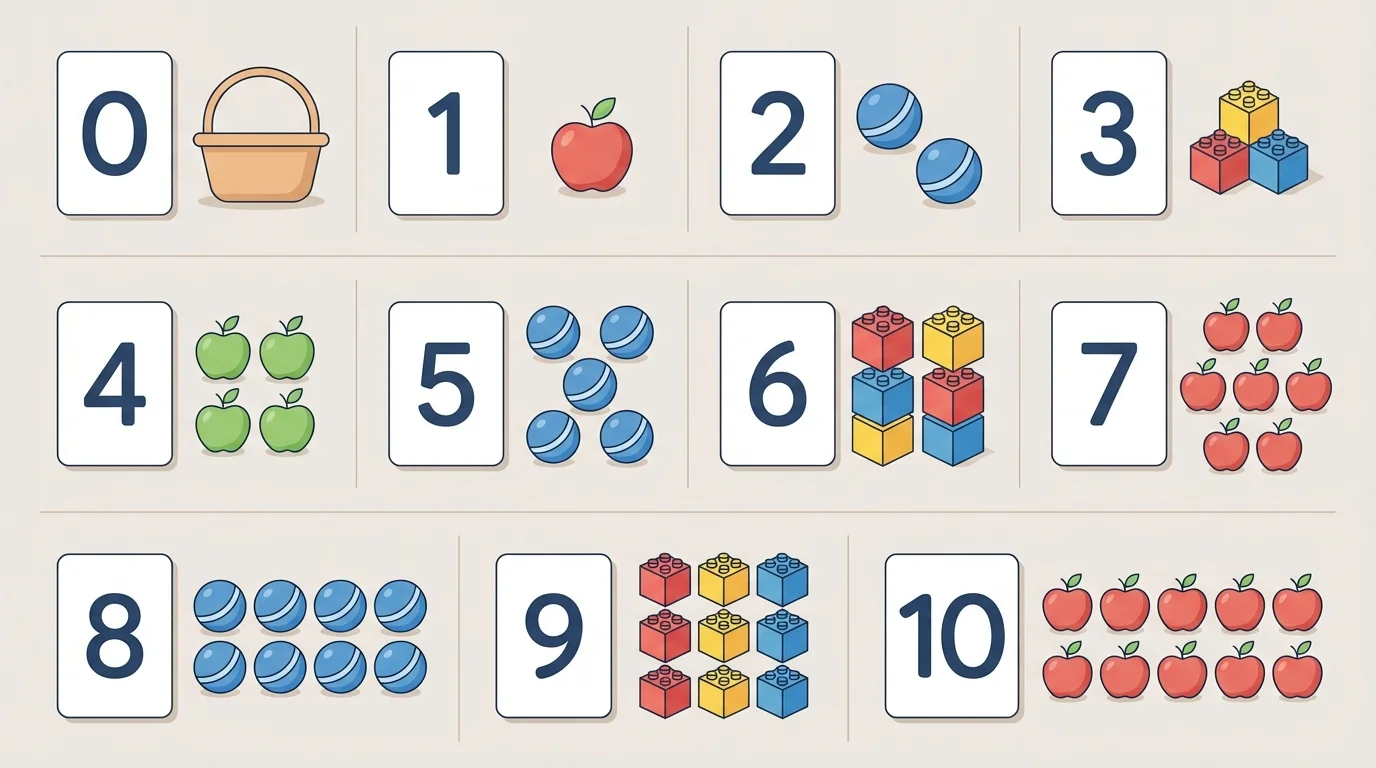
A numeral tells the number of objects in a group, as [Figure 2] shows with groups and number cards. We count each object once, then match the group to the numeral with the same amount.
If we count teddy bears and get \(1, 2, 3\), then the group matches the numeral \(3\). If we count shells and get \(1, 2, 3, 4, 5, 6\), then the group matches the numeral \(6\).
Solved example 2
There are three toy cars. Which numeral matches the group?
Step 1: Count the cars.
\(1, 2, 3\)
Step 2: Find the numeral with the same amount.
The count is \(3\).
The matching numeral is \(3\).
We can do the same with any small group. Count the items, stop at the last count word, and match that amount to the written numeral. This is called counting.
If a group has no blocks at all, it matches \(0\). If a group has ten beads, it matches \(10\). The matching idea stays the same from \(0\) all the way to \(10\).
Solved example 3
A box has no crayons in it. Which numeral matches the box?
Step 1: Look at the amount.
There are none.
Step 2: Choose the numeral for none.
The numeral for none is \(0\).
The matching numeral is \(0\).
Later, when we see many kinds of groups, we still use the same rule we saw in [Figure 2]: the numeral must match the quantity exactly.
Numerals can be read in order from smaller to larger amounts: \(0, 1, 2, 3, 4, 5, 6, 7, 8, 9, 10\). When we know the order, it is easier to recognize a numeral quickly.
Some numerals are neighbors. The numeral before \(5\) is \(4\). The numeral after \(5\) is \(6\). The numeral before \(10\) is \(9\).
Knowing order helps us notice if a numeral is bigger or smaller. For example, \(2\) comes before \(6\), so \(2\) is a smaller amount than \(6\). For very young learners, the main idea is simply that numerals follow a path in order.
The numeral \(8\) can look like two little circles stacked together, and \(10\) is the first numeral in this lesson made from two digits instead of one.
When children sing or say counting words, it helps them connect sounds and symbols. Saying "seven" while looking at \(7\) helps the brain link the name and the shape.
Numerals are not only for reading. [Figure 3] We can begin to write numerals too. Their shapes can be traced and copied, and the figure shows simple writing paths for some common numerals.
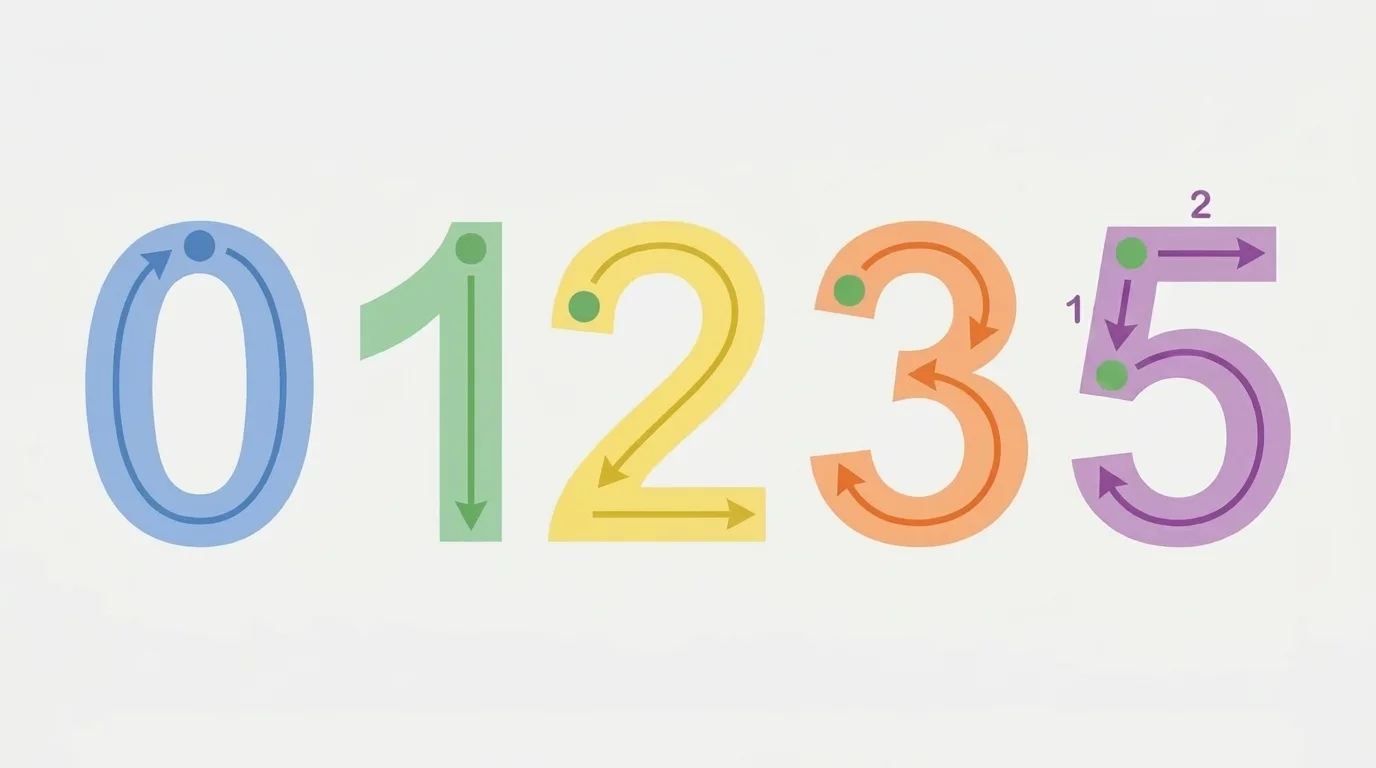
The numeral \(0\) is a round loop. The numeral \(1\) is a straight line. The numeral \(2\) has a curve and a line. The numeral \(3\) has two curves. The numeral \(5\) has a short line, a longer line, and a curve.
When beginning to write numerals, neat shape is more important than speed. A child may make a large \(4\) or a tiny \(4\); both can still mean four if the shape is clear enough to recognize.
Solved example 4
You see the written numeral \(10\). What do you say, and what amount does it mean?
Step 1: Read the numeral.
\(10\) is read as ten.
Step 2: Match it to an amount.
It means a group of ten objects.
The numeral \(10\) is named ten and matches a quantity of ten.
As children grow, writing becomes easier with practice. The shapes in [Figure 3] help them notice where a numeral starts and which way the pencil moves.
Written numerals are part of everyday life. A storybook may have page \(4\). An elevator button may show \(2\). A shirt label may show size numbers. A toy phone may have buttons with numerals from \(0\) to \(9\).
At snack time, a teacher might place \(5\) cups on a table. At cleanup time, a child might put \(1\) teddy bear in the bin. At the playground, \(0\) children may be on one swing while \(3\) children wait nearby. Numerals help us describe all of these amounts.
When you count objects, touch or look at each object one time. The last number word you say tells the total quantity. Then match that total to the written numeral.
Recognizing numerals helps children connect spoken counting, seen amounts, and written symbols. That is a big step in early math.
