Which plate has more cookies: a plate with \(2\) cookies or a plate with \(4\) cookies? When we look at two groups of things, we can tell if one group has more, less, or the same. Comparing helps us understand how many things are in each group.
When we compare groups, we look carefully at both groups, as shown in [Figure 1]. We can ask: "Which group has more?" "Which group has less?" or "Are they the same?"
If one group has \(4\) balls and another group has \(2\) balls, then \(4\) is more than \(2\). We can also say \(2\) is less than \(4\).
More means a group has a greater number of objects.
Less means a group has fewer objects.
The same means both groups have an equal number of objects.
If one group has \(3\) ducks and another group has \(3\) ducks, the groups are the same. We say \(3 = 3\).
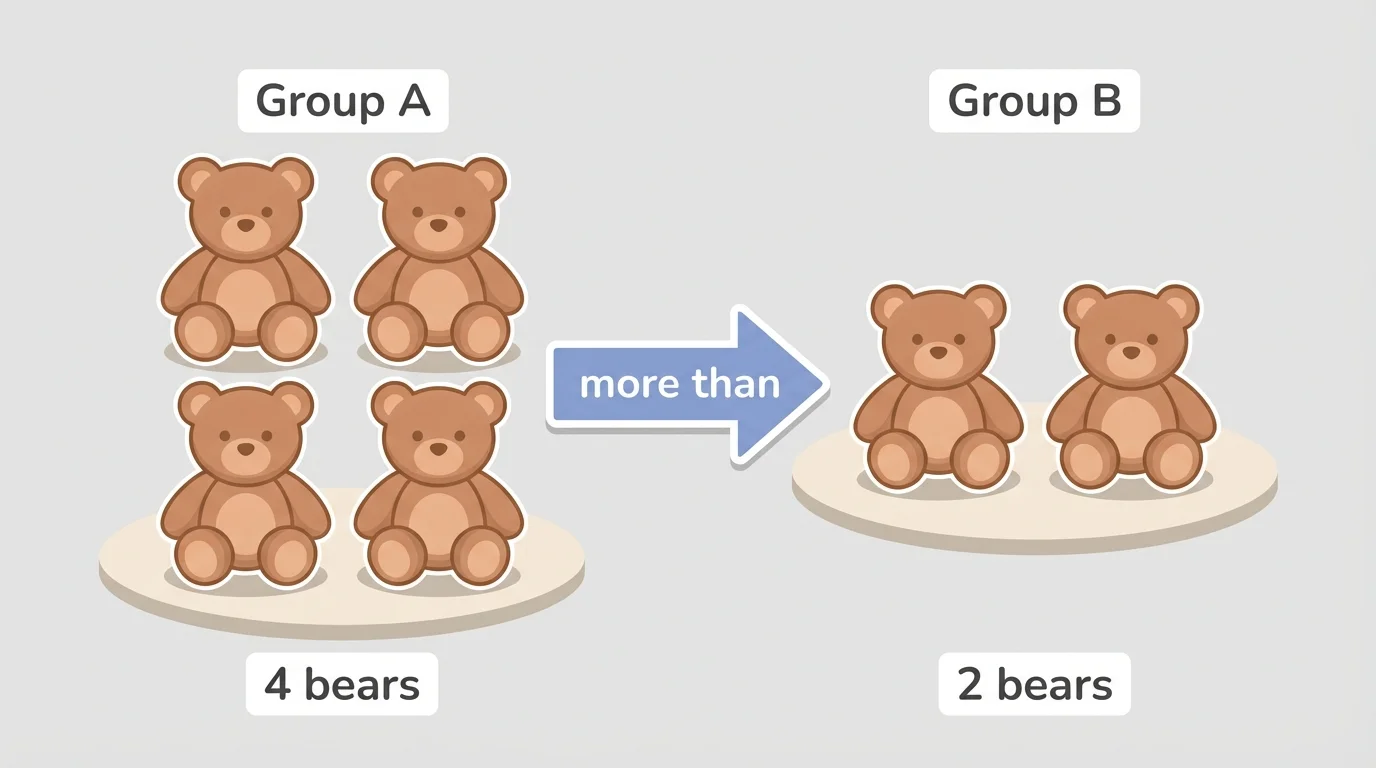
Sometimes you can see the answer quickly. A group that looks larger often has more objects. But counting helps us be sure.
To compare groups, we can count each group one time. Say one number for each object: \(1, 2, 3, 4, 5\). The last number tells how many are in the group.
Suppose you count one group: \(1\), \(2\), \(3\). That group has \(3\) blocks. Then you count another group: \(1\), \(2\), \(3\), \(4\). That group has \(4\) blocks. Since \(4 > 3\), the group with \(4\) blocks has more.
When you count, touch or point to each object once. This helps you not skip any objects or count the same object twice.
We can compare small numbers like \(1\), \(2\), \(3\), \(4\), and \(5\). If the numbers match, the groups are the same. If one number is bigger, that group has more.
Another way to compare is one-to-one matching, as [Figure 2] shows. We put one object from the first group with one object from the second group.
If every object gets a partner and none are left over, the groups are the same. If one group has an extra object after matching, that group has more. The other group has less.
Matching shows comparison clearly. You do not always need to count first. If you match one toy car to one garage, and every car fits with no extras, the groups are the same. If one car has no garage, then there are more cars than garages.
For example, match \(4\) cups with \(4\) straws. Every cup gets one straw, so the groups are the same. Match \(5\) crayons with \(4\) papers. One crayon is left over, so \(5\) crayons are more than \(4\) sheets of paper.
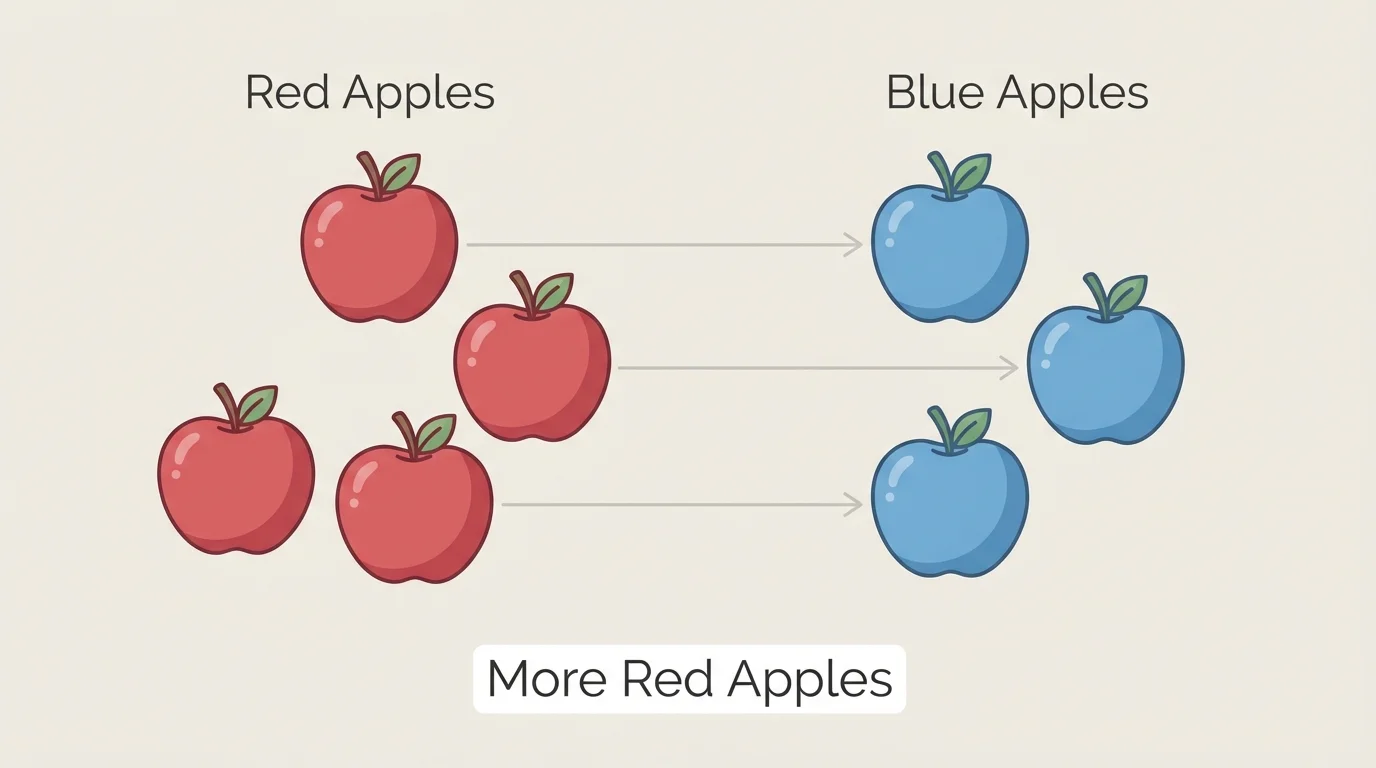
Later, when you compare other groups, you can remember the extra object. The extra one tells which group has more.
Let's look at some examples using counting and matching.
Example 1
Group A has \(2\) toy cars. Group B has \(5\) toy cars. Which group has more?
Step 1: Count Group A.
Group A has \(2\) objects.
Step 2: Count Group B.
Group B has \(5\) objects.
Step 3: Compare the numbers.
Since \(5 > 2\), Group B has more.
So, Group A has less, and Group B has more.
That comparison uses counting. We can also compare with groups that are equal.
Example 2
One plate has \(3\) grapes. Another plate has \(3\) grapes. Are they more, less, or the same?
Step 1: Count the first plate.
The first plate has \(3\) grapes.
Step 2: Count the second plate.
The second plate has \(3\) grapes.
Step 3: Compare.
Since \(3 = 3\), the groups are the same.
The two plates have the same number of grapes.
Matching also helps when we want to see leftovers.
Example 3
There are \(4\) hats and \(3\) dolls. Which group has more?
Step 1: Match one hat to one doll.
After matching, \(3\) hats are paired with \(3\) dolls.
Step 2: Look for extras.
There is \(1\) hat left over.
Step 3: Decide.
Because one hat is extra, \(4\) hats is more than \(3\) dolls.
So there are more hats, and fewer dolls.
Here is one more example with very small groups.
Example 4
Group C has \(1\) teddy bear. Group D has \(1\) teddy bear. What do we say?
Step 1: Count both groups.
Group C has \(1\). Group D has \(1\).
Step 2: Compare.
Since \(1 = 1\), the groups are the same.
Neither group has more. Neither group has less.
These examples show that comparing works with groups from \(1\) to at least \(5\).
You can compare toys, snacks, shoes, blocks, books, and many other things. If one child has \(5\) blocks and another child has \(2\) blocks, the first child has more blocks. If two shelves each have \(4\) books, the shelves have the same number of books.
This helps in real life. At snack time, a teacher can see if each child has the same number of crackers. During cleanup, children can compare baskets to see which basket has more toys.
Very young children often notice "more" before they know every number word. Comparing groups is one of the first big ideas in math.
As we saw earlier in [Figure 1], groups can be placed side by side to make comparison easier. And as in [Figure 2], matching can show an extra object right away.
[Figure 3] Sometimes groups look different but still have the same amount. One group might be in a line, and another group might be in a circle. We still count to check.
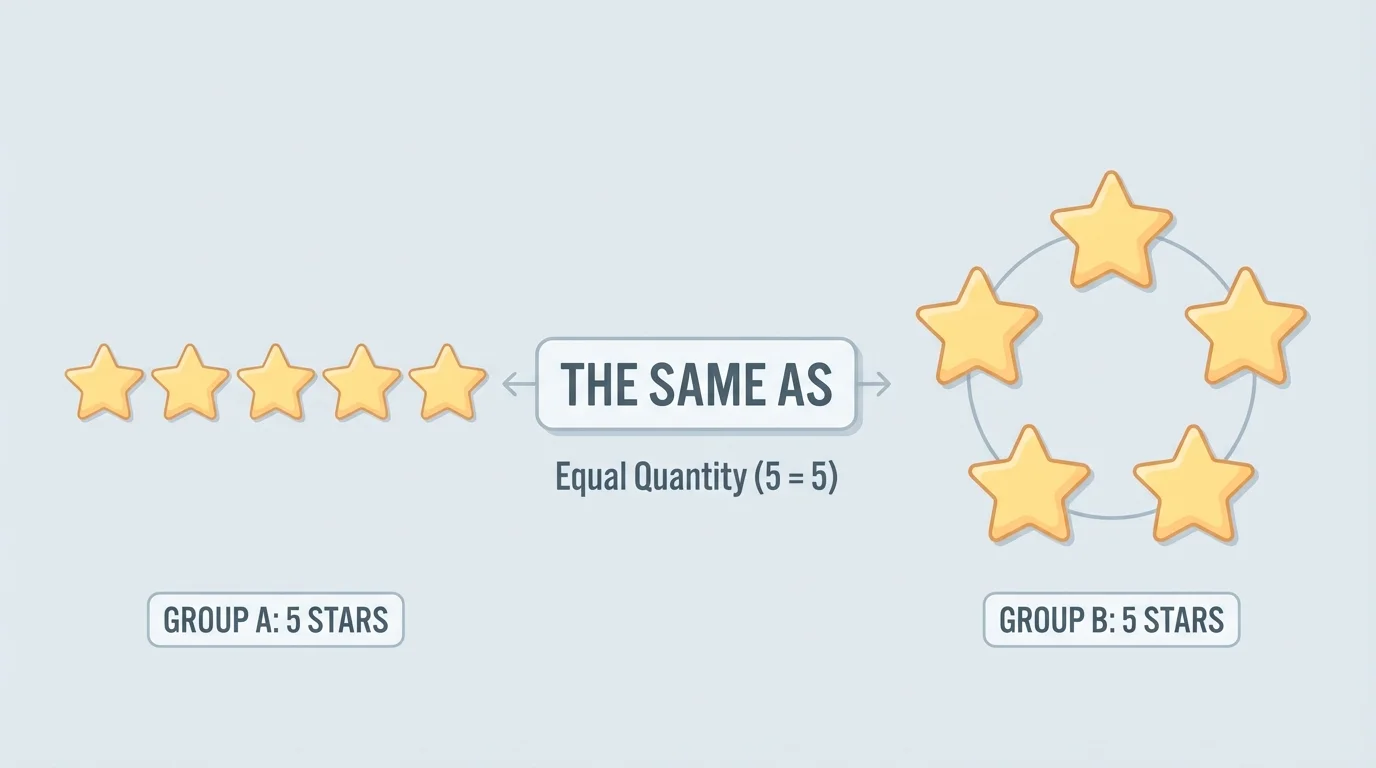
If one group has \(5\) buttons in a row and another group has \(5\) buttons spread out, the groups are the same because \(5 = 5\). Spacing does not change how many objects there are.
A long line of \(4\) cubes can sometimes look like more than a tight group of \(4\) cubes. Counting helps us know the truth. The amount stays the same when the objects are just moved around.
When you compare two groups, you can count each group or match objects one by one. Then you say more, less, or the same. If the numbers are \(2\) and \(5\), then \(5\) is more. If the numbers are \(4\) and \(4\), they are the same.
When groups are arranged in different ways, remember [Figure 3]: the way objects look on the page does not change the amount. Counting and matching help us compare correctly.
