What happens if one more teddy bear comes to the picnic? The number changes right away. When we count, each new number name means the group has one more. If we have \(1\) bear and then add \(1\) more bear, now there are \(2\) bears. Counting is a way to tell how many things there are.
Counting goes in order. We say \(1\), then \(2\), then \(3\), then \(4\). Each next number means one more than the number before. A number name is the word we say, like "one," "two," or "three." As [Figure 1] shows, when one apple is added, the number name moves to the next word.
If there is \(1\) ball, and we add \(1\) more ball, we say \(2\). If there are \(2\) balls, and we add \(1\) more ball, we say \(3\). The group keeps growing by just one each time.
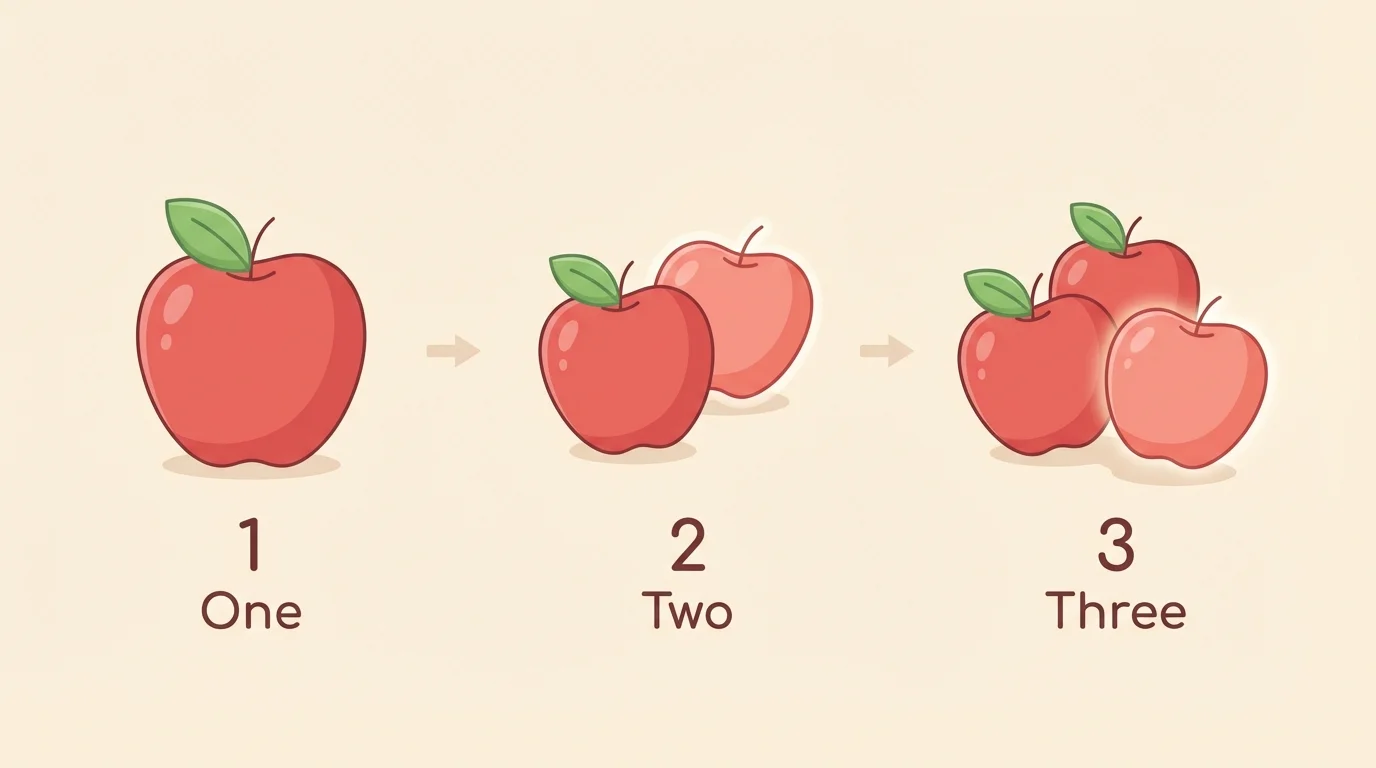
One more means adding exactly \(1\) object to a group. The next number name tells that new bigger group.
Quantity means how many things are in a group.
When we count slowly, each object gets one number word. One car gets \(1\). Two cars get \(1, 2\). Three cars get \(1, 2, 3\). We do not skip number names when we are counting in order.
A group of objects has a quantity. That means how many are in the group. The number word must match the group. A group with \(2\) ducks is called "two." A group with \(3\) ducks is called "three."
If we put out \(4\) blocks and touch one block as we say each number word, the count sounds like this: \(1, 2, 3, 4\). Each word matches one block. This helps us see that the next number name is for a group that is bigger by \(1\).
Numbers and groups stay together
When a group gets one new object, the number name moves to the next word. When a group has one less object, the number name moves back. So \(3\) is one more than \(2\), and \(2\) is one less than \(3\).
Think about crackers at snack time. If a plate has \(2\) crackers and one more cracker is added, the plate now has \(3\) crackers. The number word changes because the quantity changes.
When we count a group, the last number word we say tells how many things are there. This idea is called cardinality. If we count bears and say \(1, 2, 3\), then there are \(3\) bears. We do not need to count again to know the total.
This is why the next number name matters. If there are \(3\) shells and one more shell is added, we count to the next number name, \(4\). Now the last number said is \(4\), so there are \(4\) shells.
Very young children often learn number words before they fully know what each one means. Practice with real objects helps number words connect to real quantities.
When we hear numbers in order, we can notice the pattern: \(1\) is followed by \(2\), \(2\) is followed by \(3\), and \(3\) is followed by \(4\). Each next number name tells about a group that has one more object.
These examples use small groups, because small groups are easy to see and count carefully.
Example 1: Teddy bears
There is \(1\) teddy bear. One more teddy bear comes. How many teddy bears are there now?
Step 1: Start with the first quantity.
We begin with \(1\) teddy bear.
Step 2: Add one more.
\(1 + 1 = 2\)
Step 3: Say the next number name.
After \(1\), the next number name is \(2\).
The answer is \(2\) teddy bears.
Notice that the new number name is the next one in the counting order.
Example 2: Blocks
A tower has \(2\) blocks. One more block is added. How many blocks are in the tower?
Step 1: Start with \(2\) blocks.
Step 2: Add \(1\) block.
\(2 + 1 = 3\)
Step 3: Move to the next number name.
After \(2\), we say \(3\).
The tower has \(3\) blocks.
This shows that \(3\) is one more than \(2\).
Example 3: Claps
You hear \(3\) claps. Then you hear one more clap. How many claps did you hear?
Step 1: Start with \(3\).
Step 2: Add one more.
\(3 + 1 = 4\)
Step 3: Say the next number name.
After \(3\), the next number name is \(4\).
You heard \(4\) claps.
We can use objects we see and sounds we hear. In both cases, the next number name means one larger.
Counting happens all day. At snack time, \(2\) grapes become \(3\) grapes when one more grape is added. On the playground, \(4\) children become \(5\) children when one more friend joins. In a line, if \(1\) shoe is on the floor and one more shoe is placed beside it, now there are \(2\) shoes.
We can also notice one more when reading books, building with cubes, or putting toys away. If a basket has \(3\) cars and one more car goes in, the basket has \(4\) cars. The next number name always matches the bigger group.
[Figure 2] Numbers can also be shown in order along a path. Moving one step forward on the path means the quantity grows by \(1\). From \(1\) we step to \(2\). From \(2\) we step to \(3\). Each step is just one more.
This helps us see that numbers stay in order: \(1, 2, 3, 4, 5\). Every next number is bigger than the one before it. We do not jump over numbers when we are counting carefully.
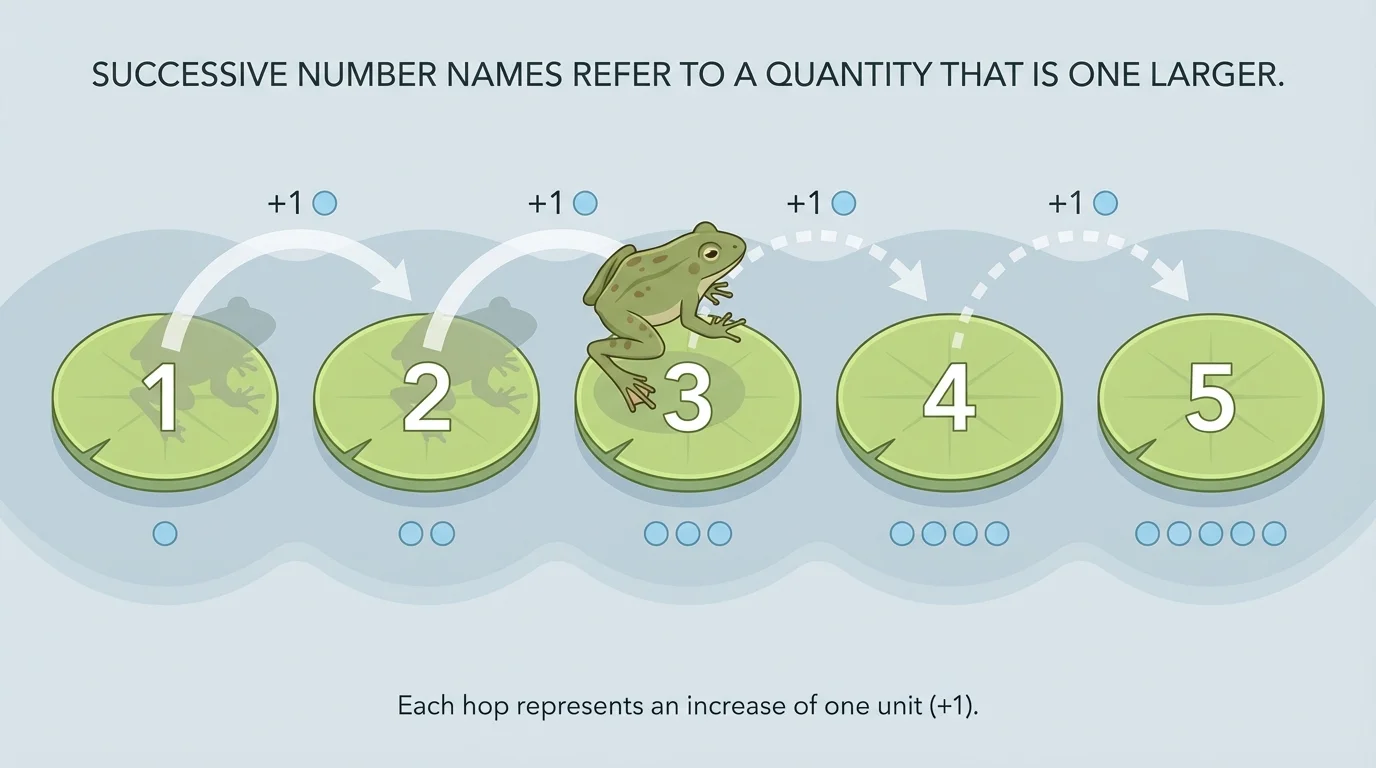
We saw the same idea earlier with apples in [Figure 1]. The group grows one by one, and the number name grows one by one too. The path in [Figure 2] shows that same pattern in a different way.
So when you hear the next number name, think: the group is bigger by exactly \(1\).
