You can be a number detective with your eyes. Sometimes you do not need to count each thing. When there are only a few objects, your brain can see the group quickly and know, "That is \(3\)!" or "That is \(5\)!" This helps you understand how many things are in a set.
When you look at a small set and know how many objects there are right away, you are recognizing the number in the set. You do not have to say, "\(1, 2, 3\)" while touching each object. You see the whole group at once.
This quick recognition works best for small groups up to \(5\). If you see \(2\) shoes, \(3\) blocks, or \(4\) crackers, you can often know the number right away. Then you can say the number or use a sign for the number.
Recognize the number means to know how many objects are in a small group just by looking. A set is a group of objects. The number tells how many are in the set.
Each object gets one count, but when the set is very small, your eyes and brain often work together so fast that counting is not needed. This is a big part of early number understanding.
Small groups are easy to notice, and [Figure 1] shows sets from \(1\) to \(5\) in clear boxes. When you see one toy, that is \(1\). When you see two socks together, that is \(2\). Little groups like these become familiar very quickly.
Here are some examples: \(1\) teddy bear, \(2\) eyes, \(3\) cookies, \(4\) wheels on a car, and \(5\) fingers on one hand. These are quantities you can often know right away.
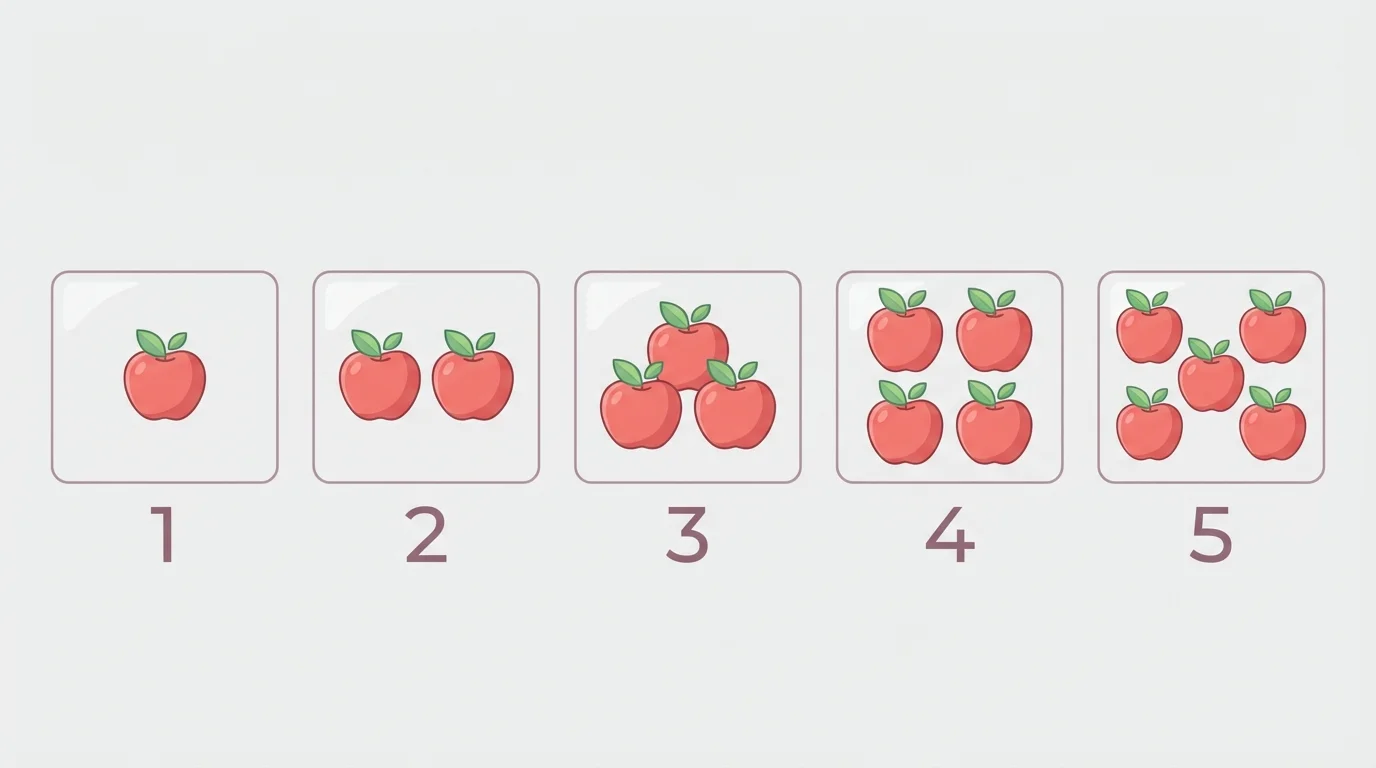
Knowing small quantities helps you connect the group you see to the number word. If there are \(3\) balls, the set matches the word three. If there are \(5\) ducks, the set matches the word five.
A set can have objects of the same kind or different kinds of objects. For example, one set might have \(2\) red blocks. Another set might have \(2\) leaves. The objects are not the same, but the quantity is the same: both sets show \(2\).
One hand is a helpful number tool. Many children learn the quantities \(1\) to \(5\) by looking at their fingers because each finger can stand for one object.
As you keep seeing small groups, your eyes learn the patterns. This is why familiar groups, like \(2\) shoes or \(4\) toy car wheels, are often easy to recognize.
A number does not change when objects move. [Figure 2] shows that \(4\) can look different in a line, a square, or a scattered group. Even when the objects are in new places, the set still has \(4\) objects.
For example, \(3\) buttons in a row are still \(3\). If the same \(3\) buttons are spread out, they are still \(3\). The arrangement changes, but the quantity stays the same.
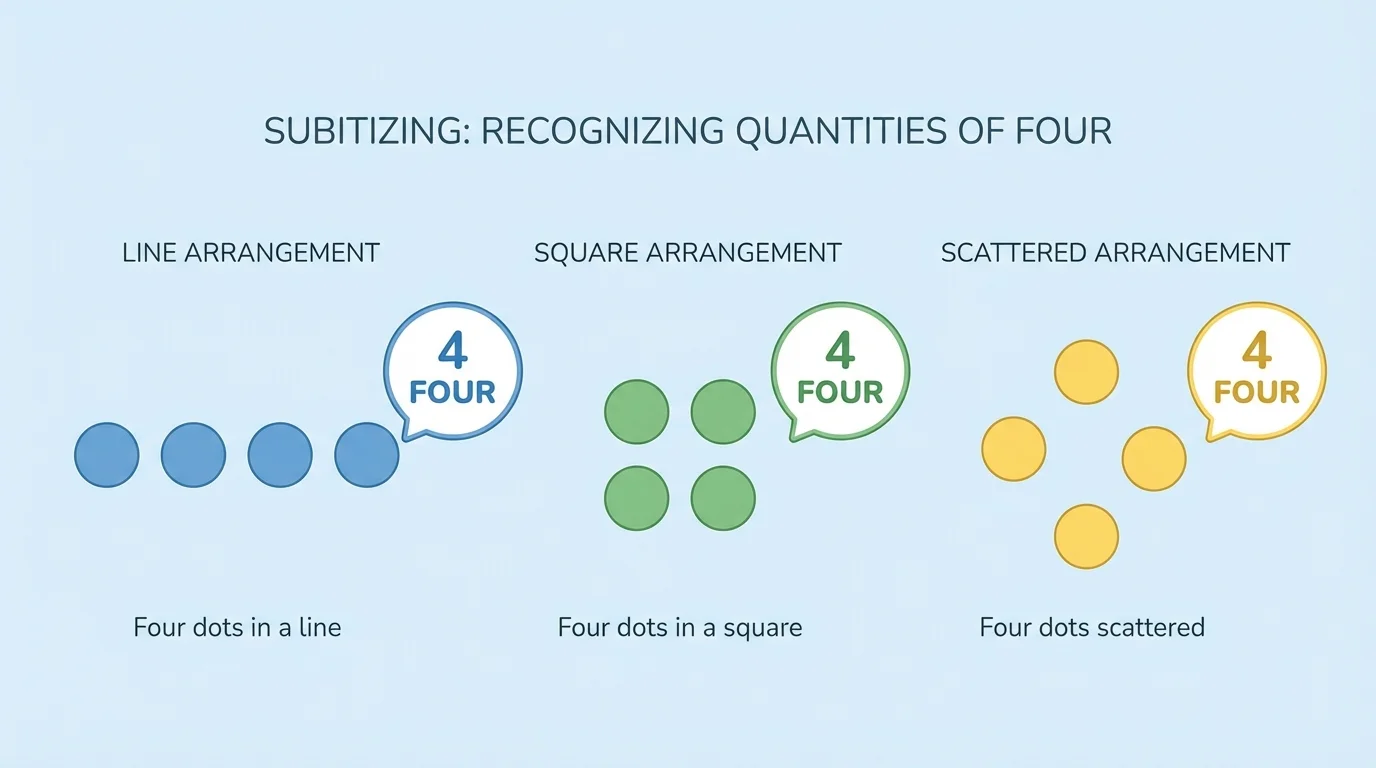
This idea is important because children sometimes think a longer row means more. But if one row has \(4\) shells close together and another row has \(4\) shells spread apart, both rows still show \(4\).
We can look for the whole group instead of only the shape. Later, when you see a new pattern of \(4\), you can remember from [Figure 2] that the same number can appear in many ways.
Same quantity, new arrangement
The amount in a set stays the same unless an object is added or taken away. Moving objects around does not change the number. A child who understands this is building strong number sense.
If there are \(5\) stars on a card, turning the card or mixing the stars around does not make the set become \(4\) or \(6\). It is still \(5\).
After you recognize the set, you match it to a number word or a sign. [Figure 3] shows small groups matched with labels from \(1\) to \(5\). Seeing the set and saying or signing the matching number helps the quantity and the number name stay together in your mind.
If you see \(2\) cups, you say or sign \(2\). If you see \(5\) crayons, you say or sign \(5\). The important idea is that the group and the number name match exactly.
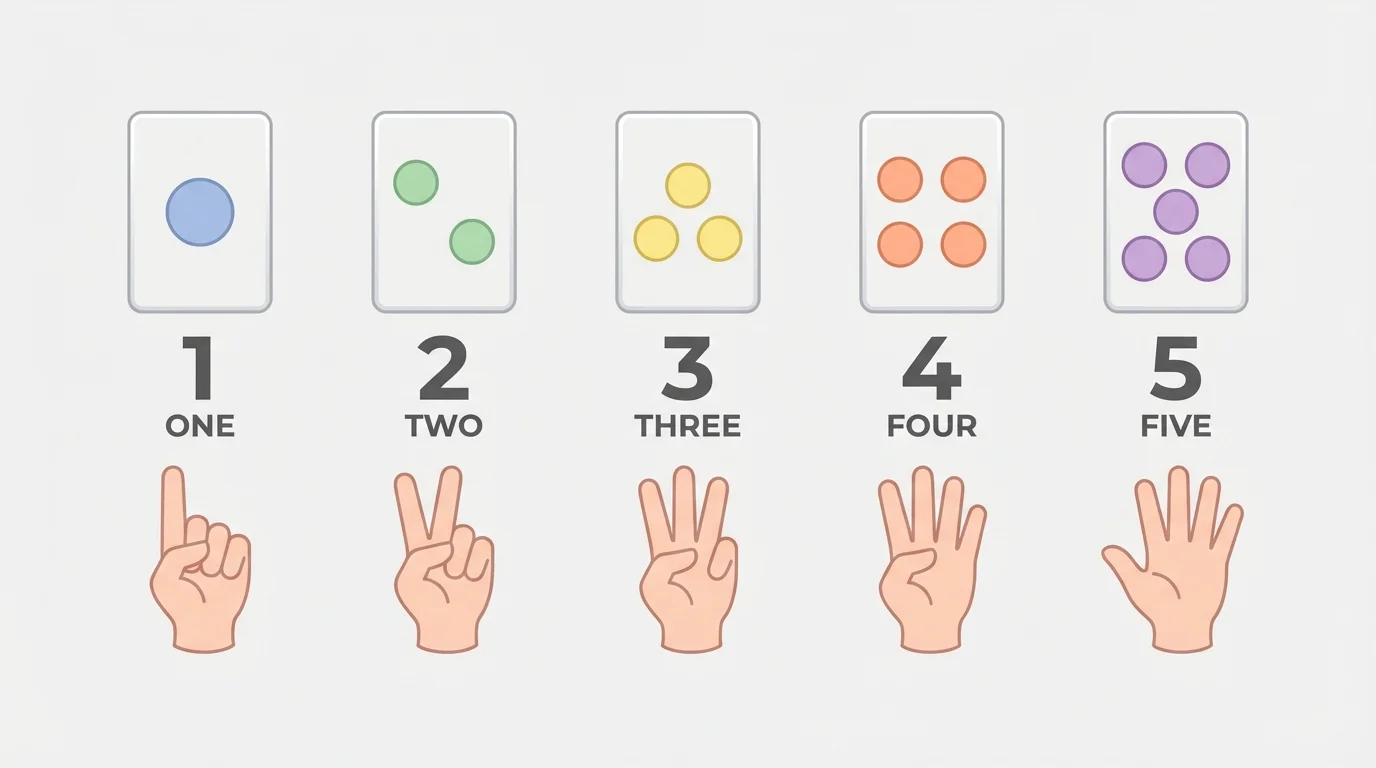
This helps children understand that numbers are not just words to repeat. Numbers tell how many objects are in the set. A child who says or signs \(4\) for a set of \(4\) objects is showing understanding of quantity.
Sometimes a child may know the set right away but need help remembering the number name. Looking again at matching examples, like those in [Figure 3], supports that connection.
Recognizing small sets happens all day long. At snack time, you might see \(3\) grapes. On the playground, you might notice \(2\) birds. During cleanup, you may pick up \(4\) blocks. These quick looks help you use numbers in real life.
Games also use small quantities. A spinner may land on \(1\), \(2\), or \(3\). A card game may show \(5\) dots. A puzzle may need \(4\) pieces in one corner. Knowing the amount quickly helps you play and solve problems.
You already know that counting tells how many. Now you are learning that with very small groups, your eyes can sometimes know the amount before you even start to count.
Nature is full of little sets too: \(1\) moon, \(2\) wings on a butterfly, \(3\) petals on a tiny flower, or \(5\) seeds in a small pod. Numbers help us describe the world.
These examples show how to look at a small set, notice the quantity, and match it to the number name.
Example 1
There are three toy cars on the rug.
Step 1: Look at the whole set.
You see a small group of cars.
Step 2: Recognize the quantity.
The group has \(3\) objects.
Step 3: Say or sign the number.
The correct number is \(3\), or three.
The set shows \(3\).
A small group like this is often recognized without counting one by one.
Example 2
A plate has four crackers.
Step 1: Look at the crackers together.
You see one small set.
Step 2: Match the set to the quantity.
The set has \(4\) crackers.
Step 3: Say or sign the number.
The matching number is \(4\), or four.
The set shows \(4\).
Even if the crackers are moved around, the set still has \(4\) unless one is added or taken away.
Example 3
On a page, there are two stars.
Step 1: Notice the small set.
The stars make a tiny group.
Step 2: Recognize the amount.
The amount is \(2\).
Step 3: Name the number.
The correct number word is two.
The set shows \(2\).
This same idea works for \(1\), \(3\), and \(5\) too. Small sets can be recognized quickly with practice and attention.
