Have you ever counted crackers, toys, or steps? Counting helps us know how many things there are. When we count, we say the number names in the right order: \(1, 2, 3, 4, 5, 6, 7, 8, 9, 10\). Each number word goes with one object.
Counting means saying numbers in order and touching, moving, or looking at one object at a time. We count like this: \(1, 2, 3, 4, 5\). Then we can keep going: \(6, 7, 8, 9, 10\).
When we count a group, we do not say all the numbers at once. We say one number word for one object. If there are \(3\) balls, we count: \(1\) for the first ball, \(2\) for the second ball, and \(3\) for the third ball.
Count means to say number names in order while matching each number word to one object. Object means a thing we can count, like a block, apple, or toy. How many means the total number in a group.
We can count many kinds of things: \(2\) shoes, \(4\) blocks, \(7\) leaves, or \(10\) fingers. The counting idea stays the same.
[Figure 1] A one-to-one correspondence means each object gets one number word. We do not give two number words to one toy, and we do not miss a toy.
If we count \(4\) cars, we can point like this: first car \(= 1\), second car \(= 2\), third car \(= 3\), fourth car \(= 4\). This helps us keep track.
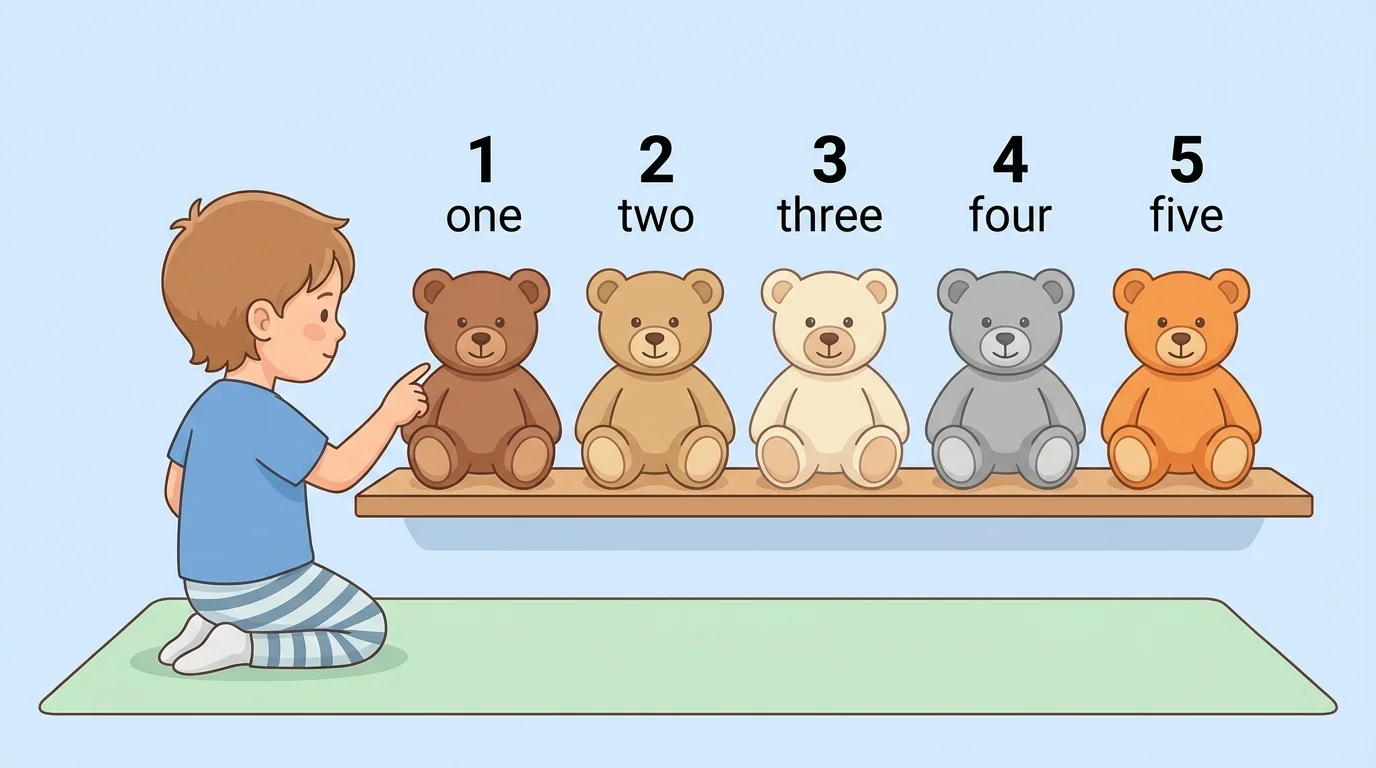
Sometimes children count too fast and forget to match the numbers to the things. Careful counters slow down. They point, touch, or move each object one time.
If there are \(5\) buttons in a row, we say \(1, 2, 3, 4, 5\) while touching one button each time. That is careful counting.
[Figure 2] After we count a whole group, the last number word tells the total, or cardinality, of the group. If we count ducks and say \(1, 2, 3, 4\), then there are \(4\) ducks.
This is an important idea. We do not need to count the same group again right away if we counted carefully. The last number already tells how many there are.
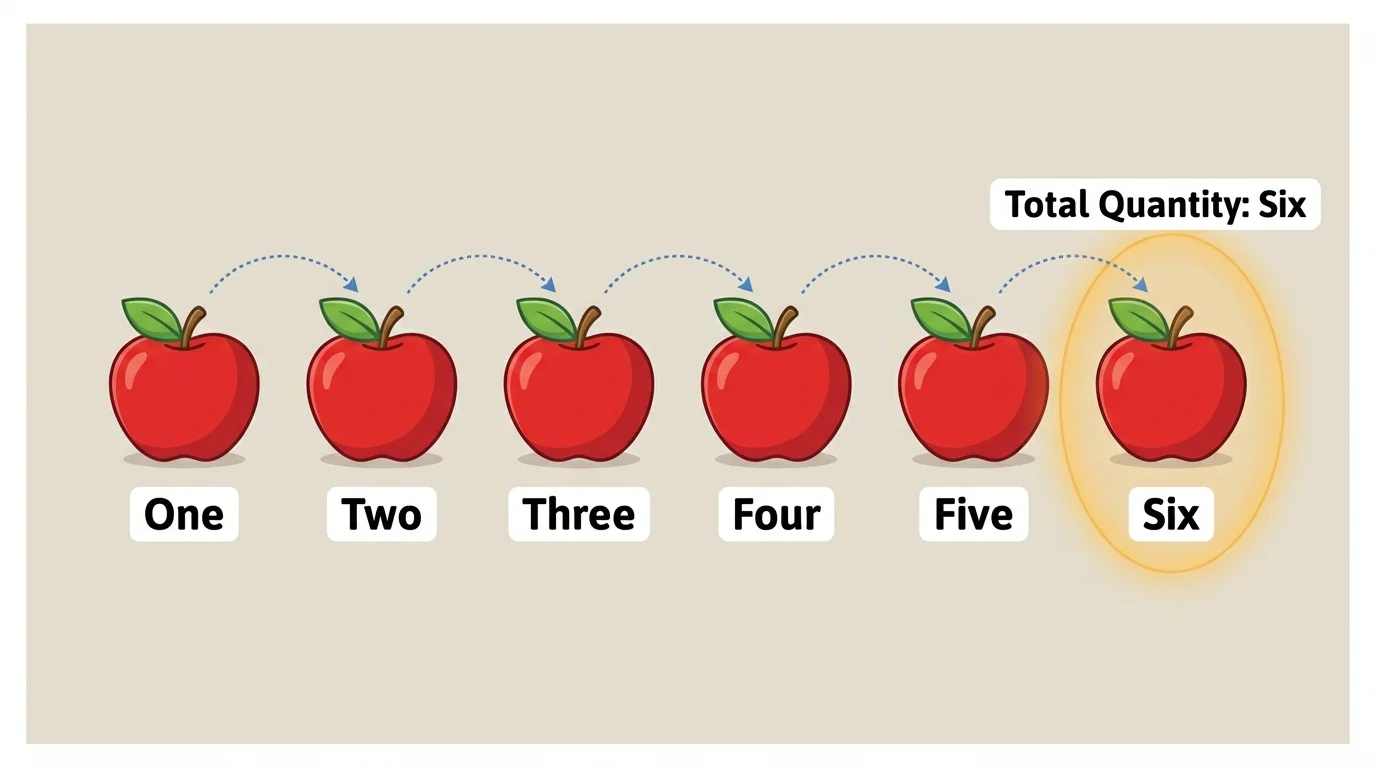
For example, if we count stars: \(1, 2, 3, 4, 5, 6\), the answer to "How many stars?" is \(6\). The last number said is \(6\).
The last number means the whole group
When a child counts one object at a time and says the number names in order, the final number name tells the size of the group. If the final number is \(8\), the group has \(8\) objects. This is true for blocks, snacks, steps, and many other things.
We can use this idea every day. Count \(3\) cups on a table, \(2\) socks in a pair, or \(10\) fingers on two hands. The final number tells the amount.
We count all around us. We can count \(1\) backpack, \(2\) shoes, \(3\) crayons, \(4\) cookies, and all the way to \(10\) blocks. Counting helps us share, clean up, and line up.
When you climb stairs, you might count \(1, 2, 3, 4, 5\). When you put toy animals away, you might count \(1\) zebra, \(2\) lion, \(3\) elephant. Counting makes groups easier to understand.
People can count things they can touch and things they only see, like birds in the sky or stars in a picture. The counting words stay in the same order.
We can also count sounds or claps. If we hear \(4\) drum taps, we can count them one by one: \(1, 2, 3, 4\).
Let's look at some careful counting examples.
Example 1: Count the bears
There are \(3\) teddy bears.
Step 1: Start with the first bear.
Say \(1\).
Step 2: Move to the next bear.
Say \(2\).
Step 3: Count the last bear.
Say \(3\).
The last number is \(3\), so there are \(3\) bears.
Each bear gets one number word. That is the same careful matching we saw earlier in [Figure 1].
Example 2: Count the blocks
There are \(5\) blocks.
Step 1: Count in order.
Say \(1, 2, 3, 4, 5\).
Step 2: Listen to the last number.
The last number said is \(5\).
So there are \(5\) blocks.
This works because the last number tells the total amount of the group.
Example 3: Count the fingers on one hand
One hand has \(5\) fingers.
Step 1: Touch one finger at a time.
Say \(1, 2, 3, 4, 5\).
Step 2: Stop when every finger has been counted once.
No finger should get counted two times.
The group has \(5\) fingers.
Now think about two hands. If one hand has \(5\) fingers and the other hand has \(5\) fingers, together they make \(10\) fingers.
Example 4: Count the ducks
There are \(7\) ducks in a picture.
Step 1: Point to each duck one time.
Say \(1, 2, 3, 4, 5, 6, 7\).
Step 2: Use the last number.
The last number said is \(7\).
So there are \(7\) ducks.
When we count this way, we find the total without guessing.
Sometimes counting mistakes happen. A child may skip an object, count one object two times, or say numbers out of order. Careful counting helps fix that.
If we have \(4\) cups and count \(1, 2, 4, 5\), that is not right because the number names are out of order. We should say \(1, 2, 3, 4\).
If we touch the same toy twice, our answer may be too big. If we skip a toy, our answer may be too small. So we move slowly and count each object once.
Number names have an order. A good counting path is \(1, 2, 3, 4, 5, 6, 7, 8, 9, 10\). Knowing this order helps us count groups correctly.
It can help to line objects up or slide counted objects to one side. Then we know which ones we already counted.
[Figure 3] Objects do not have to look the same to be counted. We can count \(1\) apple, \(2\) blocks, \(3\) shells, or any set of things. Even when objects move or are spread out, each one still gets one number word.
A group can look different and still have the same number. A line of \(4\) blocks and a scattered group of \(4\) blocks both have \(4\) blocks if we count carefully.
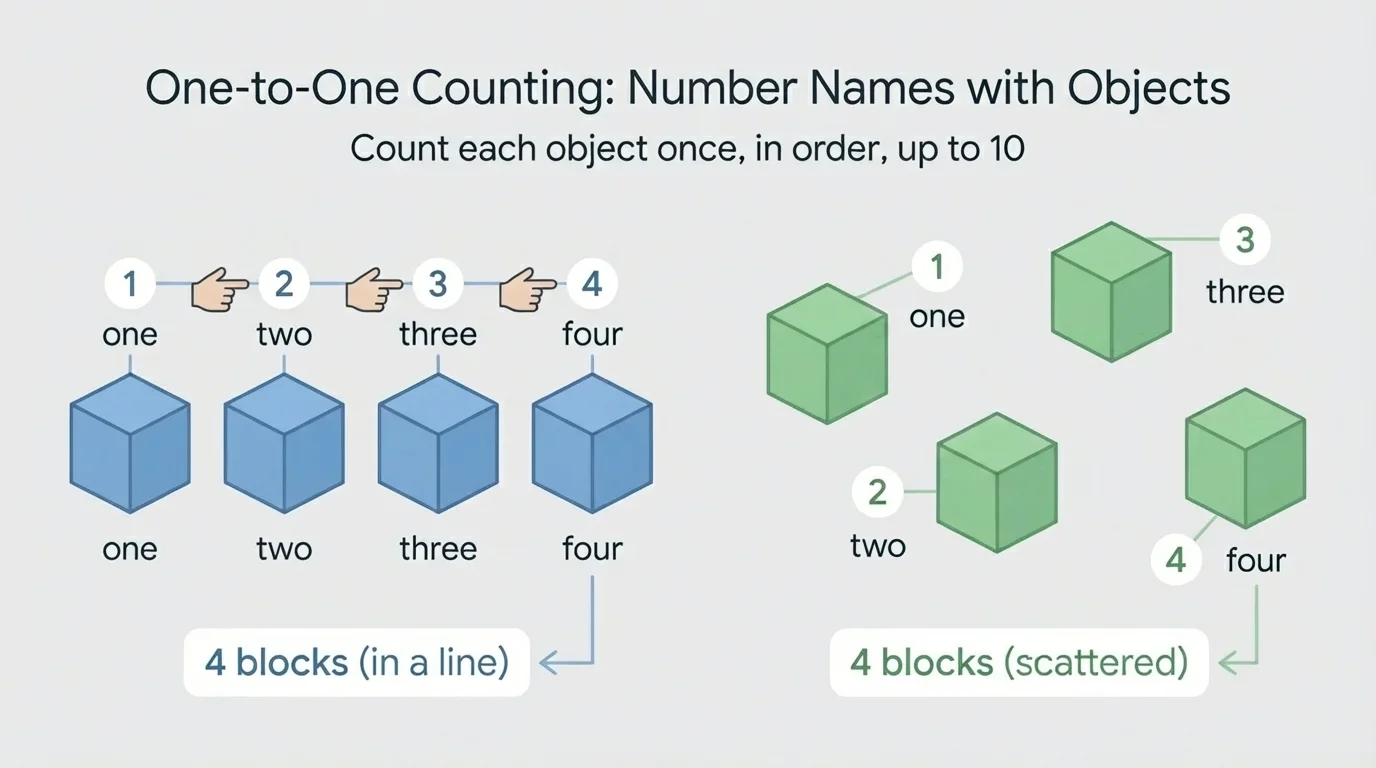
This means the way a group looks does not change how many are in it. Counting tells the amount.
We can count loud things, quiet things, big things, and small things. The rules stay the same: say numbers in order, give one number word to one object, and use the last number to tell how many.
When children count snacks, toys, or steps, they are learning an important math idea. They are connecting number names like \(1\) through \(10\) to real objects they can see and touch. The same matching idea from [Figure 3] helps them know that a group keeps its amount even if it is rearranged.
