When you count your toys, something special happens: the last number you say tells the whole amount. If you count blocks and say \(1, 2, 3, 4\), then \(4\) means there are four blocks. That is how we answer the question, "How many?"
To count well, we look at one object at a time and say one number word for each object. A count means saying number words in order and matching each word to one object: \(1, 2, 3, 4, 5\), and so on. As [Figure 1] shows, each object gets one number word. We can touch, point to, or move each object as we count.
If there are toy cars, we might say: first car, \(1\); next car, \(2\); next car, \(3\). Each car gets one turn. This helps us know we counted every object and did not count the same object twice.
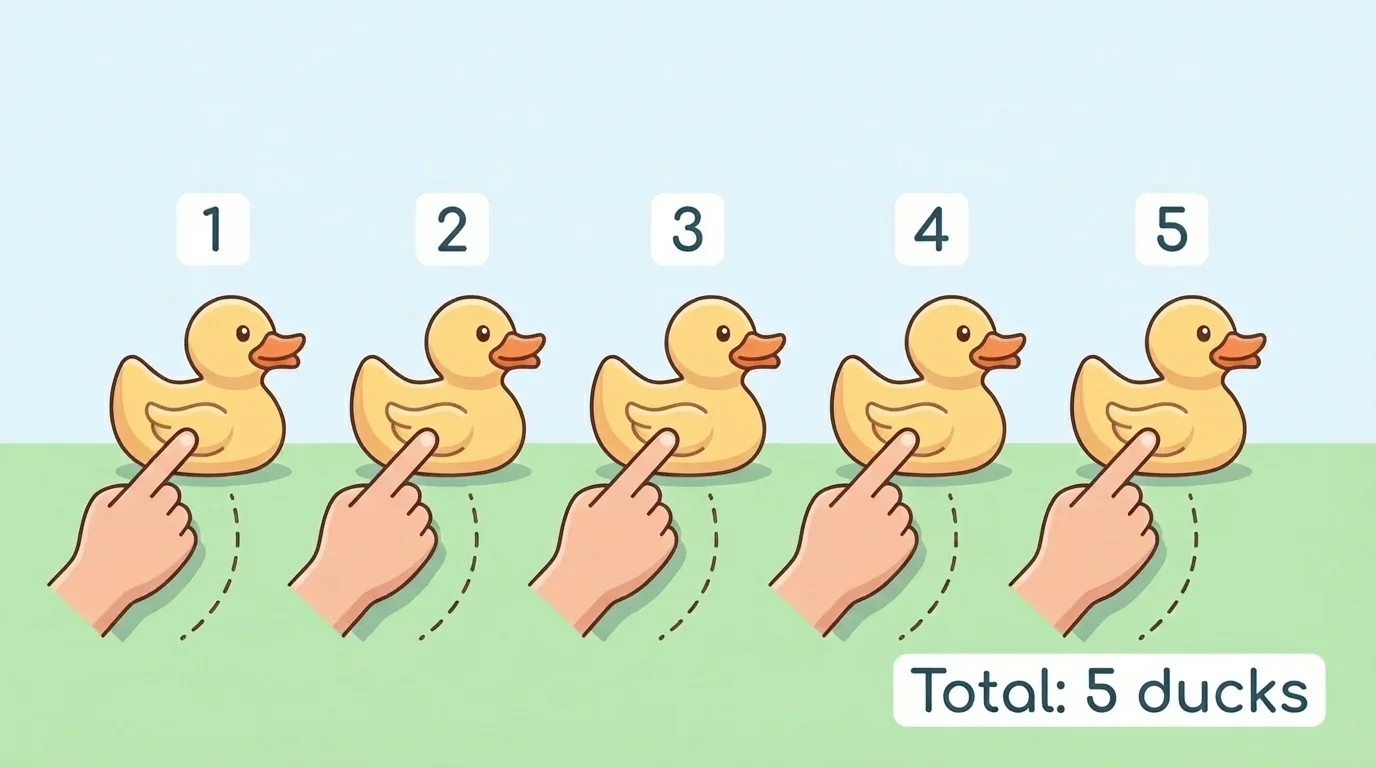
How many? means the total number of objects in a group.
Last number counted means the final number word you say when counting all the objects.
When we count a group, we do not need a new number for the group after we finish. The last number already tells us the answer.
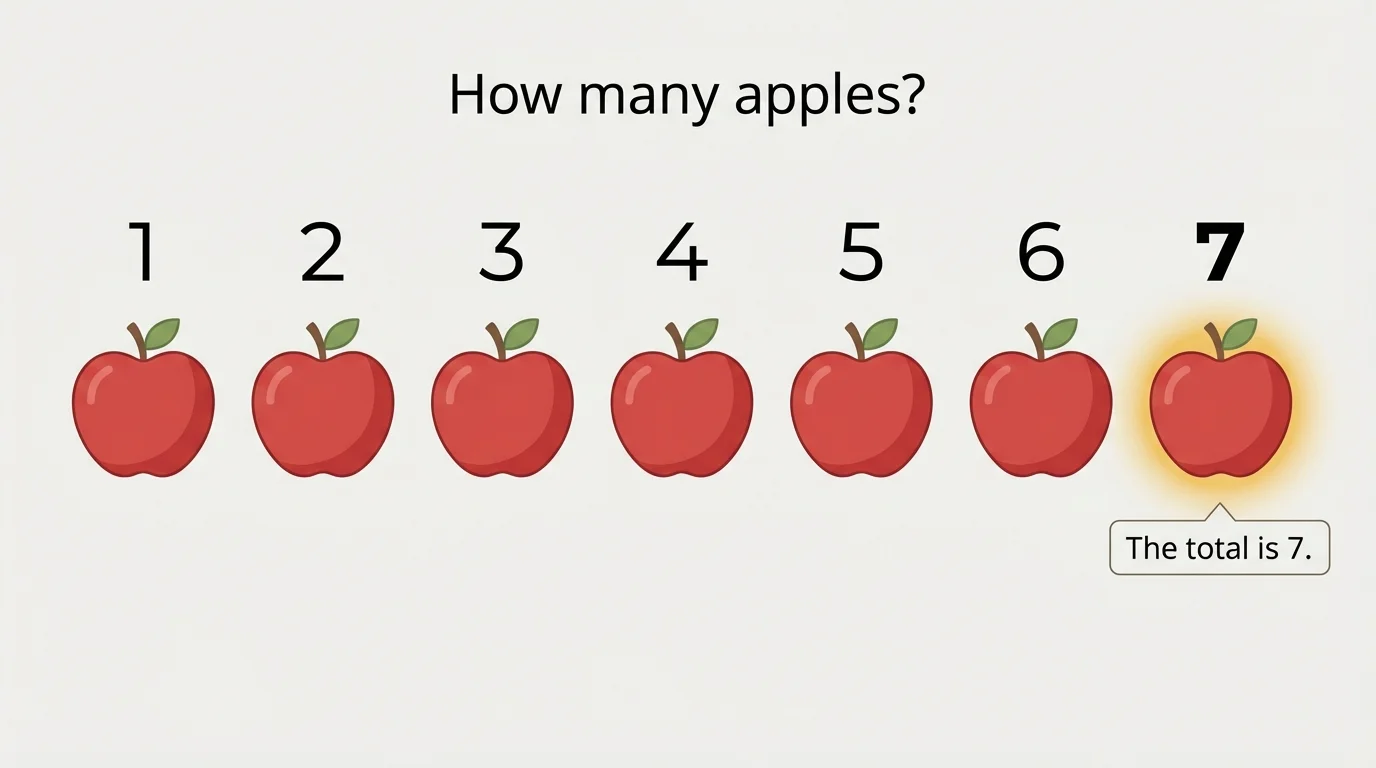
The total is how many objects are in the whole group. When we count and stop on the last object, the last number word tells the total. As [Figure 2] illustrates, if we count apples and say \(1, 2, 3, 4, 5, 6, 7\), then the answer to "How many apples?" is \(7\).
This idea is called cardinality. It means the last number counted tells how many things are in the set. Young children do not need the big word every time, but the idea is very important: count the objects, and the last number gives the answer.
So if someone asks, "How many bears are there?" and you counted \(1, 2, 3, 4\), you answer, "There are \(4\) bears." You do not start a new count. You use the last number you already said.
Even very small children can sometimes say counting words from memory, but real counting means matching each number word to one object and knowing that the last number means the whole group.
This works for small groups up to about \(10\): \(1\), \(2\), \(3\), \(4\), \(5\), \(6\), \(7\), \(8\), \(9\), and \(10\).
Let's look at some groups and see how the last number answers the question.
Example 1
There are stars on a page. How many stars are there?
Step 1: Count each star one time.
Say: \(1, 2, 3\).
Step 2: Listen to the last number said.
The last number is \(3\).
So there are \(3\) stars.
The answer comes from the last counting word, not from guessing.
Example 2
There are buttons in a bowl. How many buttons are there?
Step 1: Point to each button and count.
Say: \(1, 2, 3, 4, 5\).
Step 2: Use the last number to answer.
The last number is \(5\).
So there are \(5\) buttons.
Even if the buttons are close together, each one still gets one number word.
Example 3
There are blocks on the rug. How many blocks are there?
Step 1: Count the blocks carefully.
Say: \(1, 2, 3, 4, 5, 6, 7, 8\).
Step 2: Notice the last number.
The last number is \(8\).
So there are \(8\) blocks.
If a friend asks, "How many?" the answer is \(8\), because \(8\) was the last number counted.
Objects do not have to be in a straight line to be counted. They can be in a line, in a circle, or spread out. As [Figure 3] shows, moving objects into a different arrangement does not change how many there are. If there are \(6\) buttons, there are still \(6\) buttons after they are moved around.
Some objects may be big, and some may be small. Some may be red, blue, or green. Different colors or sizes do not change the count. We count every object, one by one, until we reach the last number.
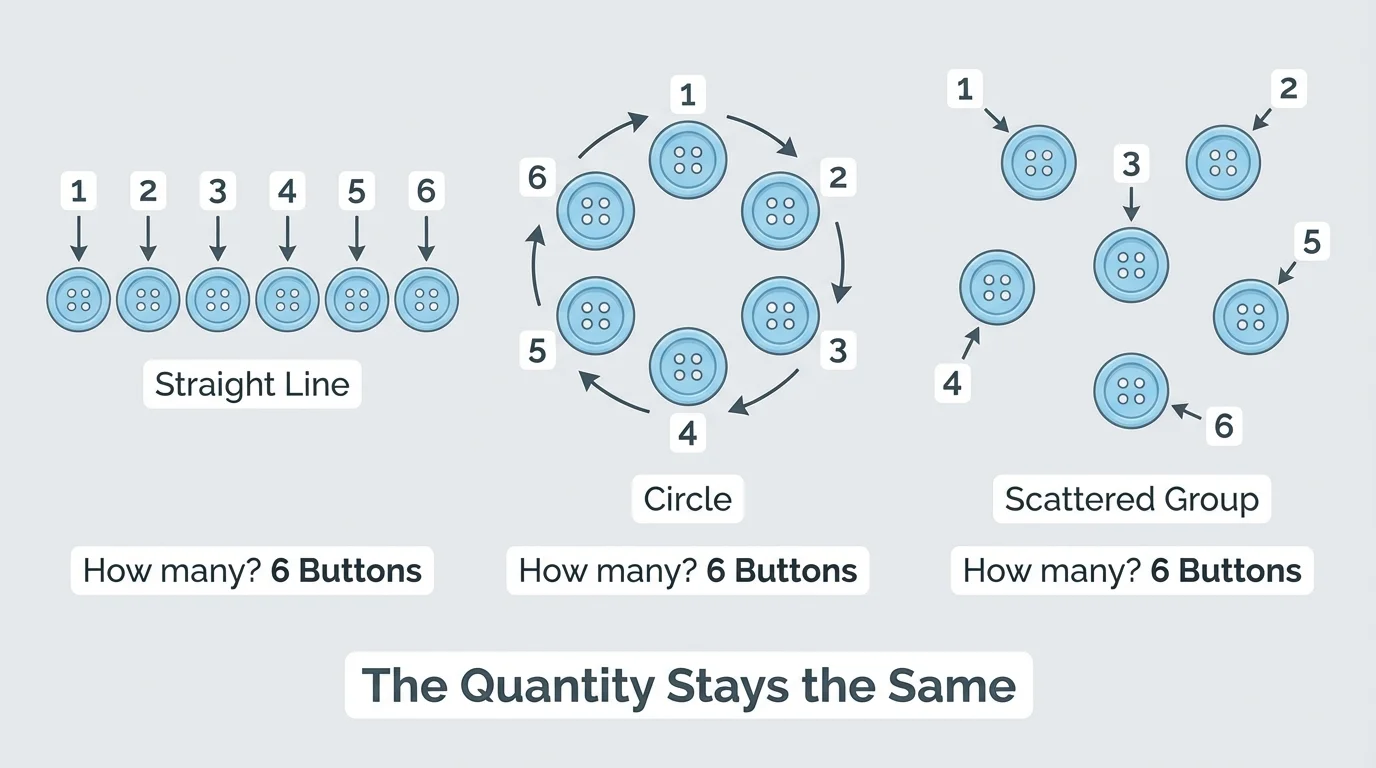
For example, if you count teddy bears in a row and get \(4\), then spread them out on the floor, there are still \(4\). The total stays the same until objects are added or taken away.
Counting helps every day. You might count \(2\) shoes, \(4\) crackers, \(5\) crayons, or \(10\) steps. When a teacher asks, "How many cups do we need?" counting helps you find the answer.
At snack time, if you count grapes and say \(1, 2, 3, 4\), then there are \(4\) grapes. At cleanup time, if you count toys and stop at \(7\), then there are \(7\) toys to put away. This is the same idea we saw earlier in [Figure 2]: the last number tells the total.
One number word for one object
Good counting means matching one number word to one object. Then, when all the objects are counted, the last number word tells how many are in the whole group.
This is why counting is more than just saying number words from memory. Counting connects number words to real things you can see and touch.
Sometimes objects are hard to count because they move, roll, or are close together. One-to-one correspondence means each object gets one number word, and each number word goes with one object.
Here are some common mistakes: skipping an object, counting one object two times, or saying extra numbers after the last object. If you count \(1, 2, 3, 4\) and there are no more objects, you stop. The answer is \(4\).
Touching each object can help. Moving counted objects to one side can help too. The different arrangements in [Figure 3] remind us that the group can look different, but careful counting still gives one total.
You already know the counting words in order. Now you are using them in a stronger way: each number word matches one object, and the last number answers "How many?"
When you count carefully up to about \(10\) objects, you can answer "How many?" with confidence.
