You can do math with your hands, your toys, and your pictures. When we put more with what we already have, we are doing addition. When we take some away, we are doing subtraction. Little numbers can tell big stories, like \(1 + 1 = 2\) when two friends sit together, or \(3 - 1 = 2\) when one cracker gets eaten.
Addition means putting together. If you have \(1\) teddy bear and get \(1\) more teddy bear, now you have \(2\). We can write that as \(1 + 1 = 2\).
Subtraction means taking away. If you have \(2\) apples and eat \(1\), now you have \(1\). We can write that as \(2 - 1 = 1\).
Add means to put more with a group. Subtract means to take some away from a group. A drawing or a group of objects can help us see what the numbers mean.
Math can be a story. Start with some things. Then something happens. Maybe more come. Maybe some go away. The numbers help us tell the story clearly.
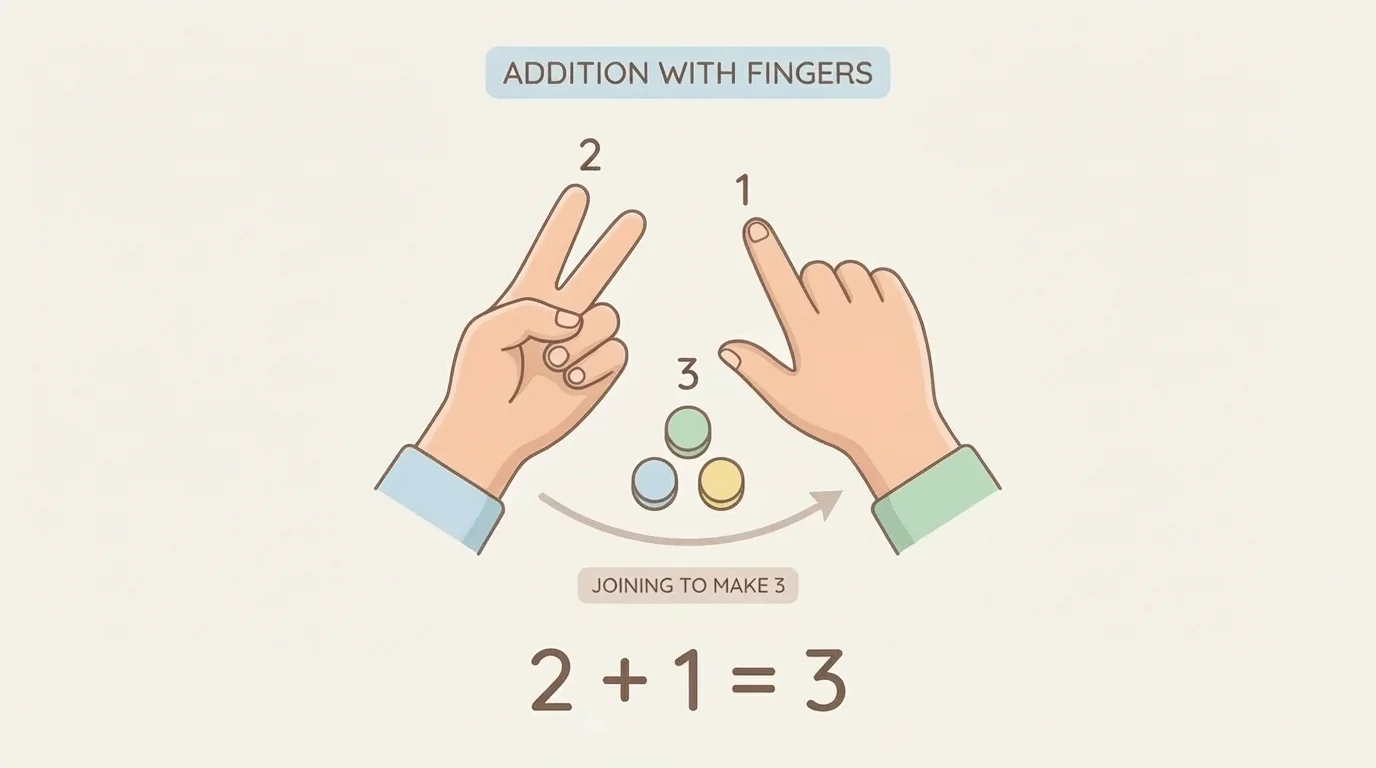
Your fingers are always ready to help. For small numbers, fingers are wonderful tools. As [Figure 1] shows, we can lift some fingers first and then lift more to see how many we have altogether.
If you hold up \(2\) fingers and then lift \(1\) more finger, you can count all the fingers: \(1, 2, 3\). So \(2 + 1 = 3\).
If you start with \(3\) fingers and put \(1\) finger down, you still see \(2\) fingers up. So \(3 - 1 = 2\).
Solved example 1
Show \(1 + 2\) with fingers.
Step 1: Hold up \(1\) finger.
Step 2: Hold up \(2\) more fingers.
Step 3: Count all the fingers: \(1, 2, 3\).
The answer is \(1 + 2 = 3\).
Fingers also help us slow down and count carefully. When children touch or see each finger, the numbers feel real. Later, when we read \(2 + 1 = 3\), we remember the fingers joining together, just like in [Figure 1].
Objects are things we can move, touch, and count. A object can be a block, a toy car, a spoon, or a cracker. As [Figure 2] illustrates, moving real things helps us see math happen.
Put \(2\) blocks on the table. Add \(1\) more block. Now count all the blocks. There are \(3\) blocks, so \(2 + 1 = 3\).
Put \(3\) toy ducks on the table. Take \(1\) duck away. Count what is left. There are \(2\) ducks, so \(3 - 1 = 2\).
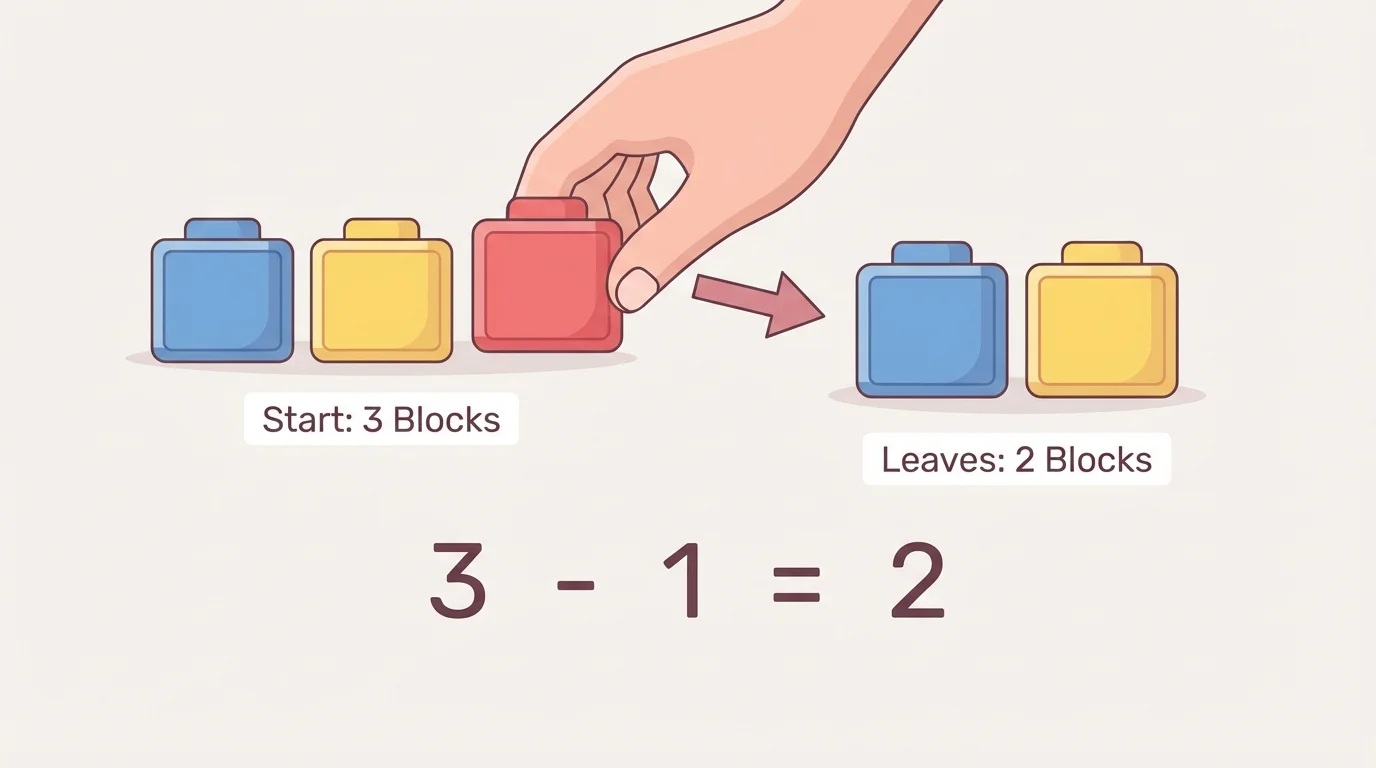
Objects can be lined up so each one is easy to count. This helps us not skip any. We can also move objects apart when we subtract, so we can see what stays and what goes away.
Solved example 2
Show \(2 + 2\) with blocks.
Step 1: Put down \(2\) blocks.
Step 2: Put down \(2\) more blocks.
Step 3: Count all the blocks: \(1, 2, 3, 4\).
The answer is \(2 + 2 = 4\).
We can do subtraction the same way. Start with all the objects, then move some away. The picture of taking away with real things, like the blocks in [Figure 2], helps us understand why subtraction makes the group smaller.
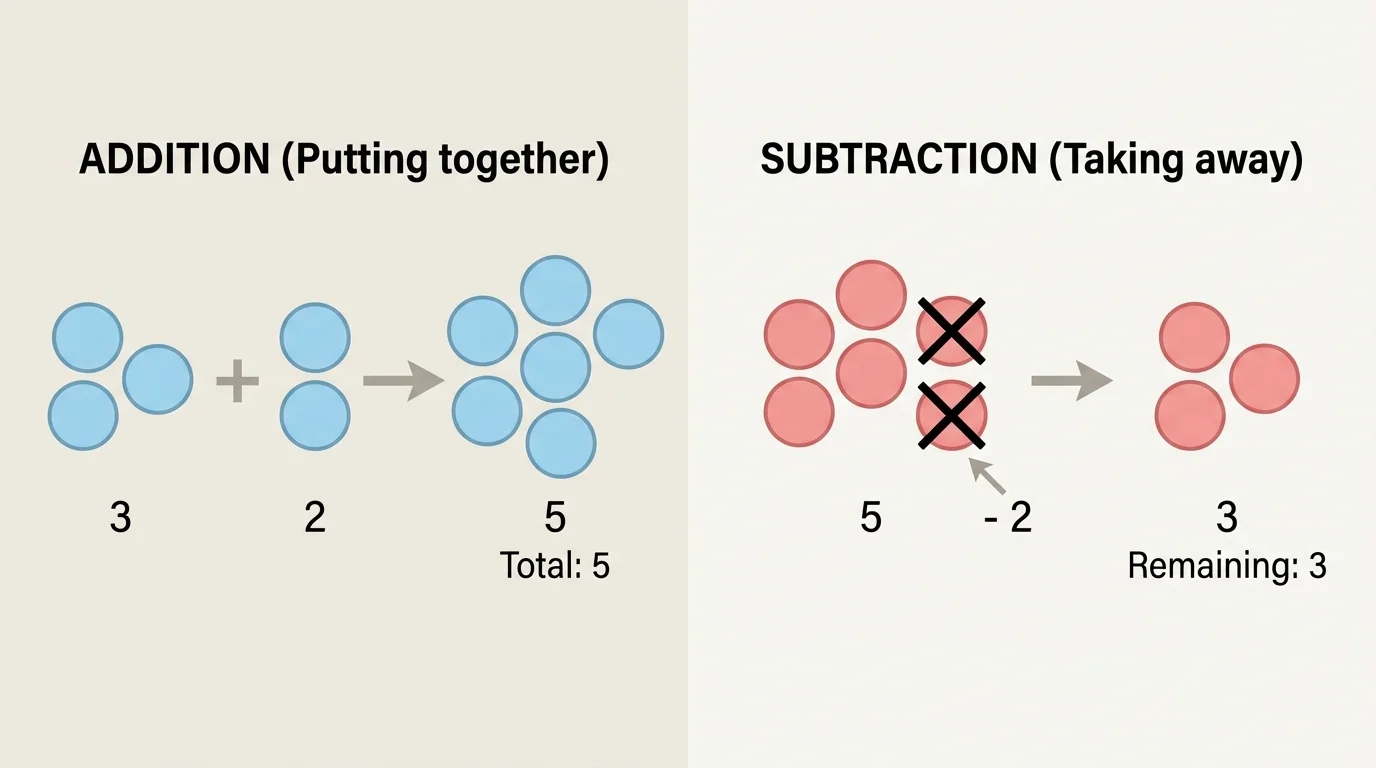
Sometimes we do not have real toys or fingers ready, but we can still show math with a drawing. As [Figure 3] shows, simple circles or stars can stand for things we want to count.
To show \(2 + 1\), draw \(2\) circles. Then draw \(1\) more circle. Count all the circles. There are \(3\) circles, so \(2 + 1 = 3\).
To show \(3 - 1\), draw \(3\) circles. Cross out \(1\) circle. Count the circles not crossed out. There are \(2\), so \(3 - 1 = 2\).
Solved example 3
Show \(4 - 1\) with a drawing.
Step 1: Draw \(4\) little stars.
Step 2: Cross out \(1\) star.
Step 3: Count the stars left: \(1, 2, 3\).
The answer is \(4 - 1 = 3\).
Drawings are helpful because they stay on the page. We can look again and count again. When we add, we draw more. When we subtract, we cross out or circle what goes away. That is easy to see in [Figure 3].
Math is all around us. If \(1\) bird is on a fence and \(2\) more birds land, now there are \(3\) birds. That is \(1 + 2 = 3\).
If \(3\) cookies are on a plate and \(1\) cookie is eaten, \(2\) cookies stay on the plate. That is \(3 - 1 = 2\).
Very young children often understand math stories before they can write number sentences. Seeing toys join or leave a group helps numbers make sense.
At home, in class, or outside, we can notice groups getting bigger or smaller. Bigger groups often mean addition. Smaller groups often mean subtraction.
Addition and subtraction are about what happens to a group. If more come, the group grows. If some go away, the group shrinks.
Look at these pairs: \(2 + 1 = 3\) and \(3 - 1 = 2\). In the first one, we add \(1\). In the second one, we take \(1\) away. The numbers tell opposite kinds of stories.
| Story | Math |
|---|---|
| \(1\) ball and \(1\) more ball | \(1 + 1 = 2\) |
| \(2\) cars and take away \(1\) | \(2 - 1 = 1\) |
| \(2\) bears and \(2\) more bears | \(2 + 2 = 4\) |
| \(4\) crackers and take away \(1\) | \(4 - 1 = 3\) |
Table 1. Small number stories matched with addition and subtraction sentences.
When we use fingers, objects, and pictures, we are learning the same math idea in different ways. That makes our thinking stronger and helps us understand what the numbers mean.
