If you already have a big group, you do not need to count every item again. You can keep the big number in your head and say the next number or the next two numbers. That is a smart way to add numbers.
Adding means putting more with a group. If you have \(3\) bears and get \(1\) more bear, now you have more than before.
Counting on means starting with a number you already have and counting forward. Larger number means the bigger amount. When we add \(1\) or \(2\), it helps to start with the larger number.
We can think, "I have \(3\). One more makes \(4\)." We do not need to go back and count \(1, 2, 3\) again first.
When one number is bigger, it is often easier to keep that bigger number in our head and count on, as [Figure 1] shows with a group that stays together while we add a little more.
If we want to add \(5 + 2\), we can start at \(5\). Then we count on two numbers: \(6, 7\). So \(5 + 2 = 7\).
If the numbers are turned around, like \(2 + 5\), we can still start with the bigger number. Start at \(5\), then count on two: \(6, 7\). So \(2 + 5 = 7\).
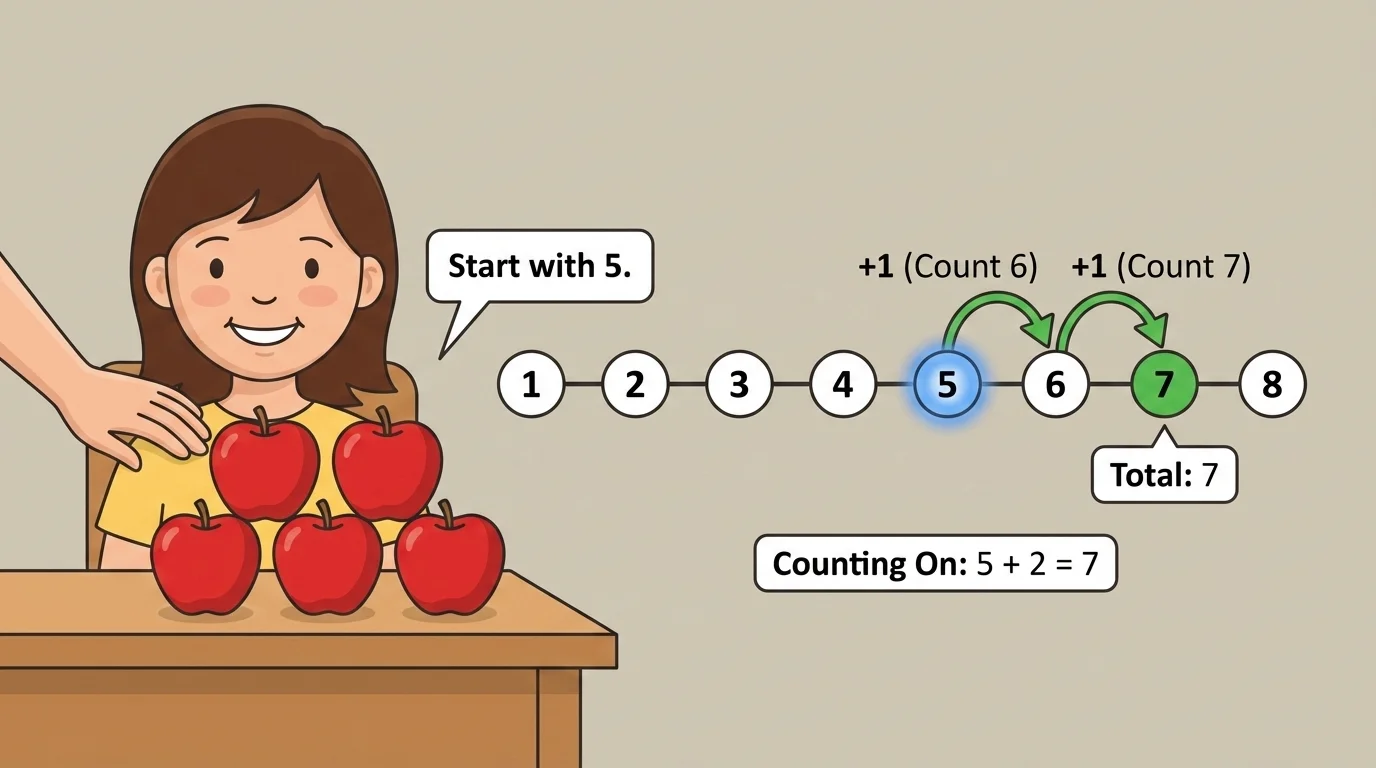
This helps because the smaller number, such as \(1\) or \(2\), tells us how many little steps to take. We keep the bigger number and move forward.
Why this works
Addition means the group gets bigger. When we add \(1\), we move forward one number. When we add \(2\), we move forward two numbers. Starting with the larger number makes the counting shorter and easier.
You can use fingers, toys, or a number path to help. But the important idea is to begin at the bigger number and then count on.
Adding \(1\) means saying the very next number. One small hop moves us forward, as [Figure 2] shows on a simple number path.
If you have \(4\) blocks and get \(1\) more, start at \(4\). Say the next number: \(5\). So \(4 + 1 = 5\).
If the problem is \(1 + 4\), we can still start with \(4\). Then count on one: \(5\). So \(1 + 4 = 5\).
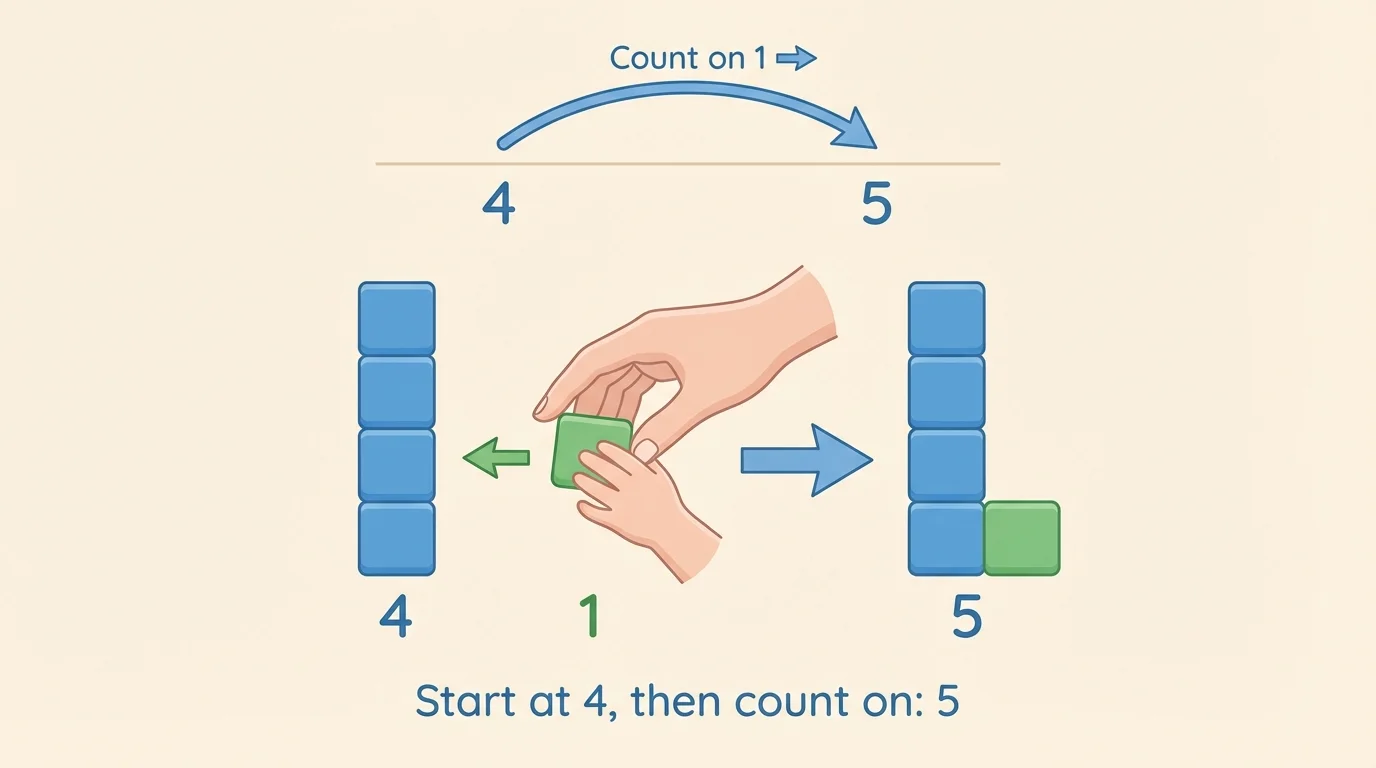
We can try more: \(6 + 1 = 7\), \(1 + 6 = 7\), and \(2 + 1 = 3\). Each time, adding \(1\) means go to the next number.
Adding \(2\) means saying the next two numbers. We start with the larger number and count forward two steps, as [Figure 3] illustrates.
If you have \(6\) cars and get \(2\) more, start at \(6\). Count on: \(7, 8\). So \(6 + 2 = 8\).
If the problem is \(2 + 6\), we still begin at \(6\). Count on two: \(7, 8\). So \(2 + 6 = 8\).
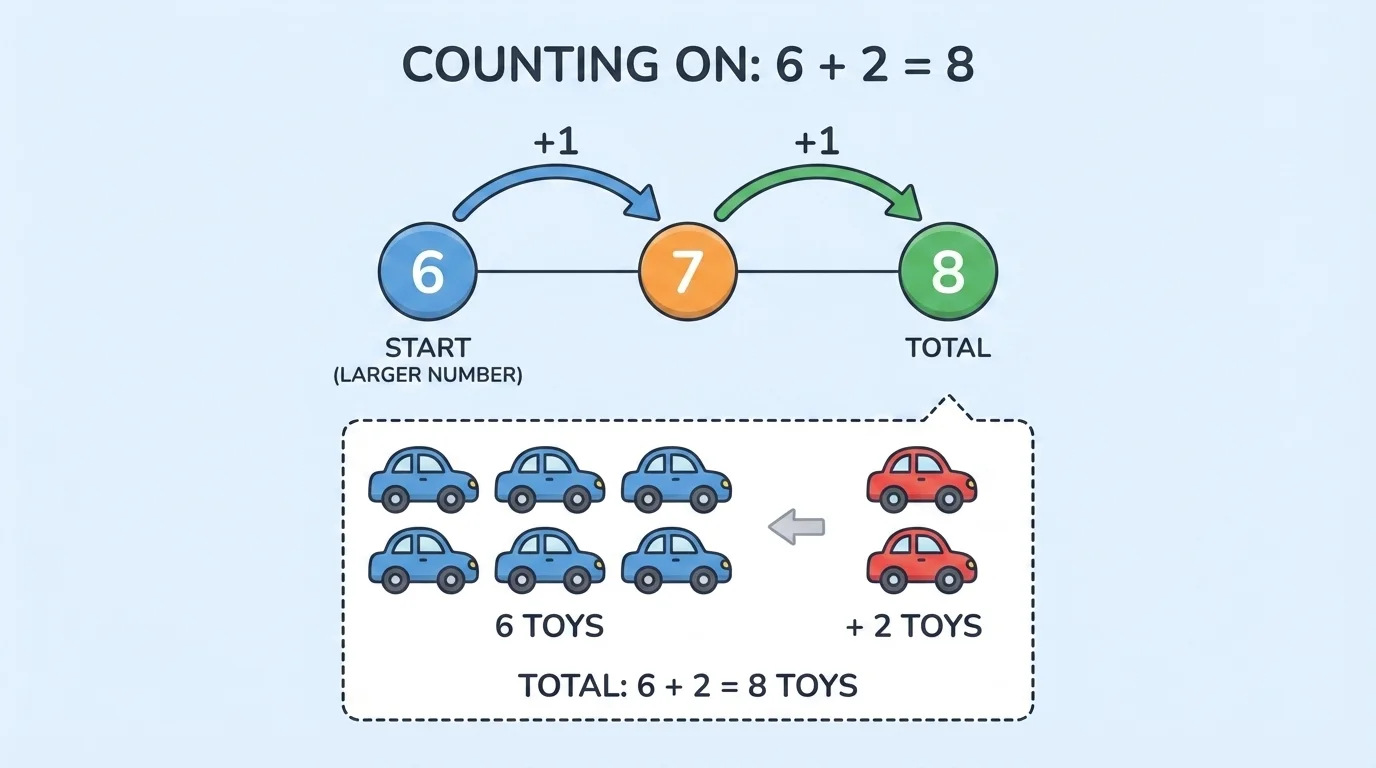
More examples are \(3 + 2 = 5\), \(2 + 3 = 5\), \(7 + 2 = 9\), and \(2 + 7 = 9\). We do not need to count all the objects from the beginning.
Let's look at some gentle step-by-step examples.
Example 1
Solve \(5 + 1\).
Step 1: Start with the larger number.
The larger number is \(5\).
Step 2: Count on \(1\).
After \(5\) comes \(6\).
The answer is \(5 + 1 = 6\)
That was one hop forward. The same idea works when the \(1\) comes first.
Example 2
Solve \(1 + 7\).
Step 1: Find the larger number.
The larger number is \(7\).
Step 2: Count on \(1\).
After \(7\) comes \(8\).
The answer is \(1 + 7 = 8\)
Even though \(1\) is written first, we can still begin with \(7\). This is the same helpful idea we saw earlier in [Figure 2].
Example 3
Solve \(4 + 2\).
Step 1: Start with the larger number.
Start at \(4\).
Step 2: Count on \(2\).
Say the next two numbers: \(5, 6\).
The answer is \(4 + 2 = 6\)
Here we made two little jumps forward. Counting on by \(2\) means saying the next two numbers.
Example 4
Solve \(2 + 5\).
Step 1: Choose the larger number.
The larger number is \(5\).
Step 2: Count on \(2\).
After \(5\), say \(6, 7\).
The answer is \(2 + 5 = 7\)
This is why starting with the larger number is helpful. We only count the small amount we are adding, just like the two hops shown earlier in [Figure 3].
Counting on helps in everyday moments. If you have \(3\) crackers and an adult gives you \(1\) more, start at \(3\) and say \(4\). If you have \(5\) toy animals and get \(2\) more, start at \(5\) and say \(6, 7\).
You can use this when putting away blocks, handing out cups, or climbing steps. If you are on step \(4\) and take \(2\) more steps, you count on: \(5, 6\).
Our brains often notice a bigger group first. Starting with that bigger group can make addition feel quicker and calmer.
Adults can help by saying the bigger number first and then helping you count the next one or two numbers out loud.
Count on means start with a number and go forward. A larger number is the bigger amount. In an addition problem, we are putting more with what we already have.
You already know how to say numbers in order: \(1, 2, 3, 4, 5\), and so on. Counting on uses that same number order. We just begin at the bigger number instead of beginning at \(1\).
When adding \(1\), say the next number. When adding \(2\), say the next two numbers. Start with the bigger number whenever you can.
