Which toy is the biggest? Which stick is the shortest? Which snack comes later: lunch or bedtime? We use special words to compare things all day long. Comparing helps us describe what we see, feel, and notice.
When we compare, we look at how things are alike and different. A comparison word tells us about that difference. We can compare by length, by how much something weighs, by size, or by time.
Comparative words are words we use to tell how things are different. Some examples are shorter, longer, heavier, lighter, bigger, smaller, earlier, and later.
If one ribbon is longer than another ribbon, we say it is longer. If one box has more space than another box, we may say it is bigger. If one event happens after another event, we say it happens later.
We can compare how long or tall things are. Sometimes it helps to put them next to each other, as [Figure 1] shows. Then we can see which one is shortest, which one is longest, which one is taller, and which one is shorter.
Think about three crayons. One crayon may be very small, one may be medium, and one may be long. The small crayon is the shortest. The long crayon is the longest.
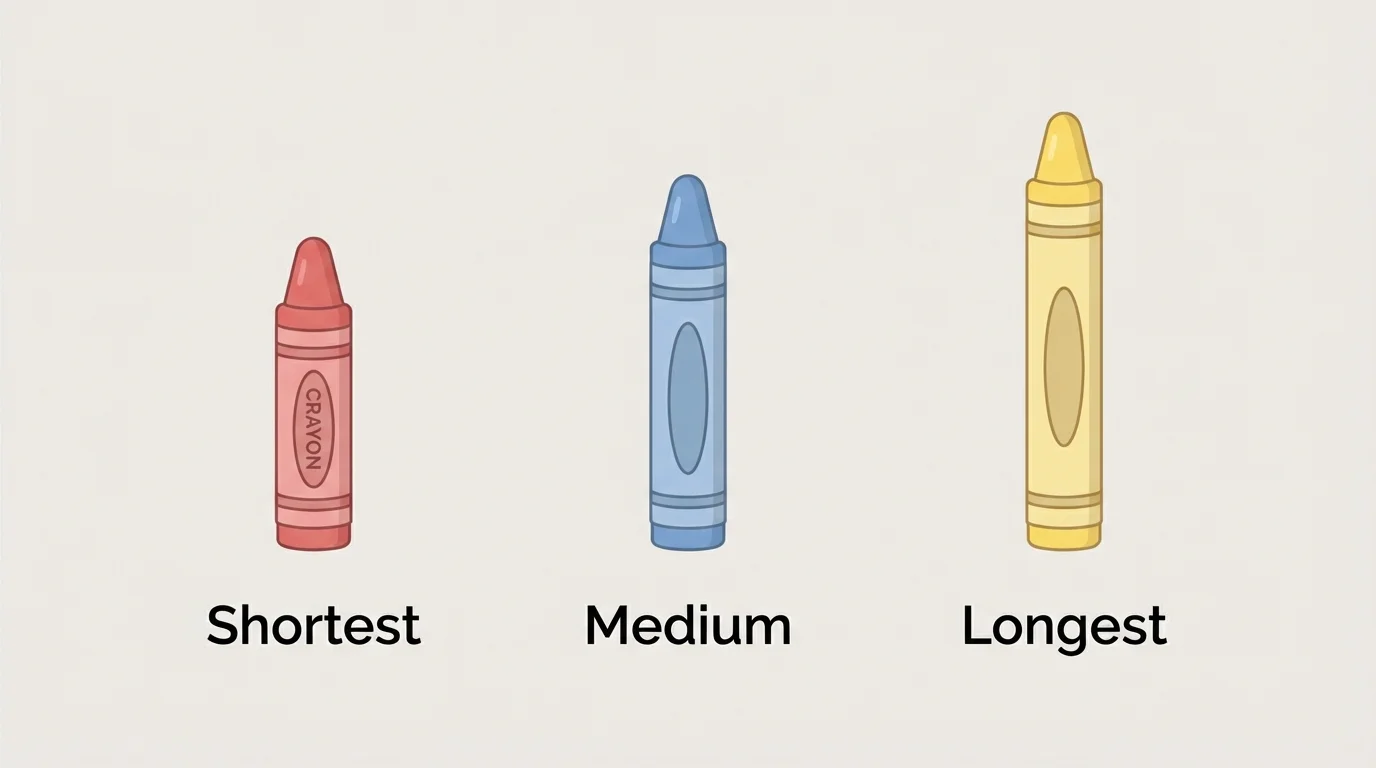
We can also compare height. A small plant may be shorter than a tall flower. A tall tower block is higher than a short tower block. When we talk about tall things, we often use taller and shorter.
Later, when you look back at [Figure 1], you can see that lining up the bottoms of objects helps us compare them fairly.
Some animals are easy to compare by height. A giraffe is taller than a dog, and a dog is taller than a mouse.
If two sticks start at the same place, we can see which stick reaches farther. The one that reaches farther is longer. The one that does not reach as far is shorter.
[Figure 2] We can compare how heavy things are too. A thing that weighs more is heavier. A thing that weighs less is lighter. On a balance, the heavier side goes down.
A rock is heavier than a leaf. A pillow is lighter than a chair. You may not know the exact weight, but you can still compare the objects.
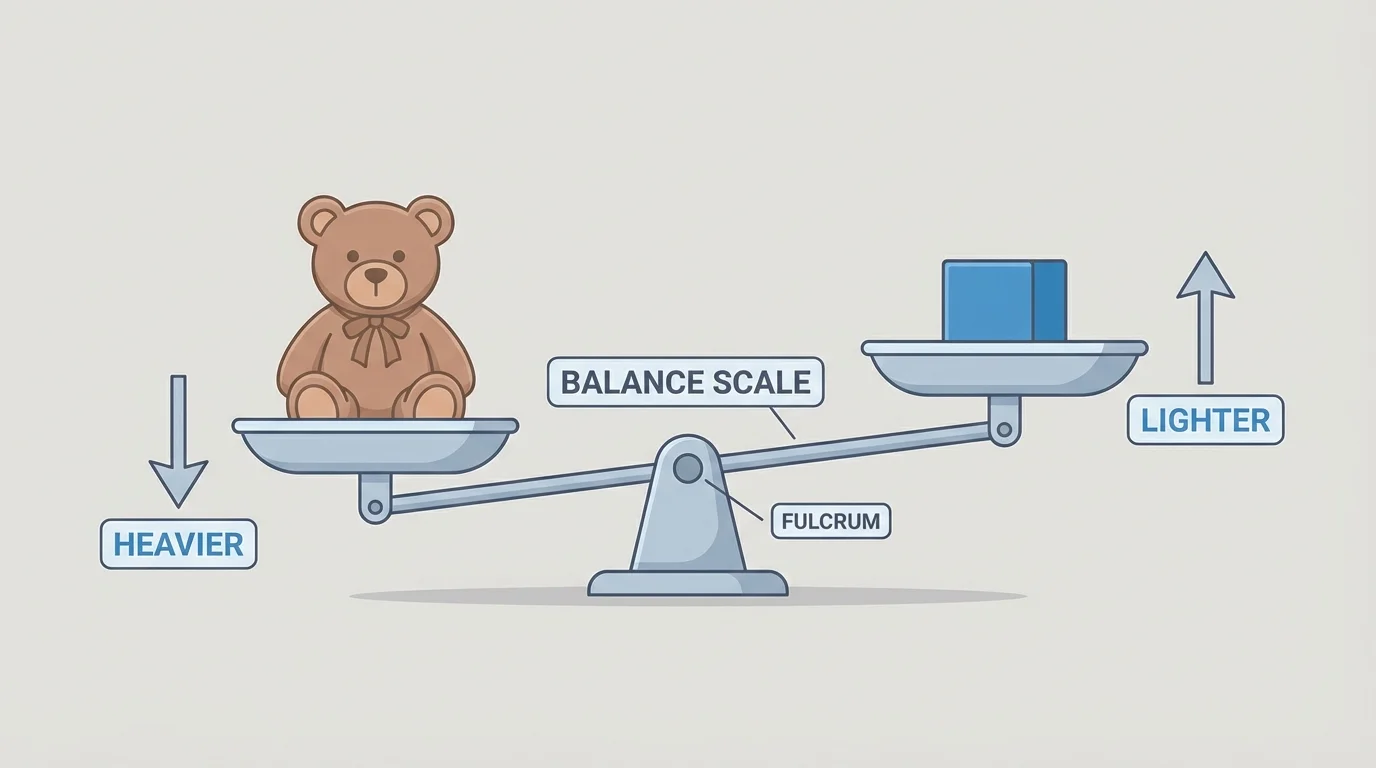
Sometimes our hands help us compare weight. If you hold one toy in one hand and another toy in the other hand, you may feel that one is heavier. The other is lighter.
When we think again about [Figure 2], we remember that heavier does not always mean bigger. A small rock can be heavier than a big feather.
Different ways to compare
Some things are best compared by looking. Some things are best compared by holding. For length, we often line objects up. For weight, we may hold them or use a balance. Good comparing means we check the same attribute each time.
That word attribute means a part we can notice about an object, like length, height, weight, or size.
[Figure 3] We also compare by size and by time. One stuffed animal may be the biggest, and another may be the smallest. Some things happen later, and some things happen earlier in a daily order.
A big ball is bigger than a small ball. In a group of three boxes, one box can be the biggest, one can be medium, and one can be the smallest.
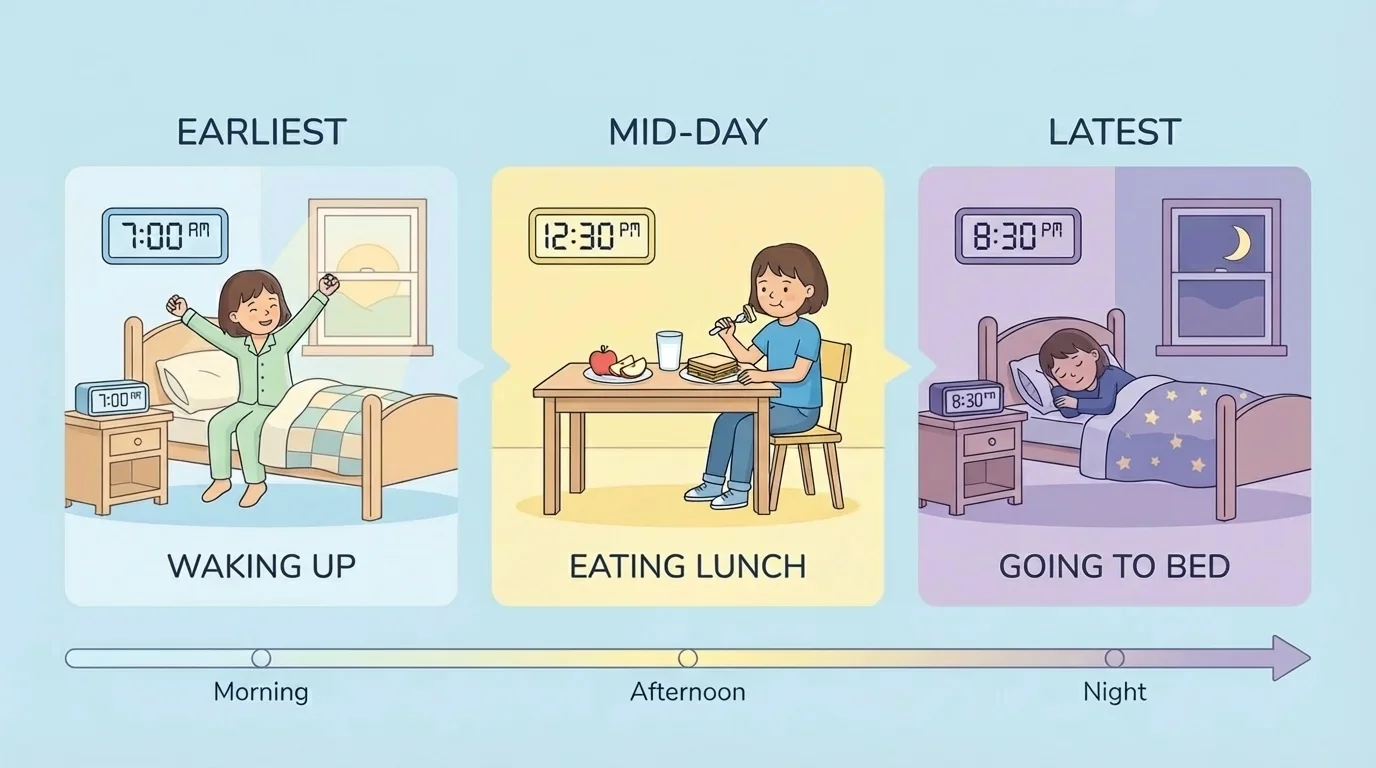
Time words help us talk about order. Waking up happens earlier than dinner. Bedtime happens later than lunch. If we know what comes first and what comes after, we can use earlier and later.
When you think about [Figure 3], notice that events move in order from first to last. That helps us decide which one is earlier and which one is later.
Let's look at some easy comparison examples.
Example 1
There are three ropes: a short rope, a medium rope, and a long rope. Which rope is the shortest?
Step 1: Look at all three ropes.
One rope is shorter than the other two.
Step 2: Choose the one with the least length.
The rope with the least length is the shortest.
The short rope is the shortest.
We did not need a number to compare. We only needed to look at the length.
Example 2
A teddy bear and a toy car are on a balance. The teddy bear side goes down. Which toy is heavier?
Step 1: Watch what happens on the balance.
The side that goes down has more weight.
Step 2: Name the heavier object.
The teddy bear side goes down, so the teddy bear is heavier.
The toy car is lighter.
A balance helps us compare weight even when we do not know a number like \(1\) or \(2\).
Example 3
Which happens later: breakfast or bedtime?
Step 1: Think about the order of the day.
Breakfast comes near the beginning of the day.
Step 2: Find what happens after it.
Bedtime comes after breakfast.
Step 3: Use the comparison word.
Something that happens after another time is later.
Bedtime happens later than breakfast.
Here is one more: if two boxes are side by side and one takes up more space, that box is bigger. If it takes up the most space of all the boxes, it is the biggest.
Comparison words are everywhere. At snack time, one cup may be fuller than another. On the playground, one slide may be taller. During clean-up time, one bin may be heavier because it has more blocks inside.
Grown-ups and children use comparing words to solve little problems. Which book fits on the small shelf? Which bag feels lighter? Which part of the day comes later? These words help us notice, describe, and choose.
| What we compare | Words we use | Example |
|---|---|---|
| Length | shorter, longer, shortest | A pencil is longer than a crayon. |
| Weight | heavier, lighter | A rock is heavier than a leaf. |
| Size | bigger, smaller, biggest | The big box is bigger than the small box. |
| Time | earlier, later | Dinner is later than lunch. |
Table 1. Common comparison words for different attributes.
When we compare carefully, we focus on one attribute at a time. A toy can be bigger but lighter. A cup can be shorter but wider. Good comparing means we say exactly what kind of difference we mean.
You already know words like big and small. Comparative words help you say more: bigger, smaller, biggest, shortest, heavier, and later.
Using these words makes your thinking clear. You can tell what you see, what you feel, and what order things happen in.
