Where is your shoe right now? Is it on your foot, under a chair, or behind a toy box? We use special words every day to talk about where things are. These words help us find objects, move safely, and describe the world around us.
A position tells where a person or thing is. We can talk about a ball, a book, a teddy bear, or a friend. We can say where it is by using words such as up, down, in front, and behind.
These words are very useful. If a teacher says, "Put the cup on the table," or "Stand behind the line," you know what to do. Position words help us understand space.
Position words are words that tell where something is. Some position words are up, down, in front, behind, first, and last.
Sometimes we talk about one object by itself. Sometimes we compare two objects. For example, a kite can be up in the sky. A toy car can be in front of a block.
In [Figure 1], Up means higher. Down means lower. A bird flies up in the air. A stone rests on the ground. One ball is high and one ball is low, so we can clearly see the difference between up and down.
Your hands can go up over your head. Your hands can go down by your sides. A balloon may go up. A leaf may fall down.
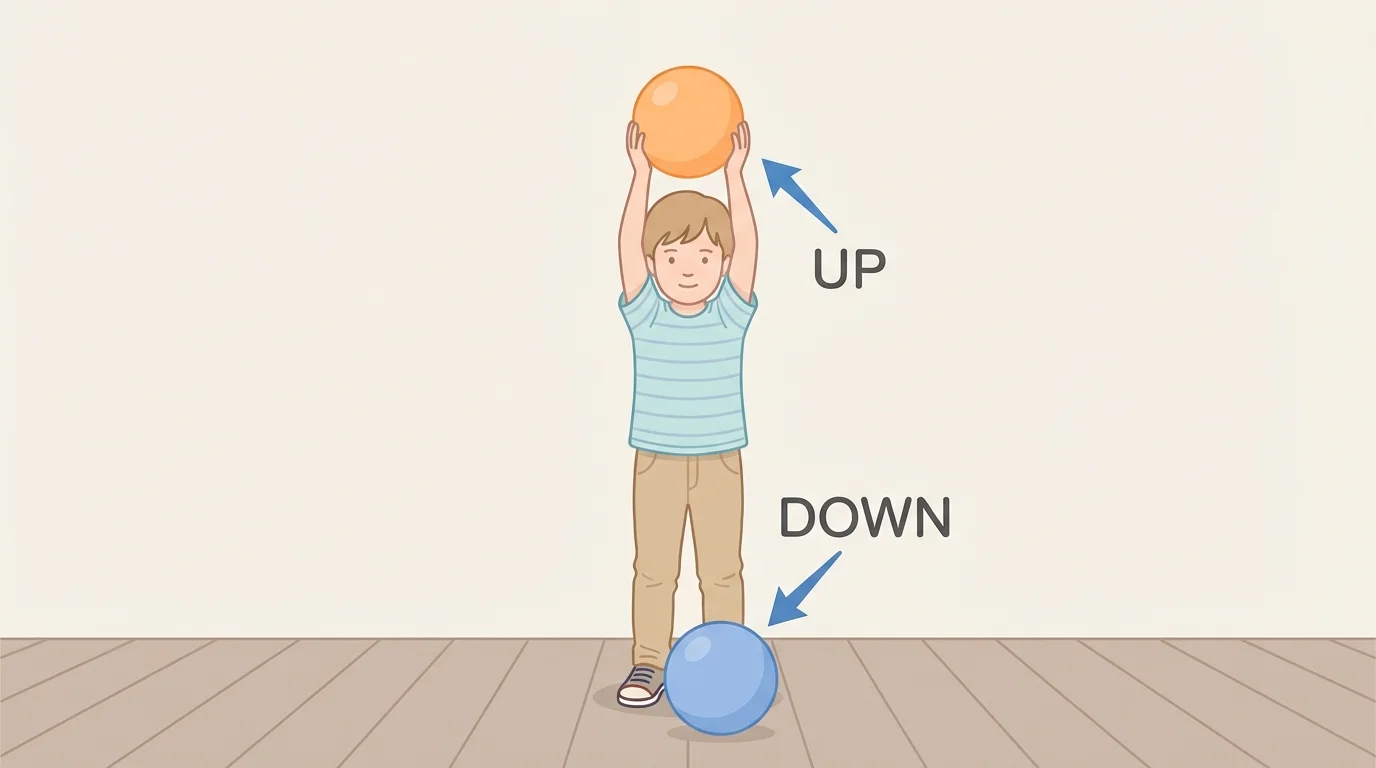
We can use these words for many objects. The sun is high in the sky. Shoes stay down near our feet. A book on a high shelf is up. A book on the floor is down.
Example 1
A toy airplane is on top of a table. A toy truck is on the floor.
Step 1: Look at the airplane.
The airplane is higher, so it is up.
Step 2: Look at the truck.
The truck is lower, so it is down.
The airplane is up. The truck is down.
Later, when we use more than one position word together, the same idea stays true, as we saw in [Figure 1]: up means high and down means low.
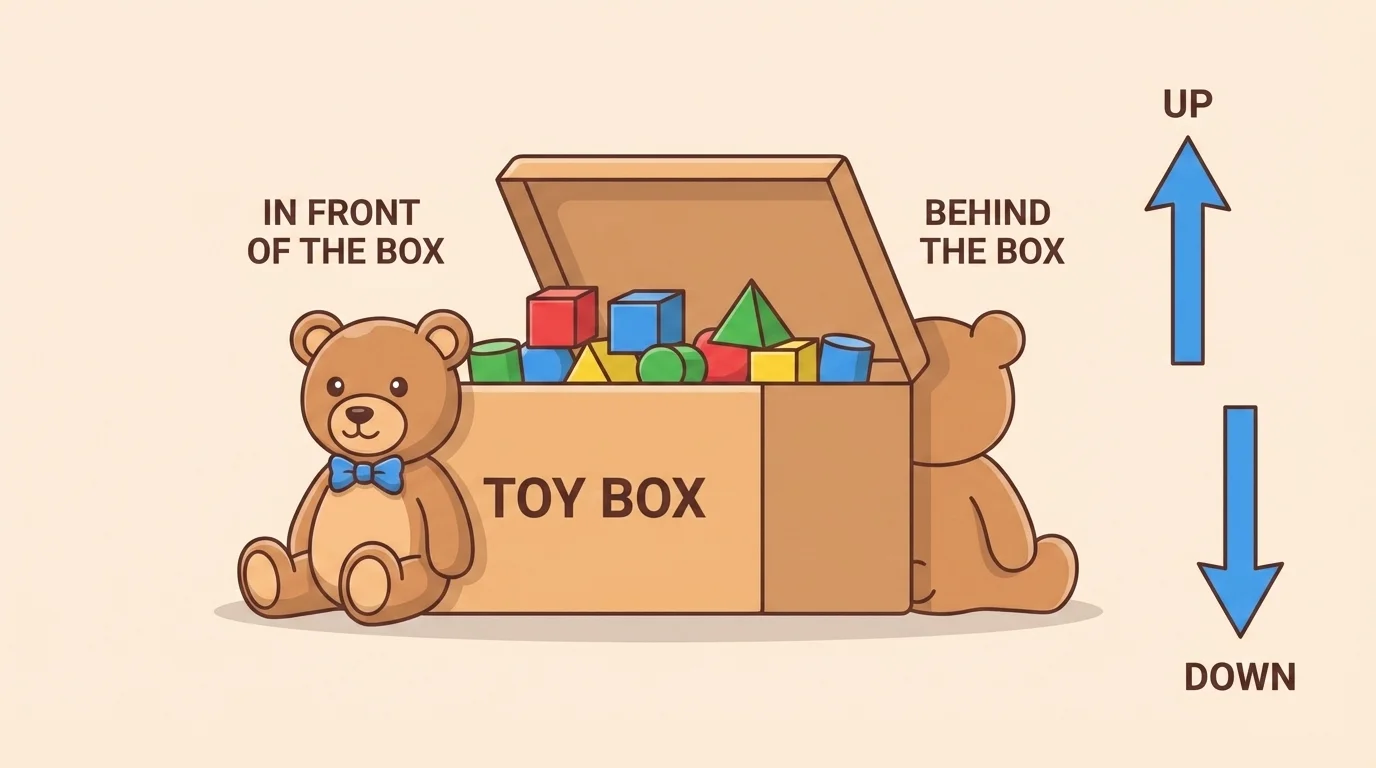
In [Figure 2], In front means on the forward side. Behind means on the back side. The teddy bear and box show that one object can be closer to the front while another stays hidden at the back.
If you stand in front of a chair, the chair is behind you. If you move behind the chair, then the chair is in front of you. The words tell how objects are placed compared with each other.
A bus may stop in front of a school. A tree may be behind the bench. A doll can sit in front of a pillow. A ball can roll behind a door.
Positions can change
The same object can be described in different ways when it moves. A toy that is in front of a box can later go behind the box. The object is the same, but its place changes.
This is why we look carefully. If a friend says, "My hat is behind the door," you know to look at the back side of the door, not the front. The teddy bear example in [Figure 2] helps us remember this front-and-back idea.
Example 2
A red block is in front of you. A blue block is behind the red block.
Step 1: Find the red block.
The red block is the object we compare with.
Step 2: Find the blue block.
If the blue block is on the back side of the red block, the blue block is behind the red block.
The blue block is behind the red block.
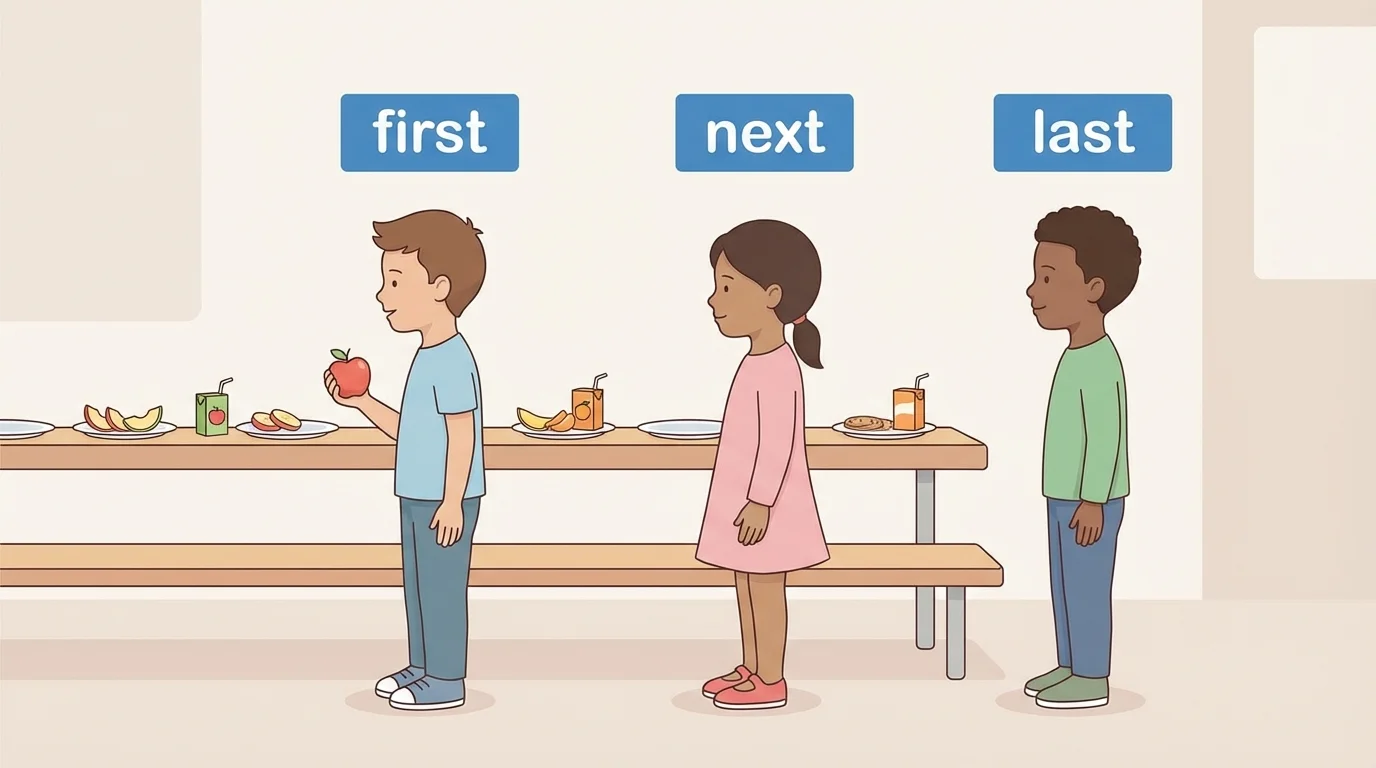
In [Figure 3], we also use position words for order. Order tells where something is in a line or a sequence. The children stand one after another, so we can talk about who is first, next, and last.
First means at the beginning. Last means at the end. We can also use words like before and after. If Ana is first and Ben is after Ana, then Ben is not first.
At handwashing time, one child may be first in line. Another child may be next. Another child may be last. At story time, one book may come before another book in a stack.
Example 3
Three toys are in a row: a duck, a car, and a bear.
Step 1: Look from the start of the row.
The duck comes first.
Step 2: Look at the middle toy.
The car comes after the duck.
Step 3: Look at the end.
The bear comes last.
The order is: duck first, car next, bear last.
Order words help with routines. We can put on socks before shoes. We can wash hands before snack. The line of children in [Figure 3] shows how order helps everyone know where to stand.
Sometimes we use more than one position word in the same idea. A bird can be up in a tree. A cat can sit down under the tree. A wagon can be in front of the tree. A ball can be behind the wagon.
We can describe a whole scene with these words. "The hat is up on the hook." "The boots are down by the door." "The teddy bear is in front of the pillow." "The puzzle box is behind the chair." These sentences help another person picture the scene.
Very young children learn many position words long before they read maps. These words are the first steps toward understanding space and geometry.
When we listen and look carefully, position words become easier to use. They help us talk about toys, people, furniture, and places inside and outside.
Position words are part of everyday life. We use them when we clean up, line up, find our backpack, or follow directions. If someone says, "Put the cup down on the table," or "Stand behind me," position words help us understand quickly.
They also help with safety. We can stay behind a line. We can look up at a sign. We can put a bag down so no one trips. Clear words about position help us know where to move and where to place things.
You already know many place words from everyday life, such as on, under, and next to. The new words in this lesson fit with those other place words and help describe space even better.
As children grow, they use these ideas in building, drawing, sports, dance, and reading simple maps. Knowing where things are is an important part of understanding the world.
