Your body can be in many places. You can be low on the floor, higher when you stand, still in one spot, or moving to a new spot. Learning how to follow directions with your body helps you at school, at home, and on the playground.
When we talk about space here, we mean the place around your body. Your body is in a place. You can be up, down, in front, or behind. You can also move from one place to another place.
A position is where your body is. If you are sitting on the rug, that is your position. If you stand up, your position changes. If you take one step, your position changes again.
Direction words tell how to move. Some important direction words are stand up, sit down, move forward, move backward, turn, and stop.
You can listen and move your body. First you hear the words. Next you think about the words. Then you move your body the right way.
Simple direction words tell your body what to do, as [Figure 1] shows. If someone says stand up, your body goes from low to high. If someone says move forward, your body goes ahead.
Sit down means bend and go down to sit. Stand up means rise to your feet. Move forward means go the way your body is facing. Move backward means go the opposite way. Turn means change which way your body faces. Stop means no more moving.
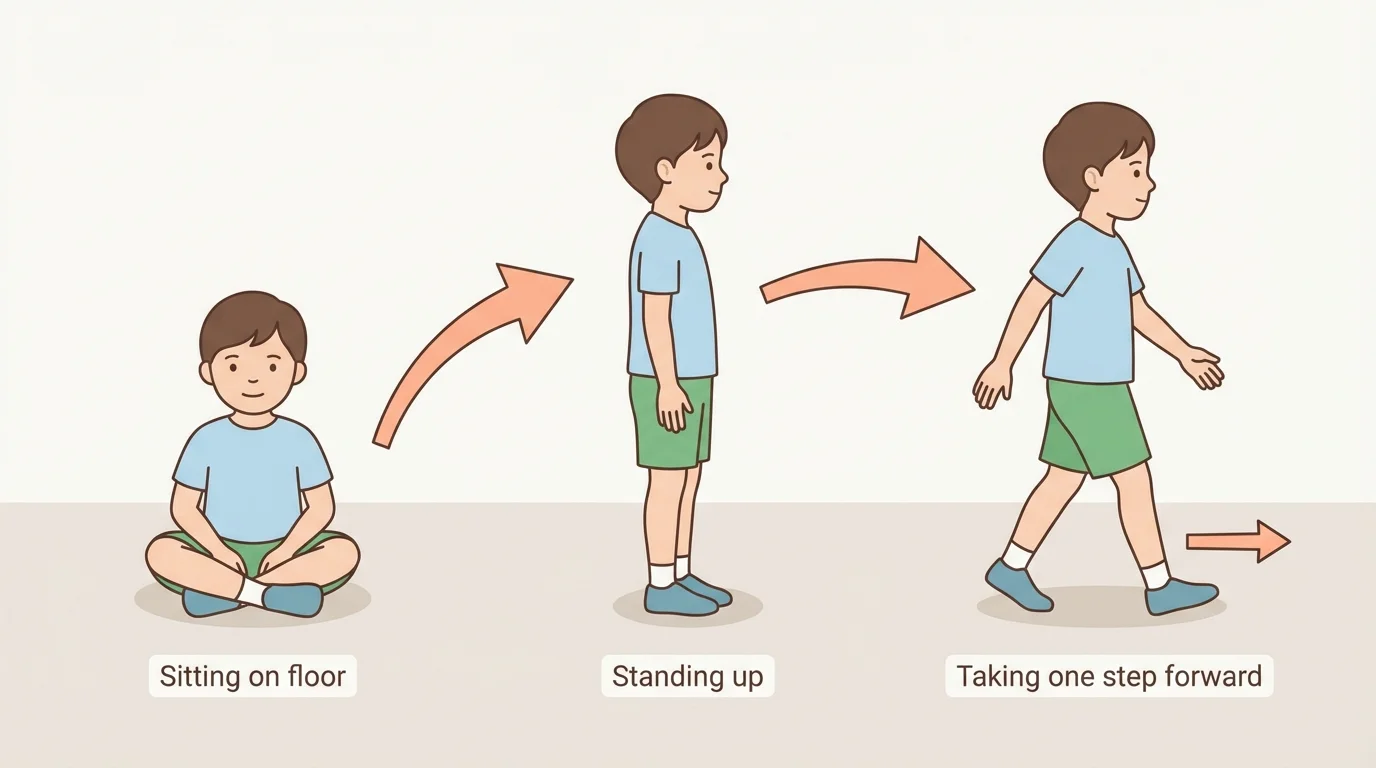
If your teacher says, "Stand up," you should rise to your feet. If your teacher says, "Move forward," you should go ahead. Following the words in the right way shows careful listening.
Your ears and body work together when you follow directions. You listen first, and then your body moves to a new place.
Sometimes directions have only one action. Sometimes they have two actions. "Stand up" is one action. "Stand up and move forward" is two actions. You do the first action, and then you do the next one.
Your own space matters when you move, and [Figure 2] helps show why. Forward depends on which way your body is facing. If you turn around, your forward direction changes too.
Think about your feet. If your toes point one way, moving forward means going that way. Moving backward means going the other way. This is why turning changes your next movement.
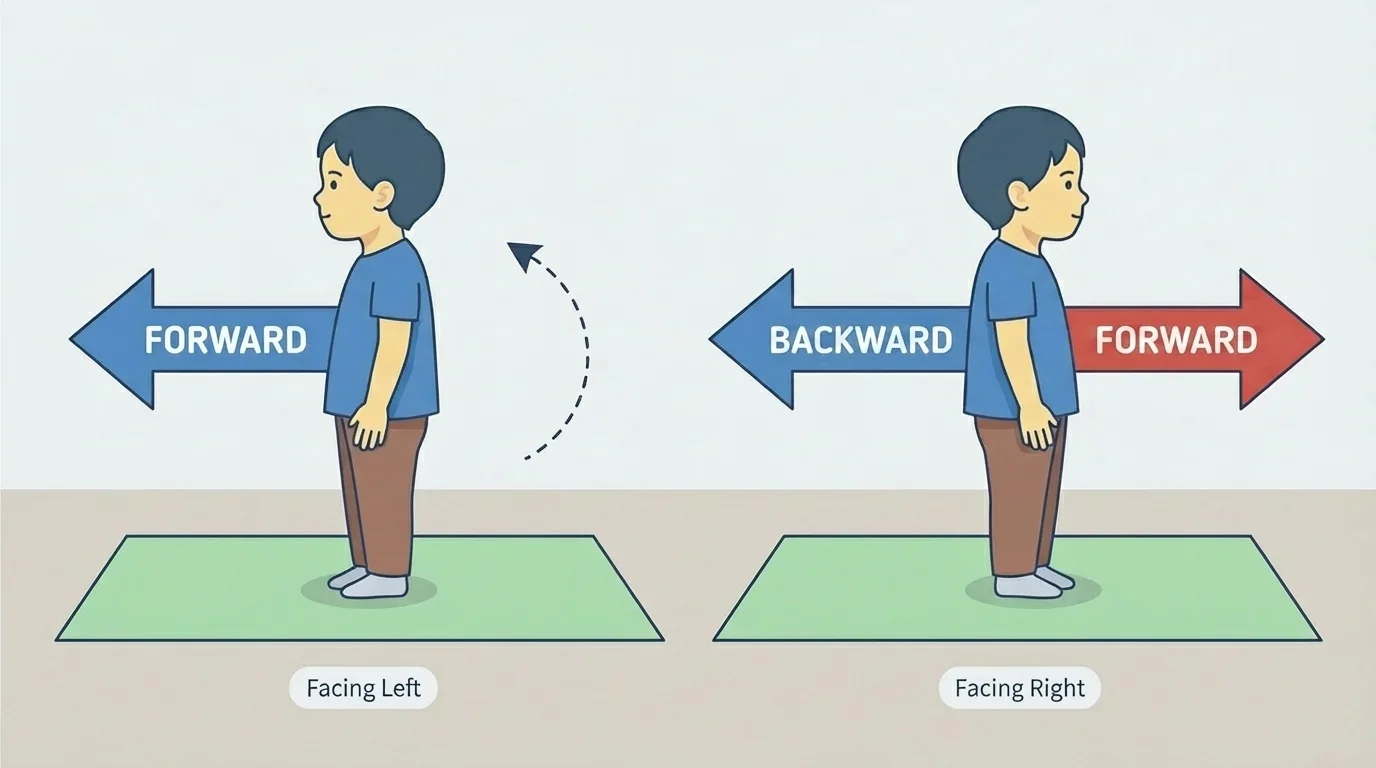
If you are facing the door and you move forward, you go toward the door. If you turn and face the window, then moving forward takes you toward the window. The word stays the same, but your body position changes what it means.
How position changes
Your body starts in one place and can move to a new place. A direction tells how to change that place. Standing changes your height. Stepping forward changes where you are on the floor. Turning changes the way you face.
That is why careful listening is important. You are not just moving. You are moving from your place in space. We can see this again in [Figure 2], where the child's forward direction changes after a turn.
Children use direction words every day, and [Figure 3] connects these words to familiar classroom routines. A teacher may say, "Stand up." Then the teacher may say, "Walk forward to the carpet." These are directions about your body in space.
At circle time, you may hear, "Sit down." In line, you may hear, "Move forward." On the playground, you may hear, "Stop." At clean-up time, you may hear, "Turn around and walk to the shelf."
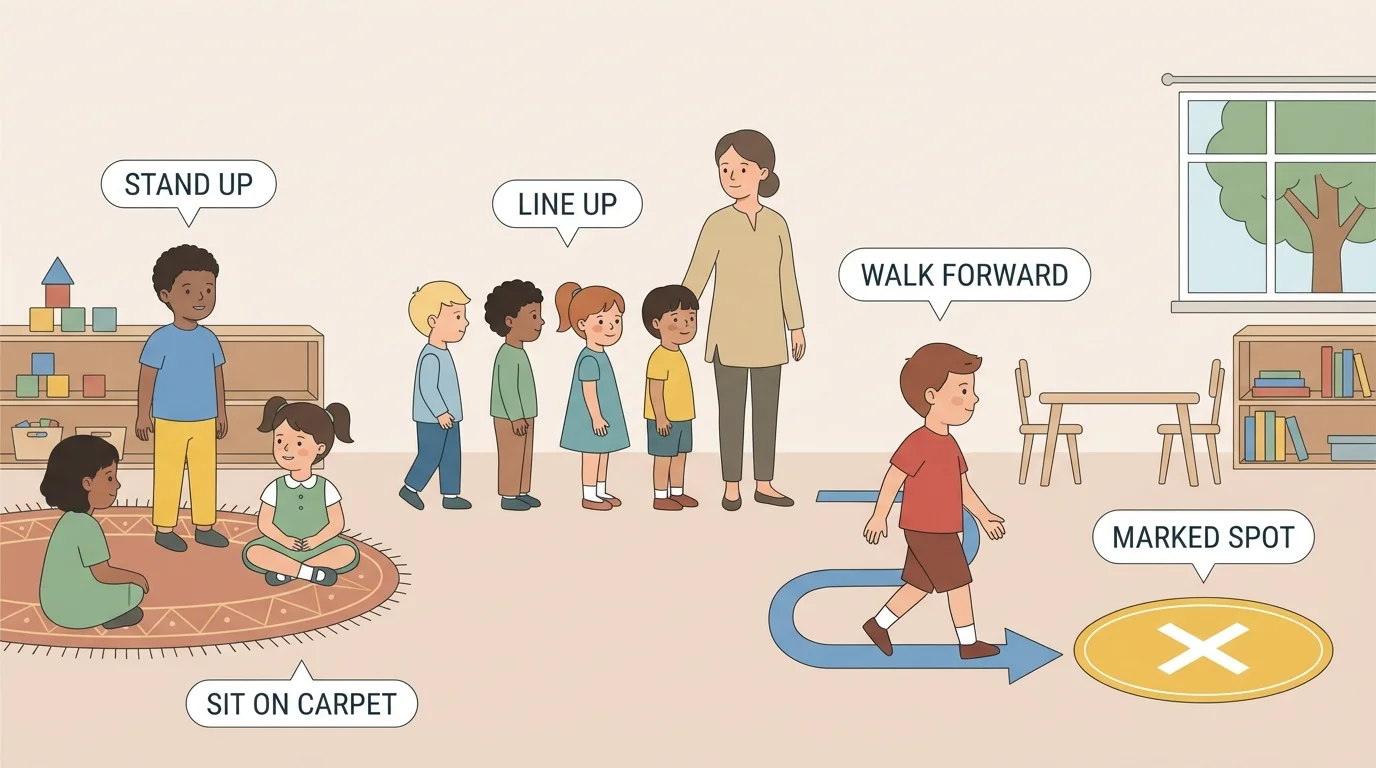
At home, a grown-up might say, "Come forward to the table," or "Stand by the chair." These words help you know where to put your body.
In games, directions help everyone move safely together. One child may stop while another child moves forward. One child may turn while another child sits down. The classroom scene in [Figure 3] shows how different directions help a group move in an organized way.
We can think about directions in order. If there are several words, we follow them one at a time.
Example 1
You are sitting. The direction is: "Stand up." What do you do?
Step 1: Listen to the words.
The words are "Stand up."
Step 2: Match the words to the action.
"Stand up" means go from sitting low to standing high.
Step 3: Do the action.
You stand on your feet.
Answer: You stand up.
This is one direction and one action. Your position changes from sitting to standing.
Example 2
You are standing. The directions are: "Move forward, then stop." What do you do?
Step 1: Listen to the first direction.
"Move forward" means go ahead the way your body faces.
Step 2: Do the first action.
You take a step or walk ahead.
Step 3: Listen to the next direction.
"Stop" means no more moving.
Step 4: Do the next action.
You stand still.
Answer: You go ahead and then stay still.
Order matters. First you move. After that, you stop.
Example 3
You are facing the toy shelf. The directions are: "Turn around and move forward." What happens?
Step 1: Do the first direction.
You turn around, so now you face away from the toy shelf.
Step 2: Think about forward.
Forward is now the new way your body faces.
Step 3: Do the second direction.
You move ahead in the new facing direction.
Answer: You walk away from the toy shelf.
This is like the turning example we saw earlier in [Figure 2]. After a turn, forward changes.
When you follow directions, move carefully. Keep your body in your own space when you can. Look where you are going. Stop when you hear "stop."
Listening comes before moving. A careful listener hears the whole direction and then does it in the right order.
If directions are fast, take a moment to listen. If directions are two parts, do the first part and then the second part. This helps your body move the right way.
Following directions about your own body helps with games, routines, lining up, dancing, and staying safe. Every time you stand up, sit down, move forward, move backward, turn, or stop, you are learning about positions in space.
