Look around. A ball, a box, a cookie, and a book do not all look the same. Some shapes are flat. Some shapes are solid. Some are big, and some are small. Learning about shapes helps us talk about the world clearly and carefully.
A two-dimensional shape is flat, and a three-dimensional object is solid. A flat shape can be on paper. A solid object can be held in your hand. This idea is easy to see in [Figure 1], where flat shapes and solid objects are shown side by side.
A circle, a square, a triangle, and a rectangle are flat shapes. A sphere, a cube, and a cylinder are solid objects. Flat shapes do not stick out. Solid objects have thickness and take up space.
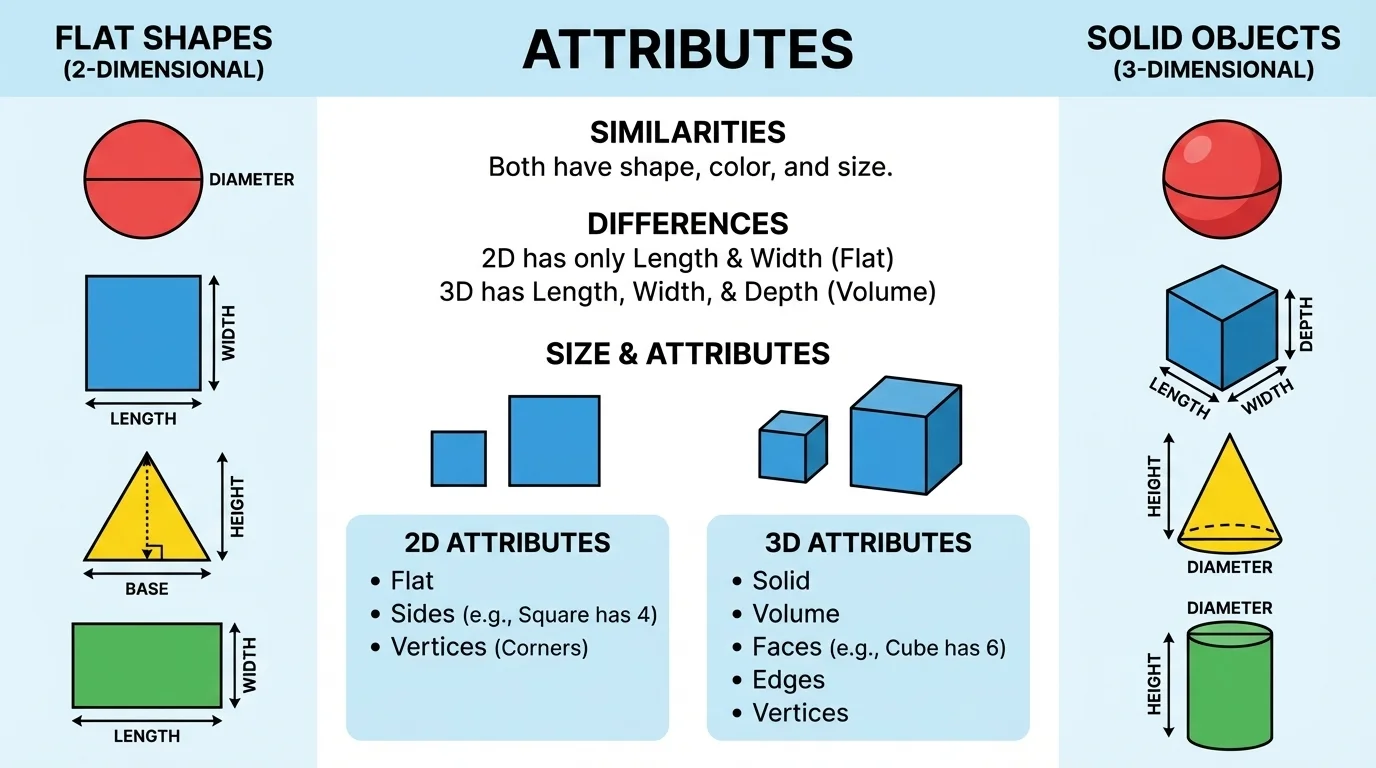
Flat shape means a shape that is smooth and flat like a drawing.
Solid object means an object that is not flat and can be picked up.
Attribute means something we can notice about a shape, like being round, having corners, or being big.
When we talk about shapes, we can look at what they have. A circle is round. A square has straight sides and corners. A triangle has \(3\) sides. A cube has flat faces. A sphere is round all over.
A circle is round and has no corners. A square has \(4\) straight sides and \(4\) corners. A triangle has \(3\) sides and \(3\) corners. A rectangle has \(4\) sides too, but it can be longer in one direction than the other.
A sphere is like a ball. It is round and rolls. A cube is like a block. It has flat faces. A cylinder is like a can. It has round ends and can roll.
A ball and an orange can both be like a sphere. A toy block and a gift box can both be like a cube.
Shapes can match in one way and differ in another way. A square and a rectangle both have \(4\) sides, but they are not always the same shape. A circle and a sphere are both round, but one is flat and one is solid.
Sometimes a shape stays the same shape even when it gets bigger or smaller. [Figure 2] shows that a small circle and a big circle are both circles. The same is true for a small cube and a big cube. Size can change, but the shape name can stay the same.
We can compare size by using words like big, small, larger, and smaller. If two toys are both cubes, the larger one is still a cube, and the smaller one is still a cube.
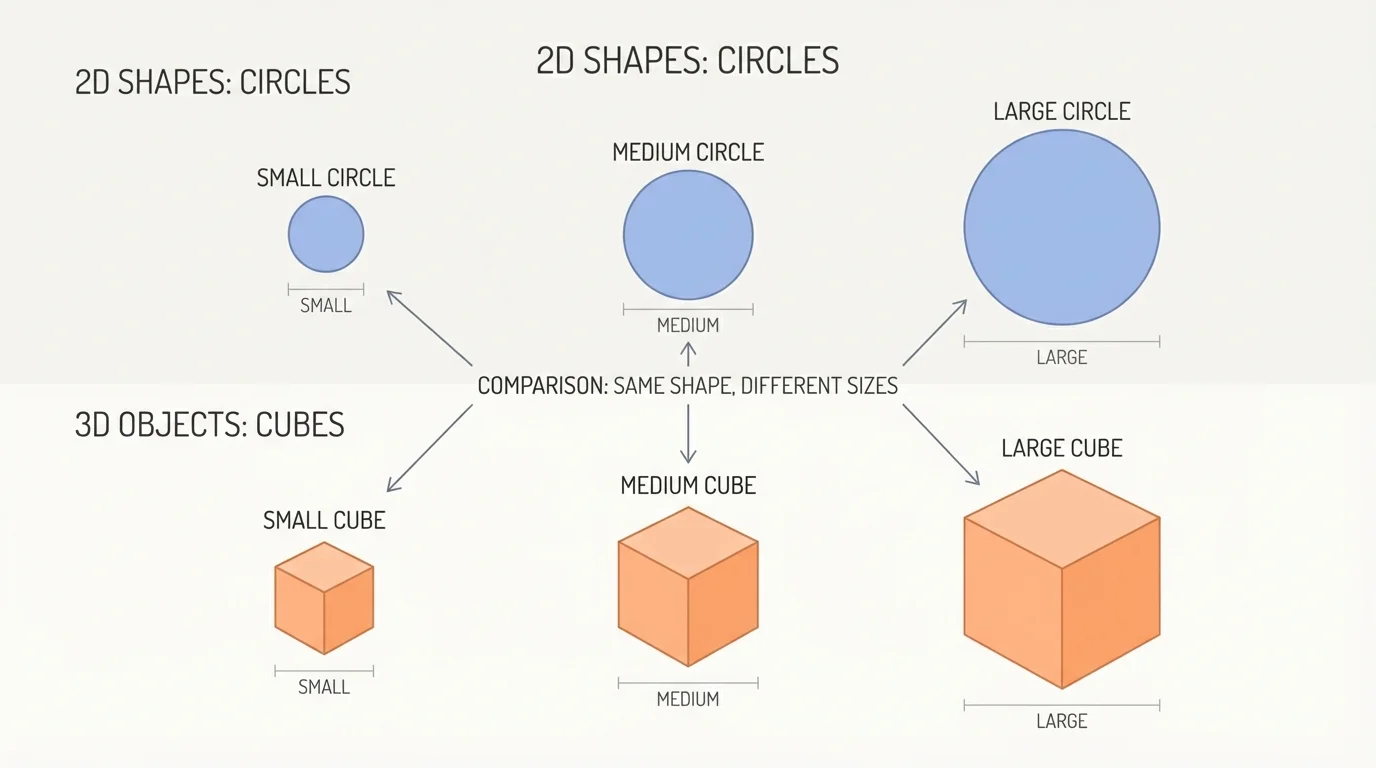
A big triangle and a small triangle are alike because both have \(3\) sides. They are different because one is larger. A large ball and a small ball are alike because both are round solid objects. They are different in size.
Shape and size are different ideas. Shape tells what kind of figure or object something is. Size tells how big or how small it is. Two things can have the same shape but different sizes.
When we compare objects, we can ask two questions: "What shape is it?" and "How big is it?" These questions help us describe objects more carefully.
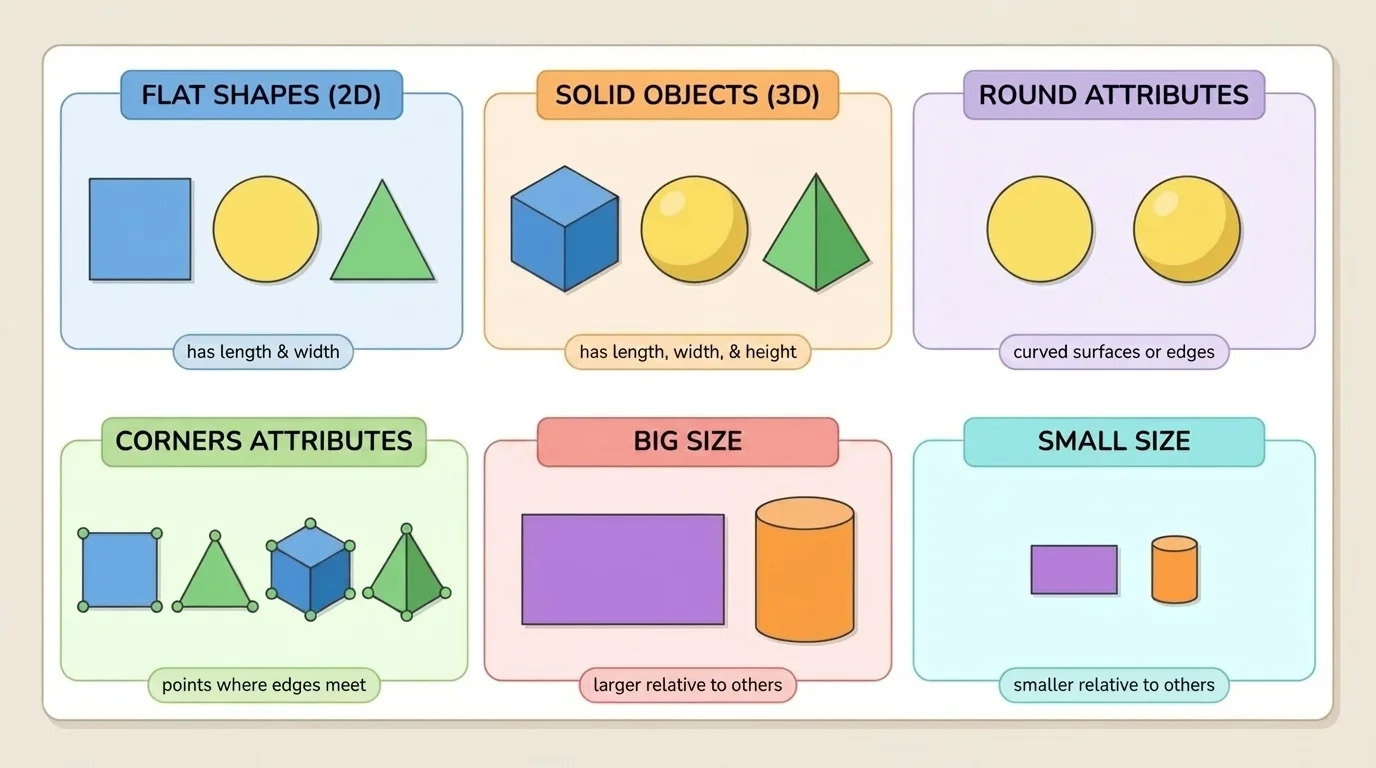
We can sort shapes by putting them into groups. [Figure 3] shows groups made by attributes such as flat or solid, round or having corners. Sorting helps us see what shapes share and what makes them different.
For example, a circle and a sphere are alike because both are round. They are different because a circle is flat and a sphere is solid. A square and a cube are alike because both have flat surfaces and corners. They are different because a square is flat and a cube is solid.
We can also sort by size. Put all the big shapes in one group. Put all the small shapes in another group. We can even sort by two ideas at once, such as big and round, or small and flat.
| Shape or object | Flat or solid | Round or corners | Size word |
|---|---|---|---|
| Circle | Flat | Round | Can be big or small |
| Square | Flat | Corners | Can be big or small |
| Sphere | Solid | Round | Can be big or small |
| Cube | Solid | Corners | Can be big or small |
Table 1. A simple comparison of flat and solid shapes using attributes.
Later, when you look again at the groups in [Figure 3], you can notice that one shape may fit with others for different reasons. A sphere fits with round things, and it also fits with solid things.
Shapes are everywhere. A plate can look like a circle. A window can look like a rectangle. A ball can look like a sphere. A box can look like a cube. A can may look like a cylinder.
Knowing shapes helps us talk about toys, food, buildings, and signs. It helps us compare objects around us. It also helps us sort blocks, puzzles, and classroom materials.
You already know how to look closely at objects. Geometry uses careful looking words so we can describe what we see.
When we use shape words and size words together, our descriptions get stronger. Instead of saying "that one," we can say "the small circle" or "the big cube."
These examples show how to compare and sort shapes and objects step by step.
Example 1
We have a circle and a square. How are they alike and different?
Step 1: Look at what both are.
Both are flat shapes.
Step 2: Look at roundness and corners.
The circle is round and has \(0\) corners. The square has \(4\) corners.
Step 3: Tell the comparison.
They are alike because both are flat. They are different because one is round and one has corners.
The circle and square are the same in one way and different in another way.
Comparing shapes means looking for both matches and differences, not just one or the other.
Example 2
We have a small cube and a big cube. How do we describe them?
Step 1: Name the shape.
Both objects are cubes.
Step 2: Compare size.
One cube is small. One cube is big.
Step 3: Tell what stays the same.
The shape stays the same. Only the size changes.
The answer is: same shape, different size.
This is like the size comparison in [Figure 2], where shapes keep their name even when they are shown in larger or smaller sizes.
Example 3
We have a ball, a box, and a paper square. How can we sort them?
Step 1: Name each object.
The ball is like a sphere. The box is like a cube. The paper shape is a square.
Step 2: Sort by flat or solid.
The sphere and cube go in the solid group. The square goes in the flat group.
Step 3: Sort by round or corners.
The sphere goes in the round group. The cube and square go in the corners group.
One set of objects can be sorted in more than one good way.
Sorting is powerful because we can use different attributes each time. That helps us think carefully about what we notice.
