Have you ever seen toys all over the floor and still known how many there were? Counting works even when objects are not in a straight line. If \(5\) bears are spread far apart, they are still \(5\) bears. A mixed-up group can be counted carefully, as [Figure 1] shows.
Objects do not have to be lined up to count them. They can be close together, far apart, on a table, or on the rug. We count each object one time: \(1\), \(2\), \(3\), \(4\), \(5\).
When objects are scattered, it helps to look slowly and move across the group. You might start on one side and point to each object as you count. This helps your eyes and fingers work together.
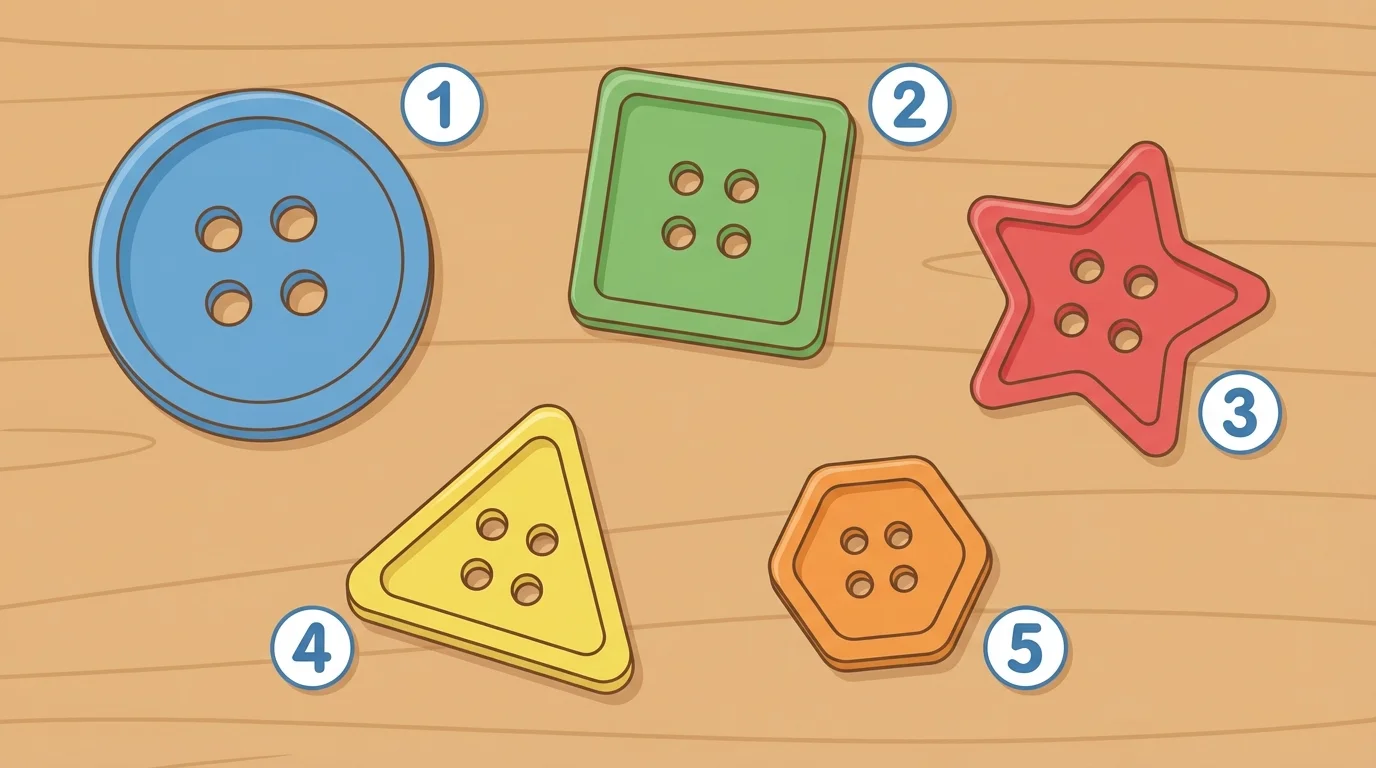
Count means to say the number words in order and match one number word to one object.
How many means the total number of objects in the group.
When we count, we use one-to-one correspondence. That means one number word goes with one object. One touch, one number. If you touch one apple and say \(1\), then touch another apple and say \(2\), you are counting correctly.
The last number you say tells the total. If you count ducks and say \(1\), \(2\), \(3\), then there are \(3\) ducks. This idea is called cardinality. The last number tells how many are in the whole group.
You can count small groups up to \(5\): \(1\) toy, \(2\) cups, \(3\) blocks, \(4\) cars, or \(5\) crayons. The group can look different each time, but the number stays the same.
Same number, different arrangement
If \(4\) shells are in a line, that is \(4\). If the same \(4\) shells are spread out, that is still \(4\). Moving objects does not change how many there are.
That is why careful counting matters more than the shape of the group. A circle of \(5\) beads and a messy pile of \(5\) beads both have the same amount.
When a group is scattered, use a simple plan. Look at one object, point, and say a number. Then move to the next object and say the next number. Stop when every object has been counted.
For example, suppose \(4\) leaves are on the ground. They are not touching. You point and count: \(1\), \(2\), \(3\), \(4\). The last number is \(4\), so there are \(4\) leaves.
If there are \(5\) pom-poms spread on the table, you can count each one once. You may touch them, slide them, or look from left to right. As we saw in [Figure 1], keeping a clear counting path helps you remember which objects are already counted.
Young children often know whether one group is larger or smaller before they can count every object. Counting helps you know the exact amount, such as \(4\) or \(5\).
It is also okay if the objects are different kinds. You might count \(1\) red block, \(1\) blue block, \(1\) car, \(1\) bear, and \(1\) cup. Altogether that can still make \(5\) objects.
Sometimes there are more than \(5\) objects, but you only need to count out up to \(5\). You can start with a big pile and stop when you reach \(5\), as [Figure 2] illustrates.
For example, if a basket has many blocks, you can pick blocks one at a time and count: \(1\), \(2\), \(3\), \(4\), \(5\). Then you stop. You have counted out \(5\) blocks from a group that has more than \(5\).
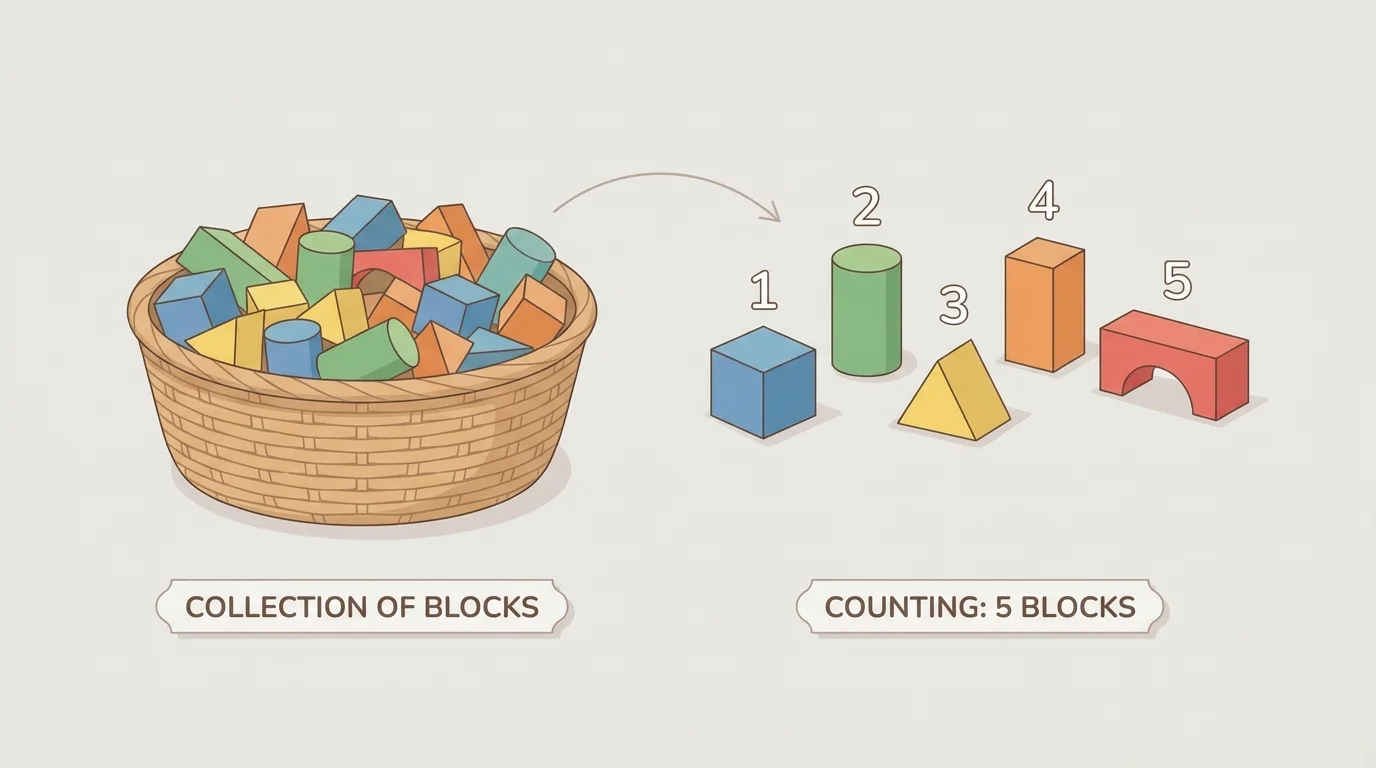
You can do this with crackers, buttons, toy animals, or crayons. The big group may have \(6\), \(7\), or even more objects, but your job is only to count as many as \(5\).
Number words go in order: \(1\), \(2\), \(3\), \(4\), \(5\). Saying them in order helps counting stay correct.
If you are asked for \(3\) objects from a bigger set, you count until \(3\) and stop. If you are asked for \(5\), you count until \(5\) and stop. Stopping at the right number is part of careful counting.
A counting path helps when objects are scattered. In the star group, [Figure 3] shows how a finger can move from one object to the next without missing any.
Example 1
There are \(5\) shells spread on the sand. How many shells are there?
Step 1: Point to each shell one time.
Step 2: Say the number words in order: \(1\), \(2\), \(3\), \(4\), \(5\).
Step 3: Use the last number said.
The last number is \(5\).
So there are \(5\) shells.
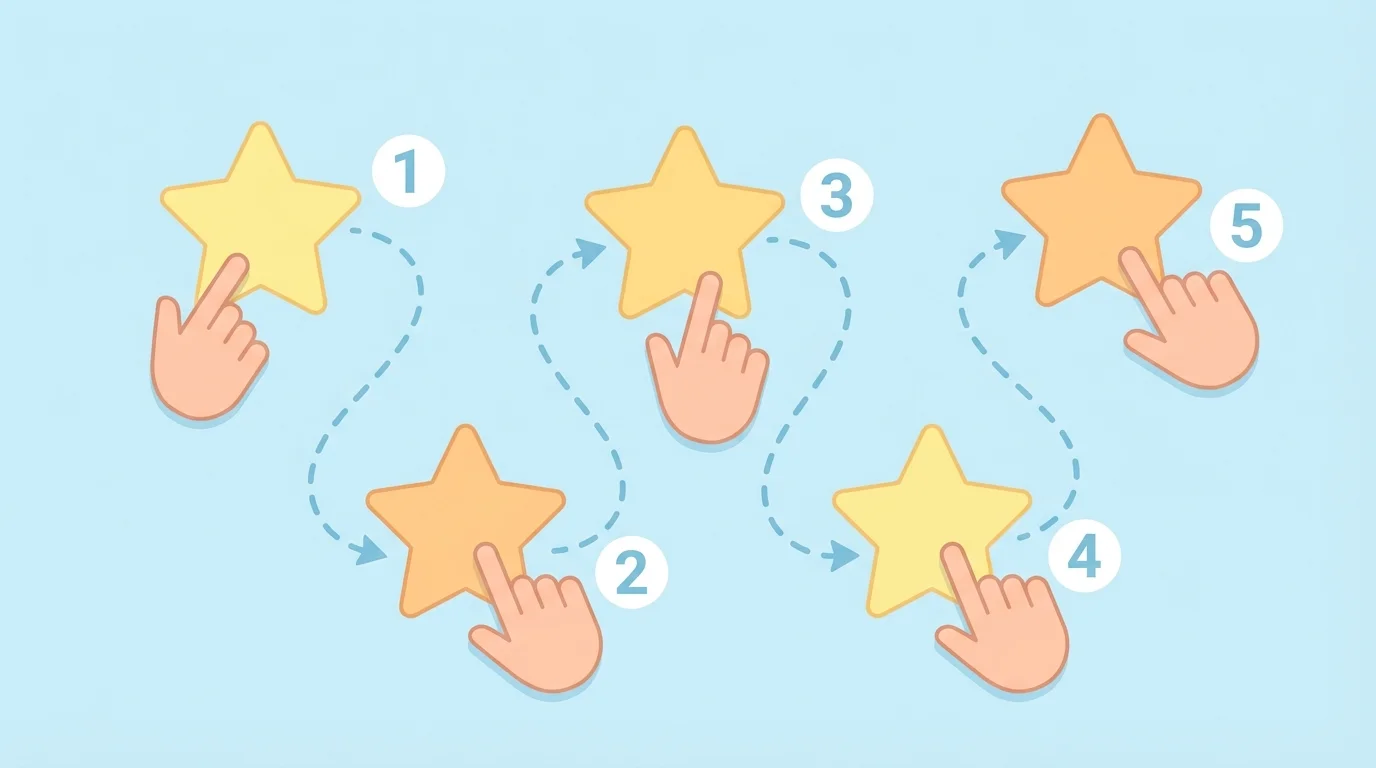
Now try to notice that the shells did not need to be in a line. The counting still worked because each shell got one number word.
Example 2
A tray has many beads. Count out \(4\) beads.
Step 1: Take one bead and say \(1\).
Step 2: Take another bead and say \(2\).
Step 3: Take a third bead and say \(3\).
Step 4: Take a fourth bead and say \(4\), then stop.
You counted out \(4\) beads from a group with more than \(4\).
Stopping matters. If you keep going after \(4\), then you no longer have exactly \(4\) beads.
Example 3
\(3\) toy cars are spread on the rug. How many toy cars are there?
Step 1: Look at one car and say \(1\).
Step 2: Look at the next car and say \(2\).
Step 3: Look at the last car and say \(3\).
Step 4: Use the last number said.
The last number is \(3\).
So there are \(3\) toy cars.
The same idea works for \(1\), \(2\), \(3\), \(4\), and \(5\). Count each object once, and use the last number to tell how many.
We count small groups every day. You might count \(5\) crackers for snack, \(4\) blocks for a tower, or \(2\) socks from a basket. When you need only a few objects, counting helps you get the right amount.
In the classroom, a teacher may ask for \(5\) markers from a box with many markers. At home, someone may ask for \(3\) apples from a bowl with lots of fruit. Counting helps you choose the exact number you need.
Even when objects are mixed up, you can still be accurate. The basket example from [Figure 2] reminds us that a large collection can still give us exactly \(5\) objects when we count carefully and stop at the right time.
Sometimes children make small counting mistakes. An object may get counted two times, or one object may be skipped. Moving slowly helps.
Good counters often point, touch, slide, or move counted objects to a new spot. If \(5\) cubes are in a messy group, you can move each counted cube aside. Then you know which cubes are already counted.
Another helpful habit is to start in one place and move across the group in a clear way. The star path in [Figure 3] shows this idea. A path keeps counting organized.
