Who gets the very first turn? Who stands next? Order words help us talk about places in a line. When we say first, second, third, fourth, and fifth, we are talking about where something is, not just how many there are.
Order words tell position. They help us name a place in a row, a line, or a list.
First means the one in position \(1\).
Second means the one in position \(2\).
Third means the one in position \(3\).
Fourth means the one in position \(4\).
Fifth means the one in position \(5\).
We can say the order like this: \(1\)st, \(2\)nd, \(3\)rd, \(4\)th, \(5\)th. For little learners, the words are most important: first, second, third, fourth, fifth.
If five ducks are on a pond, one duck can be first and another can be fifth. The ducks are still \(5\) ducks, but each duck has its own place.
When things are in a line, ordinal numbers tell where each one is. In [Figure 1], each child has a different place in the row, starting at the front or beginning.
If we start at the beginning, the first child is in place \(1\). The next child is second, then third, then fourth, then fifth.
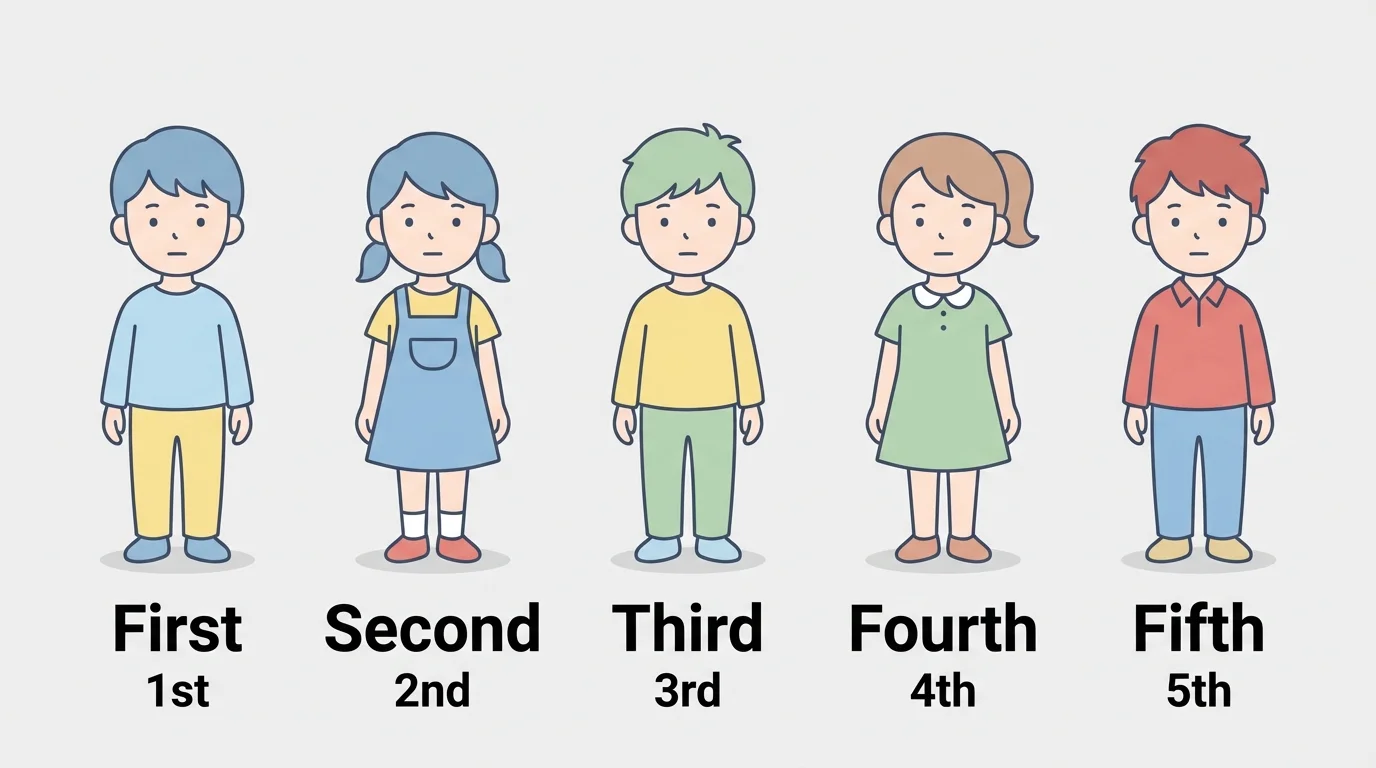
It is important to start from the same side each time. If we start from a different side, the places can change. A child who is first from one side may be fifth from the other side.
Order is different from amount
The number \(5\) can tell how many objects there are. The word fifth tells the place of one object in that group. So \(5\) and fifth do not mean the same thing.
If there are \(5\) bears in a row, the whole group has \(5\) bears. Only one bear is first, one bear is second, one bear is third, one bear is fourth, and one bear is fifth.
Toys, chairs, cups, and friends can all have places in order. In [Figure 2], the toy cars are lined up so we can name which car is third and which car is fifth.
For example, if five blocks are in a row, the red block might be first. The blue block might be second. The yellow block might be third. The green block might be fourth. The orange block might be fifth.
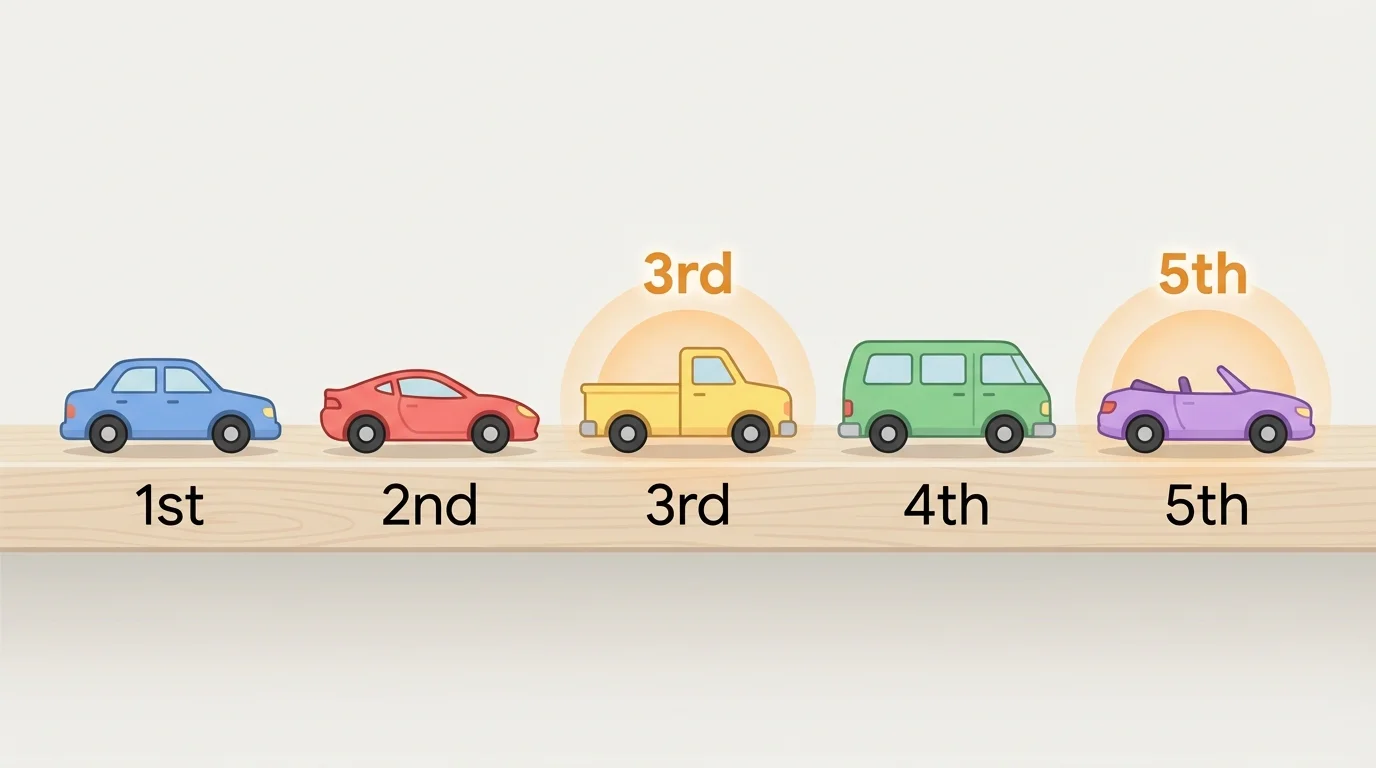
We also use these words with people. In a line for hand washing, one child is first, another child is second, and another child may be fifth.
Later, when we talk again about rows and lines, [Figure 1] still helps us remember that every place is counted one by one from the start.
Let's look at some simple examples and name the places carefully.
Example 1
There are \(5\) apples in a row. We start at the left. Which apple is in place \(1\)?
Step 1: Start at the beginning of the row.
The left apple is counted first.
Step 2: Match place \(1\) with the order word.
Place \(1\) is first.
The apple in place \(1\) is the first apple.
That means the first object is always the one we count first from the chosen starting side.
Example 2
Five children sit in chairs. Ava is in chair number \(3\). What is Ava's order word?
Step 1: Look at the chair number.
Ava is in place \(3\).
Step 2: Match the number to the order word.
Place \(3\) means third.
Ava is third.
So when we hear place \(3\), we can say third.
Example 3
There are \(5\) cups on a table in a line. The purple cup is last. Which place is last here?
Step 1: Count how many places there are.
There are \(5\) cups, so the places go from first to fifth.
Step 2: Find the last place.
With \(5\) cups, the last place is place \(5\).
Step 3: Say the order word for place \(5\).
Place \(5\) is fifth.
The purple cup is fifth.
Last and fifth can mean the same place when there are \(5\) things in the line.
Example 4
Four animals are already in line: first, second, third, and fourth. One more animal comes next. What place does it get?
Step 1: Name the places already used.
The line already has places \(1\), \(2\), \(3\), and \(4\).
Step 2: Find the next place.
After \(4\) comes \(5\).
Step 3: Say the matching order word.
Place \(5\) is fifth.
The new animal is fifth.
Order words are all around us. In a race, we say who comes first, second, third, fourth, and fifth. [Figure 3] shows how each runner finishes in a different place.
We use order words in stories too. The first page comes before the second page. The third song comes after the second song. A child can be fifth in line for a snack.
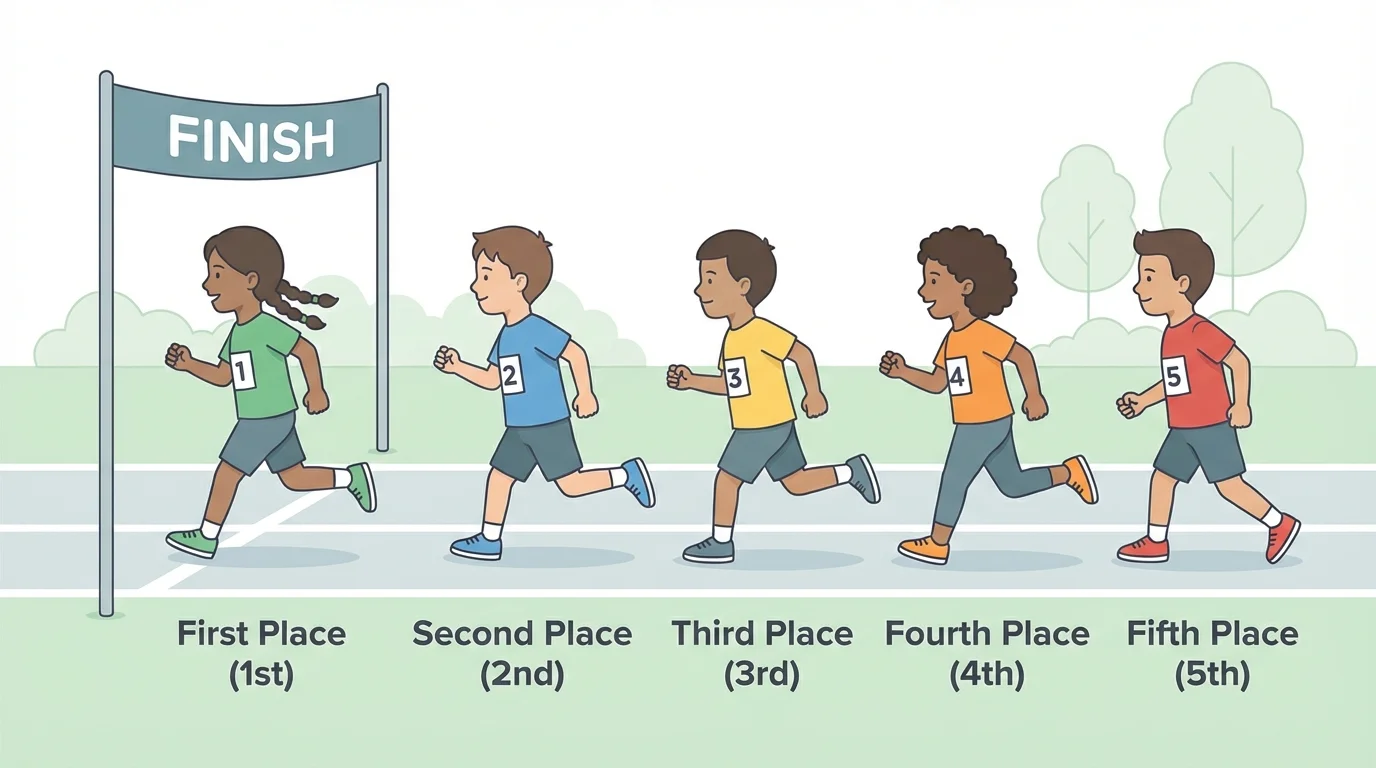
At home, you may put toys away in order. One shoe can be first in the row, and another shoe can be second. When setting out \(5\) plates, one plate is always fifth if we count all the way to the end.
Races are a fun way to hear these words again, and [Figure 3] reminds us that order words tell where someone finishes, not how many runners there are.
Counting tells how many: \(1, 2, 3, 4, 5\).
Order words tell place: first, second, third, fourth, fifth.
If a teacher asks, "How many balls are there?" the answer might be \(5\). If the teacher asks, "Which ball is blue?" the answer might be "the second ball" or "the fifth ball."
Position means where something is. A row is a line of objects or people. When we know the starting point, we can tell each position from first to fifth.
The words first, second, and third sound very different from \(1\), \(2\), and \(3\). That is one reason we practice saying them many times.
With practice, it becomes easy to look at \(5\) things in order and say which one is first, second, third, fourth, or fifth.
