Have you ever looked at a plate and known right away that it has \(2\) cookies or \(5\) grapes? Numbers help us tell how many. When we see a written symbol called a numeral, we can match it to a group of objects. Today we learn how numerals \(0\), \(1\), \(2\), \(3\), \(4\), and \(5\) go with real things we can see and touch.
A written number is called a numeral. Numerals help us show how many objects are in a group. When we see the numeral \(3\), it means a group has three things. When we see the numeral \(5\), it means a group has five things.
Quantity means how many. A numeral is a written symbol such as \(0\), \(1\), \(2\), \(3\), \(4\), or \(5\) that tells a quantity.
The numeral \(0\) is special. It means none. If there are no blocks in a basket, the basket has \(0\) blocks. If there are no apples on a plate, the plate has \(0\) apples.
Each numeral from \(0\) to \(5\) matches a group:
\(0\) means no objects, \(1\) means one object, \(2\) means two objects, \(3\) means three objects, \(4\) means four objects, and \(5\) means five objects.
We can match groups and numerals by looking carefully at how many objects there are. The matching pictures in [Figure 1] show each numeral beside a group with the same quantity. This helps our eyes and brains connect the written symbol to real objects.
If you see \(1\) ball, it matches the numeral \(1\). If you see \(2\) bears, it matches \(2\). If you see \(4\) flowers, it matches \(4\). A group with nothing in it matches \(0\).
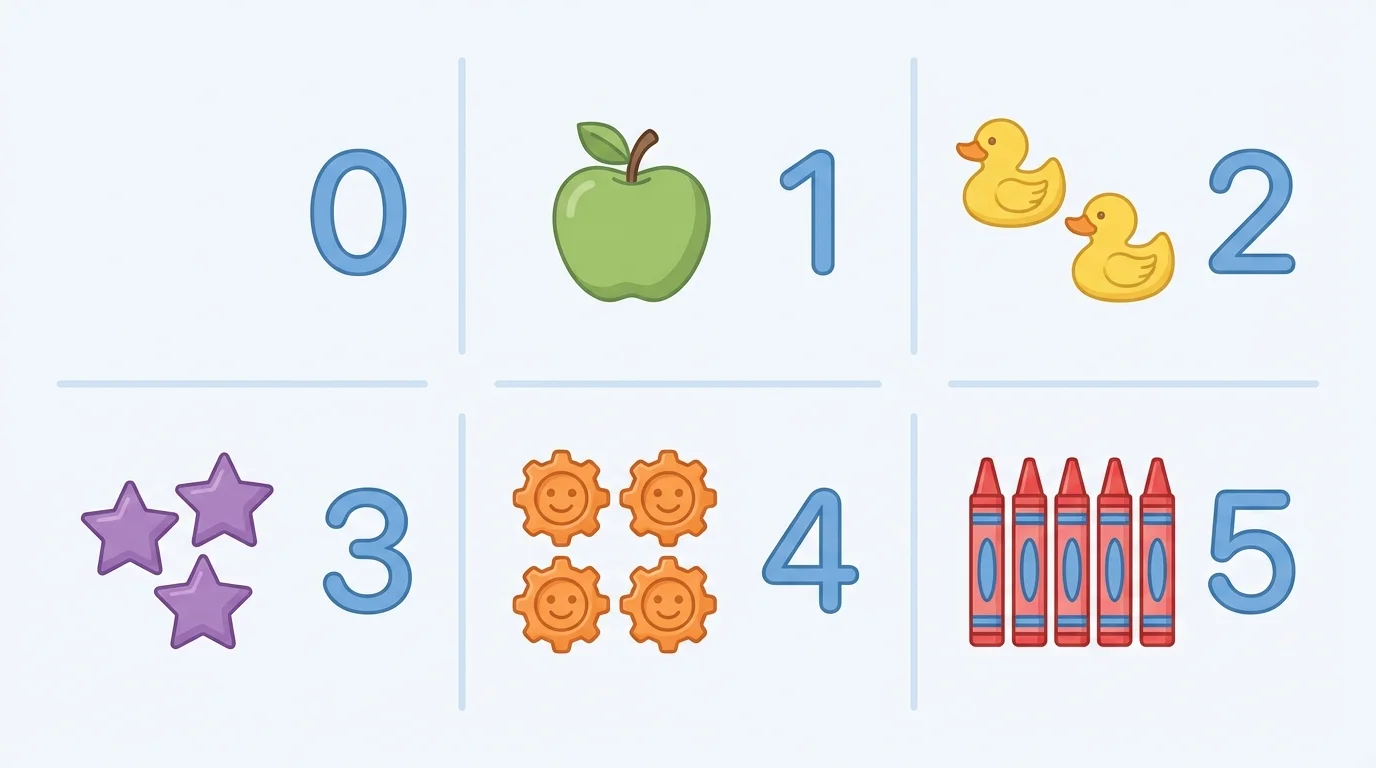
Here are some examples: one toy car matches \(1\); two shoes match \(2\); three cups match \(3\); four ducks match \(4\); five stars match \(5\).
The objects do not have to be the same kind every time. We can count buttons, spoons, leaves, or blocks. The important idea is the quantity, or how many objects are in the group.
Our eyes sometimes recognize small groups very quickly. Many people can look at \(2\) or \(3\) objects and know the number without counting each one.
A group can look different and still have the same number. Three blocks in a line are still \(3\). Three blocks spread apart are still \(3\). We will count to make sure.
To find how many objects are in a group, we use counting. We count best when we point to or touch one object at a time. This helps us count each object once.
As [Figure 2] shows, we say one number for each object: \(1\), \(2\), \(3\), and so on. The last number we say tells how many objects are in the whole group. If we touch five shells and say \(1, 2, 3, 4, 5\), then the group has \(5\) shells.
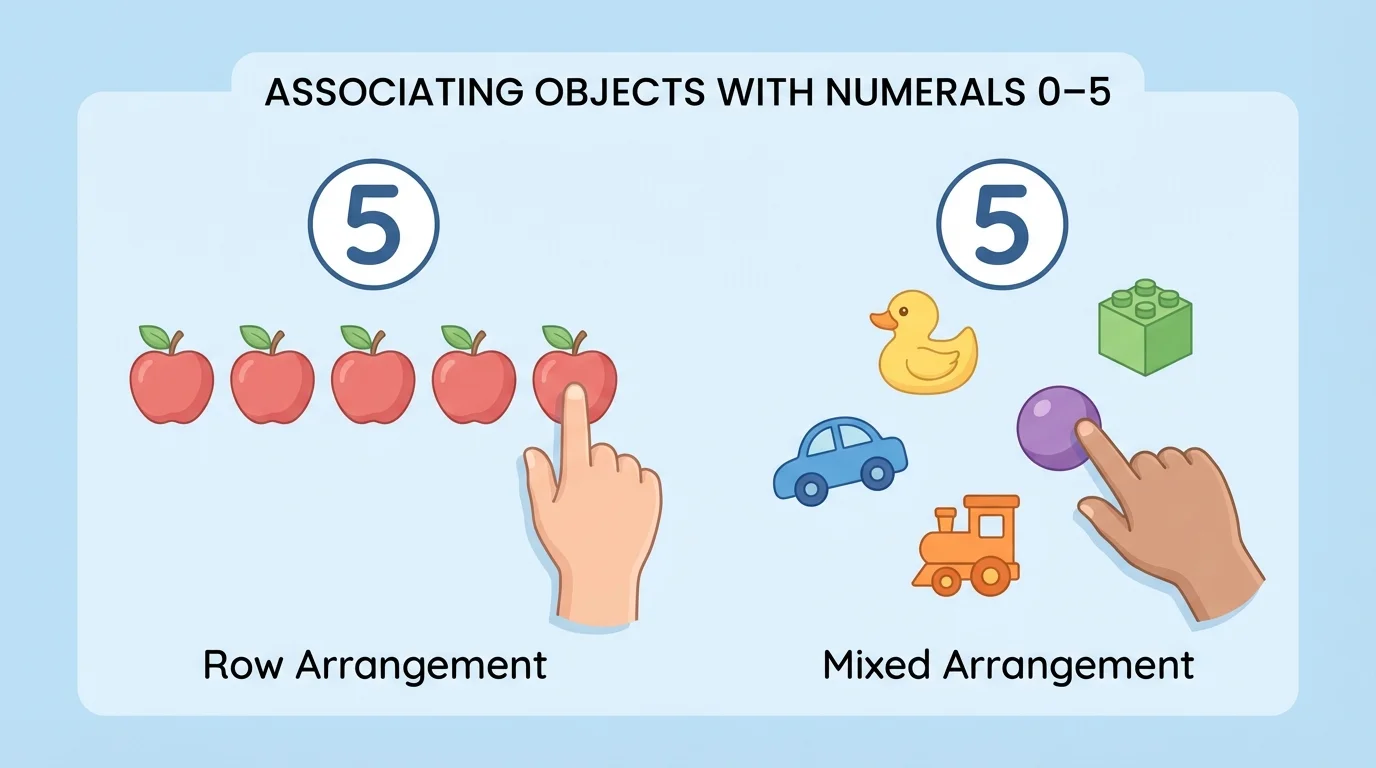
Sometimes objects are in a straight row. Sometimes they are scattered. We still count one object at a time. A row of \(4\) crayons and a scattered group of \(4\) crayons both match the numeral \(4\).
One-to-one matching means one number word goes with one object. When we count correctly, each object gets one count, and no object is skipped or counted twice.
This idea is called one-to-one matching. If we count three apples, each apple gets one number word: first apple \(1\), second apple \(2\), third apple \(3\).
We also learn that the order of objects does not change the total. If \(5\) blocks are close together or far apart, there are still \(5\) blocks. We can remember this when we look back at the matching groups in [Figure 1].
Let us match groups and numerals step by step.
Worked example 1
There are three toy ducks. Which numeral matches the group?
Step 1: Count the ducks.
We say \(1, 2, 3\).
Step 2: Listen to the last number.
The last number is \(3\).
Step 3: Match the group to the numeral.
The correct numeral is \(3\).
The group of ducks matches \(3\).
When we count slowly and touch each object once, matching is easier.
Worked example 2
A plate has no cookies on it. Which numeral matches the plate?
Step 1: Look at the plate.
There are no cookies.
Step 2: Think about what numeral means none.
The numeral for none is \(0\).
Step 3: Match the plate to the numeral.
The correct numeral is \(0\).
The empty plate matches \(0\).
The numeral \(0\) is important because it tells us that a group can have nothing in it.
Worked example 3
There are five stars in a picture. Which numeral matches the group?
Step 1: Count the stars.
We say \(1, 2, 3, 4, 5\).
Step 2: Find the last number said.
The last number is \(5\).
Step 3: Choose the numeral.
The group matches \(5\).
The stars match \(5\).
Now think about a mixed arrangement. Four buttons might not be in a line. We still count them one by one, just like the counting picture in [Figure 2].
Worked example 4
Four buttons are spread out on a table. Which numeral matches the group?
Step 1: Point to each button once.
We say \(1, 2, 3, 4\).
Step 2: Check the last number.
The last number is \(4\).
Step 3: Match to the written numeral.
The correct numeral is \(4\).
The buttons match \(4\).
We use these numbers all the time. At snack time, you may have \(2\) crackers. At cleanup time, you may put away \(5\) blocks. At story time, there may be \(0\) empty chairs if every chair is full.
Numbers help us talk about real things. A teacher might say, "Take \(1\) paper." A family might count \(4\) spoons for dinner. On a walk, you might see \(3\) birds on a fence.
When we count, we say the numbers in order: \(1, 2, 3, 4, 5\). We can also use \(0\) to tell that there are none.
Matching numerals to groups helps us understand signs, books, games, and songs. If a book page shows the numeral \(2\), we can look for a group with \(2\) objects. If a puzzle piece has \(5\), it should go with a group of \(5\).
We can also begin to write the numerals we know. As [Figure 3] shows, tracing cards can help us learn how to write \(0\), \(1\), \(2\), \(3\), \(4\), and \(5\). Writing a numeral helps us remember what quantity it means.
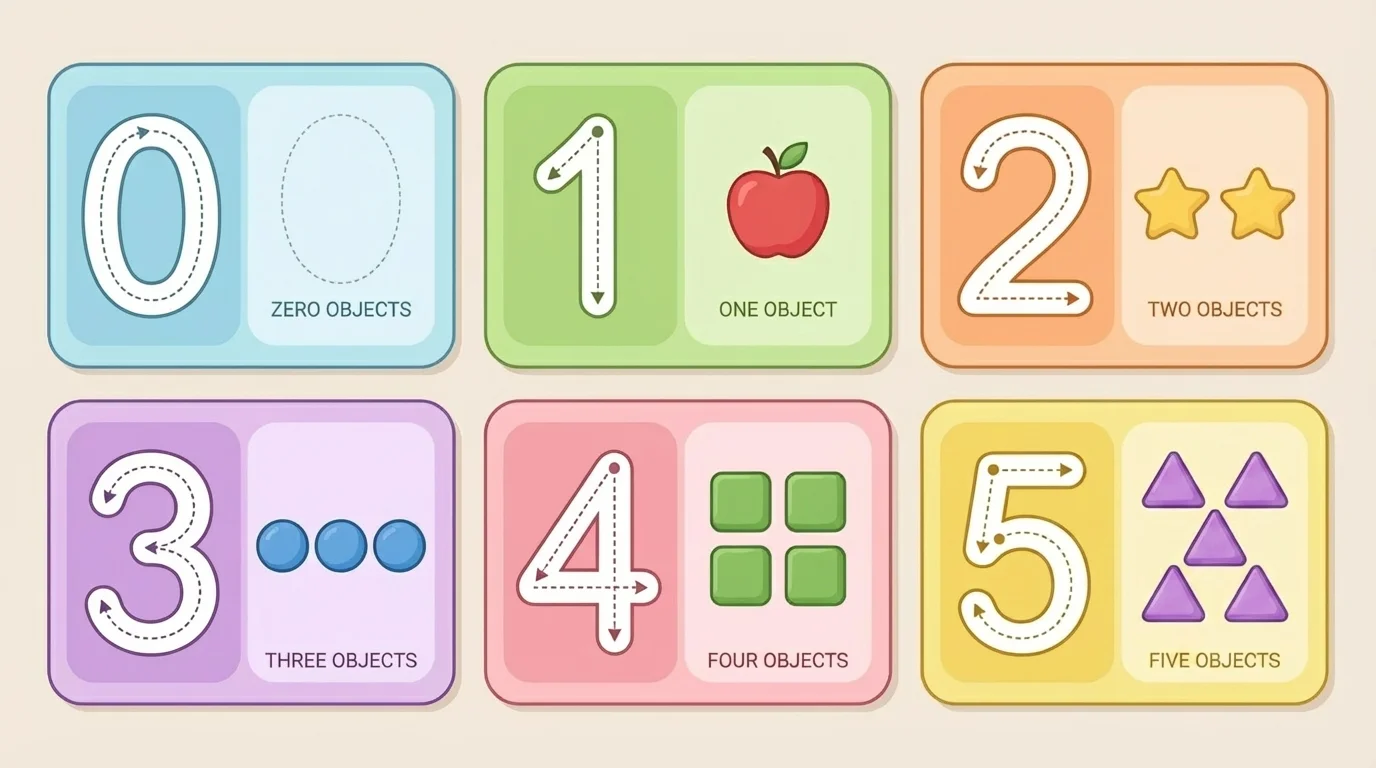
The numeral \(0\) is round. The numeral \(1\) is a straight line. The numeral \(2\) curves and then goes across. The numeral \(3\) has two curves. The numeral \(4\) has lines that meet. The numeral \(5\) has a short line, a curve, and a line down.
When children begin writing numerals, the shapes may not be perfect at first. That is okay. The important idea is connecting the written numeral to the right quantity. Seeing the numeral and the group together, as in [Figure 1], helps build that connection.
As you learn these numerals, you are building early number sense. You are learning that \(2\) is always two objects, \(4\) is always four objects, and \(0\) always means none.
