Look around: stripes on clothes, steps on stairs, and claps in a song all come in order. That order is called a pattern. When we know the order, we can tell what comes next, and we can fill in a part that is missing.
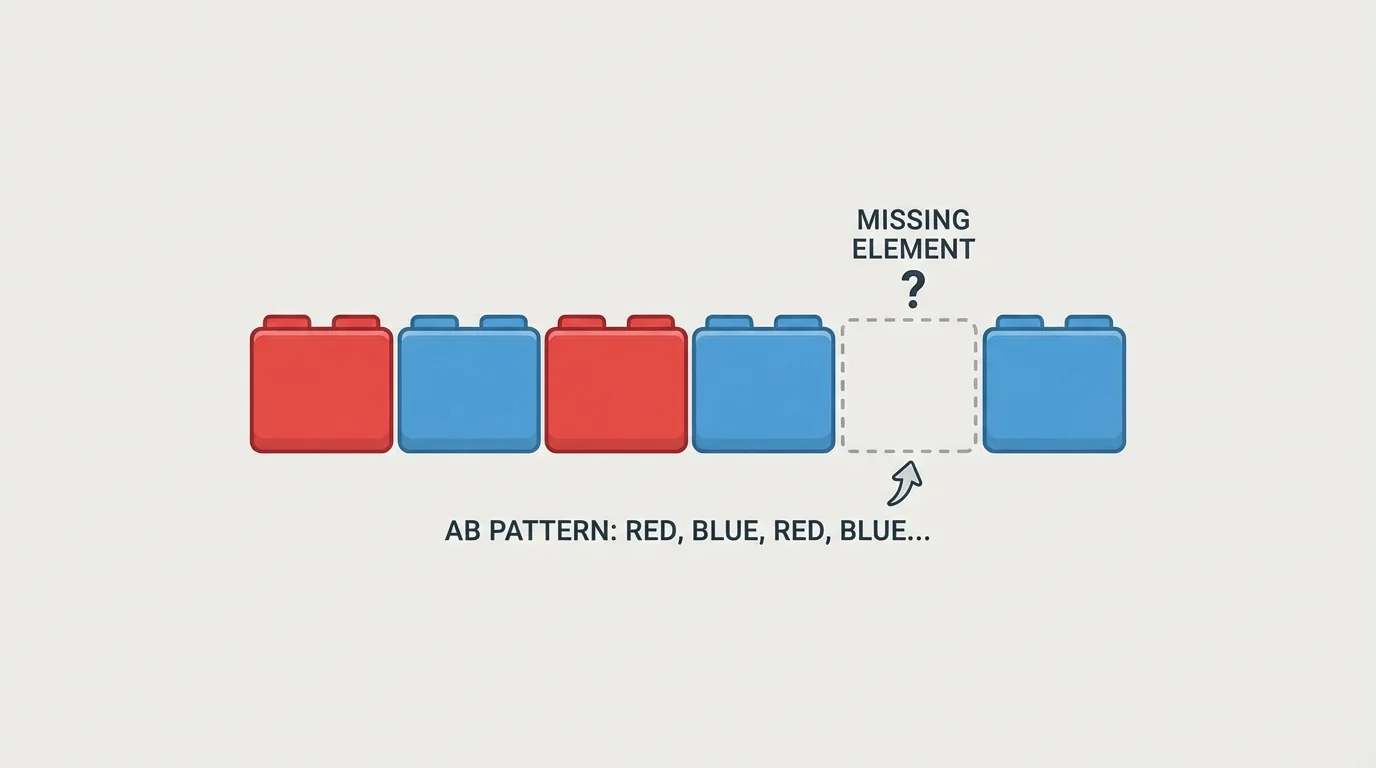
A pattern is something that happens in the same way again and again, or grows in a clear way. In a repeating pattern, the same part repeats. For example, red, blue, red, blue is a repeating pattern, as [Figure 1] shows with colored blocks. The part that repeats is red, blue.
We can also have shape patterns. The pattern circle, square, circle, square repeats too. If we see circle, square, circle, then the missing shape is square.
Some patterns grow. A growing pattern changes in a way we can follow. For example, one block, then two blocks, then three blocks is growing. Each time, we add \(1\).
Repeating pattern means the same group comes again and again.
Growing pattern means the pattern changes by the same amount each time, such as adding \(1\).
When we fill in a missing part, we look for the rule. The rule tells us what stays the same. In an AB pattern, A and B keep taking turns. In a growing pattern, the amount changes in the same way each time.
To find a missing part, look slowly from left to right. You can point to each item and say what you see: red, blue, red, blue. Then when one spot is empty, you know what belongs there.
Patterns can use colors, shapes, sounds, actions, or numbers. A clap, tap, clap, tap pattern repeats actions. A bead pattern might be yellow, yellow, green, yellow, yellow, green. A number pattern might be \(1, 2, 3, 4\), where each number is one more than the last.
How to find the rule
Ask, "Is it repeating?" or "Is it growing?" If it is repeating, find the little part that repeats. If it is growing, notice how much it changes each time, like add \(1\) or add \(2\).
Sometimes the missing part is in the middle. Sometimes it is at the end. The place does not matter. The rule stays the same.
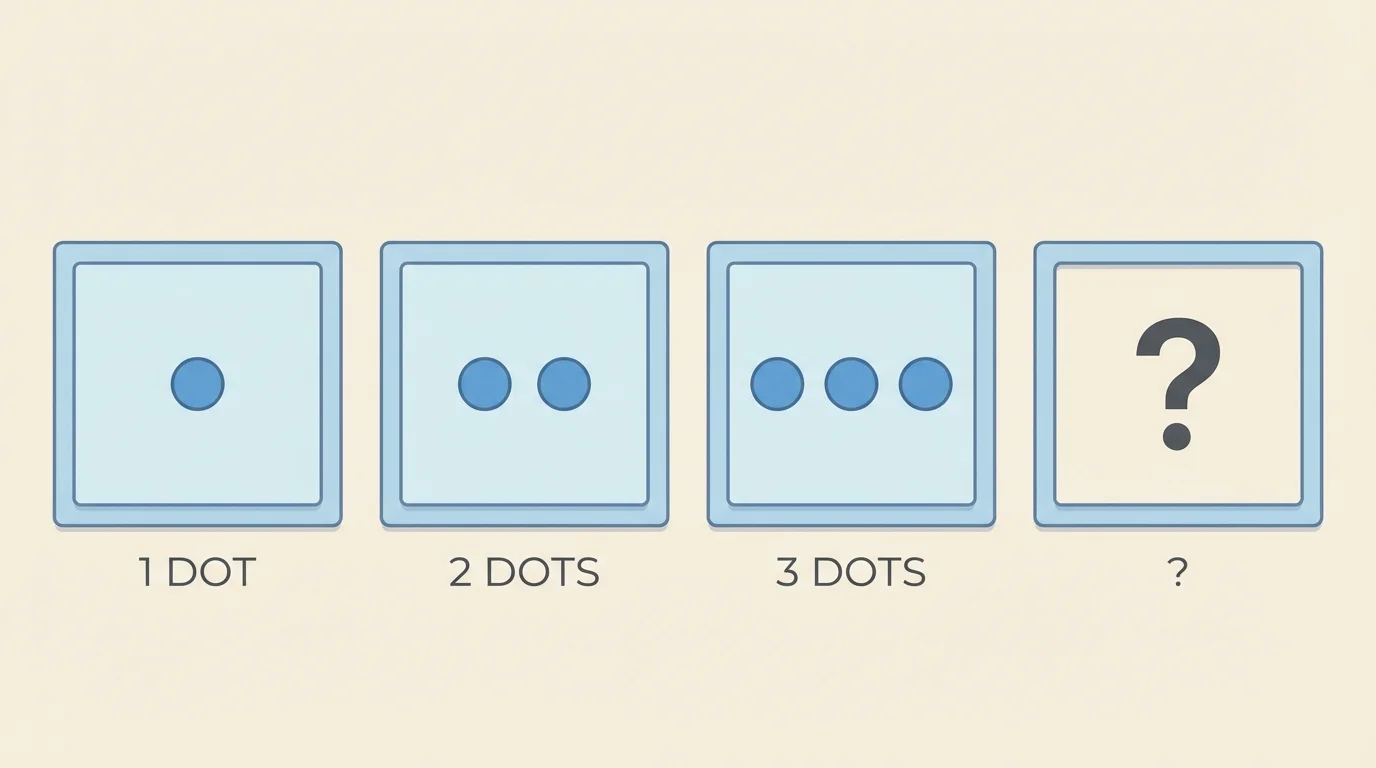
Growing patterns can also be seen with objects, as [Figure 2] illustrates with groups of dots that get bigger by \(1\). Seeing the groups helps us match the number rule to real things we can count.
Example 1: Color pattern
Find the missing color: red, blue, red, \(\textrm{\_\_}\), red, blue.
Step 1: Look for the repeating part.
The colors go red, blue, red, blue.
Step 2: Match the empty space to the rule.
After red comes blue.
The missing color is blue.
In this pattern, the rule is easy to hear: red, blue, red, blue. The empty space must keep that rule going.
Example 2: Shape pattern
Find the missing shape: circle, circle, square, circle, circle, \(\textrm{\_\_}\).
Step 1: Find the repeating group.
The group is circle, circle, square.
Step 2: Repeat the group.
\(\textrm{circle, circle, square, circle, circle, square}\)
The missing shape is square.
This kind of pattern is sometimes called AAB because two same things come first, then a different one comes next.
Now let us look at a pattern that grows instead of repeats.
Example 3: Number pattern
Find the missing number: \(1, 2, 3, \textrm{\_\_}, 5\).
Step 1: Look at how the numbers change.
Each number is one more than the number before it: \(1 \to 2\), \(2 \to 3\).
Step 2: Keep the same change.
After \(3\), the next number is \(4\).
The missing number is \(4\).
A number pattern can be checked by counting: \(1, 2, 3, 4, 5\). The order must make sense all the way through.
Example 4: Growing object pattern
Find the missing part: \(1\) star, \(2\) stars, \(3\) stars, \(\textrm{\_\_}\) stars.
Step 1: Count how many stars are in each group.
The groups have \(1\), then \(2\), then \(3\).
Step 2: Notice the change.
Each group has \(1\) more star than before.
Step 3: Add \(1\) to \(3\).
\(3 + 1 = 4\)
The missing part is \(4\) stars.
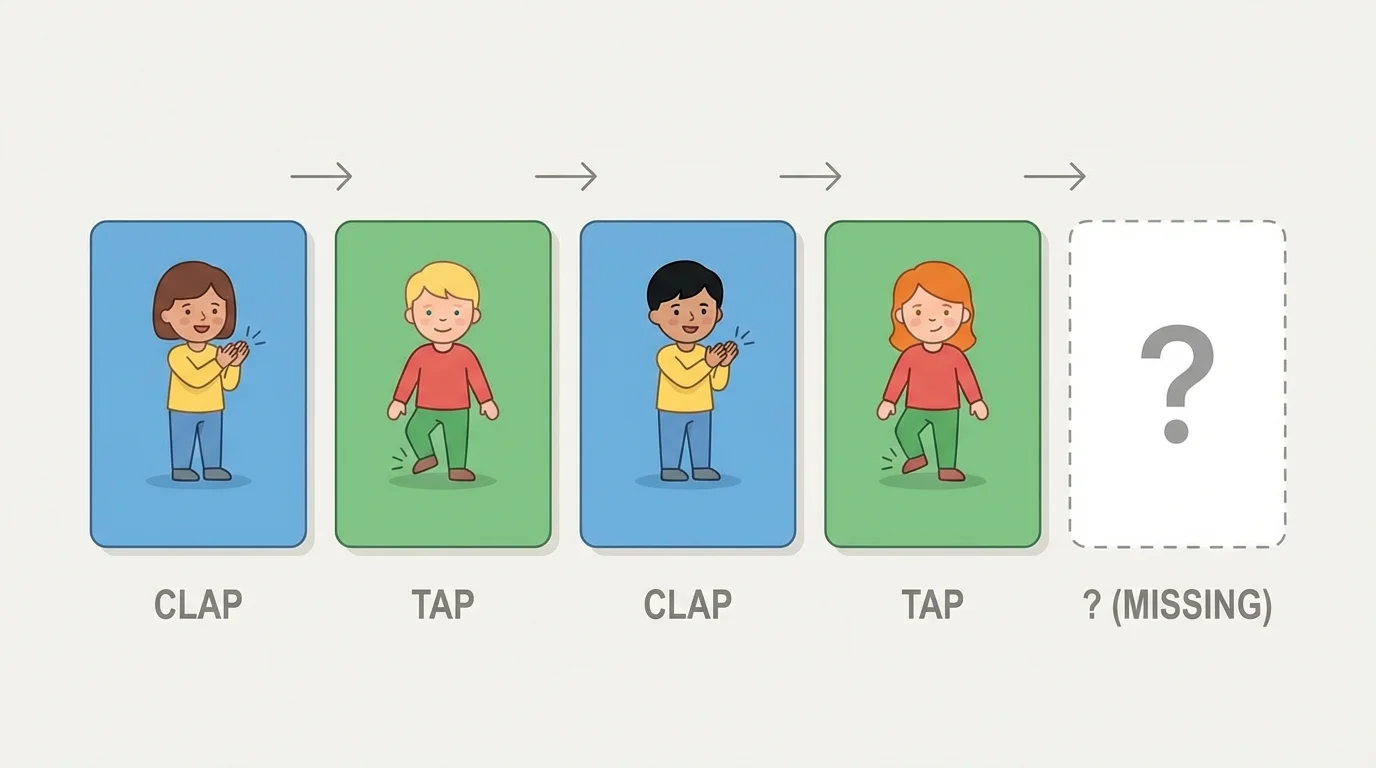
Patterns happen in games, songs, and routines, and [Figure 3] shows a movement pattern with actions that take turns. If a song goes clap, tap, clap, tap, then the next action after clap is tap.
At home, a routine can have a pattern too: wash hands, dry hands, wash hands, dry hands. On the floor, tiles can make color patterns. On stairs, the numbers of steps go up one by one: \(1, 2, 3, 4\).
When children build with blocks, they may make tower heights of \(1\), \(2\), \(3\), and \(4\). That is a growing pattern. When they string beads red, green, red, green, that is a repeating pattern. The same idea works in both: find the rule and keep it going.
Music uses patterns all the time. Beats often repeat in groups, so your ears can help you notice what should come next.
Looking back at the movement cards, we can tell the missing action by saying the pattern aloud. Hearing it can be just as helpful as seeing it.
Some simple patterns have names teachers use. AB means two things take turns, like circle, square, circle, square. AAB means two of the same, then one different, like red, red, blue, red, red, blue. ABB means one thing, then two of another, like star, heart, heart, star, heart, heart.
We can also make easy number patterns such as \(2, 3, 4, 5\). This pattern grows by \(1\). Another one is \(5, 4, 3, 2\), which gets smaller by \(1\).
Counting in order helps with number patterns. If you know \(1, 2, 3, 4, 5\), you can notice when one number is missing.
The colored blocks in [Figure 1] remind us that a repeating pattern has a small part that repeats again and again. Once we find that small part, the empty space is much easier to fill.
Say the pattern aloud. Point to each part. Look for the little group that repeats, or count how many more there are each time. Then check your answer by reading the whole pattern again from start to end.
If the pattern still sounds right, looks right, or counts right, your missing part fits. Patterns help us notice order, and noticing order is an important math idea.
