Have you ever seen colors go back and forth like a little song: red, blue, red, blue? That is a pattern. Patterns are all around us in toys, clothes, music, and building blocks. When we can see the order, we can make the same order again somewhere else, and we can keep it going for longer.
A pattern is something that happens in the same order again and again. A simple color pattern might be red, blue, red, blue. A shape pattern might be circle, square, circle, square. The order matters.
Pattern means a rule that repeats in order. Duplicate means to make the same thing again. Extend means to make it longer without changing the rule.
If the order changes, the pattern changes. For example, red, blue, red, blue matches the rule. But red, blue, blue, red does not match the same rule. We look carefully at what comes first, next, and after that.
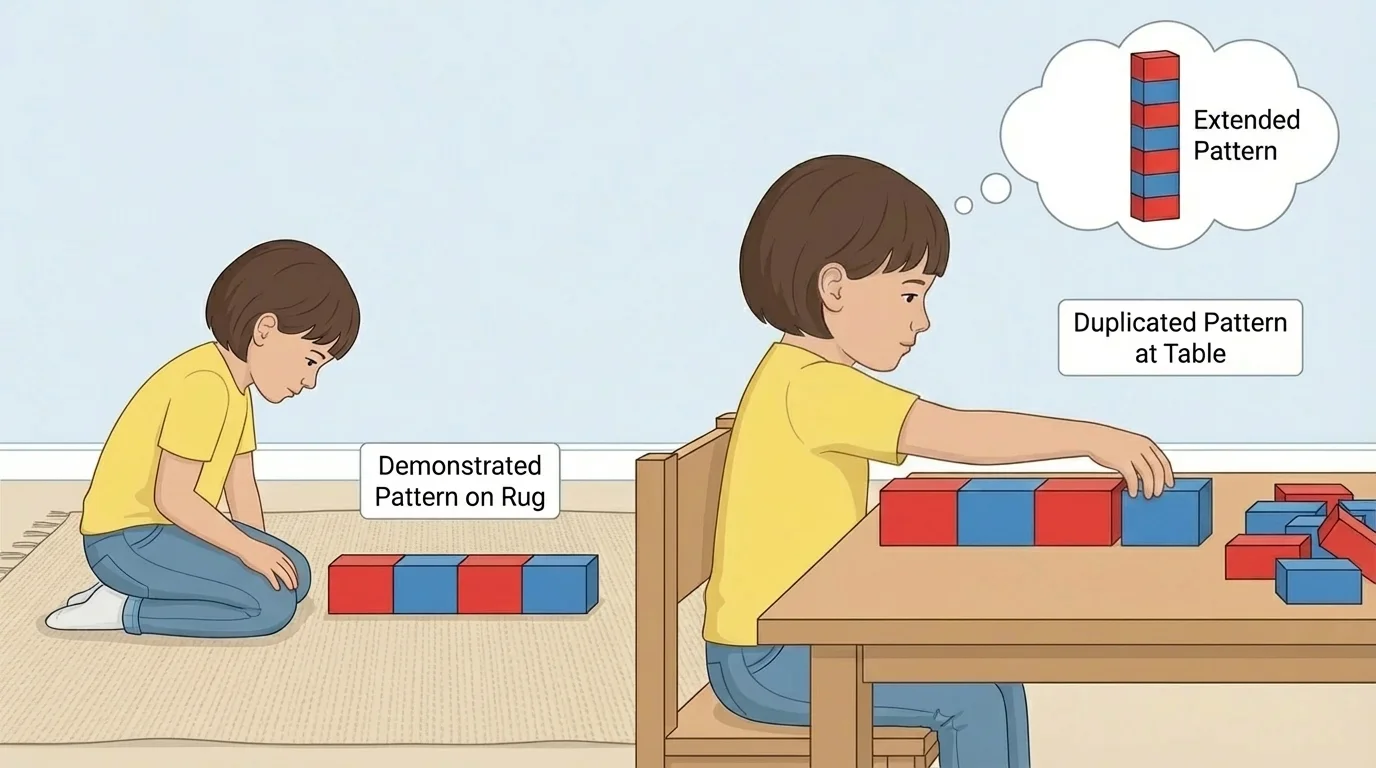
Sometimes a teacher shows a pattern on the rug, and then children make the same one at the table. The place changes, but the order stays the same, as [Figure 1] shows. If the rug has blocks in the order red, blue, red, blue, the table pattern should also be red, blue, red, blue.
This is called making the same pattern in a different location. We do not have to put it on the same rug spot. We just keep the order the same. We can look, remember, and build.
Alternating patterns switch back and forth. One common alternating pattern is red, blue, red, blue. Another is big, small, big, small. Another is clap, tap, clap, tap. The items can change, but the rule stays the same.
Solved example 1
A teacher shows blocks on the rug: red, blue, red, blue. A child wants to copy the pattern at a table.
Step 1: Look at the order.
The colors go red, then blue, then red, then blue.
Step 2: Build in the new place.
At the table, place red first, blue next, red next, blue next.
Step 3: Check each spot.
Spot 1 is red. Spot 2 is blue. Spot 3 is red. Spot 4 is blue.
The copied pattern matches: "red, blue, red, blue".
We can also copy patterns with sounds and motions. If the pattern is clap, stomp, clap, stomp, we can do it on the rug and then do the same pattern by our chair. The pattern is the same because the order is the same.
Sometimes we see a short pattern and then make it longer. This is called extending a pattern. If a tower has four blocks in the order yellow, green, yellow, green, we can keep the same order to make eight blocks, as [Figure 2] illustrates. We do not make a new rule. We keep repeating the same one.
To extend a pattern, we ask, "What comes next?" Then we keep going in the same order. A pattern with two parts can repeat many times.
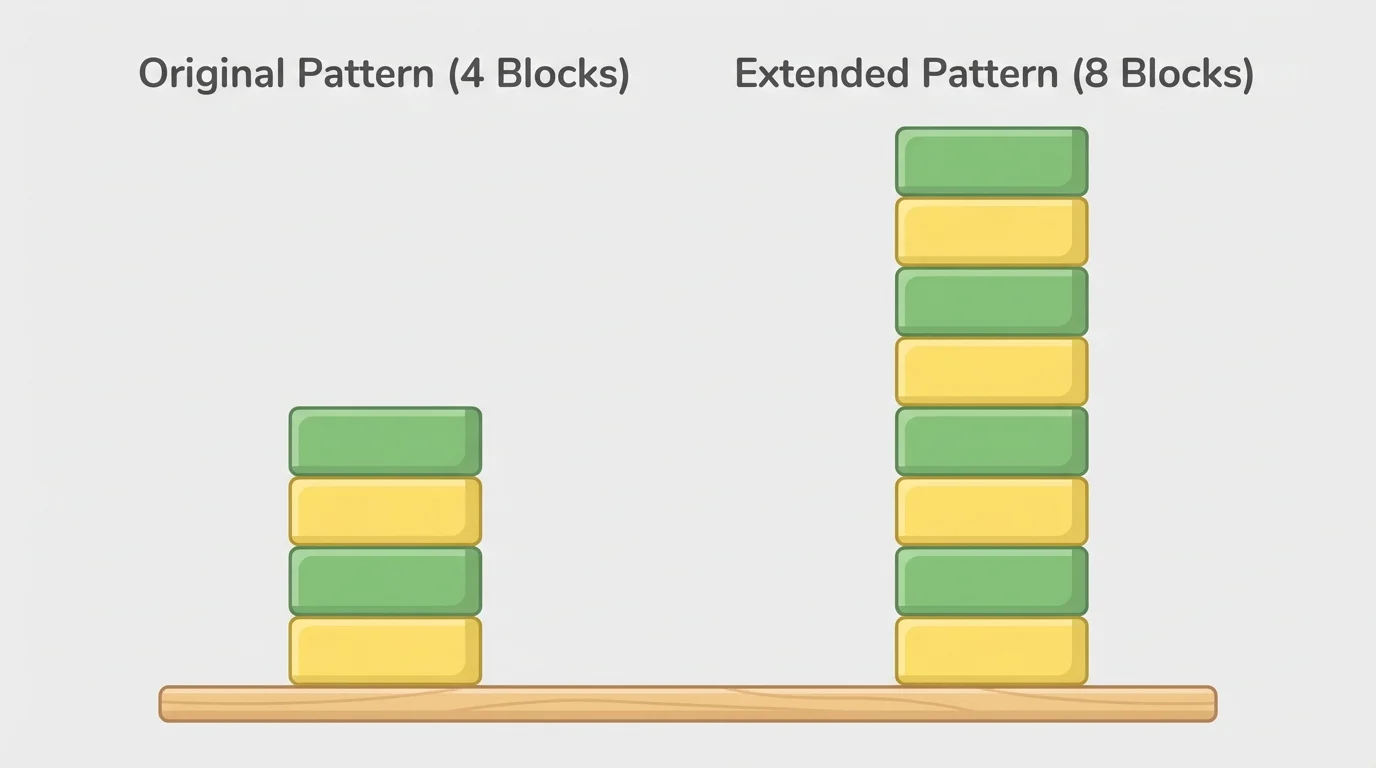
Here is one way to think about it. If the first four blocks are yellow, green, yellow, green, then the next four blocks are yellow, green, yellow, green again. Altogether that makes eight blocks.
Keeping the rule the same means every new part follows the order that was already started. If the rule is two colors that switch, we keep switching. If the rule is two shapes that switch, we keep switching those shapes.
We can describe the length with numbers too. Four blocks means "\(4\)" blocks. Eight blocks means "\(8\)" blocks. When we extend from "\(4\)" to "\(8\)", we add "\(4\)" more blocks in the same pattern.
Solved example 2
A tower shows yellow, green, yellow, green. Make the same pattern until the tower has "\(8\)" blocks.
Step 1: Count the blocks shown.
The tower has "\(4\)" blocks.
Step 2: Notice the rule.
The colors alternate: yellow, green, yellow, green.
Step 3: Add the next "\(4\)" blocks with the same rule.
The next colors are yellow, green, yellow, green.
Step 4: Read the full tower.
Yellow, green, yellow, green, yellow, green, yellow, green.
The finished tower has "\(8\)" blocks in the same pattern.
We can do this with shapes too. If we have circle, triangle, circle, triangle, then the longer pattern can be circle, triangle, circle, triangle, circle, triangle.
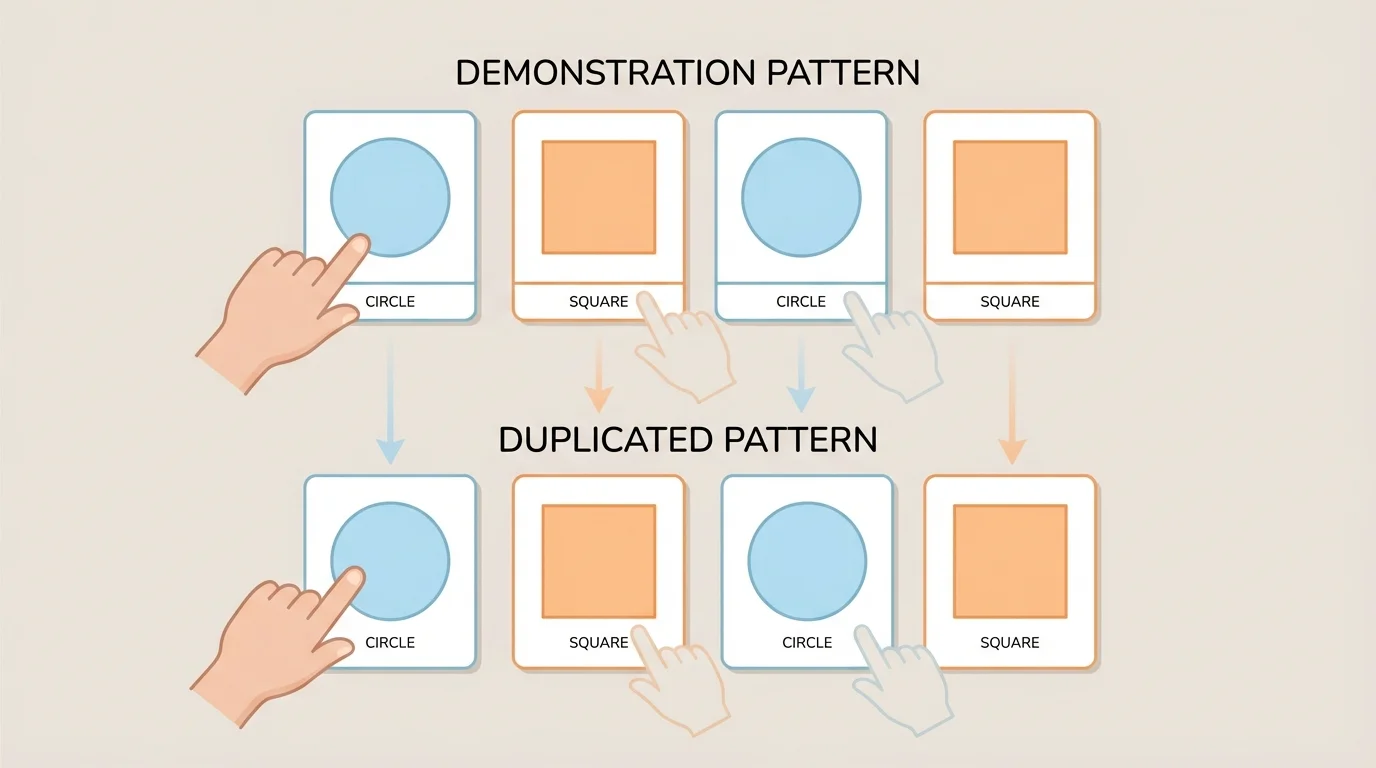
[Figure 3] Good pattern learners look at each part in order. They can point and say the pattern aloud. This helps them compare two patterns one spot at a time. We can check: first matches first, second matches second, third matches third, and so on.
A repeat means the same sequence happens again. In an alternating pattern, one repeat may be two items, like red then blue. Then red, then blue happens again.
Solved example 3
Pattern A is circle, square, circle, square. Pattern B is circle, square, circle, square. Do they match?
Step 1: Compare the first spots.
Pattern A starts with circle. Pattern B starts with circle. They match.
Step 2: Compare the second and third spots.
Second spots are square and square. Third spots are circle and circle. They match.
Step 3: Compare the last spot.
Both last spots are square.
Yes, the two patterns are the same.
If one spot is different, then the pattern is not an exact copy. For example, circle, square, circle, square does not match circle, square, square, circle. The order changed.
Later, when we look back at [Figure 1], we can see that moving from rug to table does not change the rule. We also see in [Figure 2] that making a pattern longer means repeating the same order, not inventing a new one.
Patterns are in many real places. Floor tiles can go black, white, black, white. Beads on a necklace can go pink, blue, pink, blue. A drum beat can go tap, clap, tap, clap. When children notice these orders, they are learning how to copy and extend patterns.
Zebras have stripe patterns, and many songs use repeating beat patterns. Our brains are very good at noticing what repeats.
Patterns help us predict what comes next. If we know the rule, we can keep building. If a line of blocks goes red, blue, red, blue, the next block is red. If a tower is yellow, green, yellow, green and we want "\(8\)" blocks, we keep the same switching order until the tower is complete.
| Pattern shown | Type | What comes next |
|---|---|---|
| red, blue, red, blue | alternating colors | red |
| circle, square, circle, square | alternating shapes | circle |
| big, small, big, small | alternating sizes | big |
Table 1. Examples of simple alternating patterns and the next item in each one.
When we copy a pattern somewhere new, we keep the same order. When we extend a pattern, we add more parts using the same rule. These two ideas help us become strong pattern thinkers.
