A little book can be taller than your hand, and a toy can be shorter than a shoe. How do we know for sure? We measure. Measuring helps us find out how big, how tall, or how long something is. One easy way to measure is to use snap cubes and count them: if a book is as tall as \(6\) cubes, then its height is \(6\) cube units.
We measure objects to describe them. We can say a book is tall, but measuring tells us more. We can say, "The book is \(6\) cubes tall." That number helps us compare it with another object.
When we measure with classroom things like cubes, paper clips, or blocks, we are using nonstandard units. That means we are not using rulers yet. We are still measuring carefully and counting the units we use.
Measure means to find out how big, long, tall, or heavy something is by using a unit. A unit is the thing we use again and again to measure, such as one snap cube.
If we want a fair answer, we must use the same kind of unit the whole time. If we start with cubes, we keep using cubes.
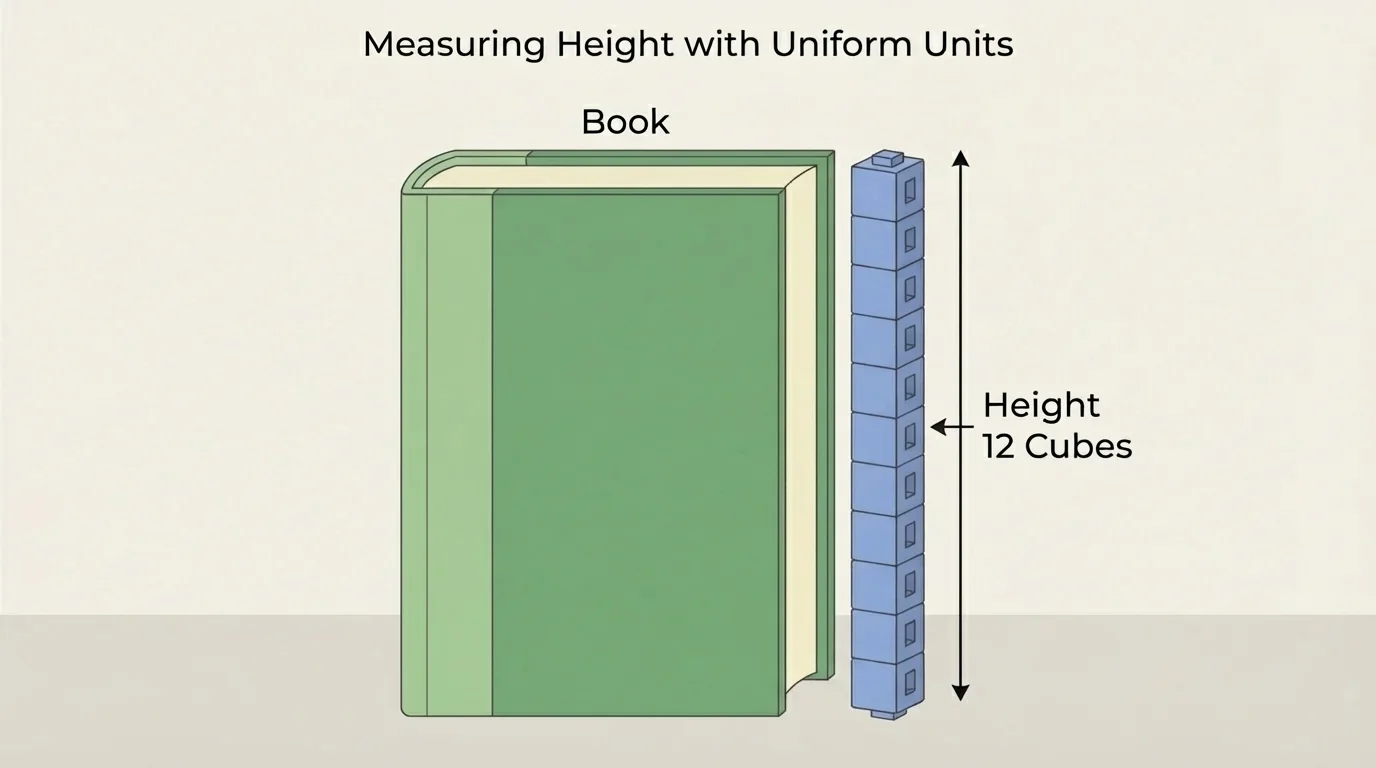
A unit is one piece we use again and again. When we measure fairly, we use the same unit for the whole object, as [Figure 1] shows. If a book is measured with big cubes at first and little cubes later, the measurements will not be consistent.
Using the same-size snap cubes helps us count correctly. Each cube stands for \(1\) equal part. So \(4\) cubes and then \(2\) more cubes make \(6\) cubes altogether.
If one toy is \(5\) cubes long and another toy is \(7\) cubes long, the second toy is longer because \(7 > 5\). The numbers help us compare.
Some things can be measured in more than one way. A book can be measured by its height, and the same book can also be measured by its width.
That means one object can have different attributes to measure. We just need to be clear about what we are measuring.
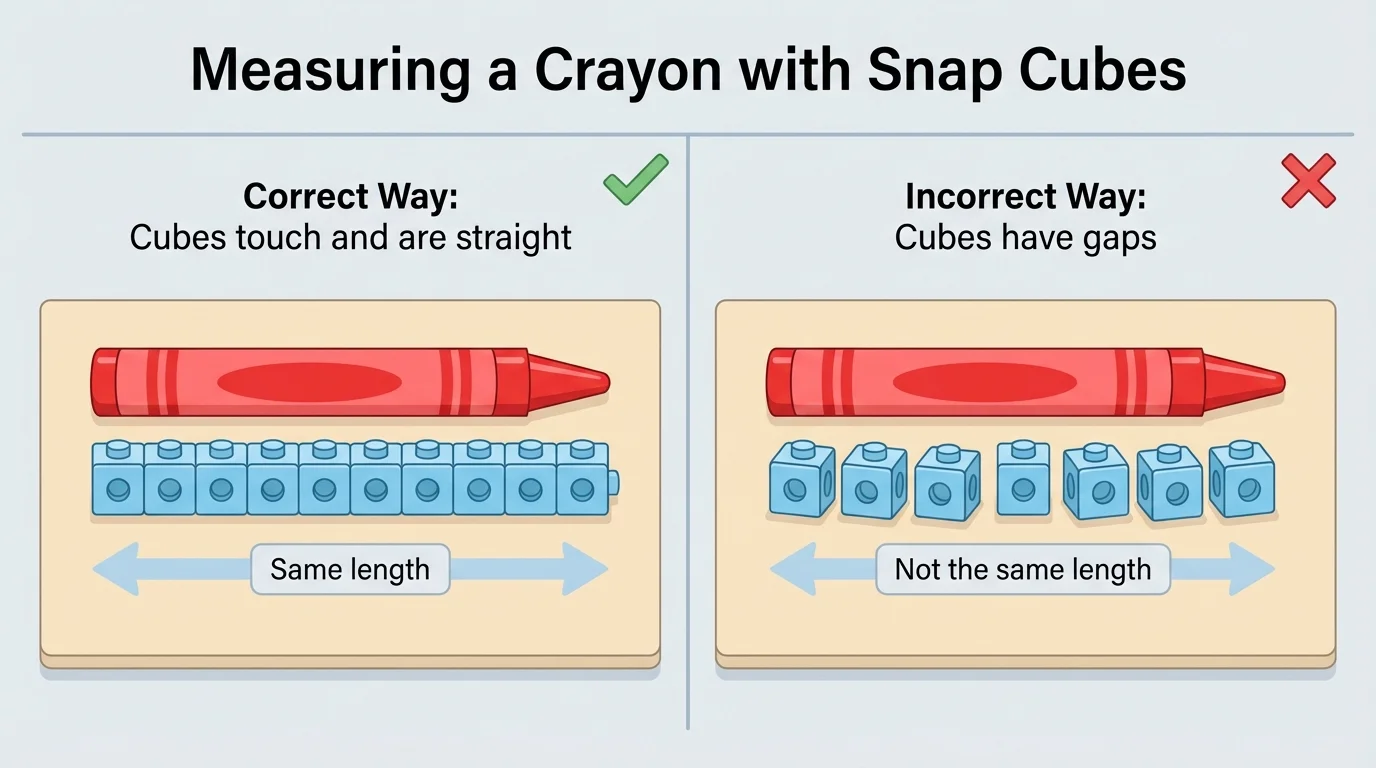
To measure with snap cubes, place the cubes in a straight line right next to the object, as [Figure 2] shows. The first cube starts at one end of the object.
The cubes must touch. There should be no spaces between cubes and no cubes on top of each other. If there are gaps, the measurement is not correct.
After the cubes are lined up, count them: \(1, 2, 3, 4\), and so on. The last number you say tells the measurement. If you count \(6\) cubes, the object is \(6\) cubes long or tall.
You can measure height by putting cubes from bottom to top. You can measure length by putting cubes from one end to the other end. We keep the cubes lined up carefully each time.
Solved example 1
A book is as tall as \(5\) snap cubes. How tall is the book?
Step 1: Look at the cubes.
There are \(5\) cubes.
Step 2: Say the measurement.
The book is \(5\) cube units tall.
Answer: The book is \(5\) cubes tall.
This is why careful counting matters. Each cube is one equal measuring piece.
Let's practice reading measurements and comparing them.
Solved example 2
A toy car is as long as \(4\) cubes. A pencil case is as long as \(6\) cubes. Which object is longer?
Step 1: Read each measurement.
Toy car: \(4\) cubes. Pencil case: \(6\) cubes.
Step 2: Compare the numbers.
Since \(6 > 4\), the pencil case is longer.
Answer: The pencil case is longer.
When the same unit is used, comparing is easy and fair.
Solved example 3
A box is \(7\) cubes tall. A can is \(3\) cubes tall. How many more cubes tall is the box?
Step 1: Find the bigger and smaller measurements.
Bigger measurement: \(7\). Smaller measurement: \(3\).
Step 2: Find the difference.
\(7 - 3 = 4\)
Answer: The box is \(4\) cubes taller.
Finding the difference tells how much more or less one object measures than another.
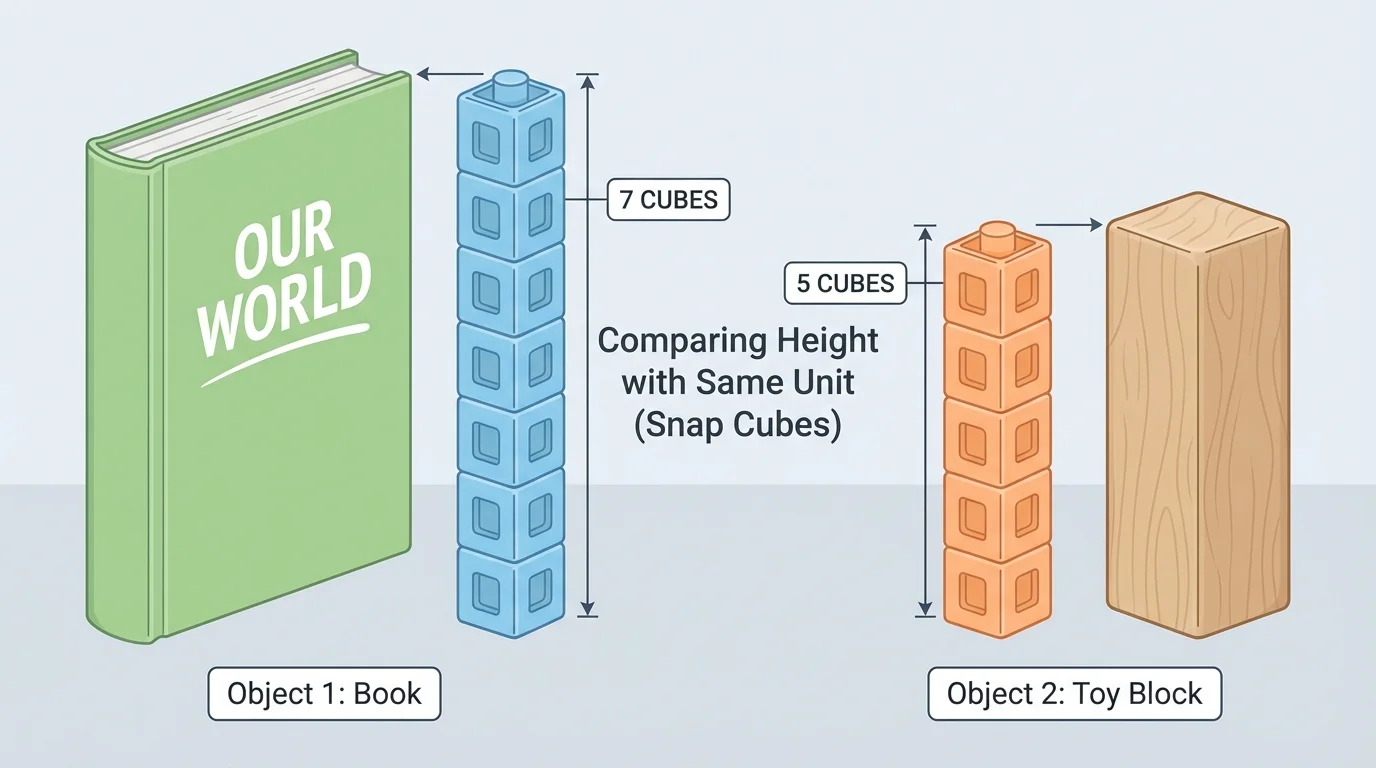
When two objects are measured with the same unit, we can compare them clearly, as [Figure 3] illustrates. If one tower is \(5\) cubes tall and another tower is \(7\) cubes tall, the \(7\)-cube tower is taller.
We can also ask how much taller. We find the difference: \(7 - 5 = 2\). So one tower is \(2\) cubes taller.
Words like taller, shorter, longer, and shorter help us describe what we see. The numbers tell exactly how much.
| Object | Measurement | What we can say |
|---|---|---|
| Book | \(6\) cubes tall | The book is taller than an object that is \(4\) cubes tall. |
| Crayon | \(3\) cubes long | The crayon is shorter than an object that is \(5\) cubes long. |
| Box | \(8\) cubes tall | The box is \(2\) cubes taller than an object that is \(6\) cubes tall. |
Table 1. Examples of objects measured with snap cubes and simple comparisons.
As we saw earlier in [Figure 1], equal cubes help us trust the measurement. As shown again in [Figure 3], equal units also make comparison simple.
People measure objects every day. We can measure how tall a book is, how long a shoe is, or how tall a block tower is. In a classroom, snap cubes are a great way to start because they are easy to line up and count.
You might notice that a storybook is \(6\) cubes tall and a small notebook is \(4\) cubes tall. Since \(6 - 4 = 2\), the storybook is \(2\) cubes taller.
One object, many attributes
An object can be measured in different ways. A book has height and width. A ribbon has length. A toy block can be measured by height, length, or width, depending on how it is placed.
What matters is choosing one attribute and measuring it carefully with one repeating unit.
Sometimes measuring goes wrong because the cubes are not touching. Other times the cubes start too far away from the object. In [Figure 2], the correct row of cubes touches with no gaps, so the measurement is more accurate.
Another mistake is changing units in the middle. If you use \(2\) big cubes and then \(3\) little cubes, the total does not tell one clear measurement. Keep one unit all the way through.
Counting tells how many. Measuring tells how many equal units fit along an object. We use counting and matching together when we measure with cubes.
When you measure carefully, your answer tells something important about the object. It tells how many equal cube units long or tall it is.
