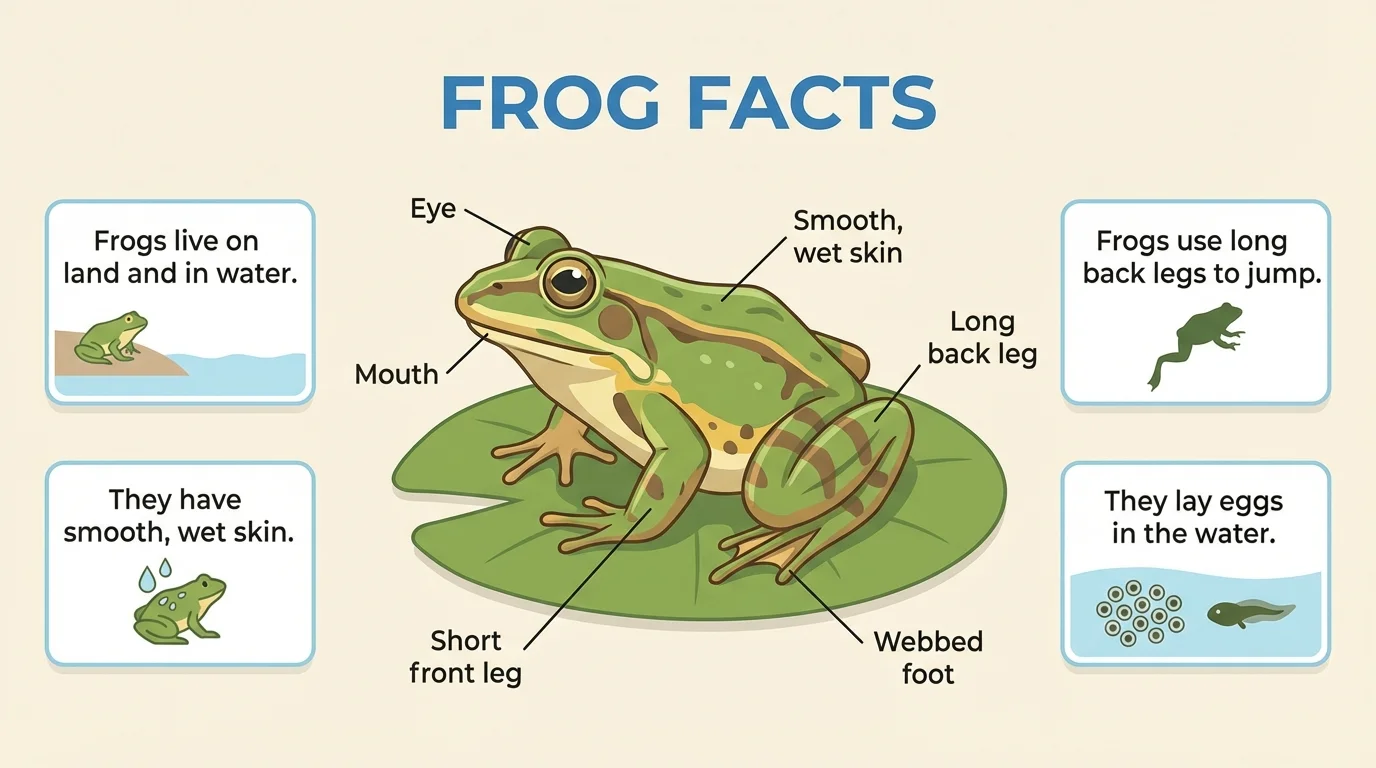
Have you ever opened a book to learn why frogs jump, how rain falls, or what firefighters do? These texts teach us about the real world. When we read to learn facts, we are reading informational texts. A page like the one in [Figure 1] shows how a book can teach true information with pictures, labels, and short sentences.
An informational text is a nonfiction book or article that gives facts. Facts are things that are true. An informational text may teach about animals, plants, weather, space, people, or places. It helps readers learn something new.
Some books tell made-up stories. Other books tell real information. If a book says that frogs live near water, that is information about the world. If a book explains that a doctor helps sick people, that is also information. First-grade readers often read short informational books with clear pictures, simple sentences, and helpful features.
Informational text is reading that teaches real facts about a topic. Nonfiction means the text is about real people, places, things, or events.
When we read informational texts, we are not only saying the words. We are also thinking, "What am I learning?" Good readers pay attention to the topic and notice the new facts the text shares.
Before reading, it helps to look carefully at the page. Readers can notice the title, the pictures, and any big words on the page. These clues help us guess the topic. If the title says Baby Birds, the book is probably about young birds and how they grow.
Readers also get ready by thinking about what they already know. Maybe you have seen a nest in a tree. Maybe you know that birds have feathers. What you already know can help you understand new facts in the book.
You already know how to look at letters and words, listen to sounds, and use pictures to help you read. Those skills also help when you read nonfiction.
Sometimes a grown-up, teacher, or partner provides prompting. Prompting is a helpful hint. A teacher might say, "Look at the picture," or "Read the heading," or "What do you think this page will teach?" Support can also mean reading together, hearing a word said aloud, or talking about the page before moving on.
As we read, we try to read the words correctly and think about what they mean. If a word is tricky, we can look at the first sound, look through the whole word, and check the picture. We can also ask for help. Reading with support means we are not alone while learning to read harder texts.
Good readers stop and think after a sentence or two. If a page says, "A turtle has a hard shell," we can think, "I learned one fact: the shell protects the turtle." This helps us understand the text instead of just saying words out loud.
Reading to learn means using the words, the pictures, and your thinking all at the same time. You read the sentence, study the picture, and ask yourself what new idea the author is teaching.
[Figure 2] Informational texts for grade 1 are appropriately complex when they are not too easy and not too hard. A child may need support with new words, longer pages, or many facts on one page. With help, the reader can still understand the important ideas.
Many informational texts have special parts called text features. These parts help readers find and understand information. A page may have a heading, labels, a caption, and bold words that point out important information.
A heading tells what a section is about. A caption tells about a picture. A label names parts of a picture. Bold words stand out so readers notice them. These features are clues that guide our eyes and our thinking.
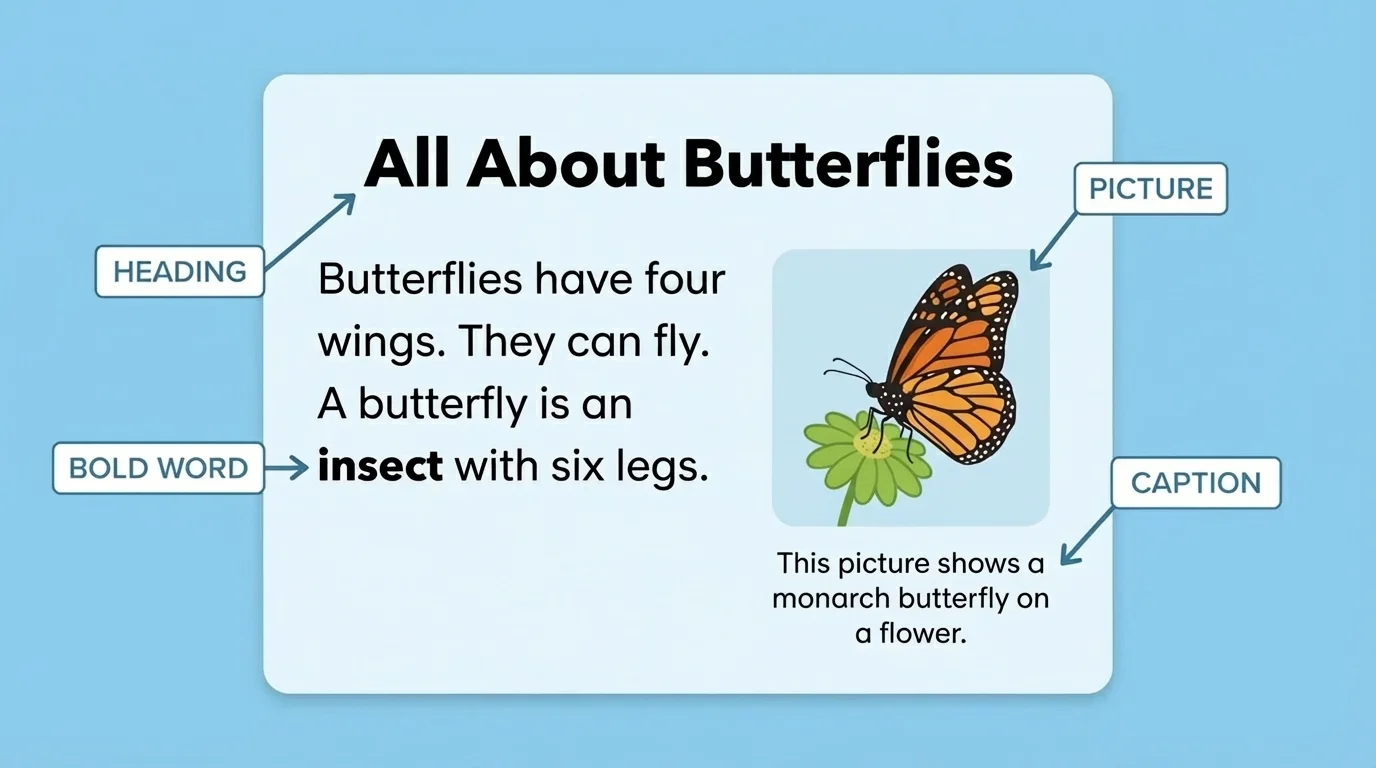
For example, a page about a plant may have the heading Parts of a Plant. A picture might show roots, stem, and flower with labels. The caption under the picture may explain that roots grow under the ground. All of these parts work together to teach the reader.
Using text features on a plant page
Step 1: Read the heading.
The heading says Parts of a Plant, so the page will teach about plant parts.
Step 2: Look at the labels.
The labels name the roots, stem, leaves, and flower.
Step 3: Read the caption.
The caption gives one more fact, such as "Roots take in water."
Now the reader learns information from both words and pictures.
Later, when you read another nonfiction page, you can use the same idea again. The features in [Figure 2] remind us that informational texts are built to teach, not just to entertain.
After reading, good readers talk about the text. They ask questions and answer questions. A question might be, "What do penguins eat?" or "Where does a seed begin to grow?" The answer should come from the text or the picture.
Readers can also tell the most important idea. If a page has many details, we do not have to say every word again. We can say the main point in a simple way: "This page teaches that bees help flowers." Then we can add one or two facts.
Young readers often understand more when they say the facts aloud after reading. Talking helps the brain hold on to new learning.
Sometimes we can retell an informational text by saying the topic and then the facts we learned. For a book about weather, a child might say, "This book is about rain. Rain comes from clouds. Rain helps plants grow." That shows understanding.
Informational reading can look different from book to book. As [Figure 3] illustrates, one text may teach about animals, another may explain weather, another may show what community helpers do, and another may give simple steps for how to plant a seed.
Animal books often give facts about where an animal lives, what it eats, and how it looks. Weather books may teach about sun, clouds, wind, and rain. Books about community helpers teach about jobs like nurse, farmer, mail carrier, or firefighter. Simple how-to texts teach steps in order.
Even when the topics are different, readers use the same helpful habits. They look at titles and pictures, read carefully, notice text features, ask questions, and think about the important facts.
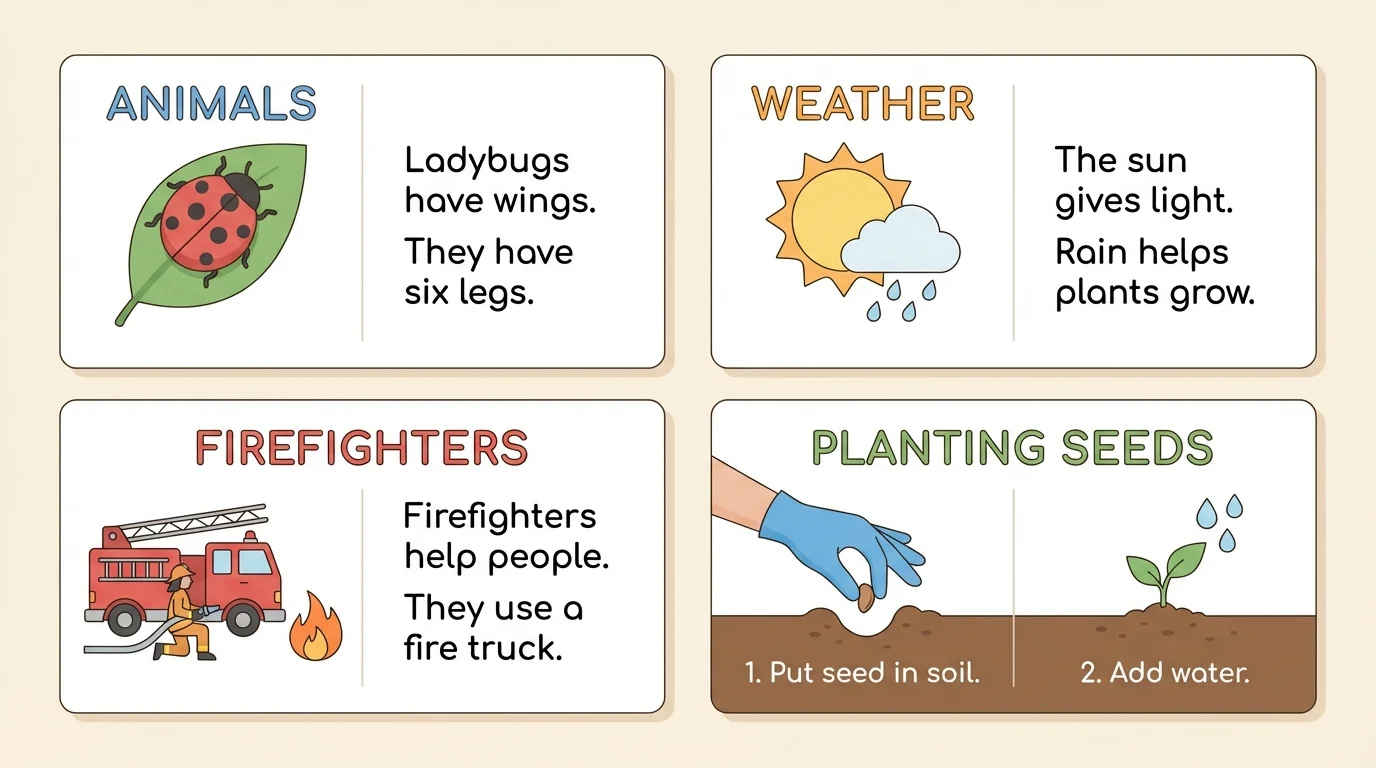
A how-to text is a little different because it often teaches actions in order. A page might say, first dig a small hole, next place the seed, then cover it with soil, and last add water. The reader learns by following the steps in sequence.
| Type of text | What it teaches | What a reader can notice |
|---|---|---|
| Animal book | Facts about an animal | Body parts, food, home |
| Weather book | Facts about nature | Words like rain, wind, cloud |
| Community helper book | Facts about jobs | Tools, places, duties |
| How-to text | Steps to do something | Order words like first and next |
Table 1. Different kinds of grade 1 informational texts and what readers notice in each one.
The examples in [Figure 3] help us remember that informational reading is all around us. We read to learn about living things, Earth, people, and how to do real tasks.
At first, some informational texts feel tricky because they have new words and many facts. That is why prompting and support matter. A teacher may read part of the page aloud, help with a hard word, or ask, "What did you learn from this picture?" Little by little, the child takes over more of the reading.
Reading well also means reading smoothly when possible. We may read slowly at first, but we keep trying. As readers practice with grade 1 books, they become more confident. They learn to use the page features, understand the facts, and talk about what they learned.
"Read to know more about your world."
When we use support wisely, we can read texts that are just right for growth. The nonfiction frog page from [Figure 1] is a good example: the pictures, labels, and short facts work together so a young reader can understand real information.
