Have you ever heard a story and then someone asked, "Who was in the story?" or "Where did it happen?" Good readers are like detectives. They listen, look closely, and find the important clues. Those clues are called details. When we ask and answer questions about key details, we understand the text better.
When you read or listen to a text, you can ask questions to think about it. A text can be a story, a poem, or a book that gives facts. Questions help readers pay attention. Answers help readers show what they learned.
Some details are small, and some details are very important. The most important details are called key details. A key detail helps us know the characters, the place, the time, the problem, or the main idea.
Ask means to say a question. Answer means to give the response. Key details are the important parts in a text that help readers understand what is happening or what the text is teaching.
When we ask and answer questions, we do not guess. We think, "What did the text say?" Then we use that information in our answer.
Readers use special question words every day. Each one helps us look for a different kind of detail, as [Figure 1] shows in a simple chart. These words help us know what to listen for or look for while we read.
Who asks about a person, animal, or character. What asks about a thing, action, or event. Where asks about a place. When asks about time. Why asks for a reason. How asks in what way something happens.
| Question word | What it asks | Example |
|---|---|---|
| Who | A person or character | Who helped the puppy? |
| What | A thing or action | What did Sam find? |
| Where | A place | Where was the nest? |
| When | A time | When did they leave? |
| Why | A reason | Why was Ana happy? |
| How | The way something happens | How did the boy get home? |
Table 1. Question words and the kinds of details they help readers find.
If the question is "Where did the duck swim?" a reader should look for a place. If the question is "Why did the girl laugh?" a reader should look for a reason.
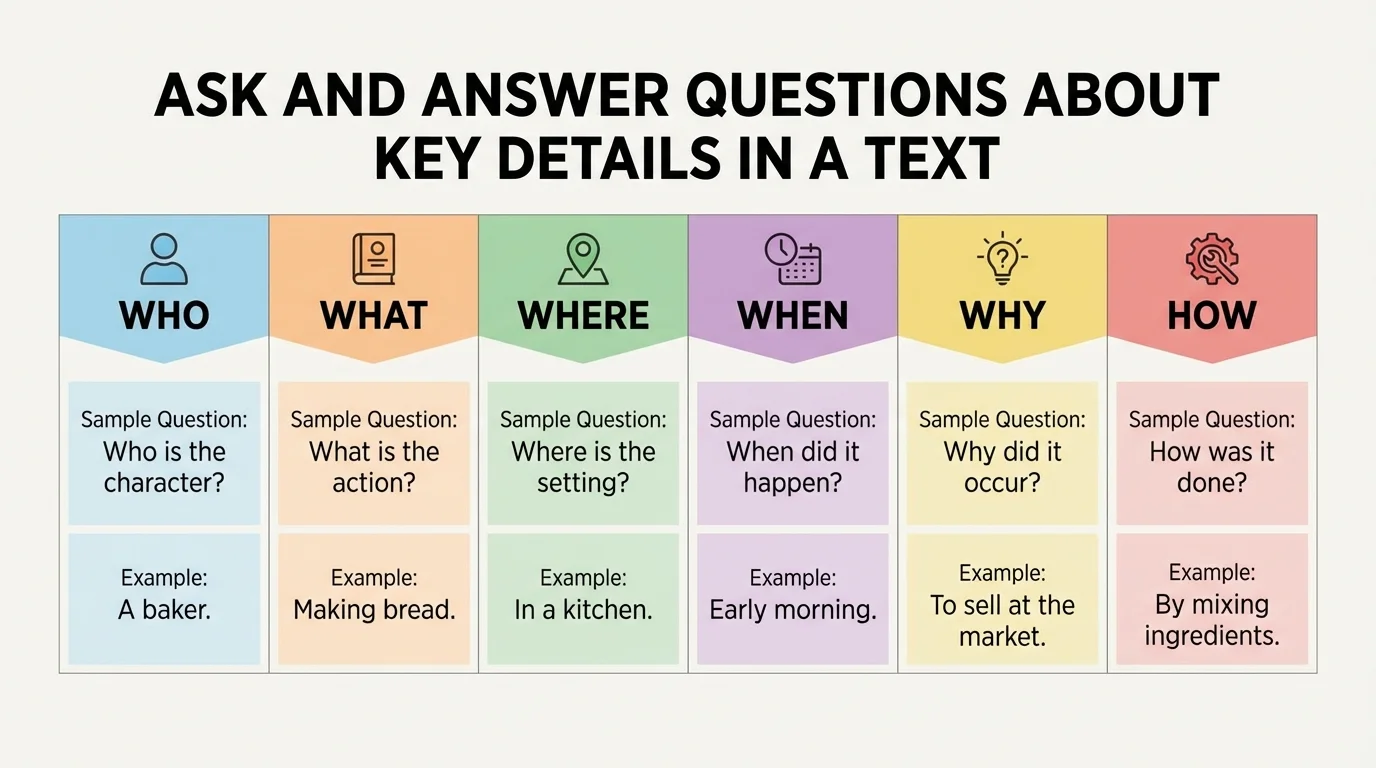
Question words are helpful in both stories and books with facts. Later, when you answer, you can use the same kind of detail the question asks for. That keeps your answer clear and on topic.
A key detail is not just any word in the text. It is an important piece of information. For example, if a story says, "Leo lost his red kite at the windy beach," there are many details. The key details might be Leo, lost his kite, and at the beach.
These details help answer questions such as: Who lost something? What did he lose? Where did it happen? If a detail helps answer a question, it is probably important.
How key details help readers
Key details work like puzzle pieces. One detail might tell who. Another might tell where. Another might tell what happened. When readers put the key details together, they understand the whole text more clearly.
Sometimes a text tells something directly. For example: "The cat slept on the chair." Then the answer to "Where did the cat sleep?" is easy to find: on the chair. Readers learn to go back to the words in the text and listen for the important part.
In many grade 1 books, readers use both the words and the pictures. The illustration in [Figure 2] helps show how a picture can support the words by showing the setting, the characters, and the action. Pictures can give clues, but the words in the text are still very important.
If a page says, "Ben throws the ball," and the picture shows a dog running in a park, you can learn more. You know Ben throws a ball, and the dog may be chasing it. The picture may also help you notice the place.
Good readers look at the picture and listen to the words together. If the question is "Where are Ben and the dog?" the picture may help you notice a park, but the best answer matches the text and picture together.
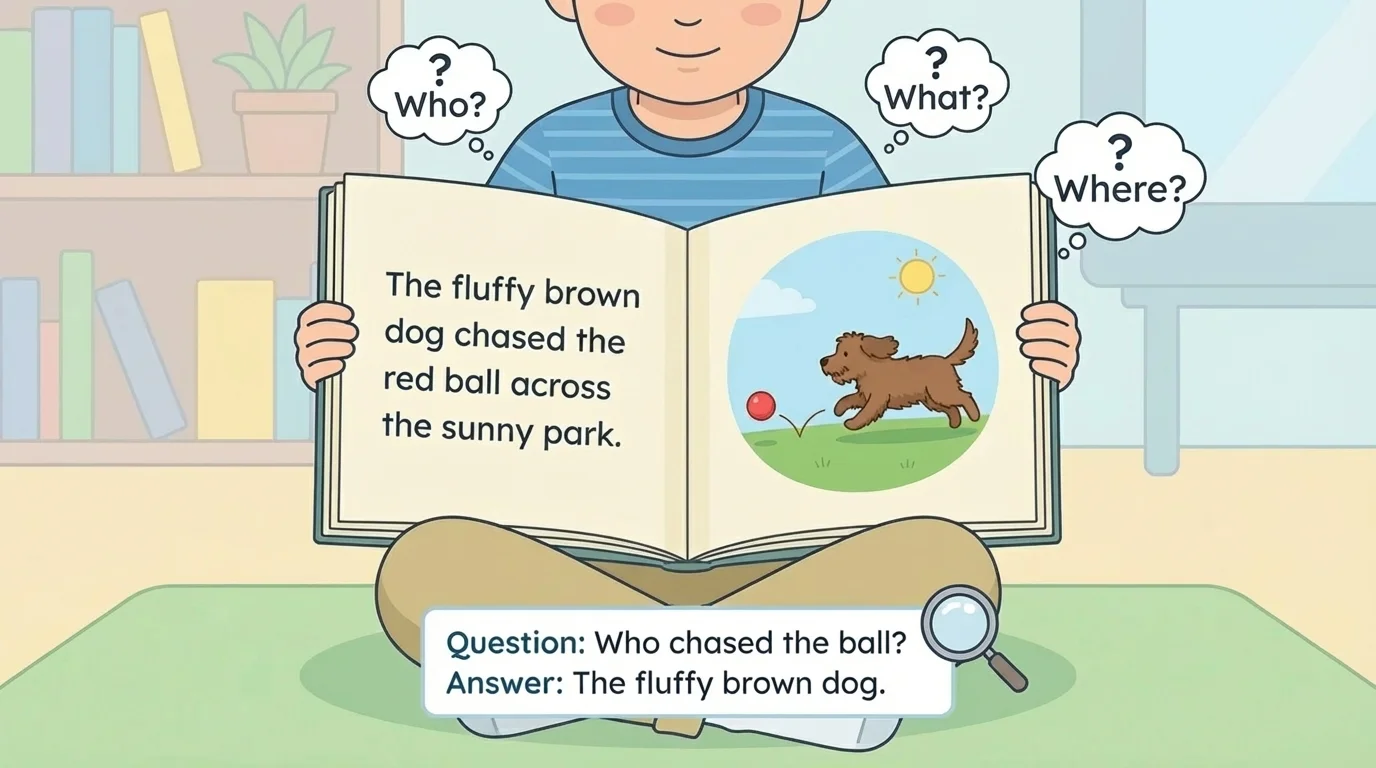
Later, when you read another book, you can do the same thing: check both the words and the picture to understand the important details.
When someone asks a question about a text, a strong answer uses words from the text. It does not have to be long, but it should be clear.
If the question is "Who baked the cake?" and the text says, "Mom baked a cake for dinner," a clear answer is "Mom baked the cake." That answer tells the key detail.
If the question is "What did the rabbit eat?" and the text says, "The rabbit nibbled a carrot," a clear answer is "The rabbit ate a carrot." We can answer in a complete sentence so others understand us easily.
You already know that stories have characters, settings, and events. Questions often ask about those parts. Remembering those story parts helps you find key details faster.
Sometimes the answer is only one word, but often saying the full idea is better. It helps you show that you really understood the text.
Even good readers do not always know the answer right away. That is okay. They can listen again or read the text again. This is called rereading. Rereading helps readers find details they missed the first time.
After you answer, check your thinking. Ask yourself, "Does my answer match the text?" If the text says the boy walked to school, the answer should not say he rode a bike. A good answer fits the words in the text.
Sometimes one short sentence can answer more than one question. A sentence like "Nina fed the fish in the kitchen this morning" tells who, what, where, and when all at once.
Checking is important because readers want answers that are true to the text. Careful readers go back to the words when they are not sure.
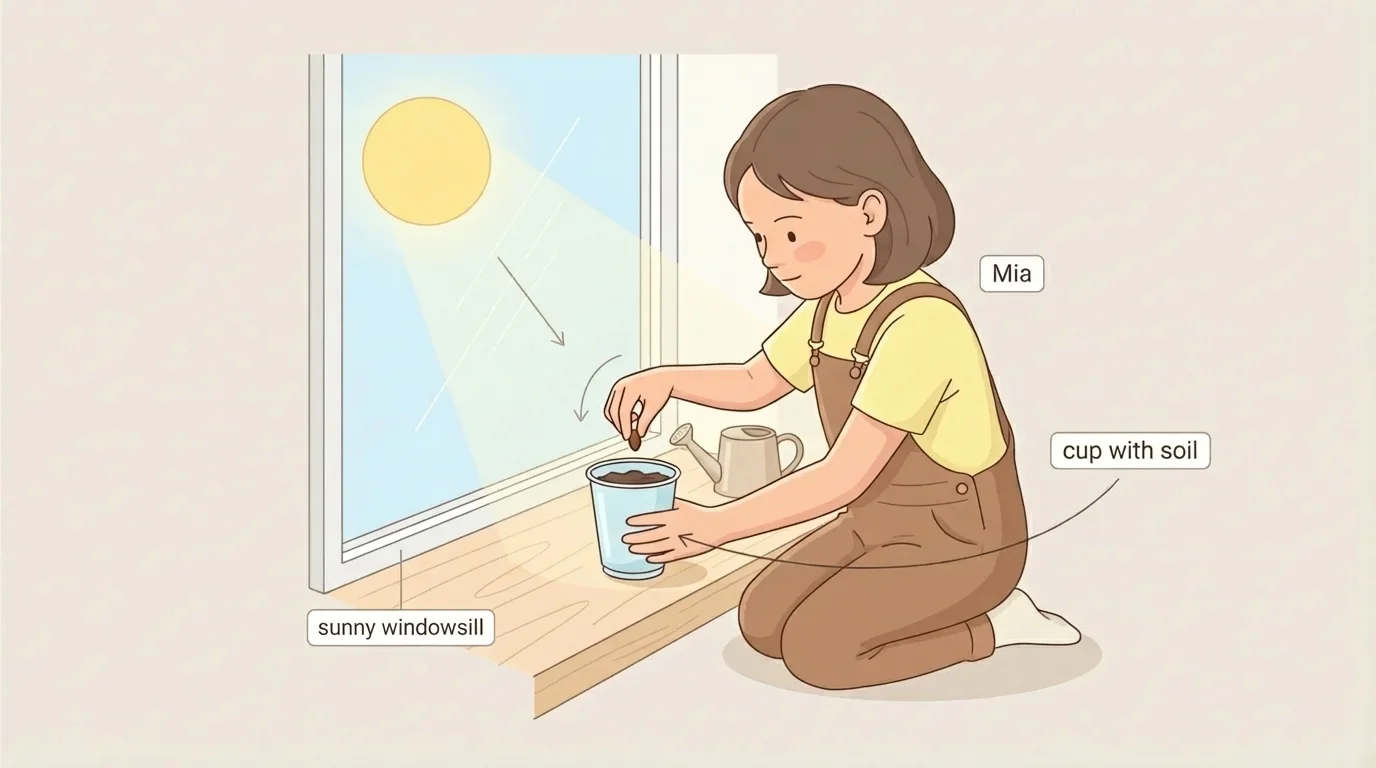
One short passage can answer many different questions, as [Figure 3] illustrates with a simple plant story. When readers pay attention to the key details, they can answer who, what, and where questions from the same text.
Read this short text: "Mia planted a seed in a cup. She put the cup by a sunny window. Every day, Mia gave the seed water."
From this text, we can ask: Who planted a seed? The answer is Mia. Where did she put the cup? The answer is by a sunny window. What did she give the seed? The answer is water.
Example 1
Text: "The little bird built a nest in the tree."
Step 1: Ask a question.
Where did the bird build the nest?
Step 2: Find the key detail.
The key detail is in the tree.
Step 3: Answer clearly.
The bird built the nest in the tree.
Now read this text: "Ava wore boots because it was raining." We can ask, "Why did Ava wear boots?" The answer is "She wore boots because it was raining." The key detail is the reason.
Read another text: "After lunch, the class went to the library." If we ask, "When did the class go to the library?" the answer is "After lunch." This answer comes from an important time detail.
Example 2
Text: "Tom and his sister made a snowman in the yard."
Step 1: Ask about who.
Who made a snowman?
Step 2: Find the key detail.
The key detail is Tom and his sister.
Step 3: Answer clearly.
Tom and his sister made a snowman.
One small text can hold several important details at the same time. Readers look for the detail that matches the question being asked.
We ask questions about stories, but we also ask questions about books that teach facts. A story may tell about a girl and her lost mitten. A fact book may tell about frogs, weather, or trucks.
In a story, questions often ask about characters, setting, and events. In a fact text, questions often ask what something is, what it does, where it lives, or how it works. In both kinds of texts, the reader looks for key details.
| Kind of text | Questions readers may ask |
|---|---|
| Story | Who is the character? Where does the story happen? What happened first? |
| Fact text | What is it? Where is it found? How does it work? |
Table 2. How questions can look a little different in stories and fact texts.
When readers ask good questions and answer them with details from the text, they understand more, remember more, and enjoy reading more.
