Have you ever noticed that some books tell a story across full sentences and pages, while other texts dance in short lines and sound like music? Readers in grade 1 learn to enjoy both kinds. When you read stories and poems, you are learning how words can paint pictures, share feelings, and tell what happens next.
Good readers do not have to do everything alone. In grade 1, it is important to read with prompting and support. That means a teacher, parent, or other helper can guide you. They might read a part first, ask you to try again, point to a word, or help you think about what the text means.
Prose is writing that tells ideas or stories in sentences and paragraphs. Poetry is writing that often uses short lines, rhythm, rhyme, or repeated words to share an idea or feeling.
As you grow as a reader, you learn to read texts that fit your grade. These books and poems are not too easy and not too hard. They have words you know, some new words to learn, and ideas that make sense for first graders.
Stories, songs, poems, and picture books are all kinds of literary reading. Some make you laugh. Some make you wonder. Some help you think about people, animals, or places. A story might tell about a lost puppy, a trip to the park, or a rainy day adventure. A poem might describe snow, a buzzing bee, or the moon at night.
When readers work with literary texts, they listen carefully, look closely, and think about the words. They may notice a funny part, a surprising part, or a part that sounds beautiful. Reading is not only saying words. Reading is also understanding and enjoying them.
Poems are often meant to be heard as well as read. That is why the sound of the words matters so much in poetry.
Some texts are easier to understand because the words are familiar and the pictures give strong clues. Other texts are a little trickier. With support, grade 1 readers can grow from simple books to richer stories and poems.
As shown in [Figure 1], Prose usually looks like regular story writing. It has sentences that go across the page and often gathers those sentences into paragraphs. In a story, there are often characters, a place where the story happens, and events that happen in order. A reader can think, "Who is in the story? Where are they? What happens first?"
Many grade 1 stories have a clear beginning, middle, and end. In the beginning, you meet the characters and setting. In the middle, something happens or a problem appears. In the end, the story finishes. These parts help readers follow the action and understand the story better.
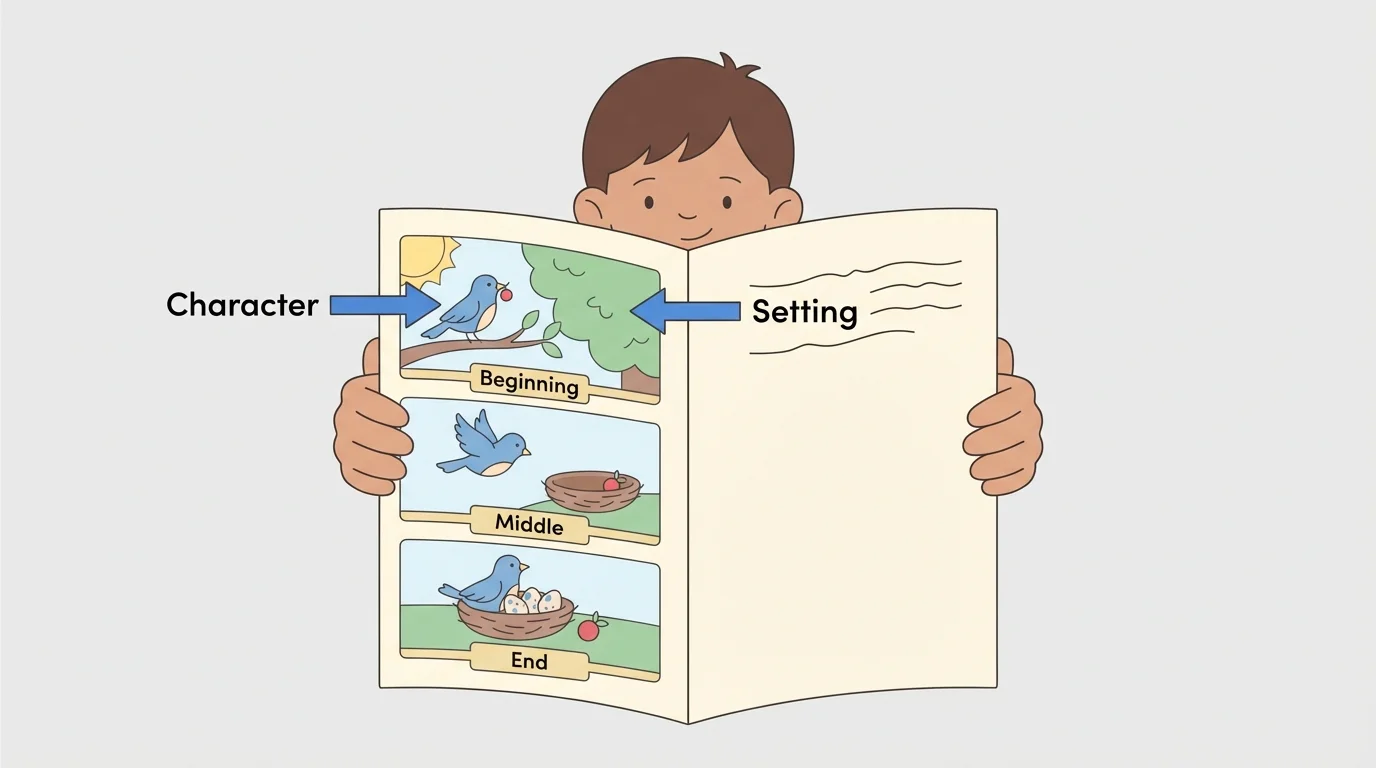
When you read prose, you can use the pictures to help. If the words say, "Ben ran to the red kite," the picture may show Ben in a field with a kite in the sky. The picture gives a clue, but the words tell the exact story. Good readers use both.
Example: Reading a story sentence
Step 1: Read the words slowly.
The sentence says, "Mila hid under the table when the thunder boomed."
Step 2: Think about what is happening.
Mila hears loud thunder and hides. That tells us she may feel scared or surprised.
Step 3: Use story clues.
The character is Mila. The event is hiding under the table. The setting may be a room inside a house.
This is how readers understand prose one part at a time.
Later, when readers talk about a story, they may name a favorite character or retell the important events. Knowing the character, setting, and story order helps readers remember what they read.
Poetry often looks different from prose. Instead of long sentences across the page, poems may have short lines with space around them. Many poems use rhyme, rhythm, or repeated words. That is why a poem can sound like a song when you read it aloud.
As shown in [Figure 2], a poem does not always tell a story from beginning to end. Sometimes it paints a picture with words. A poem about rain may use words like drip, drop, and tap to help you hear the sound in your mind. A poem about spring may repeat a word like green to show the season coming alive.
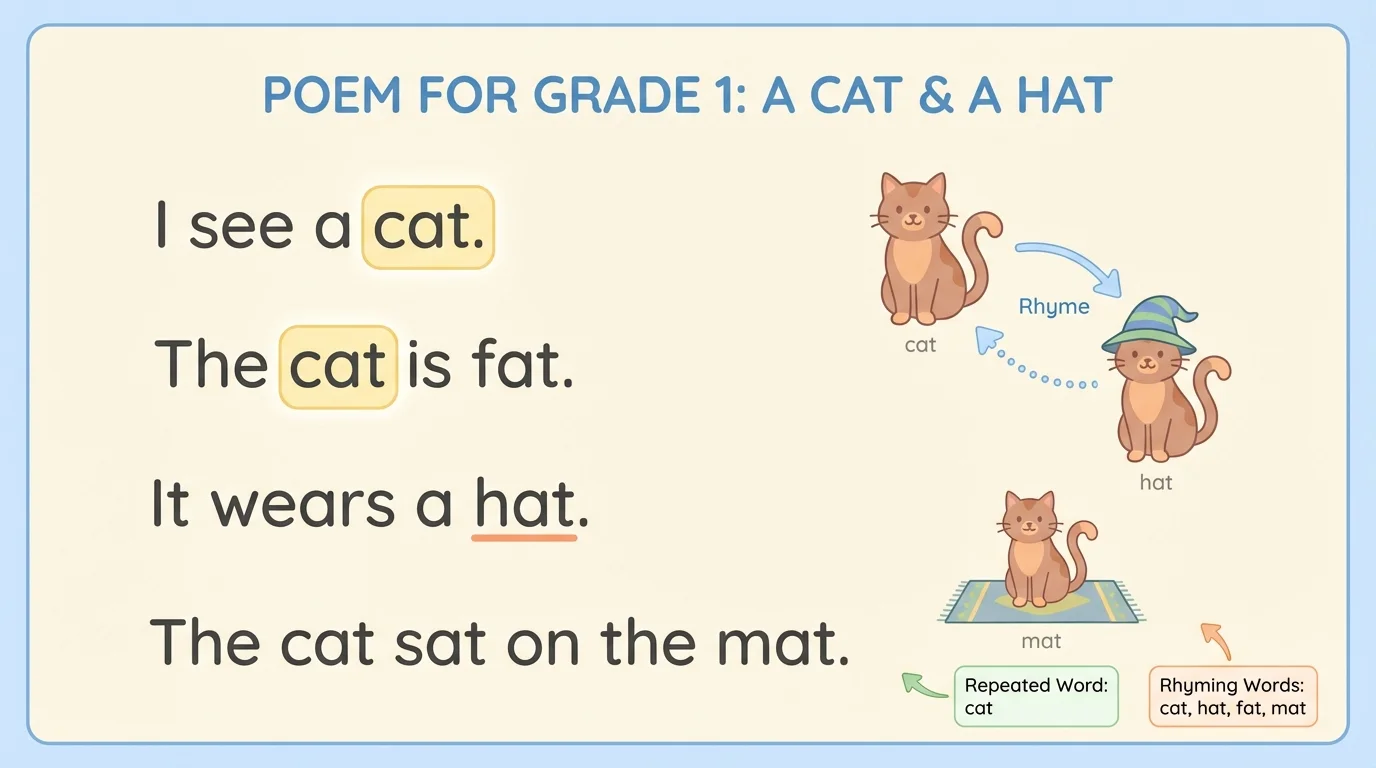
When reading poetry, it helps to listen for patterns. If two words sound the same at the end, such as cat and hat, they rhyme. If a line repeats, that repeated part is important. Poems can be joyful, quiet, silly, or thoughtful.
How poems sound
Poetry often asks readers to pay extra attention to sound. The same words can feel different when read with a soft voice, a strong beat, or a happy tone. Listening is an important part of understanding poetry.
A child might read this tiny poem: "Blue sky high, / birds fly by." The words are short, but they make a clear picture. You can see how short lines and sound patterns help a poem feel different from a story page.
As shown in [Figure 3], sometimes a book or poem has a word you do not know right away. That is when a prompt and support are helpful. A teacher or adult may ask, "What sound does this letter make?" or "What do you see in the picture?" With support, readers keep going instead of giving up.
One kind of help is echo reading. First, the teacher reads a line. Then the child reads the same line back. Another kind is choral reading, when everyone reads together. These ways help readers hear how the text should sound.
A helper may also point under each word so the reader can match spoken words to printed words. This is important because reading means tracking the words in order from left to right. Pictures, first sounds, and rereading also give support.
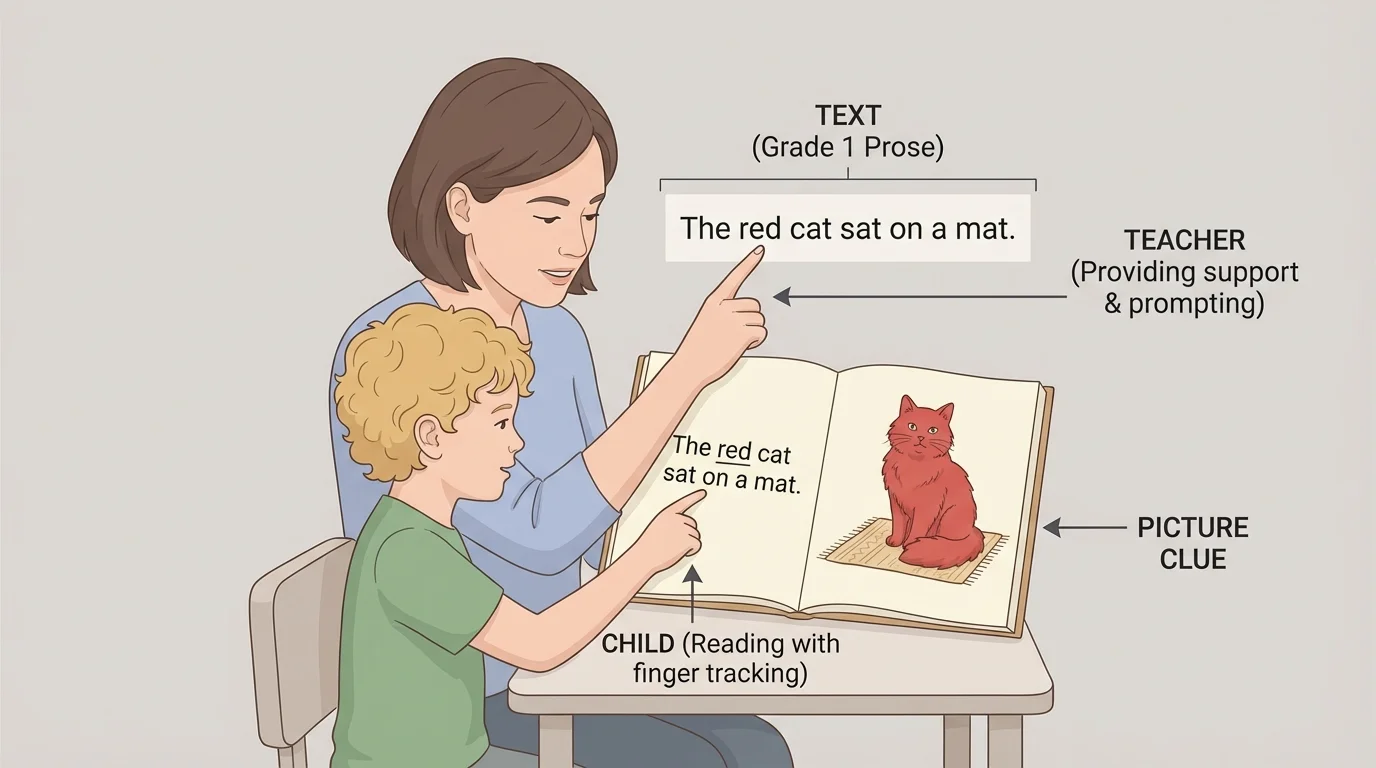
If a sentence says, "The duck paddled across the pond," and the child gets stuck on paddled, the helper might say, "Look at the picture. What is the duck doing?" Then the child can think about the action and try the word again.
Example: Using support while reading
Step 1: Try the sentence.
"The small fox slipped into the den."
Step 2: Stop at the tricky word.
If den feels hard, look at the picture and say the first sound.
Step 3: Read it again.
After the clue, read the whole sentence smoothly: "The small fox slipped into the den."
Support helps the reader solve the word and understand the sentence.
Later, readers can remember to use their finger, a picture clue, or a teacher's question to unlock meaning in a new text.
Not every text is right for every reader. A grade 1 text has ideas and words that are appropriate for first-grade readers. It may include repeating patterns, clear pictures, and shorter sentences. It may also have some new words to stretch the reader's learning.
If a text is too easy, the reader may not grow much. If a text is too hard, the reader may feel lost. A just-right text lets the child do some reading alone and some reading with help. That is how reading gets stronger over time.
You already know that letters stand for sounds and that words carry meaning. Now you are using those skills to read whole stories and poems with understanding.
Grade 1 readers often revisit favorite books and poems. Reading the same text again is not a problem. It is a smart way to build confidence, notice more details, and read more smoothly each time.
As shown in [Figure 4], good readers work on fluency, which means reading in a smooth, clear way that sounds like talking. They notice punctuation marks and let their voice match the text. A period means stop. A question mark can make the voice lift. An exclamation mark can show strong feeling.
Fluent reading is not the same as fast reading. If you rush too much, the meaning may disappear. Good readers read at a pace that lets them understand. They may slow down at a new word and then continue smoothly.
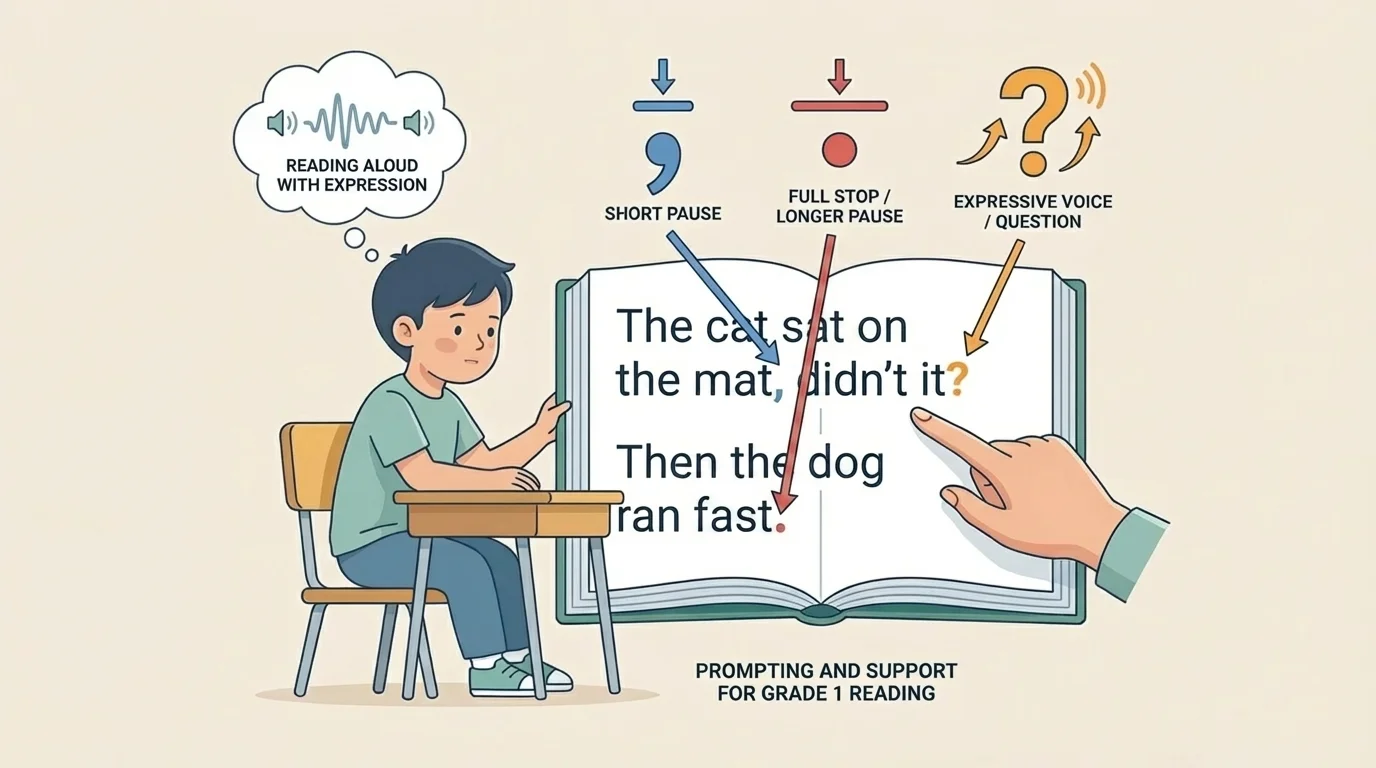
Expression also matters. A happy part of a story should not sound sad. A silly poem may sound playful. Reading with expression helps the text come alive and shows that the reader understands what is happening.
Example: Reading with fluency
Step 1: Look at punctuation.
"Can we go now?" ends with a question mark.
Step 2: Read it like a question.
Your voice lifts a little at the end.
Step 3: Read the next sentence with the right feeling.
"Yes! Put on your shoes!" sounds excited.
This helps the listener and the reader understand the meaning.
When students grow in fluency, they can understand more of what they read. Punctuation, voice, and meaning all work together in one reading moment.
Reading stories and poems is also about thinking. After reading, a child may answer questions like, "Who was in the story?" "What happened first?" "Which words rhymed?" or "How did the poem make you feel?" These questions help readers build understanding.
Readers can also make connections. A story about losing a toy may remind a child of losing something important. A poem about wind may connect to a day outside when leaves blew around the playground. These connections make reading meaningful.
"Reading is thinking with words."
With support, children learn that they can read, think, and enjoy at the same time. They learn that prose tells stories in one way and poetry uses sound and feeling in another way. They also learn that every book or poem they finish helps them become stronger readers.
