Have you ever looked at a picture in a book and known something before the words told you? A picture can help you notice a smile, a stormy sky, or a fast-running dog. Good readers look at both the illustrations and the words. When we do that, we learn more about the story.
A story is full of clues. Some clues are in the words. Other clues are in the pictures. The words may tell us what a person says, what a place looks like, or what happens next. The pictures may show colors, faces, actions, and objects that help us understand even more.
Illustrations are the pictures in a book. Details are small pieces of information in the words or pictures that help us know more. A character is a person or animal in a story. The setting is where and when a story happens. Events are the things that happen in the story.
When we read, we ask simple questions: Who is in the story? Where are they? What is happening? The answers can come from the words, the pictures, or both.
[Figure 1] A character can tell us a lot without saying a word. In many stories, the illustration helps us notice how a character looks and feels. We can look at the face, the body, the clothes, and what the character is doing.
If a girl in a picture has a big smile, open arms, and bright boots, we might say she feels happy and excited. If the words say, "Mia ran outside to jump in the puddles," that gives us more details. Now we can describe Mia as playful, cheerful, and full of energy.
Sometimes words tell us something the picture does not. The picture may show a boy sitting quietly. The words may say, "Eli was nervous about reading out loud." That detail helps us understand his feeling. Other times, the picture adds to the words. The words may say, "The bear was old." The illustration may show slow steps, gray fur, and kind eyes.
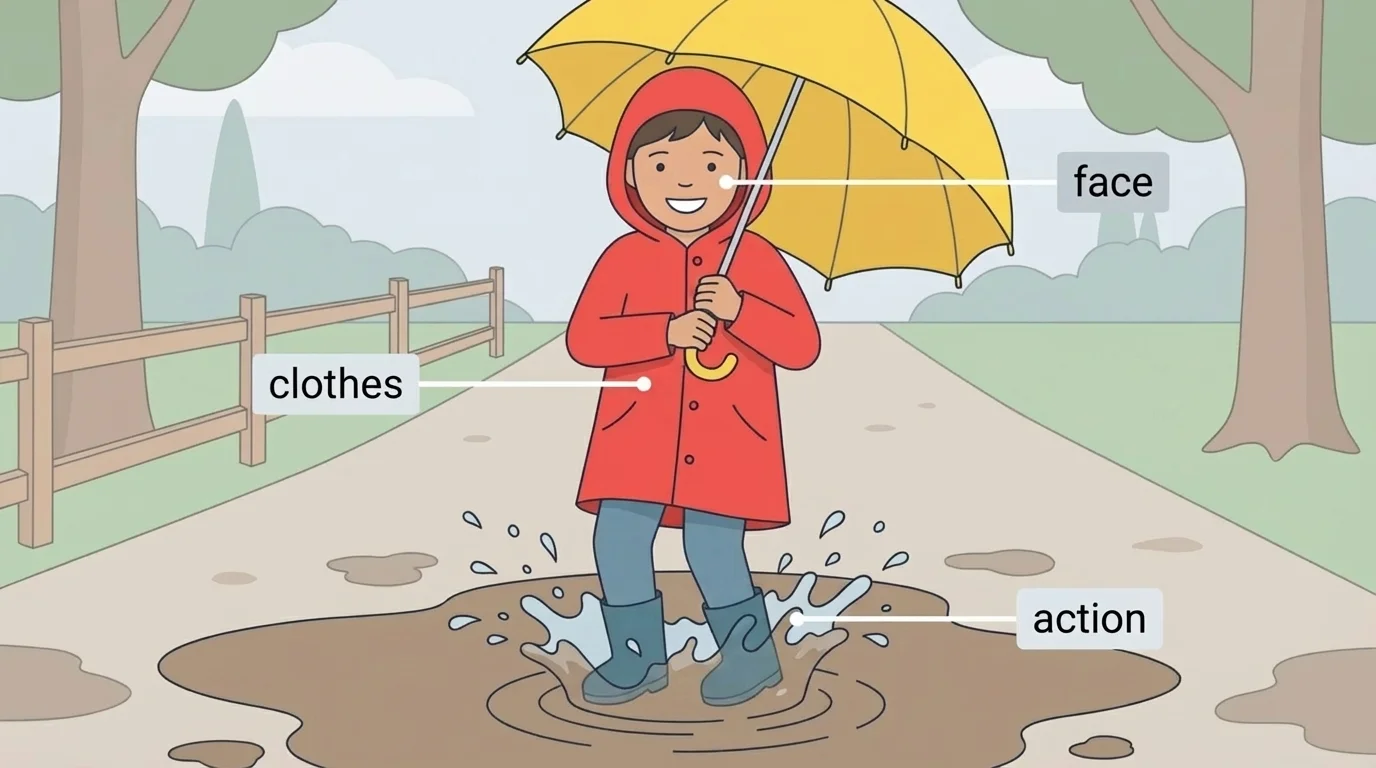
Readers can describe characters by using both kinds of clues. We might say, "The rabbit is small and scared because the picture shows wide eyes, and the words say he hid behind a rock." That is stronger than saying only, "The rabbit is there."
Example: Describing a character
Step 1: Look at the picture.
The fox is peeking from behind a tree. Its eyes are wide, and its tail is tucked close.
Step 2: Read the words.
The story says, "Fern heard a crack in the woods and froze."
Step 3: Put the clues together.
We can say, "Fern feels scared or surprised."
Later in the story, the same character may change. A shy child at the beginning may become brave by the end. We keep watching the illustrations and reading the details to notice those changes, just as we did with the picture clues in [Figure 1].
[Figure 2] The setting tells where and when a story happens. Illustrations are very helpful here because a picture can tell us about a place right away. We may see a beach, a classroom, a farm, or a snowy mountain.
The picture can also give clues about time. Bright sun may show daytime. A dark sky and moon may show nighttime. Falling leaves may show autumn. Snow may show winter. Then the words can add details such as "early morning," "long ago," or "on the hottest day of summer."
Suppose a story picture shows tall buildings, buses, and many people walking on sidewalks. The words say, "Sam hurried past the noisy shops." We can describe the setting as a busy city street. If another page shows trees, a pond, and a wooden bridge, the setting may have changed.
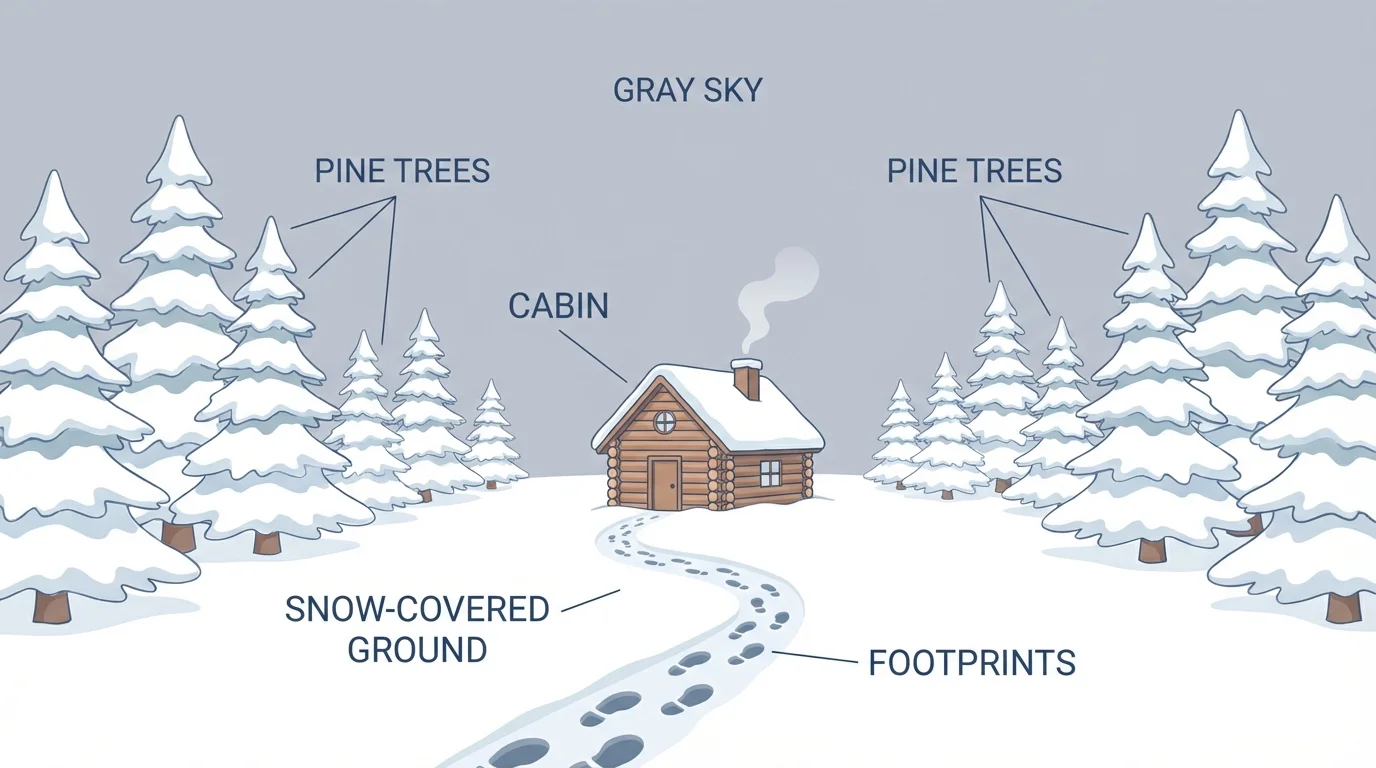
Sometimes the setting helps us understand the story's mood. A warm kitchen with soup on the table may feel cozy. A dark forest may feel spooky. The setting is not just the place. It helps the reader feel something too.
Illustrators often choose colors on purpose. Bright yellows and oranges can make a place feel warm and cheerful, while dark blues and grays can make it feel quiet, cold, or sad.
When readers describe a setting, they use details from the illustration and the words together. A winter cabin in the woods, like the one in [Figure 2], tells us more when we also notice story details such as smoke rising from the chimney or boots by the door.
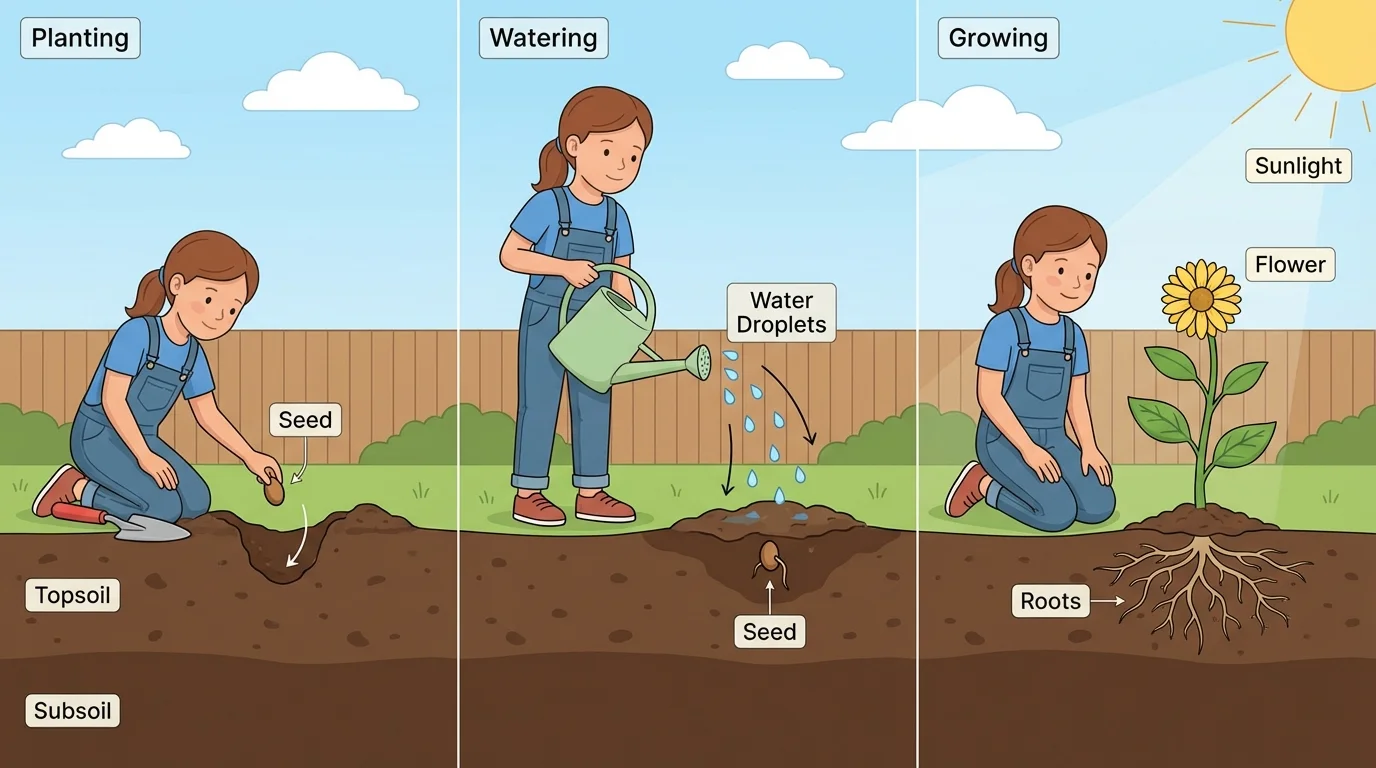
[Figure 3] Events are the things that happen in a story. Readers use illustrations and details to tell what happens first, next, and last. A sequence of illustrations helps us notice the order of events.
If we see a child digging in the dirt on one page, watering the dirt on the next page, and smiling at a flower later, we can tell what happened. First, the child planted a seed. Next, the child watered it. Last, the flower grew. The pictures and the words work together to show the sequence of events.
Words also help us understand why events happen. The story may say, "Lena forgot her lunch, so Grandpa brought it to school." The event is Grandpa bringing lunch. The reason is that Lena forgot it. Good readers pay attention to these details.
Sometimes an illustration shows action clearly. A ball flying through the air, a dog leaping, or children running tells us something is happening right now. The words can add important details: who kicked the ball, why the dog jumped, or where the children were going.
Example: Describing an event
Step 1: Look for what is happening.
The picture shows a boy holding a kite string while the kite is high in the sky.
Step 2: Read the detail words.
The story says, "A strong wind lifted Ben's kite above the field."
Step 3: Tell the event.
We can say, "Ben's kite flies high because the wind is strong."
When we retell story events, we should use important details, not every tiny thing. The sequence of events reminds us to keep events in order so the story makes sense.
Sometimes the words give one clue, and the picture gives another clue. Putting them together helps us understand more deeply. If the words say, "Nora said, 'I'm fine,'" but the picture shows tears in her eyes, we know she may not really be fine. We call this reading closely and paying attention.
We can ask ourselves questions while we read: What do I see? What do the words tell me? What can I say about the character, setting, or event now? These questions help us become thoughtful readers.
Words and pictures are teammates. Sometimes the words tell most of the story. Sometimes the illustrations tell a lot too. Strong readers do not choose just one. They use both to build a clear picture in their minds.
Here are some ways clues work together:
| What to describe | Clues from the illustration | Clues from the words |
|---|---|---|
| Character | Face, clothes, actions | Feelings, speech, thoughts |
| Setting | Place, weather, time of day | Location words, season, time |
| Event | Action in the picture | What happened, why, and when |
Table 1. This table shows how illustrations and words help readers describe characters, setting, and events.
In some books, one page may have very few words. Then the illustration becomes extra important. In other books, the words are long and detailed, but the pictures still help us notice little things. Both matter.
A careful reader might say, "The puppy is curious because the picture shows him sniffing the box, and the words say he wanted to know what was inside." That answer uses illustration and detail together. It is clear, complete, and based on the story.
When you answer questions about a story, use story clues. Do not just guess. Point to something you saw in the illustration or something you read in the words.
The more we practice noticing clues, the better we get at understanding stories. We learn to describe who the characters are, where the story happens, and what events take place. Pictures help our eyes. Details help our thinking.
