Have you ever told someone about a fun day, but they still asked, "What was it like?" That happens when our ideas need more details. Good speakers paint pictures with words. They help listeners see, hear, and feel the idea in their minds.
When we talk, we share more than facts. We also share thoughts and feelings. If you say, "I saw a dog," your listener knows a little. If you say, "I saw a tiny brown dog with floppy ears, and I felt excited," your listener knows much more. Clear speaking helps others understand exactly what you mean.
Describe means to tell what someone or something is like. We can describe with words about color, size, sound, shape, actions, and feelings. When we use the right details, our listener can form a clear picture in their minds.
Good oral expression also means thinking about the listener. We speak loudly enough, say words clearly, and use complete sentences. We can start with a main idea and then add important details.
Detail is a small piece of information that helps explain more. Feeling words are words like happy, sad, proud, surprised, or worried that tell how someone feels.
Sometimes one detail is enough, but often we need more. We can ask ourselves simple questions: What does it look like? What is it doing? How does it feel? Why is it important?
When we describe a person, we can tell how the person looks, moves, talks, or feels. We choose kind and respectful words. We might talk about hair, clothing, facial expressions, or actions.
[Figure 1] For example, instead of saying, "My teacher is nice," you can say, "My teacher has curly hair, wears bright blue shoes, and smiles when we read stories." That gives the listener a clearer picture.
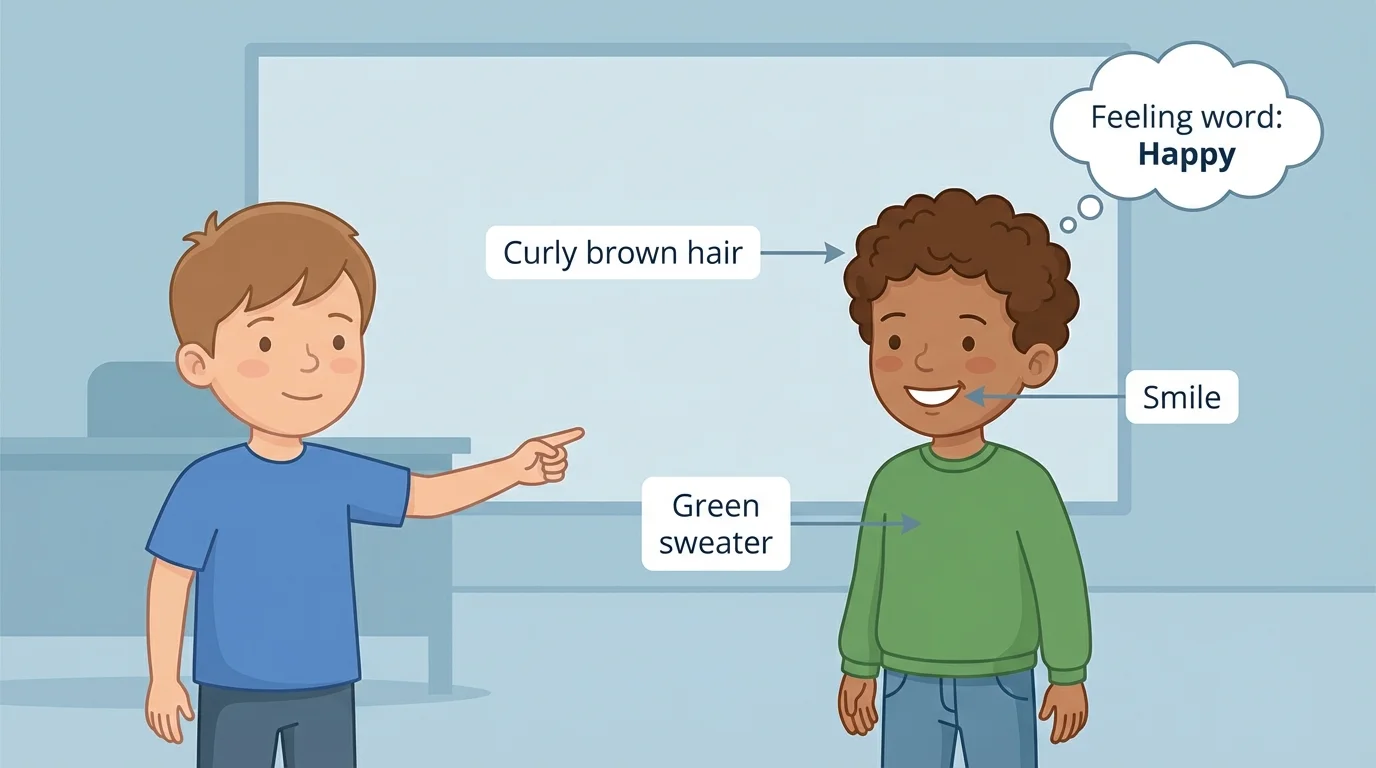
We can also describe feelings. "My brother looked tired after soccer." "My friend sounded excited about her drawing." Feeling words help listeners understand what is happening inside a person.
Examples of describing people
Step 1: Start with who the person is.
"My grandma..."
Step 2: Add what the person looks or sounds like.
"...has soft gray hair and a gentle voice..."
Step 3: Add an action or feeling.
"...and she laughs when we bake cookies together."
This description is clear because it gives details about appearance, sound, and action.
Later, if someone asks for more, we can add another detail. As we saw in [Figure 1], even a smile or clothing color can help make a person easier to picture.
A place can be described with our senses. We can tell what we see, hear, smell, or feel. A place might be bright, quiet, busy, windy, warm, or muddy.
[Figure 2] Listen to the difference. "The park was fun." That tells only a little. "The park was sunny and noisy. I heard kids laughing, and I smelled fresh grass." Now the listener can imagine the park much better.
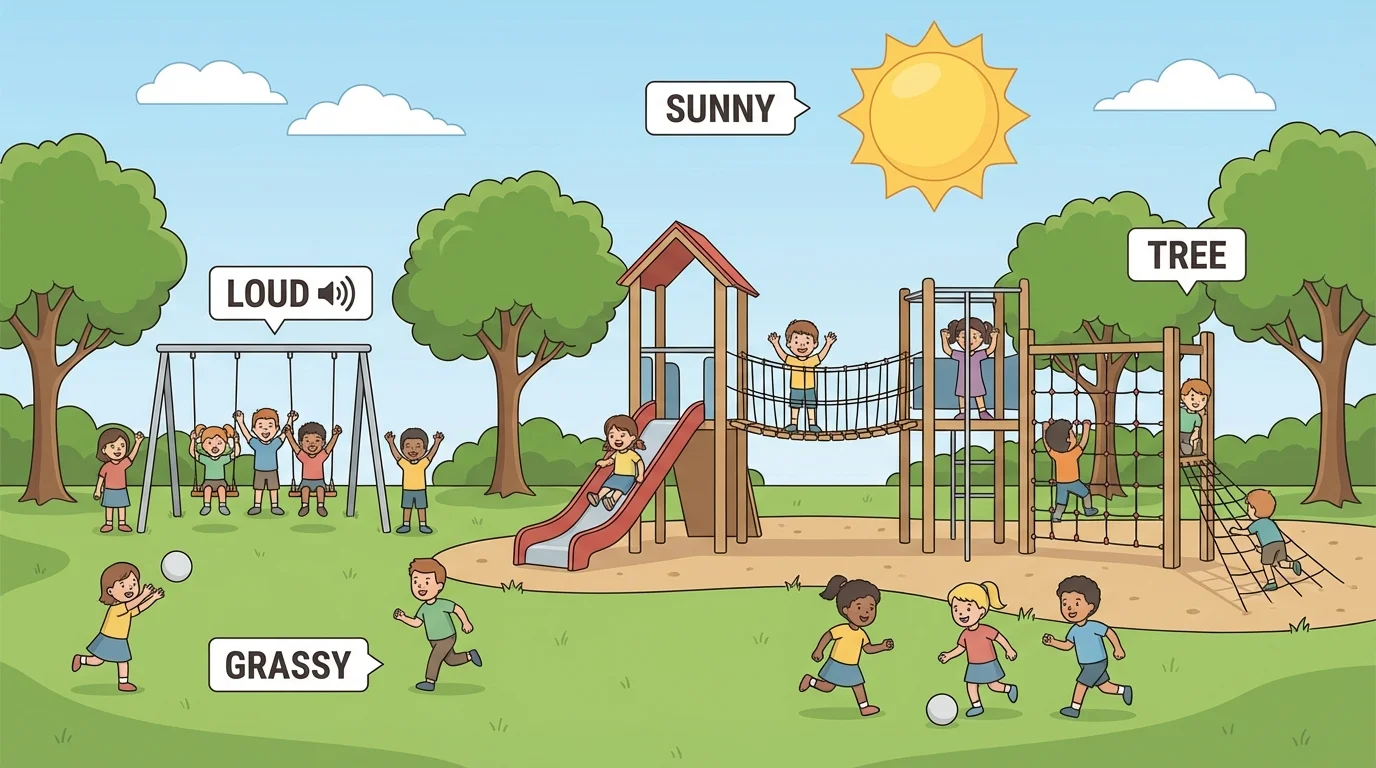
Places can also have feelings connected to them. "The library feels calm." "The dark hallway felt spooky." These feeling words tell the mood of the place.
Your brain can make a picture from words even when you are only listening. Strong details help that picture become clearer and stronger.
When you talk about a place, try to choose the most important details. The playground in [Figure 2] is easier to imagine because the description includes sounds, sights, and how the place feels.
A thing can be almost any object: a toy, a book, a leaf, or a backpack. We can describe a thing by its color, size, shape, parts, and what it does.
For example, "I have a ball" is simple. "I have a small red ball with white stars. It is bouncy and smooth." is much clearer. Those details help the listener know exactly which ball you mean.
You can also explain why the thing matters. "My blanket is soft, blue, and warm. I love it because it helps me feel safe at bedtime." That last detail shares an idea and a feeling.
Choosing the best details means picking details that help the listener most. If you are talking about a toy car, its color, size, wheels, and speed matter more than tiny details that do not change the picture very much.
Strong describing words are helpful. Words like shiny, rough, giant, tiny, curved, heavy, and colorful make speech more interesting and more exact.
An event is something that happens, and good speakers tell it in order. Helpful order words are first, next, then, and last.
[Figure 3] Suppose you are telling about a birthday party. You might say, "First, my cousins arrived. Next, we played a game. Then we sang a song and ate cake. Last, I opened my presents." Now the listener knows what happened and when.
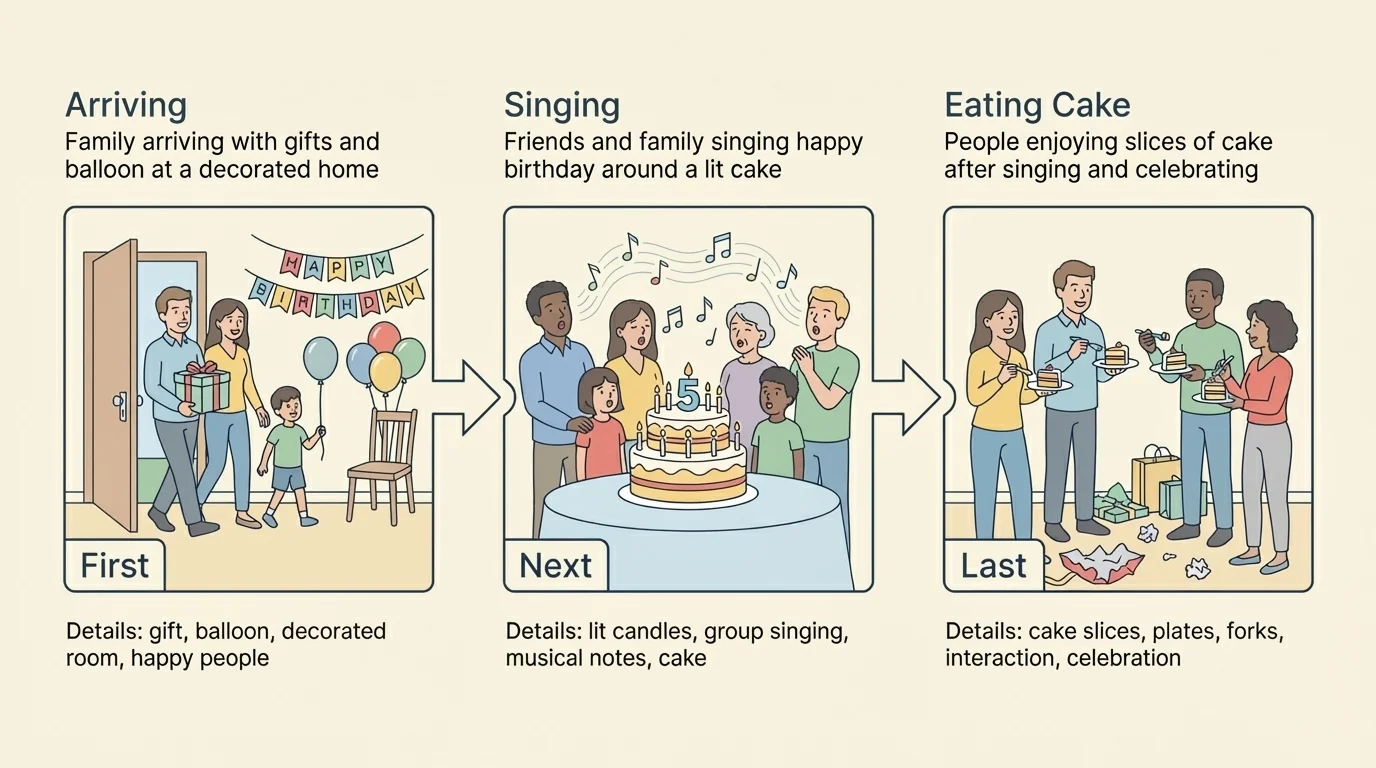
Events also include feelings. You might add, "I felt nervous before everyone came, but I felt joyful when we sang together." Feelings make your story more alive and true.
Not every event is big. A small event can be described too: losing a tooth, finding a ladybug, helping cook dinner, or hearing thunder outside. The sequence in [Figure 3] reminds us that putting events in order helps the listener follow along.
Clear speaking is not only about good words. It is also about how we say them. We use a voice that is easy to hear, face the listener, and speak at a calm pace. If we talk too fast or too softly, our details may get lost.
Listening matters too. A listener may ask, "What color was it?" or "How did you feel?" Good speakers listen carefully and add more information. This is one way we develop and expand oral communication. We do not stop after one short sentence; we grow our ideas.
You already know how to answer simple questions like who, what, where, and when. Now you are using those answers to build stronger speaking with more details and clearer feelings.
Complete sentences help. "The kitten was small and sleepy" is stronger than only saying, "Small and sleepy." A full sentence gives the listener a whole idea.
Some words are especially useful when we describe. We can choose describing words for how something looks, sounds, feels, or seems inside our hearts and minds.
| Kind of word | Examples |
|---|---|
| Looks like | red, tall, round, shiny, fuzzy |
| Sounds like | quiet, loud, squeaky, gentle |
| Feels like | soft, rough, warm, cold, sticky |
| Feeling words | happy, sad, proud, scared, excited |
| Order words | first, next, then, last |
Table 1. Examples of words that help make speaking clear and detailed.
These words help us say more than "good," "nice," or "fun." Those words are okay, but more exact words make our speech stronger. Instead of "nice," you might say "kind." Instead of "fun," you might say "exciting."
"Good words help others see what you mean."
When we describe people, places, things, and events, we are sharing pictures with our voices. We use details to make those pictures bright and clear. We use feeling words to show what matters to us. And we listen so we can add more when someone wants to know more.
