Have you ever heard a great story and wanted to tell it to someone else? That is exactly what good readers do. They remember the important parts, tell them in order, and think about what the story means. When you can tell a story again and explain what it teaches, you show that you truly understand it.
To retell a story means to tell it again in your own words. A retell is not every tiny thing in the book. It is the most important parts. When you retell, you try to say what happened first, next, and last.
A good retell sounds clear and makes sense. It includes who the story is about, where it happens, what happens, and how it ends. You do not need to say every sentence from the book. You need the parts that matter most.
Retell means to tell a story again in your own words. Key details are the important parts that help us understand the story. The central message or lesson is what the story teaches us.
When readers retell, they listen and think carefully. They ask, "What happened in this story?" and also, "Why did it matter?" Those two questions help readers understand both the events and the meaning.
Stories have important parts that fit together, as [Figure 1] shows. When you listen to or read a story, pay attention to the characters, the setting, the problem, the important events, and the ending.
The characters are the people or animals in the story. The setting is where and when the story happens. The problem is what goes wrong or what needs to be solved. Important events are the big things that happen. The ending tells how the story finishes.
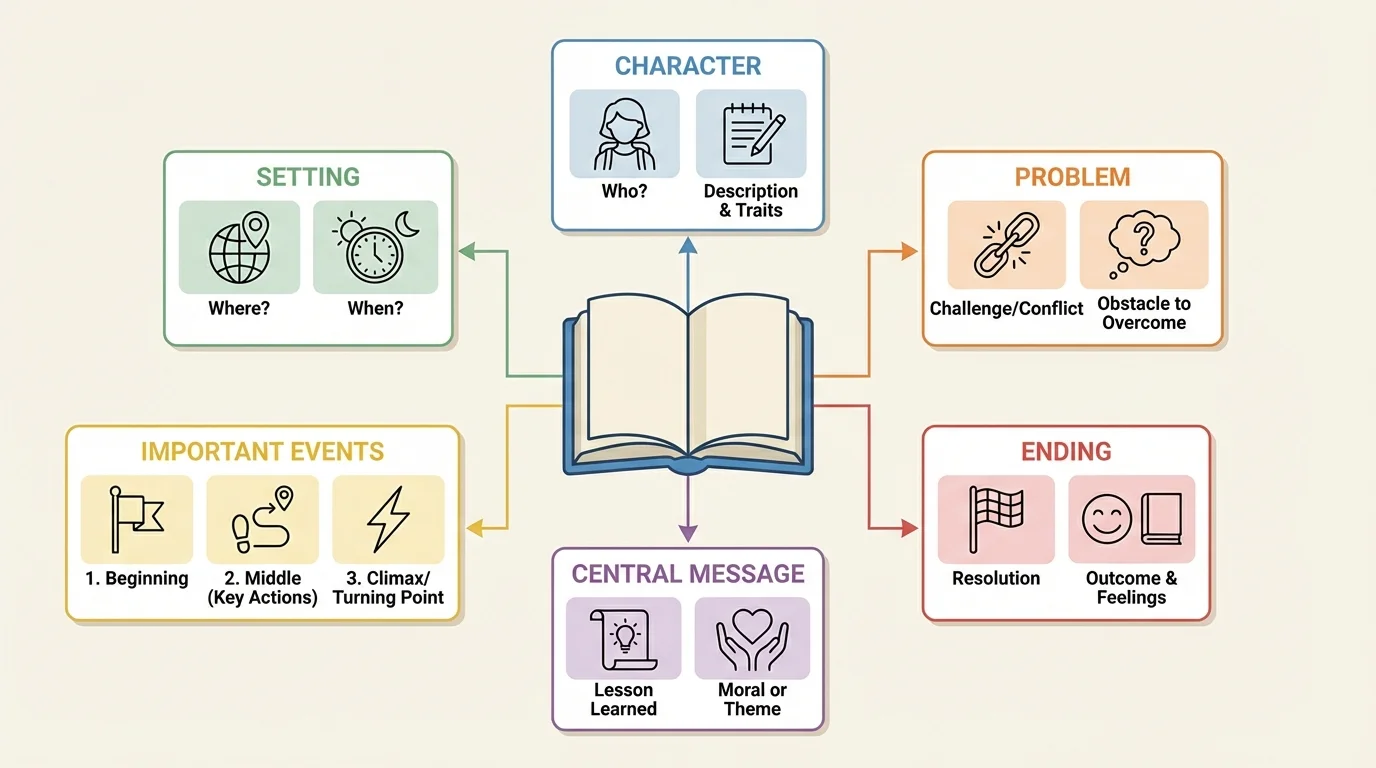
If you leave out a key detail, your retell may not make sense. For example, if you say, "The girl was happy at the end," someone may wonder why. But if you add the key detail, "She found her lost puppy," the ending is much clearer.
Readers do not need every little detail. If a story says the boy wore red shoes, that may not be important unless the red shoes matter to the story. Key details are the details that help explain the story in the best way.
Stories happen in a sequence, and [Figure 2] illustrates how events move from beginning to middle to end. When you retell, put the events in the order they happened. This helps your listener follow the story.
You can use sequence words like first, next, then, and last. These words help your retell sound smooth. They also help you remember what happened.
Many stories can be broken into three big parts: the beginning, the middle, and the end. In the beginning, we meet the characters and setting. In the middle, a problem happens and events unfold. In the end, the problem is solved, or the story reaches its finish.
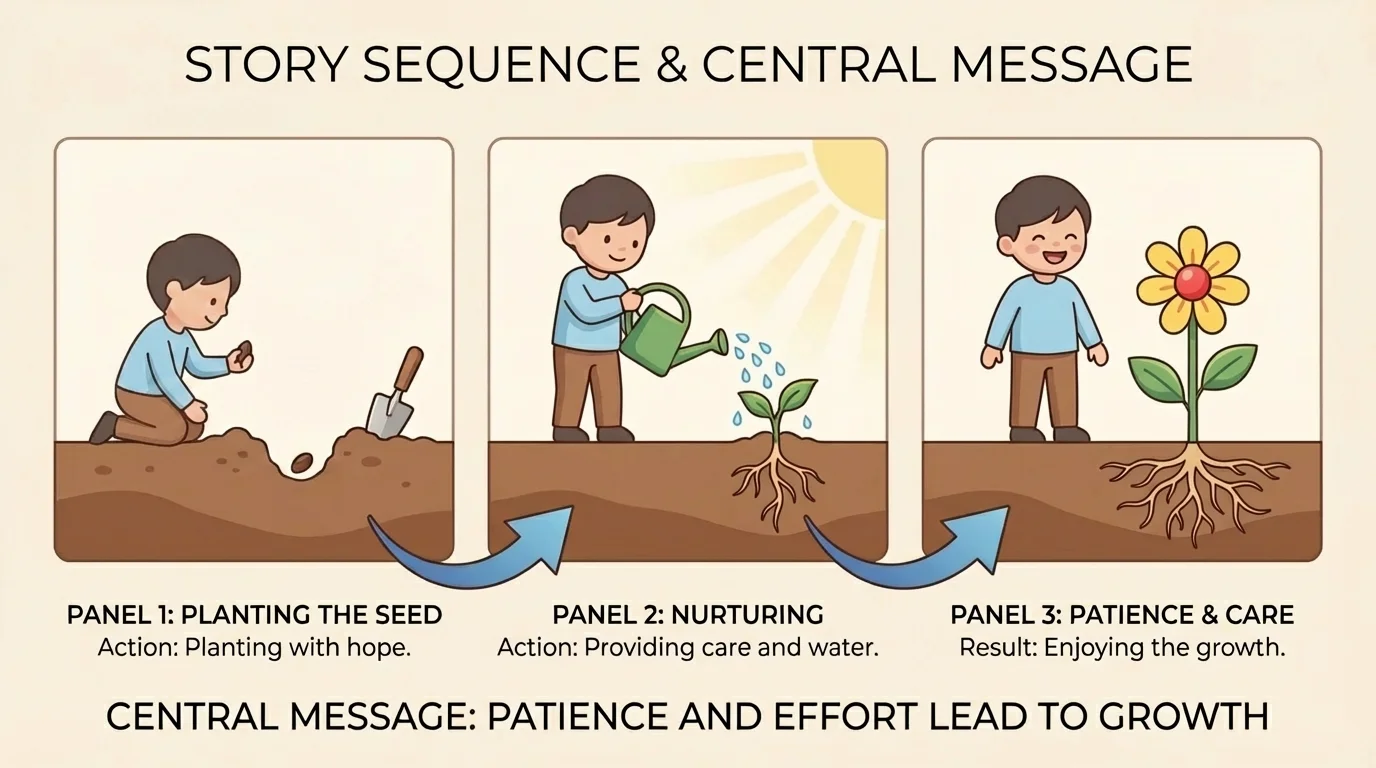
Here is a tiny retell in order: "First, Mia planted a seed. Next, she watered it every day. Last, a flower grew." That retell is short, but it gives the key events in the right order.
You already know that stories have a beginning, middle, and end. Retelling uses that same idea, but now you also choose the most important details and say them clearly.
If the events get mixed up, the story can sound confusing. Saying "The flower grew before Mia planted the seed" would not make sense. Putting events in order helps readers show understanding.
A story is not only about what happened. It is also about what the story teaches. The central message, or lesson, is the big idea readers learn from the story, and [Figure 3] shows how actions in a story can point to that lesson.
Some stories teach that it is good to be kind. Some teach that honesty matters. Some teach that hard work helps us reach a goal. The lesson is not always stated in a single sentence. Readers often figure it out by thinking about what the characters do and what happens because of those choices.
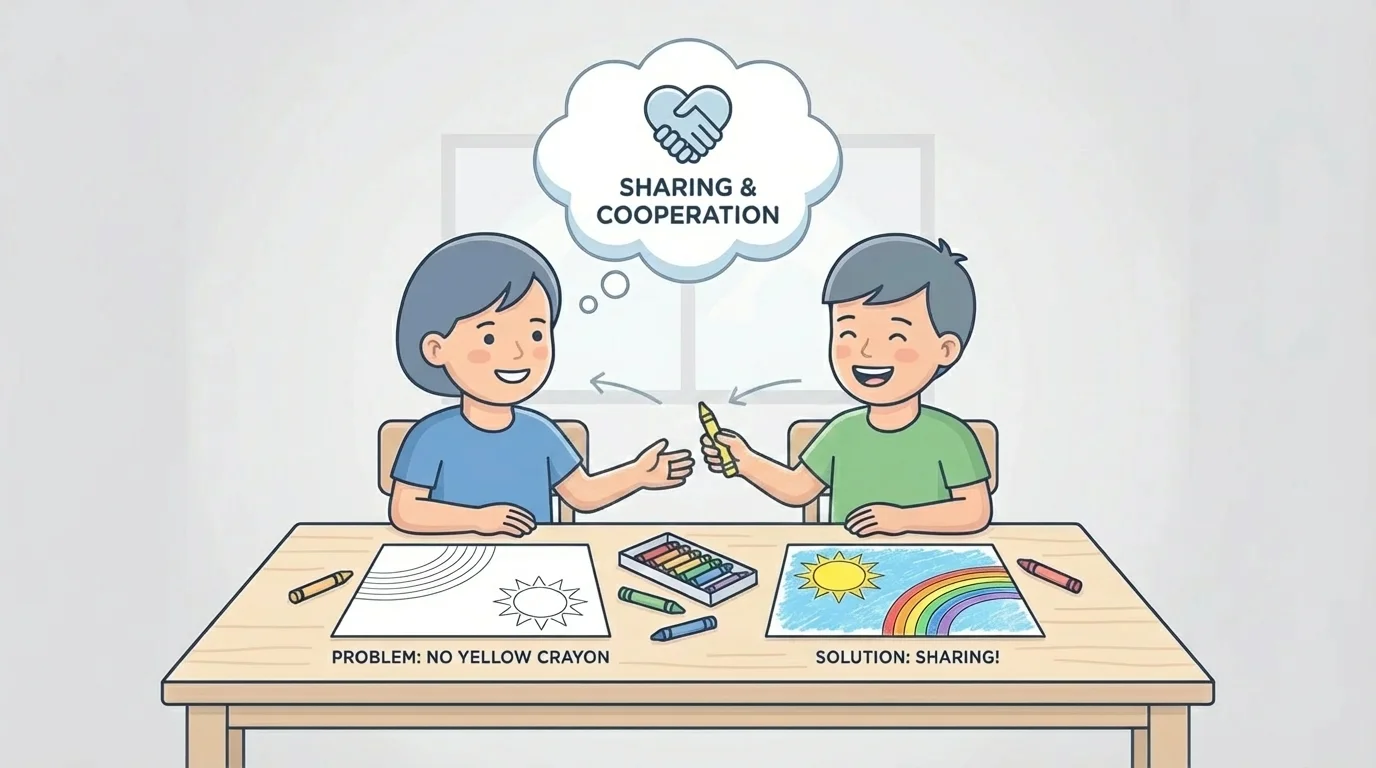
For example, if a character refuses to share and then feels lonely, the story may teach that sharing helps friendships grow. If a character keeps trying even when something is hard and finally succeeds, the lesson may be to never give up.
How to find the lesson
Think about the problem, the character's choices, and the ending. Ask yourself: "What did the character learn?" or "What can I learn from this story?" The answer often leads to the lesson.
The lesson should match the story details. If a story is about helping a friend, the lesson is probably not about cleaning your room. Good readers use clues from the story to choose a lesson that fits.
Let's look at a short story. A rabbit named Ben sees that his friend Turtle drops a basket of apples. Ben is in a hurry to play, but he stops and helps Turtle pick them up. Because Ben helps, Turtle gets to the picnic on time. At the picnic, Turtle shares a muffin with Ben, and they both smile.
A strong retell might sound like this: "Ben the rabbit saw Turtle drop a basket of apples. Ben wanted to go play, but he stopped to help. Turtle got to the picnic on time, and later Turtle shared a muffin with Ben."
Example: Finding key details and the lesson
Step 1: Name the characters and setting.
The characters are Ben and Turtle. The setting is on the way to a picnic.
Step 2: Tell the important events in order.
Ben sees the apples fall. Ben helps Turtle. Turtle gets to the picnic on time. Turtle shares with Ben.
Step 3: Think about what the story teaches.
Ben's kind choice helps his friend. The story teaches that helping others is important and kindness can come back to you.
Notice that the retell does not include tiny details that do not matter much. It stays focused on the events that help us understand the story. It also tells the events in order.
Key details are like clues. They help readers understand not only what happened, but also why the story matters. Earlier, [Figure 1] shows the parts of a story map, and each part can help us think about the lesson.
If the problem is that a character is selfish and the ending shows the character learning to share, those details help us understand the lesson. If the story begins with fear and ends with bravery, the lesson may be about courage.
Look at actions and results. When a character makes a choice, ask what happens next. If the choice leads to a happy ending, the story may be showing a good lesson. If the choice causes trouble, the story may be warning readers about that behavior.
Many old fables are remembered for hundreds of years because their lessons are so strong. Even short stories can teach big ideas.
This is why readers do more than repeat words. They think. They connect details to meaning. They ask what the author wants readers to learn.
Different kinds of stories can teach the same lesson. A fable about animals, a story about children at school, and a story about family at home might all teach kindness. The stories are different, but the lesson can be the same.
For example, one story may show a fox helping a bird. Another may show a child helping a new student. As we saw with sharing in [Figure 3], different actions can still point to the same big message: being kind makes a difference.
Some stories teach more than one idea, but young readers should start with the strongest lesson. Ask, "What is the most important thing this story wants me to remember?" That question helps you focus.
| Story Part | Question to Ask |
|---|---|
| Characters | Who is in the story? |
| Setting | Where does the story happen? |
| Beginning | What happens first? |
| Middle | What important things happen next? |
| End | How does the story finish? |
| Lesson | What does the story teach? |
Table 1. Questions readers can ask to help retell a story and find its lesson.
When you retell a story, you are showing that you understand it. When you explain the lesson, you are showing even deeper understanding. Good readers do both: they remember the important parts and think about what those parts mean.
