Have you ever picked up one book to hear about a dragon, and another book to learn about frogs? Books can be very different because they do different jobs. Some books are made to tell a story. Other books are made to teach us true facts about the world.
When we read, it helps to know why the book was written. A book that tells a made-up or retold tale is often read for enjoyment, ideas, and feelings. A book that gives facts is often read to learn about something real, like weather, trucks, plants, or space.
Good readers notice clues. They think, "Is this book telling me about people and events, or is it teaching me facts?" That helps them understand the book better.
A story book tells about characters and events. It often has a beginning, middle, and end.
An information book teaches true facts about a topic. It helps readers learn about the real world.
Both kinds of books are important. Both can be fun. But they are not the same, and readers use different ideas to understand each one.
A character in a story book is a person, animal, or creature in the story. Story books also have a place and time where the story happens. This is called the setting. Story books have events that happen in order, with a beginning, middle, and end.
Many story books have a problem to solve. A little bear may lose its hat. A girl may be afraid of the dark. Then the characters do things, and the story moves toward a solution. Readers often ask, "What happens next?" and "How does the character feel?"
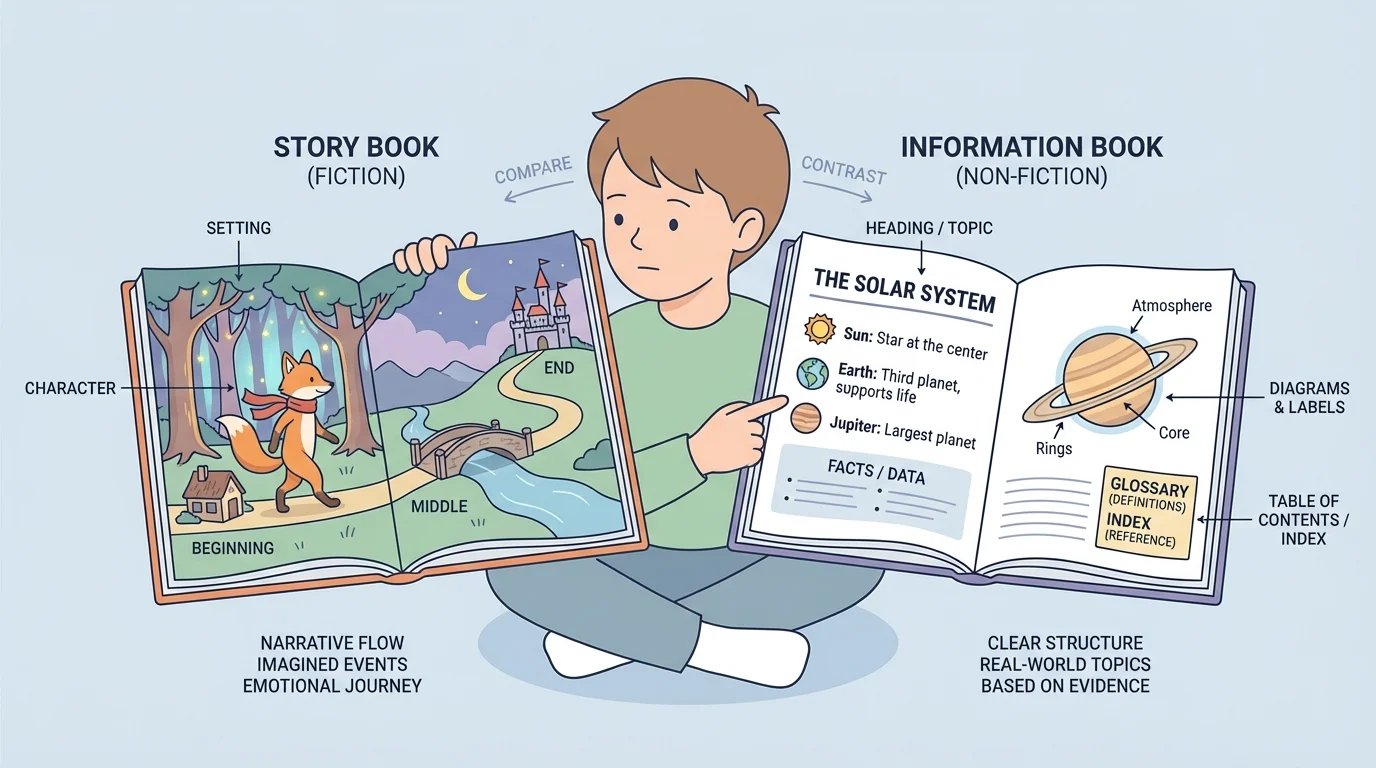
Story books may be make-believe, like a fairy tale about a talking fox, or they may tell a realistic story about a child going to school. Even when a story feels real, it is still built around characters, actions, and feelings.
The pictures in story books often help show mood, action, and emotion. If a page shows dark clouds and a worried face, the reader can tell something important may happen. In a story book, the pictures usually help tell the story.
Example: A story book
Step 1: Read the title The Lost Puppy.
Step 2: Meet the character, Mia, and her puppy.
Step 3: Notice the problem: the puppy runs away.
Step 4: Follow the events as Mia looks in the yard, at the park, and by the fence.
Step 5: Find the ending: Mia finds the puppy and feels happy.
This book tells a story because it has characters, a problem, events, and an ending.
When readers talk about a story book, they often retell the story in order. They may say who was in it, where it happened, what went wrong, and how it ended. Those are strong clues that the book is a story book, or story-based.
An information book gives true facts about a topic. It may teach about penguins, fire trucks, seasons, or how seeds grow. Readers ask different questions here and can notice helpful parts, like headings, labels, and real pictures.
Instead of a character with a problem, an information book usually has a topic. The topic is what the whole book is about. Then the book gives details to teach more. For example, a book about bees may tell where bees live, what they eat, and how they help flowers.
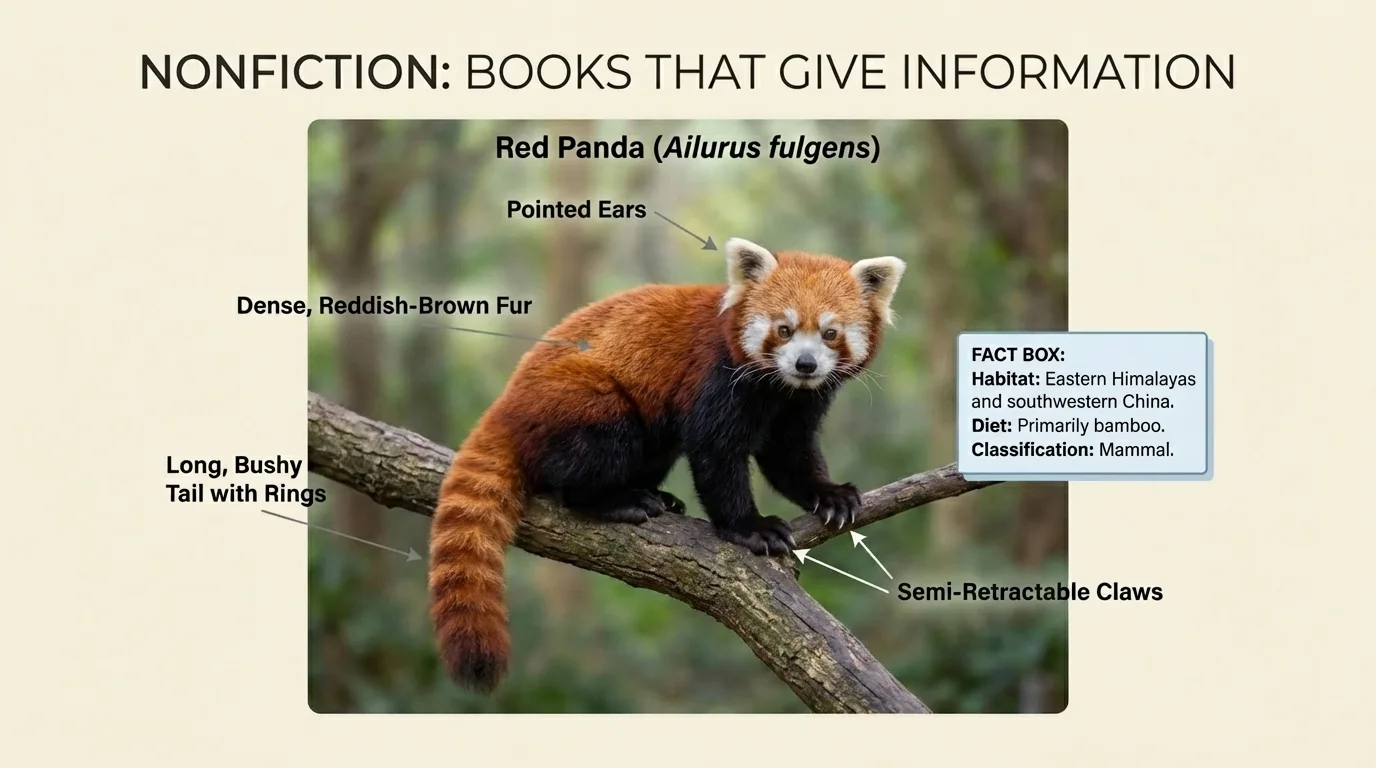
Information books often use special text features to help readers learn. They may have headings, captions, labels, diagrams, or a table of contents. These features help the reader find facts quickly.
The pictures in information books usually show something real. A photo of a turtle shell or a labeled drawing of a plant helps the reader learn correct information. The goal is to teach, not to tell a made-up tale.
Some young readers first think every book with pictures is a story book. But many books with pictures are information books because the pictures teach real facts.
When readers talk about an information book, they often say what they learned. They may share facts such as, "Frogs start life as tadpoles," or "A firefighter wears special gear." That is different from retelling story events.
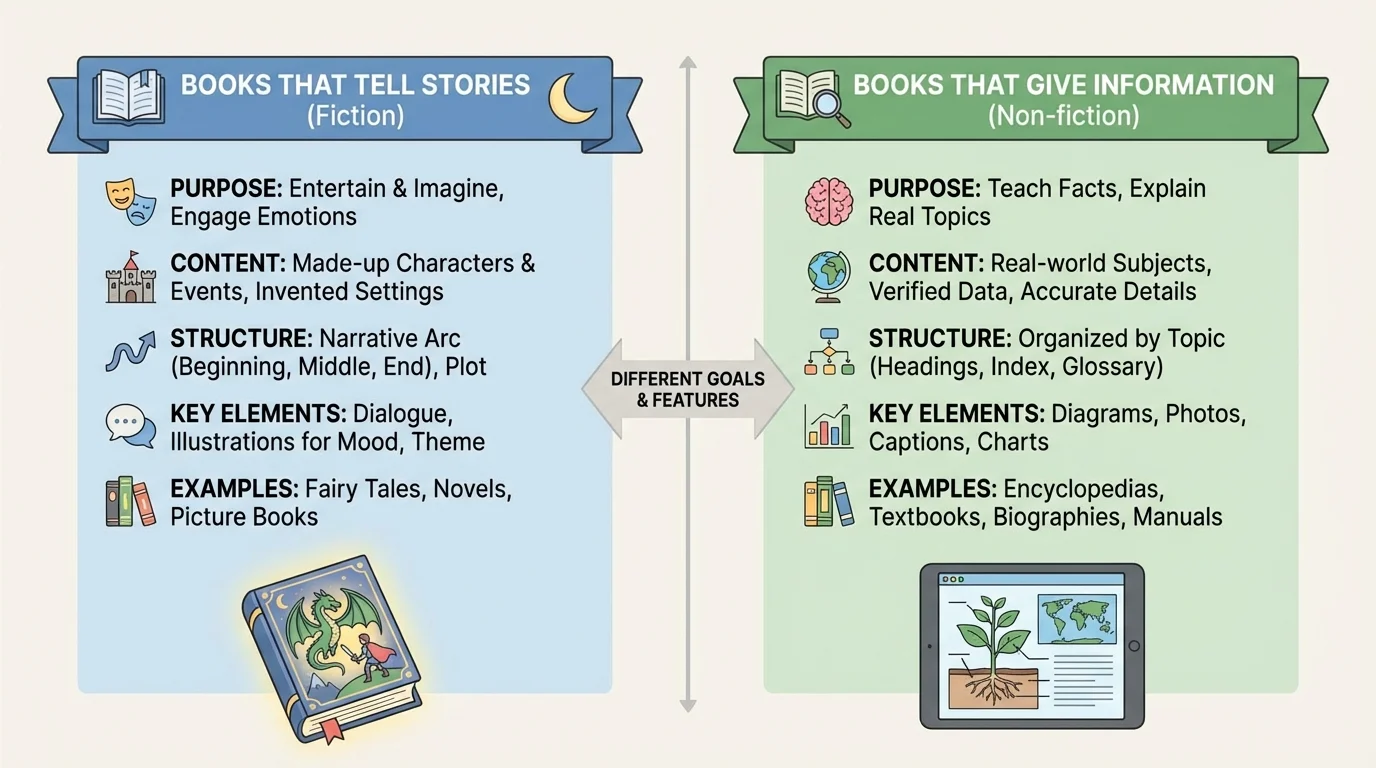
[Figure 3] Story books and information books often look different on the page in a side-by-side comparison. A story book may have full-page art and sentences that move the plot. An information book may have shorter pieces of text, headings, and labeled pictures.
| Story books | Information books |
|---|---|
| Tell about characters and events | Teach true facts about a topic |
| Often have a beginning, middle, and end | Often have headings and sections |
| Ask what happens next | Answer questions about the real world |
| Pictures help tell the story | Photos and labels help teach facts |
| May be make-believe | Should be true and accurate |
Table 1. A comparison of important features of story books and information books.
A title can also give clues. The Brave Little Squirrel sounds like a story. All About Squirrels sounds like a book of facts. Readers can look at the cover, the pages, and the words to decide what kind of book they are reading.
Sometimes one page makes the difference clear right away. If the page says "Habitat" at the top and shows labels pointing to animal parts, it is probably an information book. If the page says "Max ran into the forest," it is probably a story book.
Readers do not read every book in exactly the same way. With story books, readers pay close attention to the characters, the setting, the problem, and the order of events. They may predict what will happen next or think about how a character feels.
With information books, readers pay close attention to facts and big ideas. They may stop and think, "What am I learning?" or "Which part teaches about food?" They may use headings and labels to find information again.
Different books, different reading jobs
Story books help readers enjoy a tale, understand characters, and follow events. Information books help readers learn facts, answer questions, and build knowledge about the world. Strong readers notice the book's job and adjust how they read.
That is why text features matter. In an information book, a heading tells what the next section is about. In a story book, the next page usually continues the action. Back in the comparison we saw earlier, those visible clues help a reader know what to expect.
Some books mix the two kinds. A book may tell a true story about a real person, such as a child who helped plant a garden, and still include factual notes at the end. Another book may tell a simple story about an animal but also add real facts on some pages.
This means readers must look carefully. The main part may act like a story, while an extra page gives information. Or the whole book may mostly teach facts, even if it starts with a small story.
That does not make the book confusing. It just means books can be creative. Good readers use all the clues: the words, the pictures, the features, and the purpose of the book.
If you want to laugh, wonder, and follow a character on an adventure, a story book is a great choice. If you want to learn how butterflies grow or why rain falls, an information book is a great choice.
In a classroom library, on a school shelf, or at home, both kinds belong. One helps build imagination and understanding of stories. The other helps build knowledge about the world. Reading many kinds of books makes a reader stronger.
When you open a new book, you can ask: "Is this mostly telling a story, or is it mostly teaching facts?" That one smart question helps you understand what kind of reading work to do.
