Have you ever noticed that two story characters can both be brave, but one climbs a hill while another sails across water? Stories are full of exciting people, places, and problems. When we look at two characters together, we can learn even more about what happens to them and how they grow.
When we compare story characters, we tell how they are the same. When we contrast story characters, we tell how they are different. We can compare and contrast what characters do, where they go, what happens to them, and how they feel.
Compare means to tell how things are alike. Contrast means to tell how things are different. A character is a person or animal in a story.
Good readers do not just say, "They are different," and stop. Good readers look for story details. They think carefully about each character's actions, feelings, and problems.
An adventure is something exciting, new, or challenging that happens in a story. [Figure 1] Adventures can happen in very different places, and they can bring different kinds of trouble. One character may walk through a dark forest. Another may ride in a boat on a windy lake.
Two characters can both have adventures, but their adventures may not be the same. One adventure might be quiet and careful. Another might be fast and scary. One character may look for a lost puppy. Another may try to find the way home.
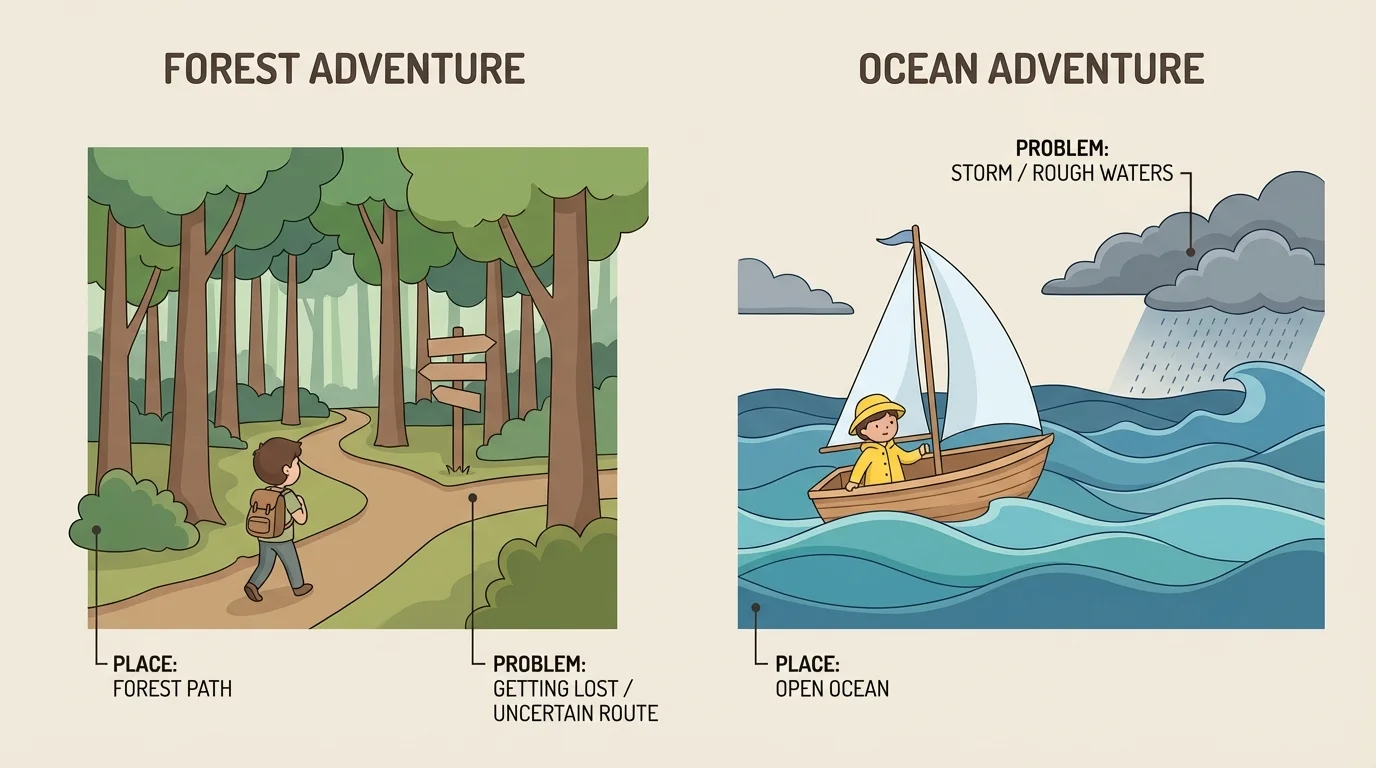
When you compare adventures, think about where the adventure happens, what problem the character faces, and what the character does. These details help you say more than just "same" or "different."
Some characters go on big adventures far away, but other characters have adventures close to home. A lost mitten, a surprise storm, or a new school day can all feel like adventures in stories.
For example, two characters might both be looking for something. That is a similarity. But one may search in the woods while the other searches in a busy town. That is a difference.
An experience is something that happens to a character. Experiences include events, feelings, and what the character learns. A character may feel happy, worried, proud, or surprised during an experience.
Two characters can have the same kind of experience but feel different about it. For example, two children in two different stories may both start a new school. One child may feel excited. The other child may feel shy. The event is alike, but the feelings are different.
Adventures and experiences work together. A character's adventure is often the journey or challenge. The experiences are the things that happen during that adventure, including feelings, choices, and lessons learned. When readers compare both, they understand the character more deeply.
Readers should also notice what changes. At the beginning of a story, a character may feel scared. At the end, that same character may feel strong and proud. Another character in another story may change in a different way.
When we talk about two characters, special words help us. We can say both when two characters share something. We can say but, different, however, or while when we explain how they are not the same.
Here are some sentence ideas: "Both characters are brave." "One character climbs a tree, but the other character crosses a bridge." "Both characters have a problem." "One feels excited, while the other feels afraid."
These words help us speak and write clearly. They help us show that we are thinking about details from the story.
Suppose one story is about Mia, who loses her red kite in a park. Another story is about Ben, who loses his toy boat near a pond. Mia and Ben are from different stories, but we can still compare them.
Both characters lose something important. Both characters try to get it back. Both characters keep going even when the problem is hard. Those are similarities.
Character comparison example
Step 1: Find what is the same about the characters.
Mia and Ben both lose something they care about.
Step 2: Find what is different about the characters.
Mia searches in a grassy park, but Ben searches near water.
Step 3: Compare feelings.
Mia feels frustrated and then hopeful. Ben feels nervous because the boat is near the pond.
Step 4: Think about the ending.
Mia gets help from a friend. Ben uses a stick to pull the boat closer.
This comparison uses story details, not guesses.
We can also contrast the ways they solve their problems. Mia may need teamwork. Ben may solve the problem by himself. So, both are determined, but their experiences are not exactly the same.
Comparing characters helps us notice important parts of stories. We can see who is brave, who is kind, who changes, and who learns a lesson. This makes us better readers.
Sometimes two characters make different choices in similar situations. One character may tell the truth right away. Another may hide the truth at first. When readers compare these choices, they understand each character better.
Remember that a story has parts like characters, setting, problem, and ending. These story parts give us the clues we need when we compare and contrast.
Comparing also helps us think about the story's message. If two characters face fear in different ways, we may learn that courage can look different from one story to another.
[Figure 2] Readers can compare story details one by one. Helpful details include the setting, the problem, the actions, the feelings, and the ending. Looking at these parts keeps our thinking organized.
If we only think about one small part, we may miss something important. A character may live in the same kind of place as another character, but solve the problem in a very different way.
| Story Detail | What to Ask |
|---|---|
| Setting | Where does the story happen? |
| Problem | What goes wrong? |
| Actions | What does the character do? |
| Feelings | How does the character feel? |
| Ending | What happens at the end? |
Table 1. Questions readers can ask when comparing and contrasting characters.
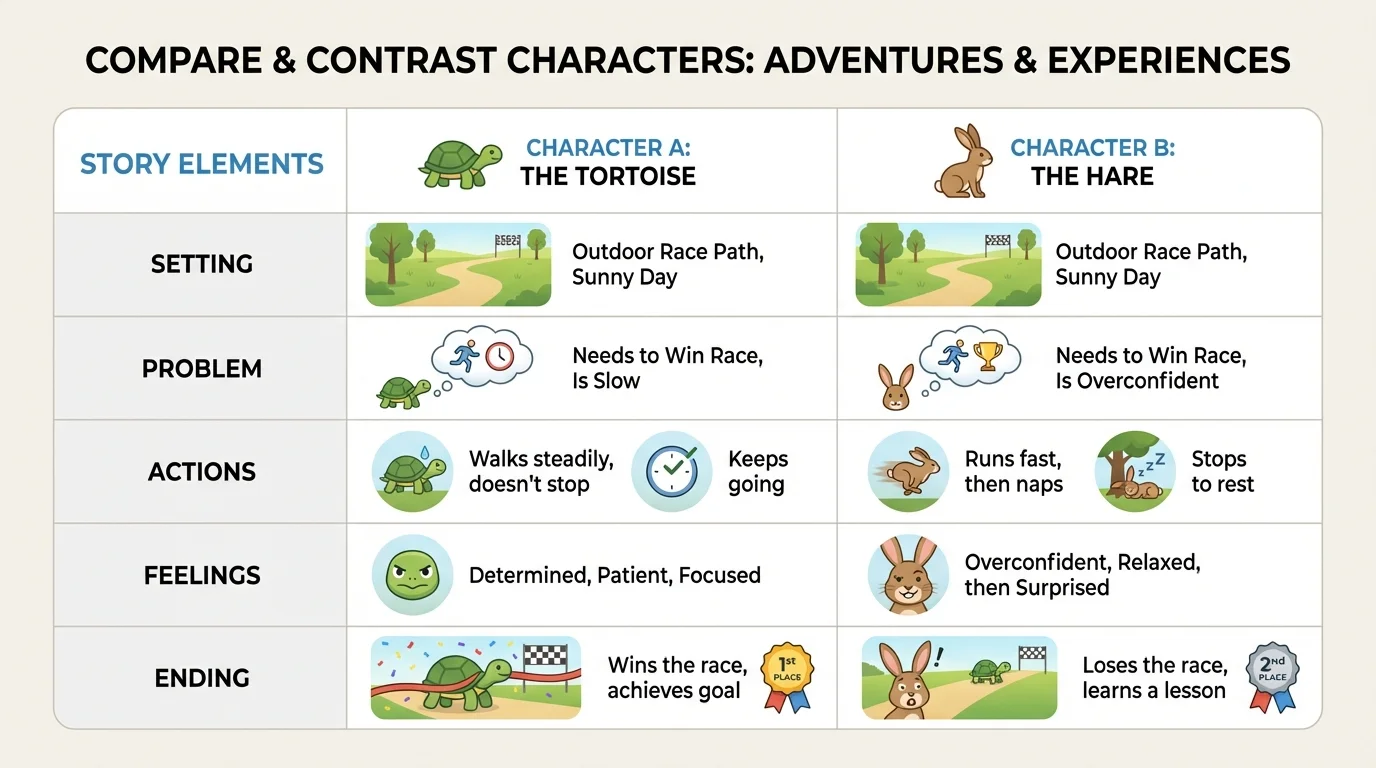
Later, when you think again about characters like Mia and Ben, the chart helps you remember to compare more than one detail. You can check where each character is, what each one wants, and how each problem ends.
Now think about two new characters. Ana hikes up a hill to find her missing goat. Leo crawls under a porch to rescue his kitten. Both characters try to help an animal. That is one way they are alike.
But Ana's adventure is outdoors on a hill, and Leo's adventure is close to home under a porch. Ana's trip is longer. Leo's space is tighter and darker. Their adventures are different, even though both are helpful and caring.
Another comparison
Ana and Leo both care about animals and work hard to help them. Ana travels farther and has a bigger journey. Leo works in a small space and must move carefully. Ana may feel tired from climbing, while Leo may feel squeezed and worried in the dark.
Notice how comparing and contrasting gives a fuller picture. If we only said, "Both help animals," that would be true, but it would not tell enough. If we only said, "They are different," that would also not tell enough. Strong readers explain how they are alike and how they are different.
When you read stories, listen for details that show each character's path. Ask yourself: What happened to this character? How did the character feel? What did the character learn? Then think about another character and look for matches and differences.
