Have you ever heard a story and then someone asked, "What happened first?" Sometimes your brain has to go back and find the important parts. That is what strong listeners do. They listen, think, and talk about the most important ideas. When you can ask and answer questions about key details, you become a better listener, speaker, and learner.
When someone reads aloud, gives directions, or shows information, your job is to listen with care. Listening closely means your ears, eyes, and brain are all working together. You look at the speaker, keep your body calm, and think about what you hear.
Good listening helps you understand stories and facts. If your teacher reads a story about a lost puppy, you should try to notice who the story is about, where the puppy goes, and what happens at the end. If a grown-up says, "Put your folder in the bin and sit on the rug," you listen for the important parts so you know what to do.
Key details are the important parts that help us understand a story or information. They tell us the big facts, such as who, what, where, when, and what happened.
Question means something we ask to learn more.
Answer means the response that tells what we know.
Sometimes not every detail is a key detail. If a story says a girl wore red shoes, that may or may not be important. But if her red shoes help her leave footprints in the snow, then that detail becomes important.
In a story, key details often tell us about the people or animals in the story, the place, and the main events. A story might tell us that Ben went to the park, dropped his hat, and a dog brought it back. Those are important details because they help us understand what happened.
[Figure 1] In information that is not a story, key details are important facts. If someone talks about butterflies, the key details might be that butterflies start as caterpillars, rest in a chrysalis, and then change. Those facts help you understand the topic.
Here are some kinds of important details listeners look for:
| Kind of detail | What it tells | Example |
|---|---|---|
| Who | The person, animal, or thing | The story is about Mia. |
| Where | The place | Mia is at the beach. |
| When | The time | It happens in the morning. |
| What happened | The main event | She found a shiny shell. |
| Important fact | A fact to remember | Crabs walk sideways. |
Table 1. Examples of common kinds of key details students listen for.
When you listen, try to notice which details help the whole text make sense. If you miss an important part, the story or information may feel confusing.
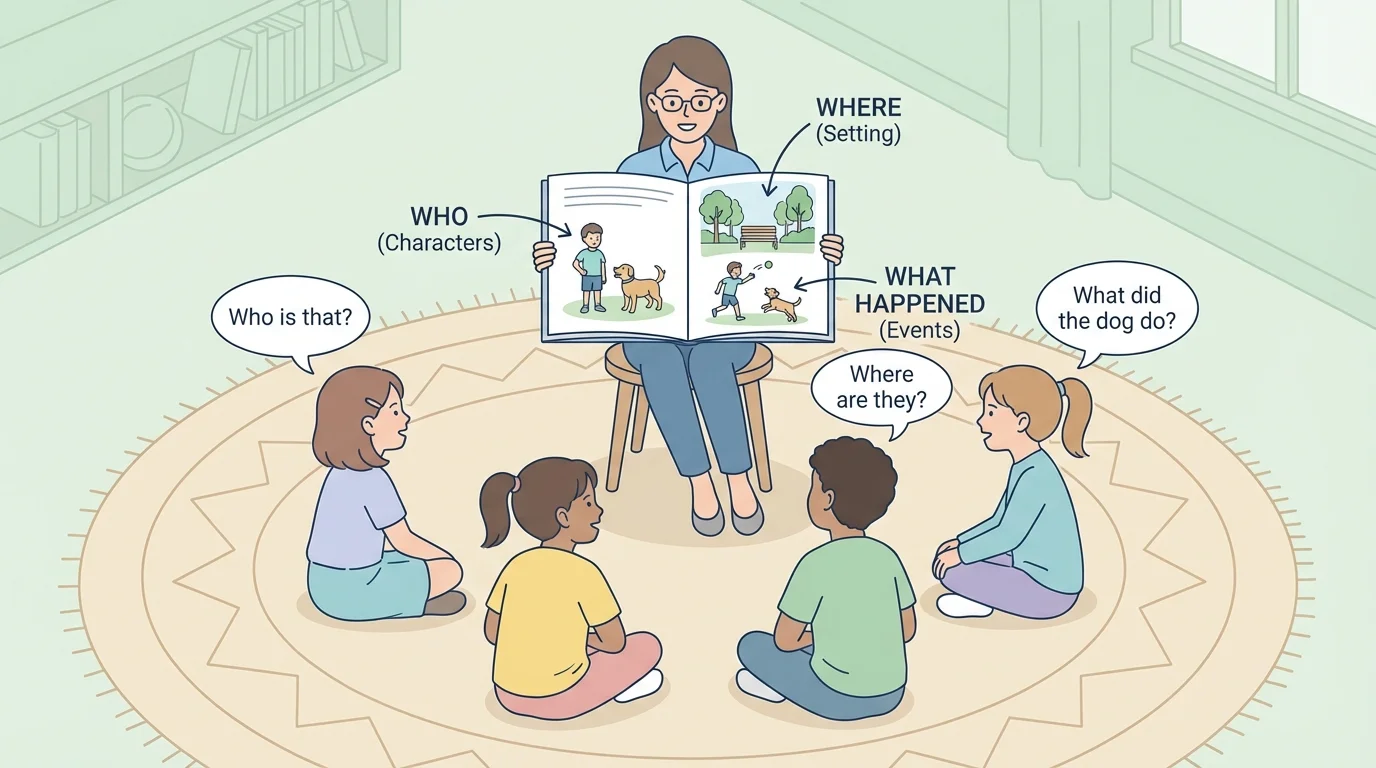
A strong listener can also tell the difference between a tiny detail and an important detail. The most helpful details are the ones that explain the story clearly.
Your brain does a lot of work while you listen. It remembers words, connects ideas, and helps you decide which details matter most.
That is one reason listening is an active job, not a sleepy job. Good listeners are thinking all the time.
[Figure 2] Questions help us find missing information. One easy way to ask about a detail is to use question words. These words help us know what kind of answer we need.
The most useful question words are who, what, where, when, why, and how. If a story is read aloud, you might ask, "Who found the shell?" or "Where did Mia go?" If your teacher gives directions, you might ask, "What do we do next?"
Here are examples of good questions:
Who is the story about?
What happened first?
Where did the boy go?
When did it happen?
Why was the girl happy?
How did the problem get solved?
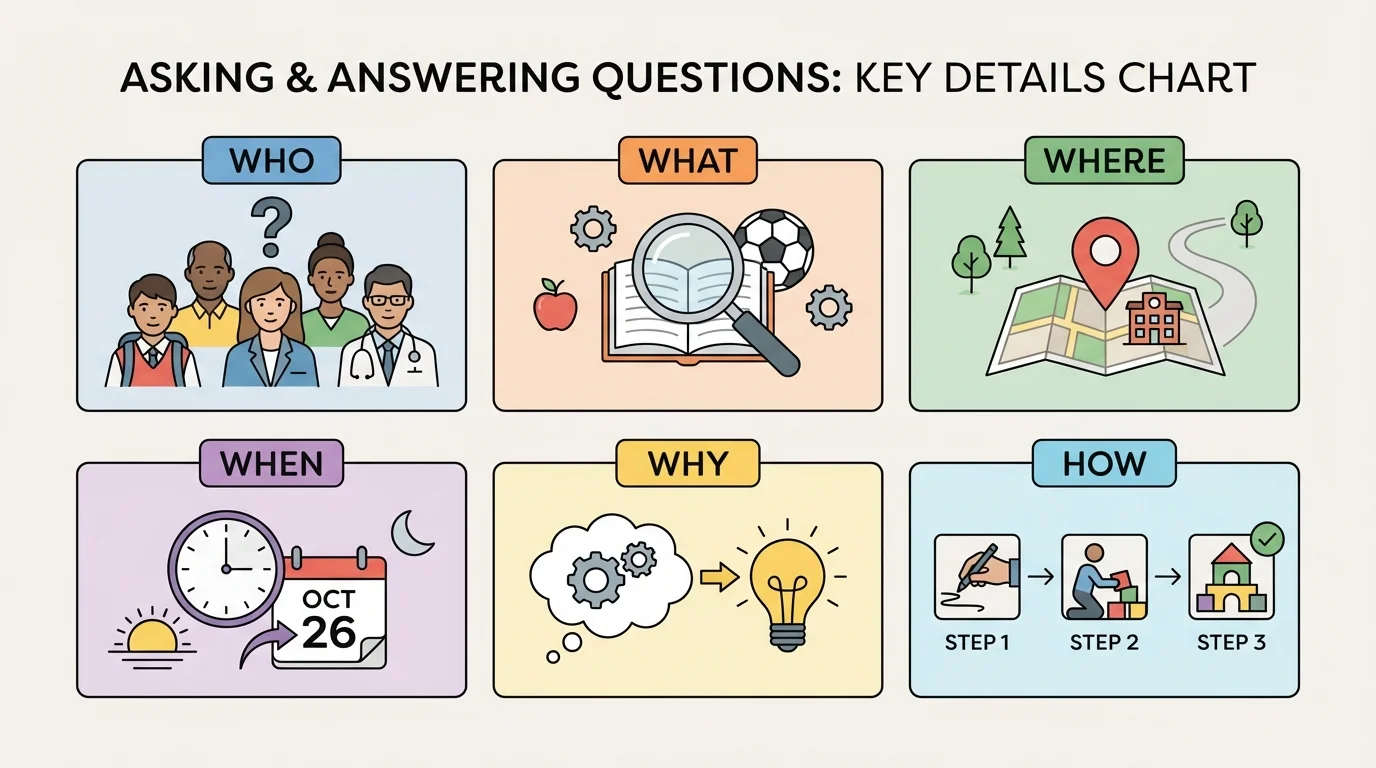
Good questions match the information you heard. If the class listened to a short talk about frogs, a question like "What do frogs eat?" fits the topic. A question like "What color is the moon?" does not fit because it is not about the talk.
Example: Asking questions after a read-aloud
The teacher reads: "Lena planted a seed in a cup. She watered it every day. Soon a green sprout popped up."
Step 1: Listen for the topic.
The topic is Lena and her seed.
Step 2: Ask a question with a question word.
You could ask, "What did Lena plant?"
Step 3: Ask another question about an important event.
You could ask, "What happened after she watered it?"
These questions are about important parts of what was heard.
Later, when you hear another story or set of directions, the same question words still help. Each question word points you toward a certain kind of answer.
When you answer a question, say the most important information. You do not need to say everything. You should say enough so another person understands you.
If someone asks, "Where did Mia find the shell?" a clear answer is, "She found it at the beach." If someone asks, "Why was Lena excited?" a clear answer is, "She was excited because the seed started to grow."
You also communicate with your face and body. Nonverbal language means messages we send without speaking. Looking at the speaker, nodding, pointing, and showing a thinking face can all help others know that you are listening and understanding.
Words and body work together
Good communication includes both verbal language and nonverbal language. Verbal language is what you say. Nonverbal language is how your face, hands, eyes, and body help show meaning. When students listen carefully and answer clearly, both kinds of communication support understanding.
It is also okay to ask for help if you are not sure. You can say, "Can you read that part again?" or "I did not understand. Can you say more?" Asking for clarification is something strong learners do.
[Figure 3] We do not learn only from books. Sometimes information comes from a story read aloud. Sometimes it comes from a person speaking. Sometimes it comes from a picture, a chart, a recording, or a short video. In all of these, you can still ask and answer questions about key details.
If you hear a weather report, key details might be "It will rain after lunch" and "Bring a coat." If you look at a picture of children planting flowers, key details might be who is in the picture, what they are doing, and what tools they are using. If you watch a short video about penguins, key details might be where penguins live and how they move.
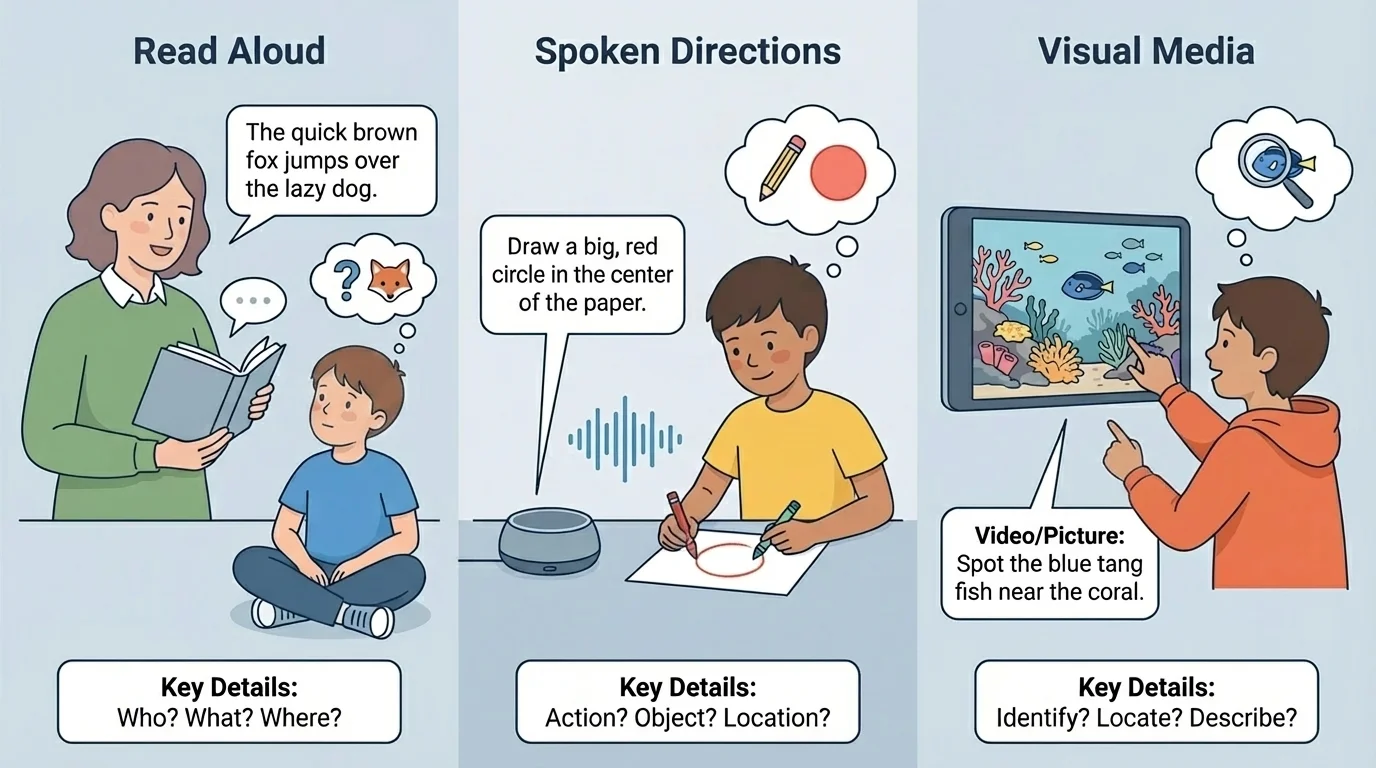
The kind of source may change, but the skill stays the same. You listen or look carefully, think about what matters, ask good questions, and answer with important information.
Example: Using details from other media
A class watches a short video about bees. The video shows bees visiting flowers and carrying pollen.
Step 1: Notice the main topic.
The video is about bees and what they do.
Step 2: Find key details.
Bees land on flowers. Bees carry pollen. Bees help plants.
Step 3: Answer a question.
If asked, "What do bees do on flowers?" a good answer is, "They land on flowers and carry pollen."
The answer uses details from what was seen and heard.
That is why this skill matters all day long. You use it during read-aloud time, science talks, class directions, and even when a friend tells you about something that happened at recess.
After you answer, think: "Does my answer match what I heard or saw?" A good answer comes from the text or from the information that was presented. It is not just a guess.
For example, if the teacher read that the rabbit hid under a bush, then the answer to "Where did the rabbit hide?" should be "under a bush." It should not be "in a tree," because that detail was not in the story.
Sometimes you may remember only part of the information. Then you can listen again, look again, or think about the order of events. Earlier we saw in [Figure 3] that information can come from talking, stories, and pictures or videos, and in every case careful checking helps you answer correctly.
When you retell, you tell important parts in order. Asking and answering questions is connected to retelling because both skills depend on noticing key details.
Listening and speaking are teamwork skills. One person shares information, and another person shows understanding by asking and answering. When both people pay attention, communication becomes clearer and stronger.
"Good listeners are good thinkers."
Each time you practice this skill, you get better at understanding stories, following directions, and learning from the world around you.
