Have you ever tried to tell someone about a big, exciting day and then wished they could just see it? A picture can help your words do an even better job. When you speak to others, a drawing, a chart, or even a real object can make your ideas easier to understand. Good speakers do not only use words. They also use visual displays when they help explain something important.
When you talk and show a picture at the same time, your listeners can hear your words and see your idea. That helps them remember what you say. It can also help you feel ready and confident because the picture reminds you what to talk about.
Visual display means something people can look at to help them understand. A visual display can be a drawing, a photo, a labeled picture, an object, or a simple chart.
Clarify means to make something easier to understand.
Sometimes one small picture can explain more than many words. If you say, "I went to the park," your class understands a little. But if you show a picture of you on a swing, with a kite in the sky and a dog running nearby, your class understands much more.
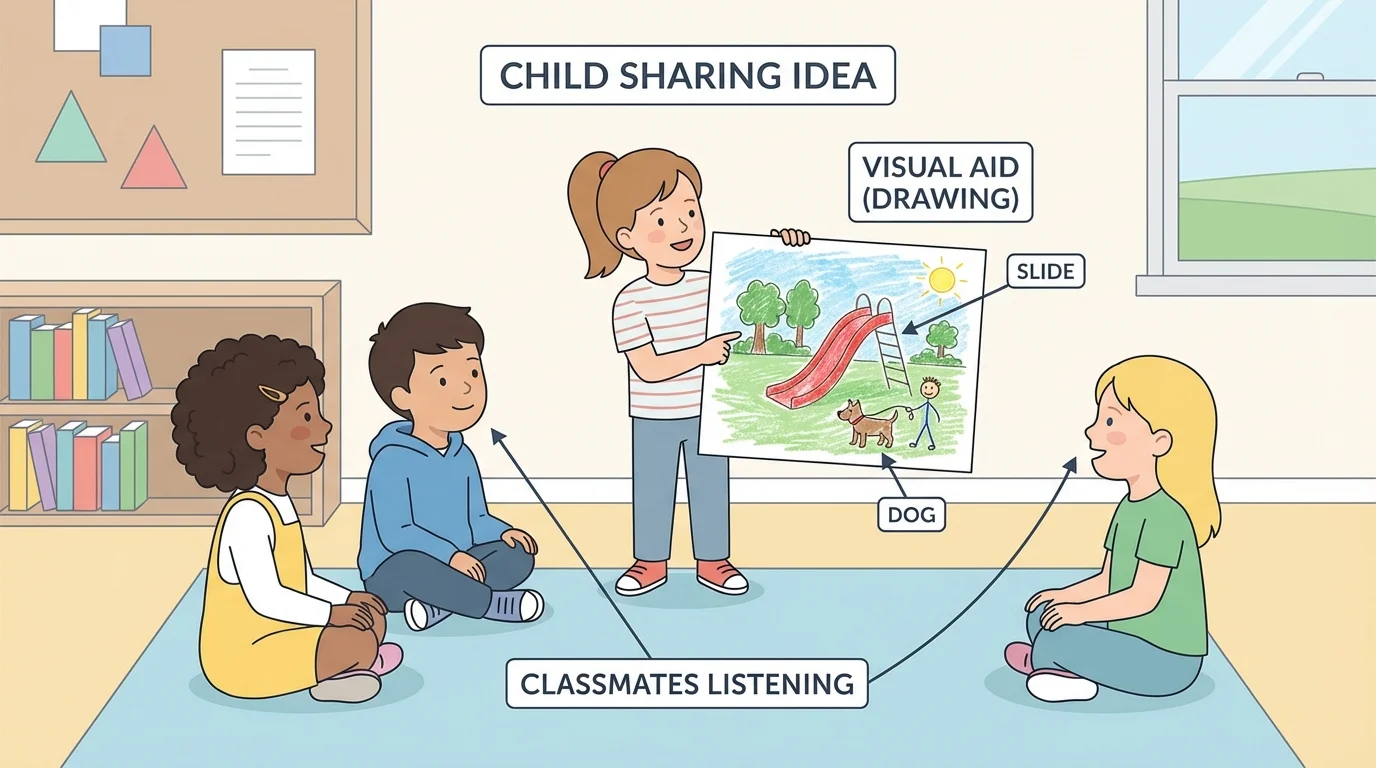
Pictures help listeners notice important details, as [Figure 1] shows in a classroom sharing time. A speaker may say many words, but a matching picture helps everyone know exactly what the speaker means.
A visual can help with three big things: ideas, thoughts, and feelings. Ideas are what happened. Thoughts are what you were thinking. Feelings are how you felt. A good picture can support all three.
If you tell about planting a seed, a drawing of the pot, the soil, and the tiny sprout helps the class understand your idea. If you tell about losing a tooth, a picture of your smile helps show what happened. If you tell about being nervous on the first day of school, your picture can show your face and your backpack by the door.
Visuals also help listeners stay focused. They know where to look while they listen. Later, they may remember the picture and then remember your words too.
There are many kinds of visuals a speaker can use. You do not always need a fancy poster. You only need something that helps your message become clear.
[Figure 2] One kind is a drawing. A drawing can show people, places, animals, or things from your story. Another kind is a labeled picture. You might draw a butterfly and add labels like wing, body, and antenna. A third kind is a real object, sometimes called a prop. If you are talking about a shell you found at the beach, you can hold the shell while you speak.
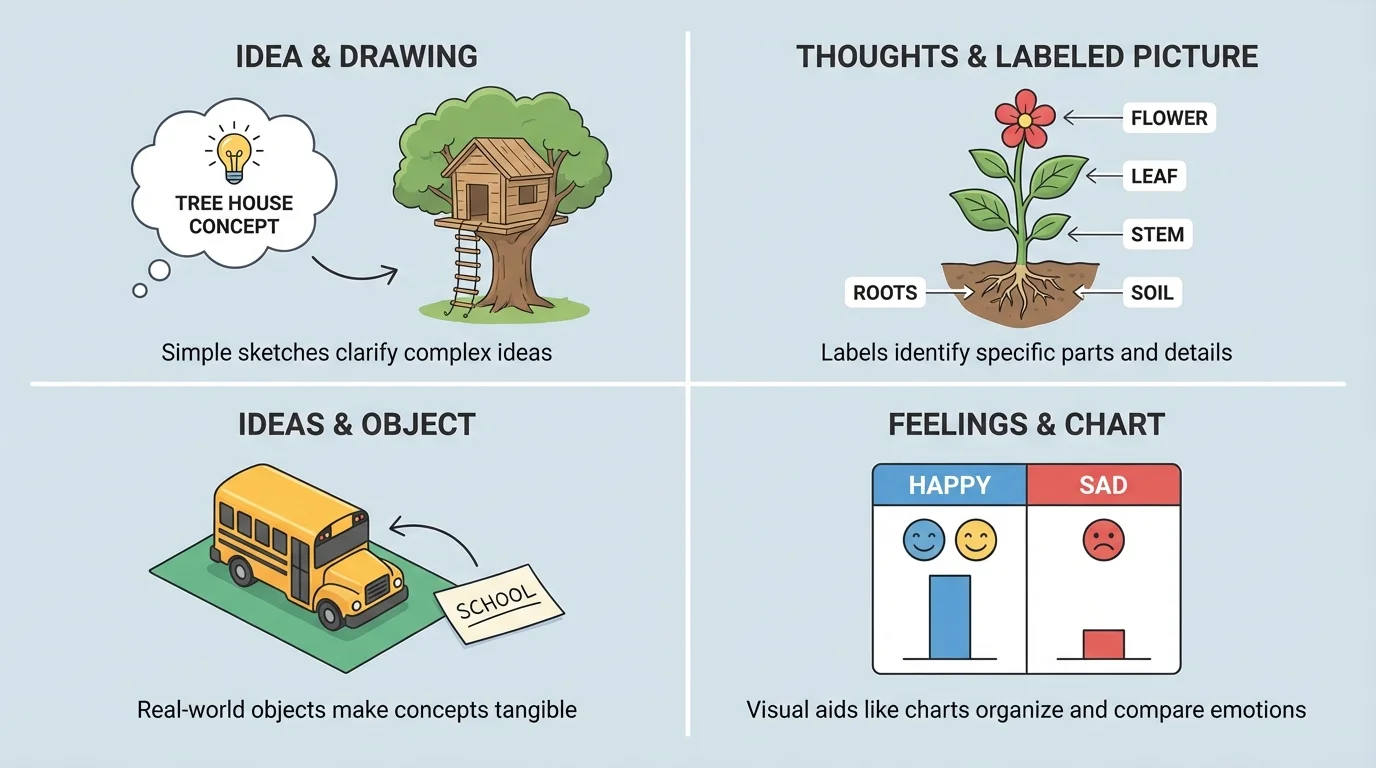
You can also use a simple chart. A chart can sort ideas. For example, if you are talking about favorite fruits in your class, a picture chart with apples, bananas, and grapes helps everyone see the information quickly.
Some visuals are best for stories. Some are best for facts. A drawing works well for "what happened." A labeled picture works well for "what are the parts?" A chart works well for "how many?" or "which one?"
A strong visual matches the words you say. That means the picture should show the most important part, not every tiny detail. If your talk is about making a sandwich, your picture should show bread, cheese, and the steps you did. It does not need to show the whole kitchen.
Think about the main idea. Ask yourself: What do I want others to understand? Then choose or make a picture that helps with that one idea. If you are talking about your pet turtle, your visual should show the turtle clearly. If the turtle is too tiny in the corner of a big page, the visual does not help enough.
Pick the most helpful part
A visual is strongest when it focuses on the part your listeners need most. Good speakers choose details that support the message. They do not crowd the page with too many extra things.
Sometimes a speaker uses more than one picture. That can help when the talk has steps or a sequence. For example, you may show one picture of seeds, one picture of watering the plant, and one picture of the flower blooming. The pictures work together to tell the story in order.
Pictures can show feelings, not only objects, and [Figure 3] makes that easy to notice. A face, a body pose, and even colors in the picture can help others understand if a person feels happy, proud, sad, scared, or excited.
If you are talking about winning a game, your drawing might show a big smile, raised arms, and bright colors. If you are talking about a stormy night, your drawing might show a worried face, dark clouds, and a person holding a blanket.
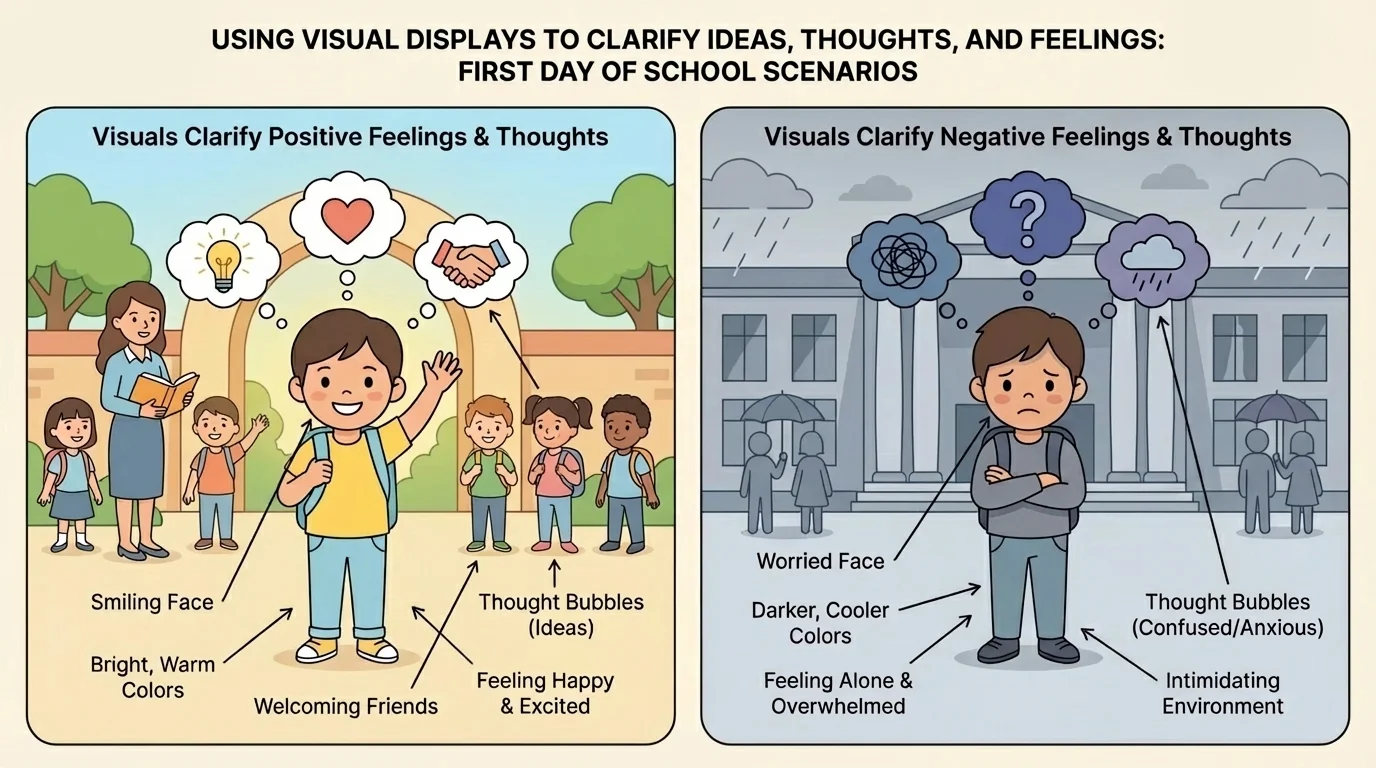
These details help your audience understand your feelings. When your picture and your words match, your message becomes stronger. If you say, "I was excited," but the face in the picture looks sleepy or bored, your listeners may get confused.
Later, when you want to explain mood in a story or your reaction to an event, you can remember [Figure 3]. Small changes in a face or color choice can change the whole meaning of a visual.
Your brain understands pictures very quickly. That is one reason signs, maps, and picture books are so useful when people need to understand something fast.
Feelings can also be shown by what is happening in the scene. A child hugging a grandparent may show love. A child standing alone in the rain may show sadness. A child opening a present may show surprise.
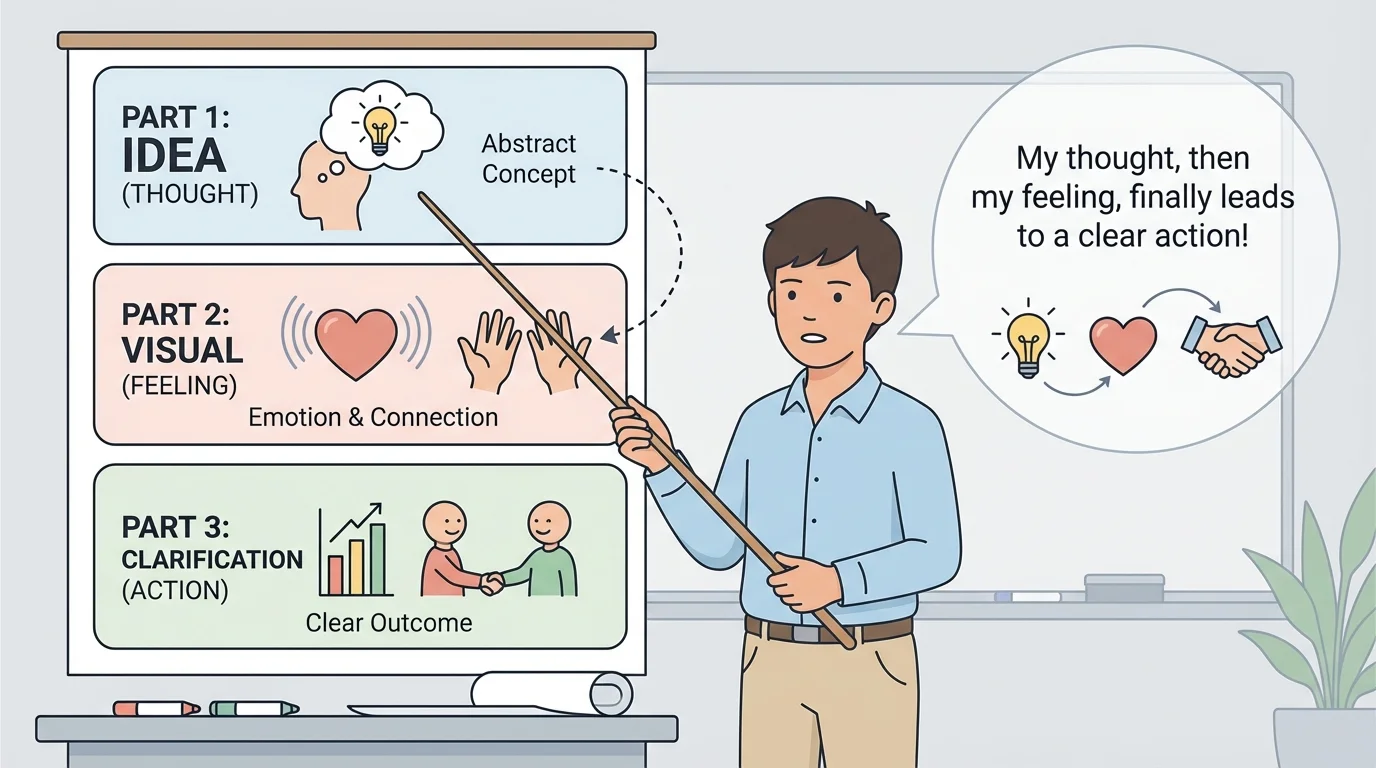
A visual helps the speaker too, because it acts like a guide, as [Figure 4] illustrates in a short class presentation. When you look at your picture, you can remember what to say next.
Good speakers do a few simple things. They hold the picture where others can see it. They point to the part they are talking about. They speak in a clear voice. They look at the audience, not only at the page.
You can also talk in order. Say words like first, next, and last. If your poster has three pictures, point to the first picture and say what happened first. Then move to the next one. This keeps your speaking organized.
For example, a child sharing about baking cookies might say, "First, I mixed the dough. Next, I put the cookies on the tray. Last, we ate them." The pictures help the class follow each part.
Speaking with a picture
A student wants to talk about a trip to the zoo.
Step 1: Show the visual.
The student holds up a drawing with the lion, the monkeys, and the penguins.
Step 2: Point and name.
The student points to the lion and says, "First, I saw the lion."
Step 3: Add details.
The student points to the monkeys and says, "Next, the monkeys were swinging and making me laugh."
Step 4: Share a feeling.
The student points to the penguins and says, "I felt excited because they splashed in the water."
The drawing helps the speaker stay on topic and helps listeners understand the story.
As you continue speaking, the visual should support your words instead of replacing them. The audience still needs your voice. The picture is a helper, not the whole talk.
A clear visual is large enough for others to see. Important parts should be easy to notice. If you use labels, write them neatly. If you use color, use it to help meaning, not just to fill space.
Too much on one page can make a visual hard to understand. A page filled with tiny drawings may confuse listeners. It is often better to draw one big clear scene than many small crowded ones.
When we listen and speak in class, we try to help others understand our message. We can do that with clear words, a strong voice, careful listening, and helpful visuals.
Neatness matters because your listeners need to understand quickly. A simple picture of a red apple is easier to understand than a messy page with many shapes that do not match your topic. If you make a chart, keep it simple and easy to read.
When you need to explain steps, a sequence of pictures often works well. When you need to explain feelings, faces and scene details matter most. When you need to explain parts of something, labels are useful.
People use visuals everywhere. Teachers use pictures on the board. Cooks use recipe pictures. Drivers use road signs. Doctors use diagrams. Athletes use play charts. Musicians may follow symbols and marks. Visuals help people understand fast and clearly.
At school, you might use a picture to share about your family, explain how you made an art project, tell the steps of washing hands, or describe a book character. Just as we saw earlier in [Figure 1], a picture can turn a short sentence into a fuller, richer message.
When you choose the right visual, keep it clear, and speak while pointing to it, you become a stronger communicator. Your listeners can understand your idea, thought, or feeling more easily. That is what it means to clarify your message.
