Have you ever told a story and then suddenly talked about something totally different, like starting with your dog and ending with your lunch? Writers learn to keep their ideas together. When you write, you can focus on one idea, listen to helpful questions, and add more to make your writing better.
Good writers do not always get everything perfect the first time. They often write a little, listen, think, and fix their work. A teacher, parent, or another adult can help. Classmates can help too by asking questions like, "What color was it?" or "Where did that happen?" These questions help a writer say more.
Every piece of writing has a main idea, or topic. The topic is what the writing is about. When you focus on one topic, all your sentences match that idea, as [Figure 1] shows. If you are writing about your cat, your sentences should tell about your cat, not jump to bikes, pizza, or the weather.
Read this example: "My dog is brown. He runs fast. He likes to chase a ball." These sentences all stay on the same topic: the dog. Now look at this: "My dog is brown. He runs fast. I like ice cream." The last sentence does not match the topic. It is a different idea, so it does not belong in this piece of writing.
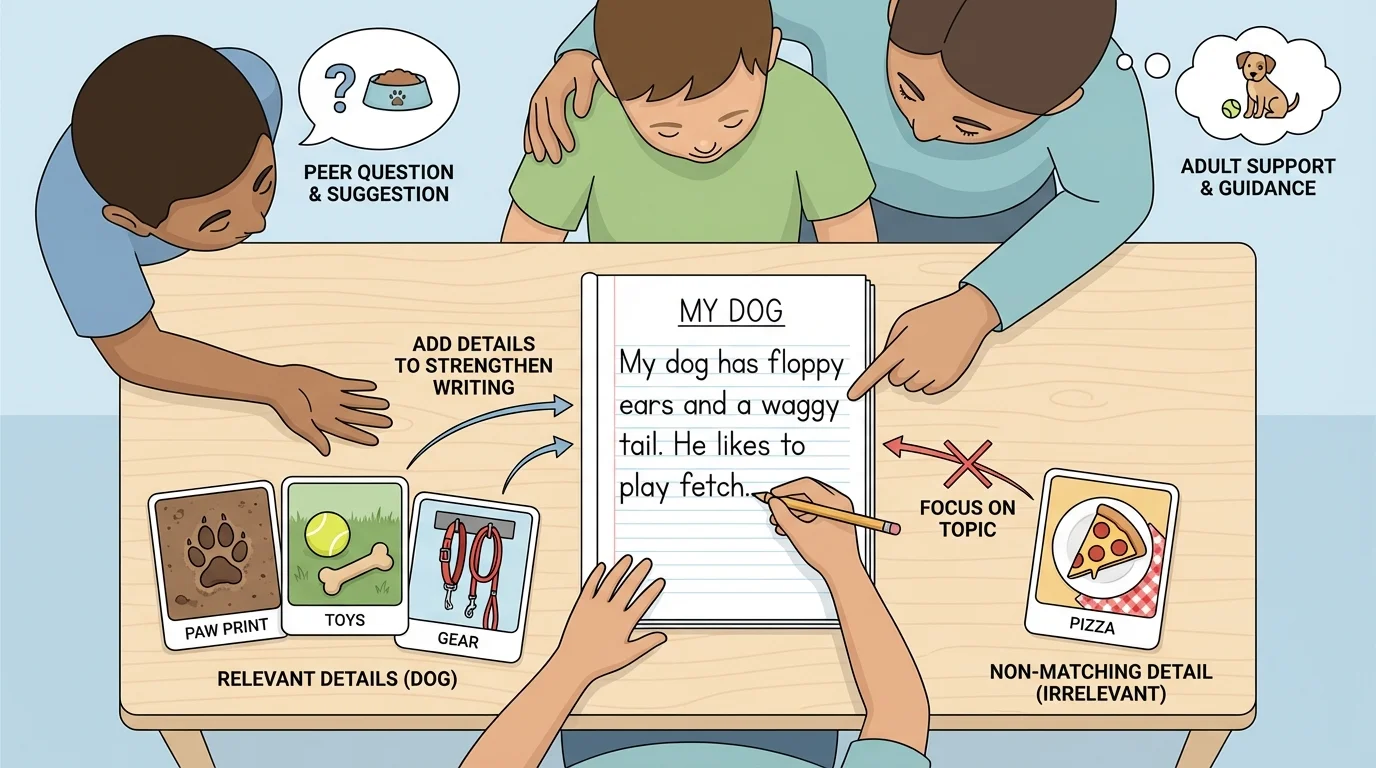
Sometimes an adult helps you choose a topic. A teacher might say, "Write about your favorite place," or "Tell about one animal." That helps you know what to write about. Then you try to keep every sentence connected to that one idea.
Topic means the main thing your writing is about. Detail means extra information that tells more about the topic.
When you are not sure whether a sentence belongs, ask yourself, "Is this about my topic?" If the answer is no, you can take it out or save it for another piece of writing. Writers make choices like that all the time.
Writing gets stronger when you listen to help. A grown-up may guide you by asking a question, reminding you to stay on topic, or showing you a word to spell. A classmate may say, "I want to know where you were," or "Can you tell what happened next?" These are not mean comments. They are helpful ideas.
When someone asks you a question about your writing, you can respond. To respond means to answer. If your friend asks, "What color was the kite?" you can add, "The kite was red and blue." If your teacher says, "Tell more about the park," you can add something like, "The park had a tall slide and green grass."
Sometimes a suggestion tells you how to improve your writing. A suggestion might be, "Add a feeling word," "Tell who was with you," or "Put a period at the end." Writers listen, think, and then decide what to change. With support, first-grade writers can make small changes that make a big difference.
Questions help writing grow. A short piece of writing can become clearer when other people ask simple questions such as who, what, where, when, and how. These questions help a writer remember important parts and explain them.
You do not have to change everything. But when a question or suggestion helps your reader understand your writing better, it is smart to use it. That is part of becoming a stronger writer.
A sentence can be good, but a few more details can make it even better. Writers often start with a simple sentence and then add more information. Detail questions help, and [Figure 2] shows how one short idea can grow when a writer answers questions about who, where, and what happened.
Look at this short sentence: "I saw a bird." That tells something, but not much. We can add details: "I saw a small yellow bird in the tree by my house." Now the reader knows more. The topic is still the bird, but the writing is stronger.
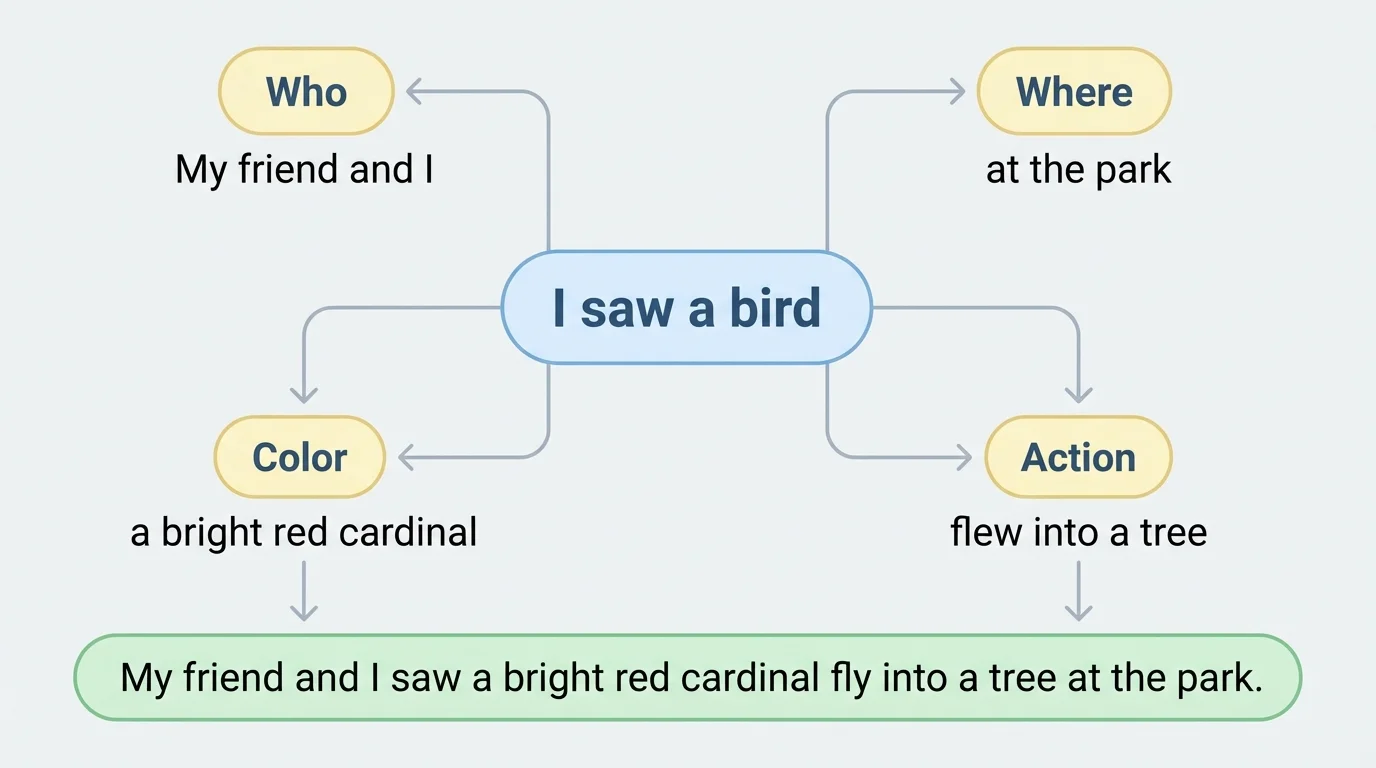
Here are some ways to add details: tell who, tell what, tell where, tell when, and tell how something looked, sounded, or felt. You might also add an action word. Instead of "The dog was there," you might write, "The dog wagged his tail by the door."
Details should match the topic. If your topic is a rainy day, good details are "big gray clouds," "wet boots," and "a loud splash." A detail about birthday cake does not fit unless your rainy-day story is also about a birthday. Writers choose details that belong.
Making one sentence stronger
Start with: "I went to the park."
Step 1: Answer where.
"I went to the park near my school."
Step 2: Say who went with you.
"I went to the park near my school with my dad."
Step 3: Answer what happened.
"I went to the park near my school with my dad, and I slid down the tall slide."
The last sentence gives the reader a clearer picture.
Later, when you read your writing again, you can ask yourself, "Can I add one more detail?" As we saw in [Figure 2], even one sentence can grow into a fuller idea when you answer simple questions.
[Figure 3] Strong writing is not only about ideas. It is also about helping the reader read your words easily. Figure 3 shows how small fixes can make a sentence much clearer. Writers check capitalization, spelling, spaces between words, and punctuation. A clean sentence is easier to understand.
Sentences begin with a capital letter. Names like Sam, Rosa, and Monday also need capitals. Sentences end with punctuation, usually a period for a telling sentence, a question mark for an asking sentence, or an exclamation mark for strong feeling. Writers also leave spaces between words so the reader can tell where one word ends and the next word begins.
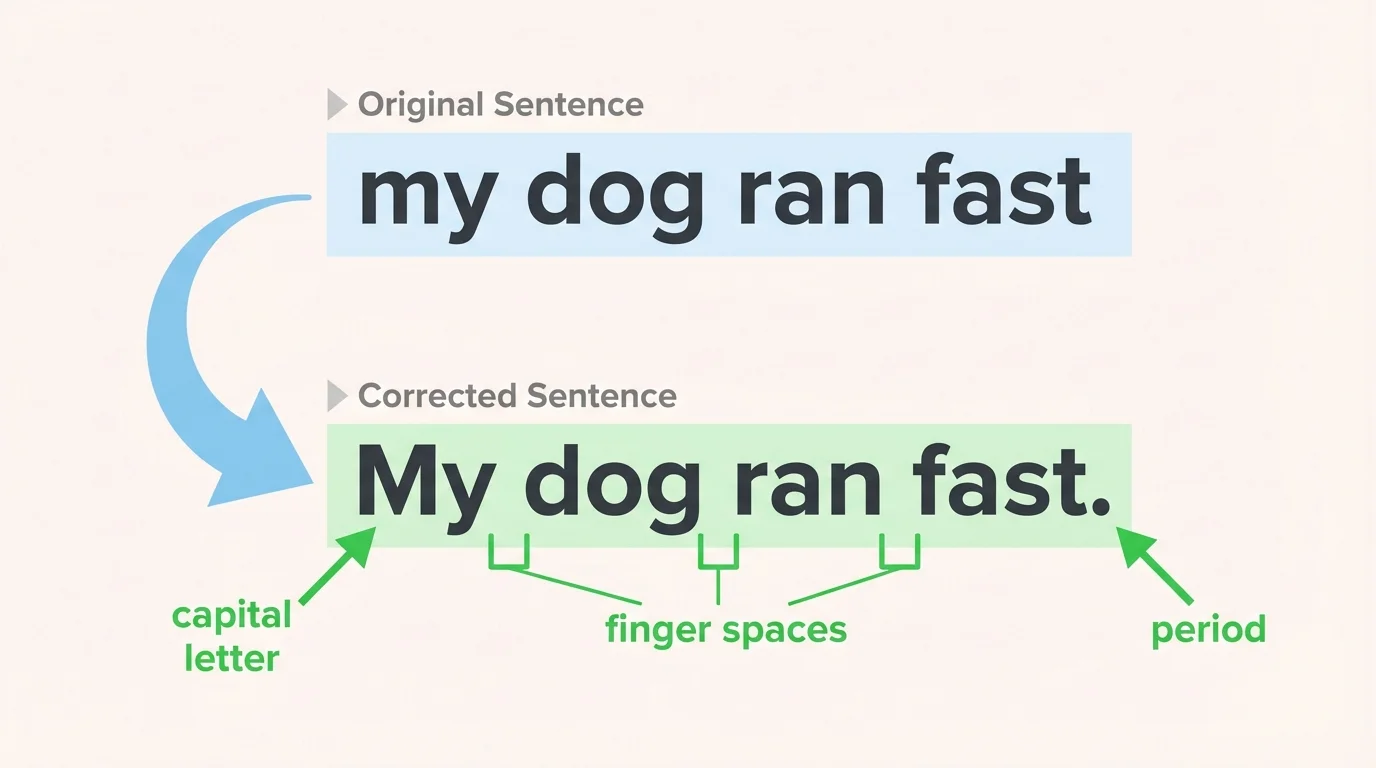
Spelling matters too. In first grade, you may not spell every word perfectly yet, and that is okay. You can stretch out the word and listen for sounds. You can use a word wall, ask a grown-up, or check words you know. If a teacher says, "This word needs a capital," or "Add a period," that is part of making your writing stronger.
Grammar helps ideas sound right. For example, "He run fast" can become "He runs fast." "I goed home" can become "I went home." These changes help your writing sound smooth when someone reads it.
Remember that a sentence is a group of words that tells a complete idea. It starts with a capital letter and ends with punctuation.
When you revise, you might first add details and then fix capitals and punctuation. Both jobs matter. One helps your writing say more, and the other helps your writing look right and sound right.
Writers often make a draft first. A draft is the first version of writing. It does not have to be perfect. After that, a writer can change it. A grown-up may help the writer hear missing words, and classmates may ask questions that lead to better details.
Here is a first draft: "i went to the beach. it was fun." The topic is clear, but the writing can be stronger. A teacher might say, "Start with a capital letter." A friend might ask, "What did you do at the beach?" Then the writer can improve it.
Before and after revision
First draft: "i went to the beach. it was fun."
Step 1: Fix capitals.
"I went to the beach. It was fun."
Step 2: Add details from a question.
A friend asks, "What did you do?"
The writer adds, "I built a sandcastle."
Step 3: Read the new writing.
"I went to the beach. It was fun. I built a sandcastle."
The new draft stays on one topic and tells more.
Another writer may begin with "My frog is green." A classmate might ask, "Where does your frog live?" Then the writer can add, "My frog is green. He lives in a tank by my bed." This is how questions help writing grow.
When you write, you are not just putting words on paper. You are teaching your reader about your topic. Staying focused, listening to helpful questions, and adding details make your writing clearer and more interesting. Much later, when you edit again, the small fixes from [Figure 3] still matter because they help every reader understand your ideas.
Many real authors revise their writing again and again. Even books in libraries started as first drafts that needed changes.
With guidance and support from adults, you can choose one topic, answer questions, use suggestions, and make your writing better one step at a time.
